
Clear Aligner Attachments in Japan: Purpose and Removal
Reviewed by Dr. Ryosuke Murai, DDS, MSD — Prosthodontist, trained at Indiana University School of Dentistry (U.S.). Last updated September 2026.
Clear aligner attachments are small tooth-coloured composite shapes bonded to selected teeth so the plastic tray has something to push against. They are the reason a course of clear aligners can rotate a canine or move a root, and also the reason some patients finish treatment with a rough, slightly dulled patch of enamel where a bump used to sit. If you are weighing aligner treatment in Japan as a self-pay adult, the useful questions are practical: which teeth get attachments, whether they show, and what removal actually costs your enamel. The evidence on the last point is small but specific.
Where treatment is sequenced around a small number of trips, that is set out in our guide to clear aligner treatment in Japan for English-speaking adults. This article covers one narrow piece: the attachments themselves.
What an attachment is for
A tray made of thin plastic cannot grip a smooth, rounded crown. It can tip a tooth, but rotating a canine or moving a root needs a defined surface to press on. An attachment is that surface. Each one is a small ramp, block or bevel of composite resin, placed through a template made from your digital plan, and then light-cured. The plan specifies the position and shape of each attachment before a single tray is made.
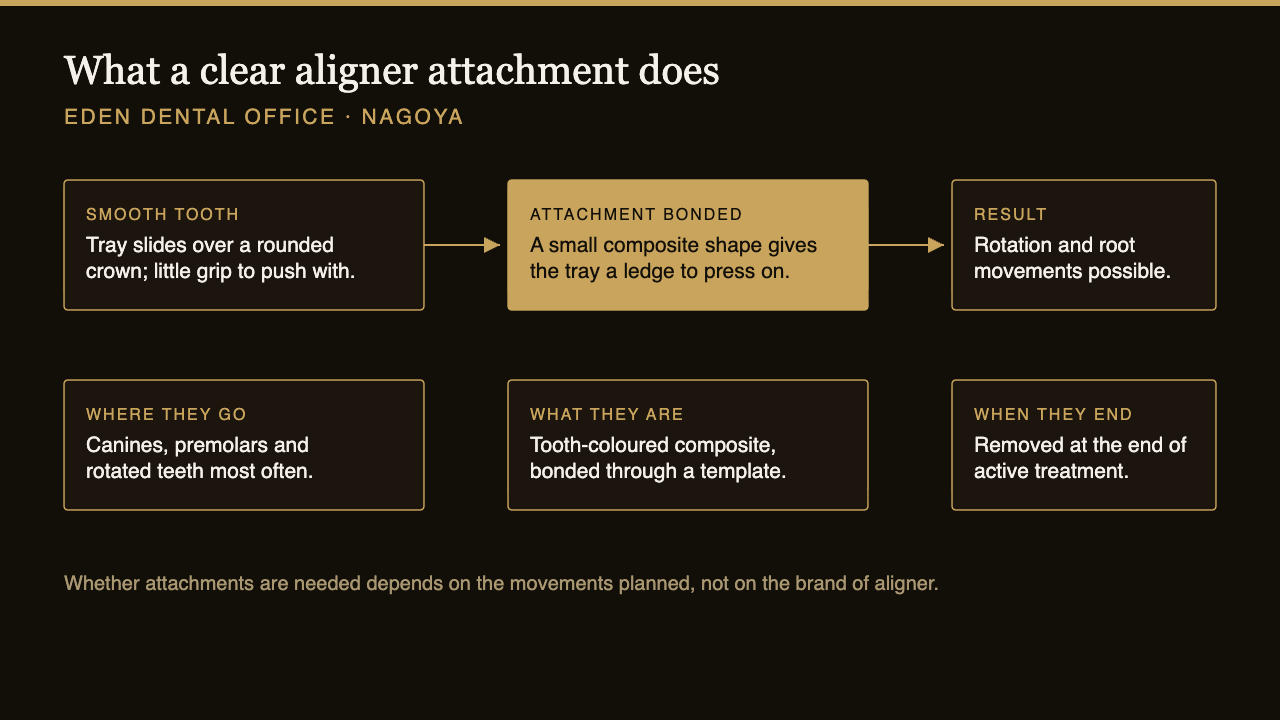
Not every case needs them. Small alignment of front teeth can often be done without any. Rotations of round teeth, extrusion, and movement of premolars and canines usually call for them, and the more complex the plan the more of them you will see. In our clinic we decide on attachments from the digital simulation, and we tell patients before treatment starts how many teeth will carry them, because that is one of the few parts of an aligner course that is visible to other people.
Do they show, and can they be less visible?
They are matched to tooth shade, but they are not invisible. In ordinary conversation most people will not notice them; in a photograph taken close up with flash, they can look like small ridges. The trade-off is real: fewer or smaller attachments mean a less visible appliance and generally a less predictable movement for the harder tooth movements. The material also matters. A 2026 systematic review in Biomolecules covering fifteen studies found that the type of composite resin influences the mechanical, optical and functional performance of attachments, including durability and how well the shade holds over months of treatment. See the PubMed record. The practical consequence is that an attachment can chip, stain or debond, and the choice of material is a clinical decision rather than a default.
| Question | Typical answer | What it depends on |
|---|---|---|
| Which teeth get them? | Canines, premolars and rotated teeth most often | The movement planned for each tooth |
| Will they be noticed? | Rarely in conversation, sometimes in close photographs | Size, position and shade match |
| Can I avoid them entirely? | Only for milder plans | Rotation, extrusion and root movement need them |
| What if one comes off? | Contact the clinic before the next tray | Tooth affected and treatment stage |
| When are they removed? | At the end of active treatment | Refinements can keep them in place longer |
| Do they affect enamel? | Removal removes a small, measurable amount | Removal protocol and operator technique |
What removal takes from the tooth
At the end of active treatment the attachments are taken off. Composite is bonded to enamel by design, so removal is not a simple peel: the bulk is debonded, the remainder is ground away with rotary instruments, and the surface is polished. A 2026 systematic review in Clinics and Practice pooled the available evidence, and the honest headline is how thin it is. Only three in vitro or ex vivo studies qualified out of 656 records screened, and the authors could not run a meta-analysis because the methods differed too much.
Within those three studies, reported enamel loss ranged from roughly 15 µm to more than 50 µm depending on the removal protocol, and residual composite covered about 20–40% of the treated surface. Multi-step protocols using tungsten carbide burs followed by silicone polishers, under magnification, gave the most favourable balance between removing composite and preserving enamel. Fiberglass burs left smoother surfaces but tended to leave more composite behind. The full text is indexed on PubMed.
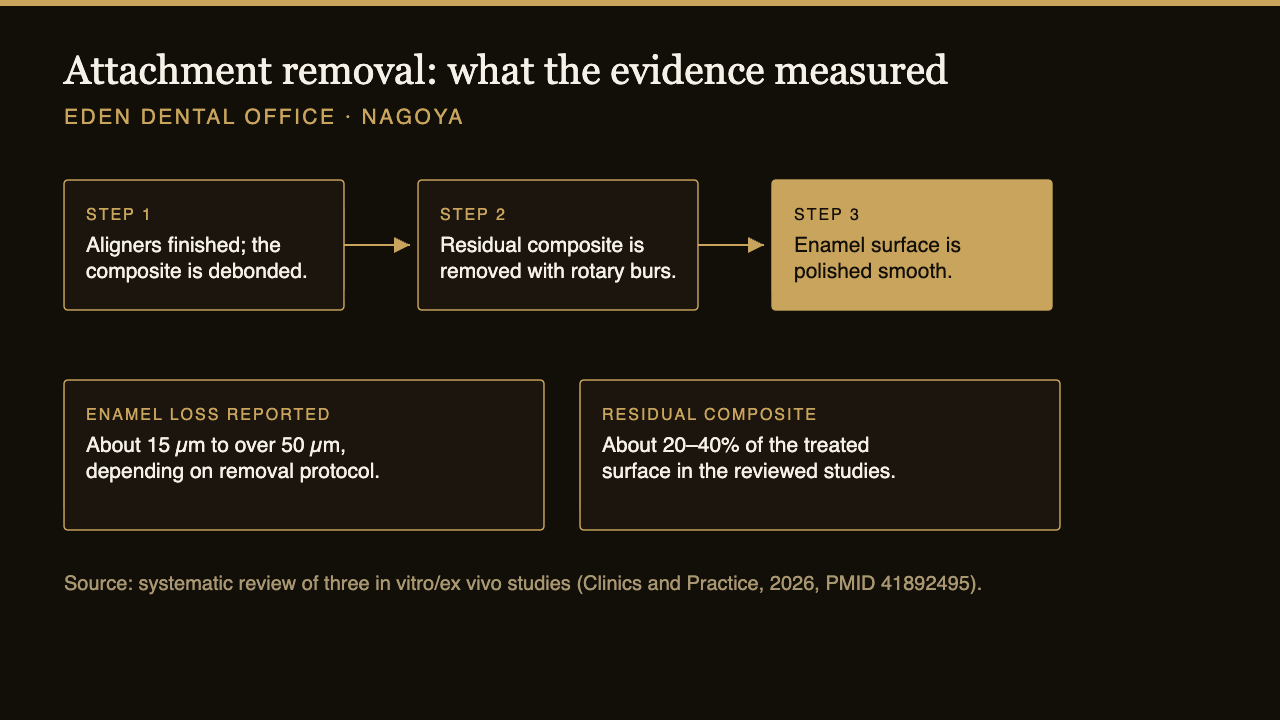
Two cautions on reading those numbers. First, they come from laboratory and extracted-tooth studies, not from patients over years, so they say what removal costs in the short term, not whether it matters later. Second, the spread between 15 and 50 µm is the point: how the composite is taken off changes the outcome, which is a good reason to ask any clinic what its removal protocol is before you start rather than after.
In our clinic, removal is done under magnification with a stepwise sequence and a final polish, and a check of the surface finish at the end of the visit. We plan the appointment as its own procedure rather than fitting it into a retainer-delivery slot, because rushed removal is where avoidable enamel loss tends to come from.
How attachments interact with the rest of the course
Attachments do not exist in isolation. Small contact adjustments to create space are covered in how much enamel interproximal reduction removes, and a debonded attachment is one of the causes described in why an aligner stops tracking. If you have crowns or veneers, attachment bonding is a separate question again; see aligners with existing crowns and restorations. Once the attachments are off and the teeth are in position, the result is held only if retainers are worn as instructed.
For patients who live overseas, a lost attachment between visits is the practical worry. The rule we give is simple: do not advance to the next tray with an attachment missing, send photographs, and we decide whether it needs re-bonding at the next in-person visit or sooner. A missing attachment on a tooth that is meant to rotate is more urgent than one on a tooth that is only being tipped.
Attachments collect film around their edges, so a careful routine matters; see cleaning clear aligners in Japan.
Frequently asked questions
Do all clear aligner patients need attachments?
No. Mild cases, especially small front-tooth adjustments, can sometimes be done without them. Rotation, extrusion and root movement generally need attachments, and the digital plan shows in advance which teeth will carry them.
Will clear aligner attachments damage my teeth?
Bonding and removal do affect the enamel surface slightly. A 2026 systematic review of three laboratory studies reported enamel loss of about 15 to over 50 micrometres depending on the removal protocol, so technique matters.
What should I do if an attachment falls off?
Do not advance to the next tray. Photograph the tooth and contact the clinic; whether it is re-bonded at once or at the next in-person visit depends on the tooth and the planned movement.
Can attachments be placed on crowns or veneers?
Sometimes, but bonding to ceramic and other restorative materials is less predictable than bonding to enamel, and it should be planned with the restorations in mind before treatment starts.
How visible are attachments?
They are matched to tooth shade and are seldom noticed in conversation, but they can be seen in close photographs and are slightly more visible on the front teeth.
Risks, limits, and what remains uncertain
Clear aligner treatment carries real downsides: root resorption, gum recession where teeth are moved through thin bone, transient speech changes, decalcification if hygiene lapses, and relapse if retention is not maintained. Attachments add their own: they can chip, stain or debond, they make cleaning around the tooth slightly harder, and their removal takes a small amount of enamel that does not grow back. The evidence on removal comes from a handful of laboratory studies, and the evidence on composite materials comes largely from in vitro work, so neither should be read as a guarantee of how any one patient’s teeth will respond. Fees, duration and refinement policy are set out in a written estimate in English before treatment begins, and the number of attachments is confirmed from the digital plan at that stage. Individual results vary.
If you are considering aligner treatment and want to know how many attachments your plan would need, send your records and we will show you the simulation. Our treatment overview shows how aligner work fits alongside restorative planning; WhatsApp is the fastest way to reach the clinic in English.
Another visible change after alignment is the space under the contact points: what causes black triangles.
Heavy night-time loading can also stress trays and attachments; see aligners and teeth grinding.
More on this topic: Aligner Guides — every article we have published in this cluster, grouped by stage.