
Black Triangles After Clear Aligners in Japan: Options
Reviewed by Dr. Ryosuke Murai, DDS, MSD — Prosthodontist, trained at Indiana University School of Dentistry (U.S.). Last updated October 2026.
A small dark triangle between two front teeth is one of the most common complaints after crowding is corrected. The dental term is an open gingival embrasure: the gum no longer fills the space beneath the point where two teeth touch. For adults who chose clear aligners for a better smile, it can feel like a bad trade. This article explains why black triangles appear after aligner treatment in Japan or anywhere else, who is more likely to get them, and what can be done, so you can raise the question before treatment starts rather than after the final tray.
A boundary first. This sits within our wider prosthodontic treatment planning. How much enamel is removed between teeth to create space is covered in our explanation of interproximal reduction, and the overall course, from records to retainers, is laid out in our guide to clear aligner treatment in Japan for English-speaking adults. This piece covers one specific outcome: the gap that shows once the teeth are straight.
What a black triangle actually is
Between healthy neighbouring teeth, a small pink wedge of gum, the papilla, fills the space under the contact point. When that wedge is shorter than the space it must fill, light passes through and the gap looks dark. Two things set the size of the space: the shape of the crowns and the height of the bone beneath the contact.
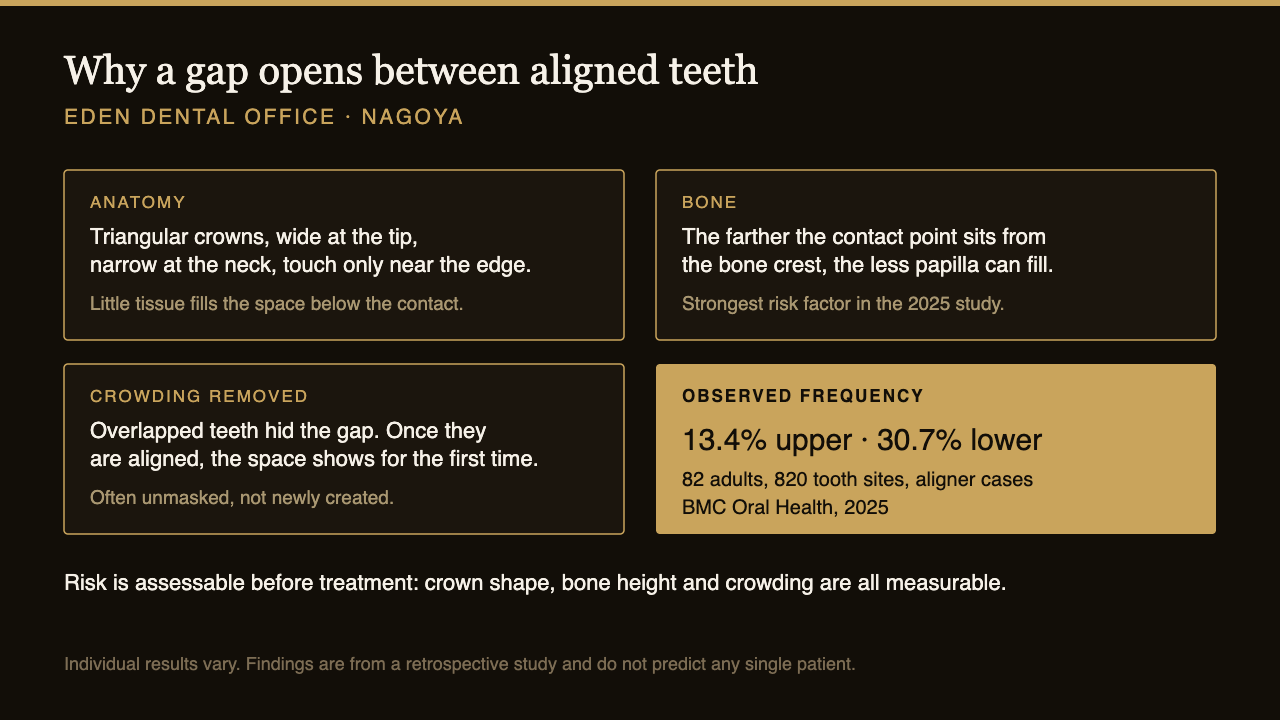
Triangular crowns, wide at the biting edge and narrow near the gum, touch each other only high up. Straighten such teeth and the contact sits well above the bone, leaving a larger space to fill. Square or rounded crowns touch over a longer area, so the same movement leaves a smaller gap.
Crowding also hides the problem. Overlapped teeth may have no visible space between them at all. Once they are aligned, a gap that was always present shows for the first time. In those cases the aligner has unmasked a feature of the anatomy rather than created it, which is why the conversation belongs at the planning stage.
How common they are, and who is more likely to get them
The numbers are higher than most patients expect. A retrospective study in BMC Oral Health in 2025 examined 82 adults who had non-extraction clear aligner treatment, assessing 820 tooth sites in the front of the mouth from intraoral photographs. Open gingival embrasures appeared at 13.4% of upper sites and 30.7% of lower sites. The strongest predictor was the distance from the contact point to the bone crest, with an odds ratio of 8.0 in the upper jaw. The authors also found associations with age and with the degree of crowding. The paper is indexed on PubMed.
These figures are not specific to aligners. An earlier study of 100 patients after conventional orthodontic treatment, published in The Angle Orthodontist in 2018, found the gap between the upper central incisors in 22% of patients and in 36% of the lower jaw. Tipping the incisors backward and a larger distance from contact point to bone were both linked to it. The paper is available on PubMed. Both studies are retrospective, so they show association, not proof of cause, and they describe groups, not you.
| Factor | Effect on gap risk | Can it be checked before treatment? |
|---|---|---|
| Triangular crown shape | Higher | Yes, from photographs and scan |
| Contact point far from bone crest | Higher | Yes, from radiographs and CBCT where indicated |
| Marked crowding | Higher once corrected | Yes, from the scan |
| Thin gum tissue | Higher | Yes, on examination |
| Older age | Higher | Yes |
| Plaque and gum inflammation | Can worsen appearance | Yes, and treatable first |
What we do about it before treatment starts
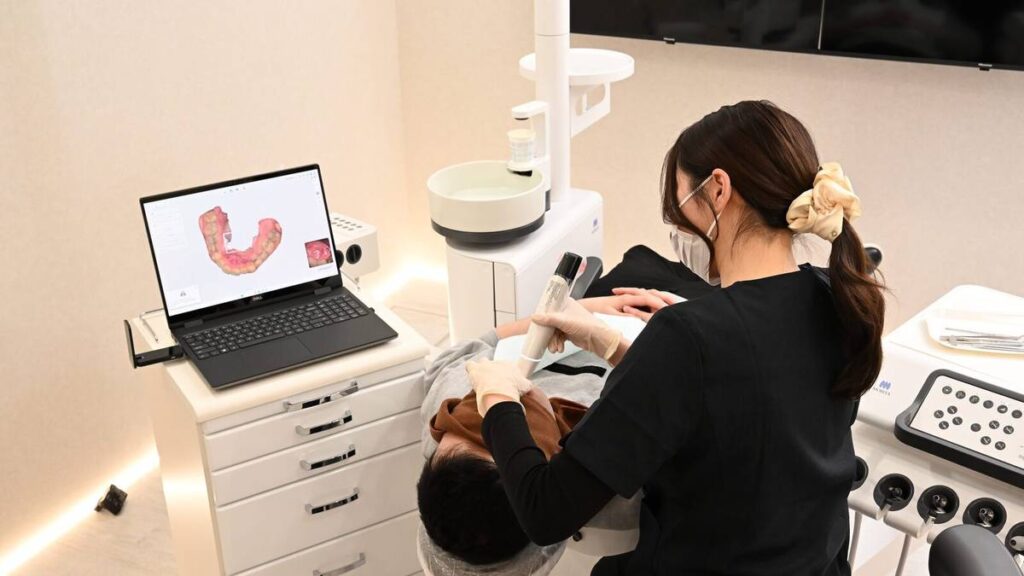
In our clinic, we plan aligner cases from the finished smile backwards, the same habit that governs how we sequence aligners with restorative work. For a patient with triangular front teeth and crowding, that means looking at the likely gap during planning and saying so in plain terms. We take intraoral scans and radiographs, and use CBCT where the bone question needs it, in our in-house digital workflow.
Three practical choices follow. First, we treat gum inflammation before moving teeth, because swollen papillae can mask the true space and then shrink. Second, we are conservative with enamel reduction on triangular crowns, since removing enamel at the contact moves it toward the bone and can reduce the problem, but only within safe limits. Third, we agree a plan for the gap in advance: accept it, narrow it with a small restoration, or choose a different treatment route altogether.
Options if a gap has already appeared
The right option depends on the size of the gap, the patient’s smile line and how much of the original tooth is still available to change.
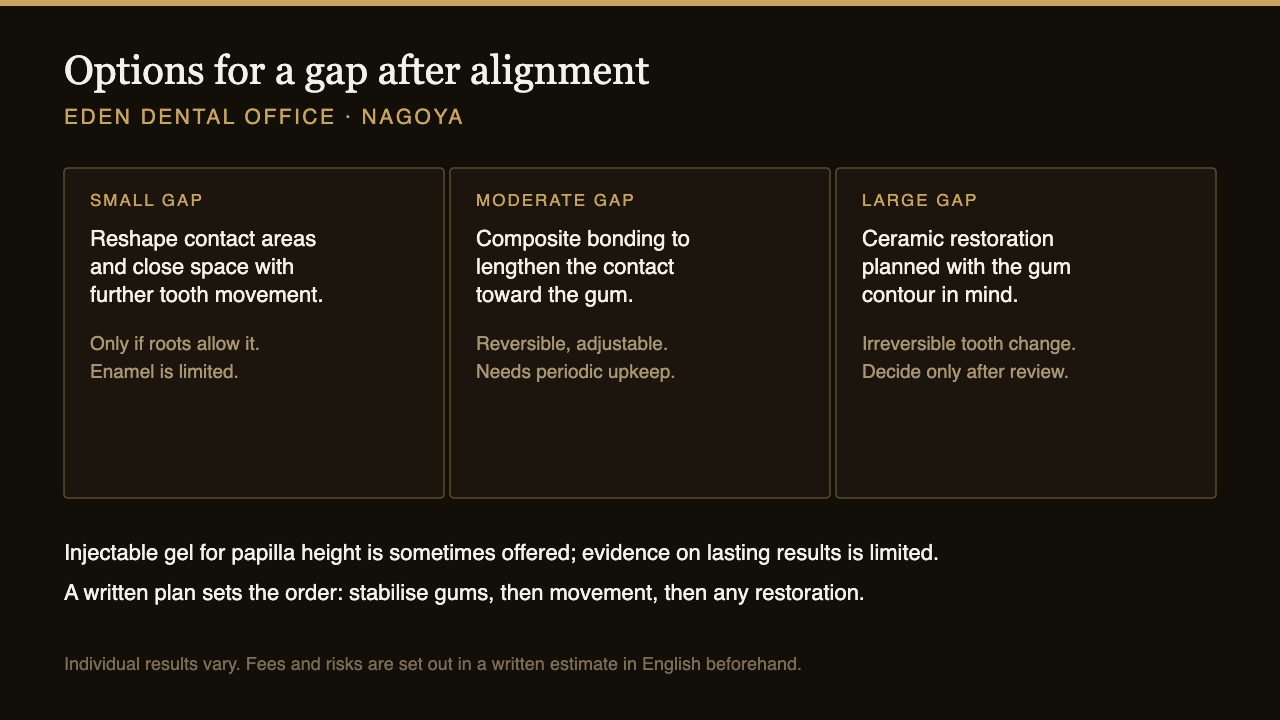
For a small gap, minor reshaping of the contact areas followed by further tooth movement may close it, provided the roots have room. For a moderate gap, composite bonding can lengthen the contact toward the gum so the space is smaller. It is reversible, adjustable and relatively conservative, though it needs periodic polishing or repair; our comparison of bonding and veneers sets out the trade-offs. For a large gap, a ceramic restoration designed with the gum contour in mind can work, but it changes the tooth irreversibly and should follow a full review, not precede one. Where several front teeth are involved, how gum contouring is planned around veneers is relevant.
Injectable gel is sometimes offered to add papilla height. Evidence for lasting results is limited, and we do not present it as a reliable fix. Whatever the route, treatment is staged in a written plan: stabilise the gums, finish tooth movement, hold the result with consistent retainer wear, and only then consider any restoration. Composite attachments on the teeth during treatment are a separate matter, covered in our article on aligner attachments.
Planning this from outside Japan
Because assessment relies on scans and radiographs, the first visit matters. Patients who live abroad usually fold records and planning into one trip; the structure is described in planning a dental treatment trip to Nagoya. Nagoya is about 100 minutes from Tokyo by shinkansen and about 40 minutes from Chubu Centrair International Airport. Mid-course review of how a gap is developing is easier when the plan includes a scheduled scan visit, a point covered in our piece on remote review limits.
What this costs
Our published packages, a check-up package at ¥40,000, a whitening package at ¥75,000 and membership tiers from ¥88,000 to ¥288,000 per year, are on our fee page. Aligner fees depend on the number of stages and complexity, and any bonding or ceramic work is quoted separately. The estimate is provided in writing in English before treatment, with each step listed on its own line.
Frequently Asked Questions
Are black triangles after clear aligners normal?
They are common. In one 2025 study of aligner patients they appeared at 13.4% of upper and 30.7% of lower front tooth sites. Common does not mean unavoidable: risk can be assessed in advance.
Will the gum grow back to fill the gap?
Sometimes a small gap narrows in the months after treatment, especially if inflammation settles. A gap caused by bone height is unlikely to fill by itself.
Can I tell before treatment whether I will get one?
Often, yes. Triangular crowns, crowding and a high contact point can be judged from photographs, a scan and radiographs. It cannot be predicted with certainty.
Does filing between the teeth cause black triangles?
Not by itself. Careful enamel reduction can move the contact toward the bone and help. The bigger drivers are crown shape and bone height.
What is the least invasive way to close one?
Composite bonding is reversible and conservative, but it needs upkeep. Ceramic work is more durable but irreversible, so it comes later.
Risks, limits, and what remains uncertain
Clear aligner treatment carries real downsides: root resorption, gum recession where teeth move through thin bone, transient speech changes, decalcification if hygiene lapses, and relapse without retention. Black triangles are one of several possible outcomes, and the studies above are retrospective, so they describe association rather than prediction. Bonding can chip or stain and needs maintenance; ceramic restorations remove tooth structure; injectable gel results are uncertain. Duration, fees and risks are set out in a written estimate in English before treatment begins. Individual results vary.
If you are weighing aligners and have triangular front teeth, send photographs and any existing radiographs and we will tell you which records are needed to judge the gap risk. Our treatment overview shows how aligner work fits alongside restorative planning; WhatsApp is the fastest way to reach the clinic in English.
More on this topic: Aligner Guides — every article we have published in this cluster, grouped by stage.