
Will Clear Aligners File My Teeth? IPR in Japan Explained
Reviewed by Dr. Ryosuke Murai, DDS, MSD — Prosthodontist, trained at Indiana University School of Dentistry (U.S.). Last updated September 2026.
Crowded teeth cannot be straightened without finding room somewhere, and clear aligners create most of that room by removing a fraction of a millimetre of enamel between the teeth. The technique is interproximal reduction, or IPR, and it is the step patients ask about most once they read their treatment plan. The honest summary: IPR is small, irreversible, and well tolerated when the amounts are planned rather than improvised — and the enamel available differs from one tooth to the next, which is why a plan that strips every contact equally is worth questioning. This article covers how much enamel comes off, what long-term follow-up shows about decay and sensitivity, what IPR can and cannot do about black triangles, and how we decide on it in Nagoya.
Three ways to make room, and why the choice is not cosmetic
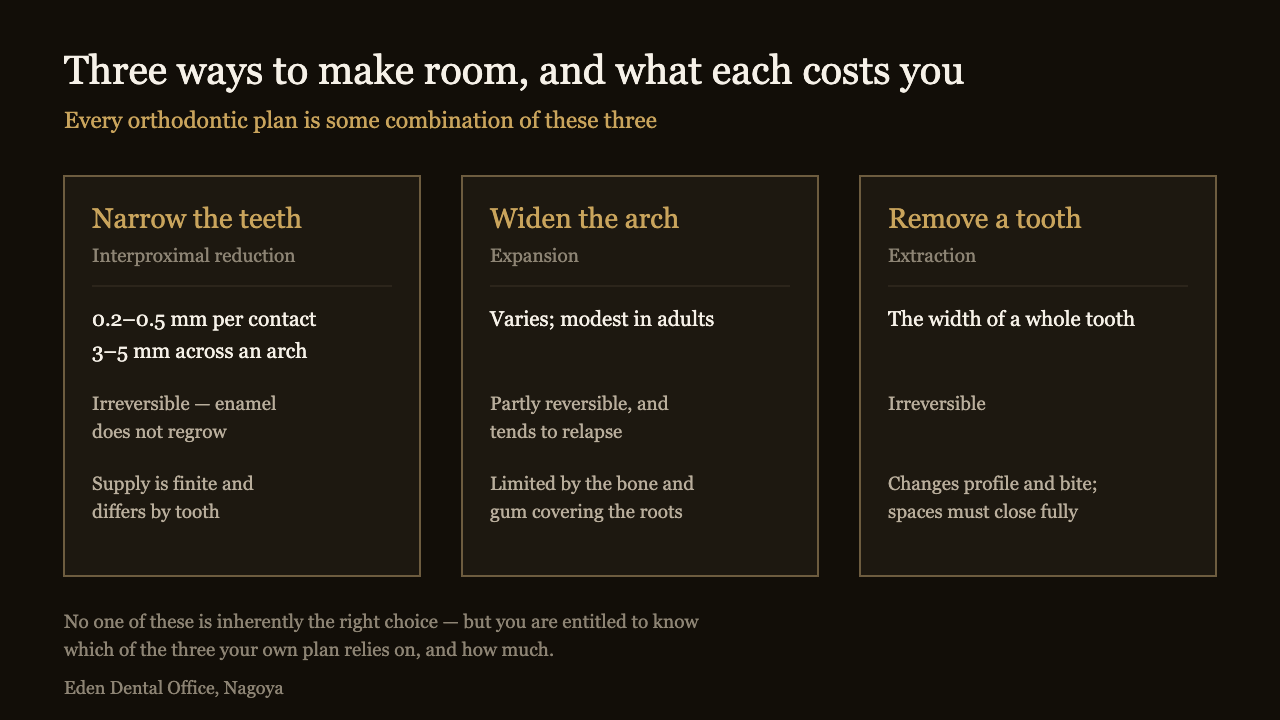
Crowding is a mismatch between the width of the teeth and the length of the arch holding them. There are only three ways to resolve it: narrow the teeth, widen the arch, or remove a tooth. Every orthodontic plan combines the three, and the combination determines how the face and bite look at the end — not merely how straight the front teeth are.
| Method | Room gained | Reversible | Main trade-off |
|---|---|---|---|
| Interproximal reduction (IPR) | 0.2–0.5 mm per contact; a few mm per arch | No — enamel does not regrow | Finite supply; slightly narrows tooth shape |
| Arch expansion | Varies; modest in adults | Partly; tends to relapse | Limited by bone and gum covering the roots |
| Extraction | The width of a whole tooth | No | Changes profile and bite; spaces must close fully |
In adults the arch is not as expandable as marketing copy suggests, because the roots can only be pushed as far as the bone and gum covering them allow. That leaves IPR doing most of the work in mild to moderate crowding, with extraction reserved for shortfalls measured in whole millimetres rather than fractions. Our guide to clear aligner treatment in Japan sets out where the technique’s limits sit.
How much enamel actually comes off
The usual planning figure is 0.2 to 0.5 mm per contact — 0.1 to 0.25 mm from each adjoining surface, or about five sheets of paper in total. Across a crowded lower arch, a series of small reductions can free up three to five millimetres, often the difference between aligner treatment and extractions.
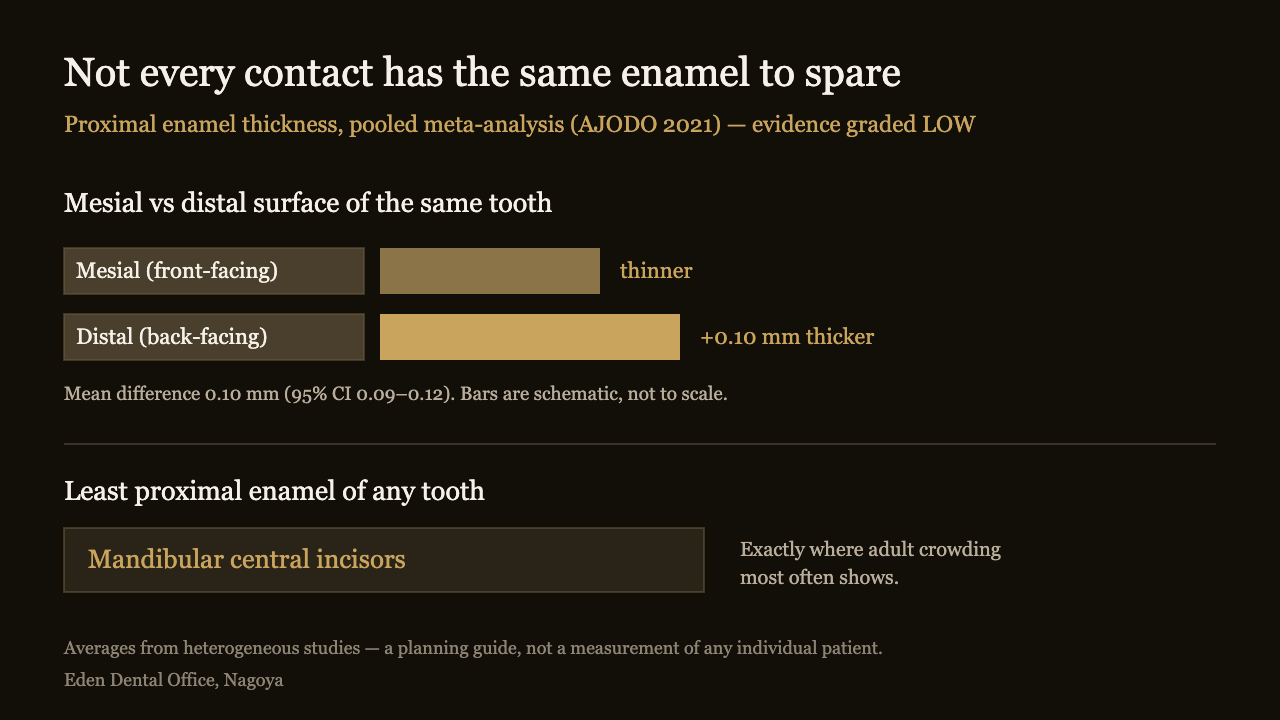
Less widely appreciated is that the supply is not uniform. A 2021 systematic review and meta-analysis in the American Journal of Orthodontics and Dentofacial Orthopedics pooled the available measurements of proximal enamel thickness and found that enamel on the distal surface of a tooth is thicker than on the mesial surface by an average of 0.10 mm (95% CI 0.09–0.12), and that the mandibular central incisors carry the least proximal enamel of any tooth. The authors graded the certainty of the evidence as low, which is worth stating: these are averages from heterogeneous studies, not a measurement of your teeth.
Two consequences follow. The lower front teeth — exactly where adult crowding tends to show — are least able to spare enamel, and the two sides of the same contact are not equally expendable. A plan assuming a uniform allowance everywhere will over-reduce somewhere.
Does filing enamel cause decay or sensitivity?
The evidence is more reassuring than most patients expect, with caveats worth reading.
A systematic review in Orthodontics & Craniofacial Research screened nearly 2,400 citations and pooled the studies tracking caries after interproximal enamel reduction. It found no statistical difference in caries between reduced and untouched enamel surfaces from one to seven years afterwards. The caveat is the size of that evidence base: of eighteen included studies, only four addressed caries at all, and the roughness data were too inconsistent to pool. Demineralization remains the more common enamel problem after aligner treatment in any case, and the white spots it leaves behind respond to resin infiltration rather than to any further reduction.
The longest follow-up comes from Oslo, where patients whose lower front teeth had been reduced more than ten years earlier were re-examined against an untreated group. The authors reported no new caries lesions and no evidence of root pathology, and 59 of 61 patients reported no increase in sensitivity to temperature.
The qualifier matters: that result belongs to a protocol, not to the procedure in general. The reduction was performed with fine diamond disks under air cooling and followed by polishing, and the reference group numbered only sixteen. Enamel left rough and unpolished is not the same intervention. Carefully performed, polished IPR has not been shown to raise decay or sensitivity risk — which is not the same as saying any amount of filing is consequence-free.
Black triangles: what enamel reduction can and cannot fix
Dark gaps beneath the contact points of the upper front teeth are a common disappointment after adult orthodontics, and patients are often told IPR will prevent them. That overstates it.
The reference study examined 337 adults after orthodontic treatment and found open gingival embrasures to be common, with post-treatment factors carrying the greatest weight — specifically the distance from the bone crest to the contact point, and root angulation. Crown shape and contact position contribute; the bone and gum underneath decide the outcome.
Reshaping a contact so it sits lower and broader can genuinely close a small triangle, and it is one of the few conservative tools available. But where the bone has receded, no amount of enamel reduction will fill the space, and the realistic options become gum treatment, composite, or ceramic. If a gap is the principal complaint rather than the alignment, it is worth reading how tooth movement and veneers solve different problems.
How we plan and record it in Nagoya
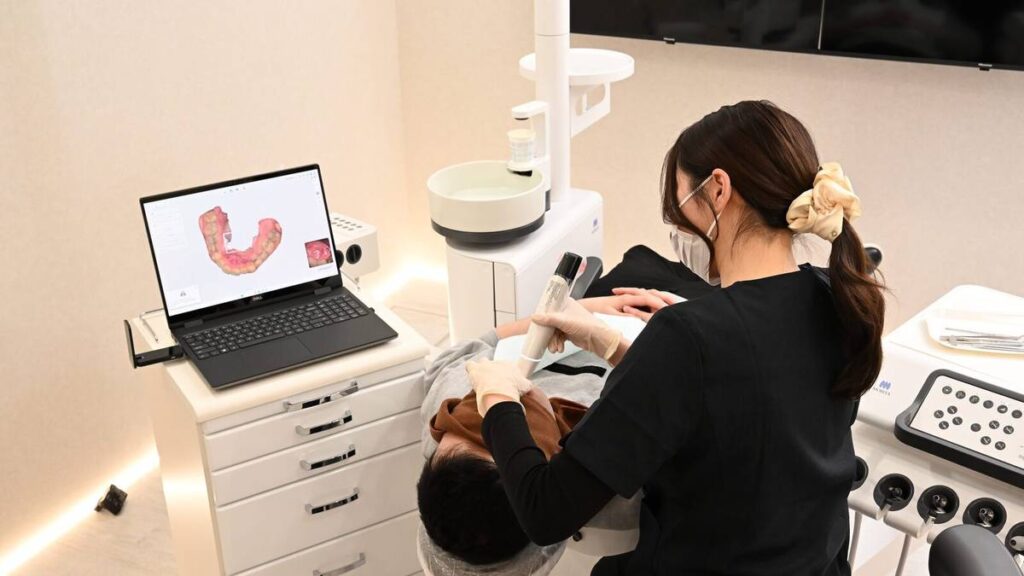
IPR is planned digitally before anything is touched. The arch is scanned, the crowding measured against the space available, and the reduction distributed according to where the enamel is — heavier on distal surfaces, conservative on the lower central incisors, and staged across the treatment rather than done in one sitting. The planned figure for every contact is recorded, and the amount achieved is measured with gauges as it is performed, because planned and performed are not automatically the same number.
Two things follow from planning this as a prosthodontic case rather than a purely orthodontic one. A tooth with a crown, veneer, or bonded filling at the contact is not enamel; reduction there means cutting restorative material, and how existing restorations behave during aligner treatment is a planning question in its own right. And if ceramic work is anticipated afterwards, the final tooth widths belong in the plan from the start — narrowing a tooth now and rebuilding its width in porcelain later is avoidable waste.
Every contact is polished and fluoridated at the end of each session. For patients travelling in, reduction is grouped into fewer, longer appointments, which we work through alongside the rest of planning a treatment trip to Nagoya.
What this costs in Japan
At a self-pay clinic in Japan, interproximal reduction is normally included in the quoted aligner fee rather than billed per visit, because it is part of the plan rather than an optional extra. What matters when comparing quotes is whether that is stated in writing, and whether refinement aligners and retainers are included on the same terms — retention is a long-term cost that quotes routinely omit. Our published fees are on the fee page, and the range for a specific case is given in writing after assessment.
Reduction planning assumes the tooth will finish where the simulation predicted; when it does not, our note on what a remote photo check can and cannot confirm about a stalled tray covers how that is caught.
Frequently Asked Questions
Will my teeth look narrower afterwards?
At 0.2–0.5 mm per contact the change to any individual tooth is not visible in conversation. What patients notice is the contact between the front teeth becoming slightly longer and flatter, usually read as teeth sitting more closely together.
Does interproximal reduction hurt?
Most patients need no anaesthetic; the sensation is pressure and vibration rather than sharpness. Teeth already sensitive at the necks, or visits reducing several contacts at once, are the exceptions, and local anaesthetic is straightforward if wanted.
Does the enamel grow back?
No. Enamel has no cells capable of replacing it, which is why the amount is planned in advance and measured as it is performed rather than judged by eye in the chair.
Can I refuse IPR and still have aligners?
Sometimes. With slight crowding, or an arch that can accept modest expansion, a plan without reduction may be possible. In moderate crowding the alternative is usually extraction or a compromised result, and it is fair to ask which of the three a proposed plan relies on.
How is it different from having teeth filed for veneers?
The direction and volume differ. IPR removes a fraction of a millimetre from the sides of teeth to create space for movement; veneer preparation removes enamel from the front surface to make room for ceramic. The tooth reduction involved in cosmetic options is a separate decision.
Limits, risks and individual variation
Interproximal reduction removes tooth structure that does not come back, and the enamel available differs by tooth, by surface, and by person; published averages are a planning guide, not a measurement of your own teeth. Excessive or unpolished reduction carries risks that carefully executed reduction has not been shown to carry, and the reassuring long-term evidence applies to a specific protocol of fine disks, cooling, and polishing. Enamel reduction will not close a black triangle caused by lost bone, and cannot substitute for the space extraction provides in genuinely crowded arches. Costs, treatment time, and visit numbers depend on the case and are given in writing before treatment begins. Individual results vary.
If you are weighing up an aligner plan and want to know how much enamel it depends on, our treatment page sets out how we assess these cases, and WhatsApp is the quickest way to reach the clinic in English. Bring the existing plan if you have one — its reduction figures are the fastest way to see what it is really doing.
Related: Clear aligner attachments in Japan covers why attachments are bonded and what removal takes from enamel.
Contact-area reduction interacts with gum shape; see black triangles after clear aligners for how the gap risk is assessed.
More on this topic: Aligner Guides — every article we have published in this cluster, grouped by stage.