
Clear Aligners Not Tracking: Remote Review Limits in Japan
Reviewed by Dr. Ryosuke Murai, DDS, MSD — Prosthodontist, trained at Indiana University School of Dentistry (U.S.). Last updated September 2026.
An aligner that no longer sits fully down on a tooth is a common reason a clear aligner course runs long, and it is the one thing a photograph is worst at showing. “Not tracking” means the tooth has fallen behind the position the software predicted for that stage, leaving a visible gap between the plastic and the incisal edge. For a patient living in Tokyo, Singapore or London and treating in Japan, the practical question is not whether remote review is convenient — it obviously is — but how much of the clinical decision it can carry. The published evidence on that is less flattering than the marketing. This article is for self-pay adults who want to know where monitoring stops being measurement and starts being an estimate.
A boundary first. Which appointments must happen in person, and how a course is sequenced around a small number of trips, is covered in our guide to clear aligner treatment in Japan for English-speaking adults; the assessment before you book a flight is handled in what a video consultation can honestly assess. This piece is about the middle of treatment.
What “not tracking” actually means
Every aligner stage is a prescription: the software specifies where each tooth should be after that tray, and the tray is manufactured to that shape. When the tooth moves less than prescribed, the tray no longer fits the tooth it was built for — the sign is an air gap at an incisal edge or cusp tip, most often on a canine, premolar or second molar. Continue anyway and each subsequent tray rests on an assumption that is already wrong, so the error compounds.
Patients usually assume this is a wear-time failure. Sometimes it is. Often it is not: the movement prescribed for that tooth sat at the edge of what the appliance expresses, and no amount of discipline would have delivered it. The distinction matters because the remedies are opposite — one is a conversation about hours, the other is a new scan and a revised plan.
What a phone photograph can verify, and what it cannot
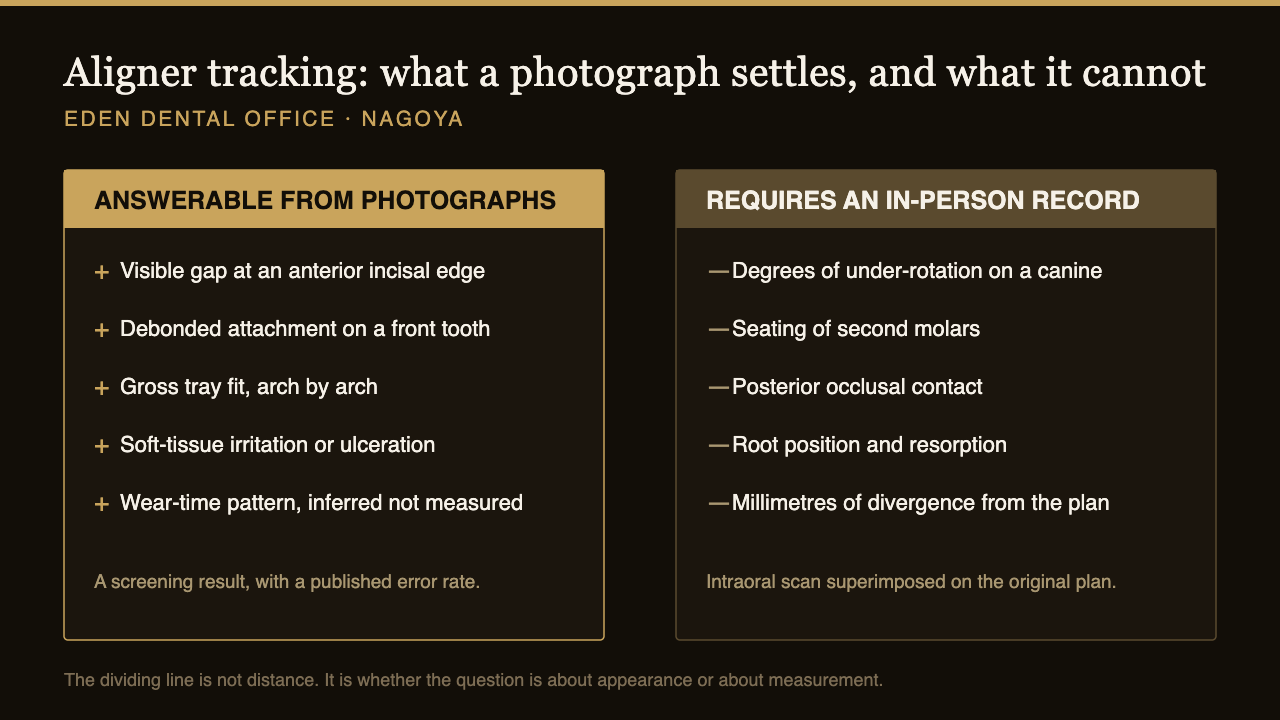
Remote review compares photographs of your teeth in the current tray against the simulation. That is useful for gross fit and gross compliance, and structurally blind to anything not visible from the front of a smiling mouth in ambient light.
| Question | Answerable from remote photographs? | Why |
|---|---|---|
| Is there a visible gap at an anterior incisal edge? | Usually yes | High-contrast edge against the tray, front-facing |
| Have attachments debonded? | Often yes, on anterior and premolar teeth | Composite bumps are visible when the tray is out |
| Are you wearing the trays enough? | Indirectly | Inferred from fit, not measured |
| Is a second molar seating? | Rarely | Out of the camera’s line of sight in most self-taken images |
| By how many degrees has a canine under-rotated? | No | Requires a 3D scan superimposed on the planned position |
| Is the posterior bite opening as a side effect? | No | Occlusal contact is not photographable |
| Is root position acceptable? | No | Requires radiographs |
The American Association of Orthodontists reaches the same line from the other direction in its consumer alert on direct-to-consumer orthodontics: an initial in-person examination including radiographs is needed to rule out underlying disease, and treatment should run under in-person supervision. Remote review at our clinic supplements scheduled visits rather than replacing them.
The repeatability problem, in numbers
A prospective study from Harvard School of Dental Medicine, published in the American Journal of Orthodontics and Dentofacial Orthopedics in August 2023, tested the obvious question: if you scan the same patient twice, does the system give the same answer? Thirty patients in aligner treatment were scanned twice with a smartphone-based remote monitoring application. The instructions agreed between the first and second scan 83.3% of the time, and gauge compatibility was 44.7% — below the accepted industry standard. There was no complete consensus between repeat scans on which teeth were failing to track, or on how many.
The second finding is the one that changes clinical behavior. Among patients told to proceed to the next tray, mean maximum discrepancies between actual and planned position were 1.997 mm mesiodistally and 8.911° of tipping; among those told not to proceed, 1.771 mm and 8.673°. Statistically similar. The authors concluded that the automated decisions “were inconsistent with quantitative findings.” The paper is indexed on PubMed.
That is not an argument against remote review. It is an argument against treating a green light as a measurement — a “go” instruction is a screening result with a meaningful error rate attached, and we present it to patients that way.
Which movements drift from the plan
Some prescribed movements are also less reliably expressed than others, independent of monitoring. A prospective multicenter study of 79 adult patients and 2,212 teeth, published open access in Progress in Orthodontics in 2023, superimposed post-treatment intraoral scans on the planned final-stage models and measured the shortfall. Rotation of round-crowned teeth fared worst: roughly 0.4° of loss for every 1° prescribed on upper canines, 87% of which carried an attachment, and about 0.3° per degree on lower canines. Second molar movements were, in the authors’ phrasing, “mostly unexpressed.” Changing aligners every 14 days rather than every 7 reduced the shortfall by 12%. The paper is available from Progress in Orthodontics.
So a canine that stops tracking at stage 14 is often not a compliance story. It is the appliance doing what the literature says it does with that movement on that tooth shape.
How we run a long-distance case at Eden
Because our practice is prosthodontic, we plan aligner cases backwards from the finished bite rather than forwards from the crowding — the same habit that governs how we sequence restorative and orthodontic treatment together. Three protocol points follow from the evidence above.
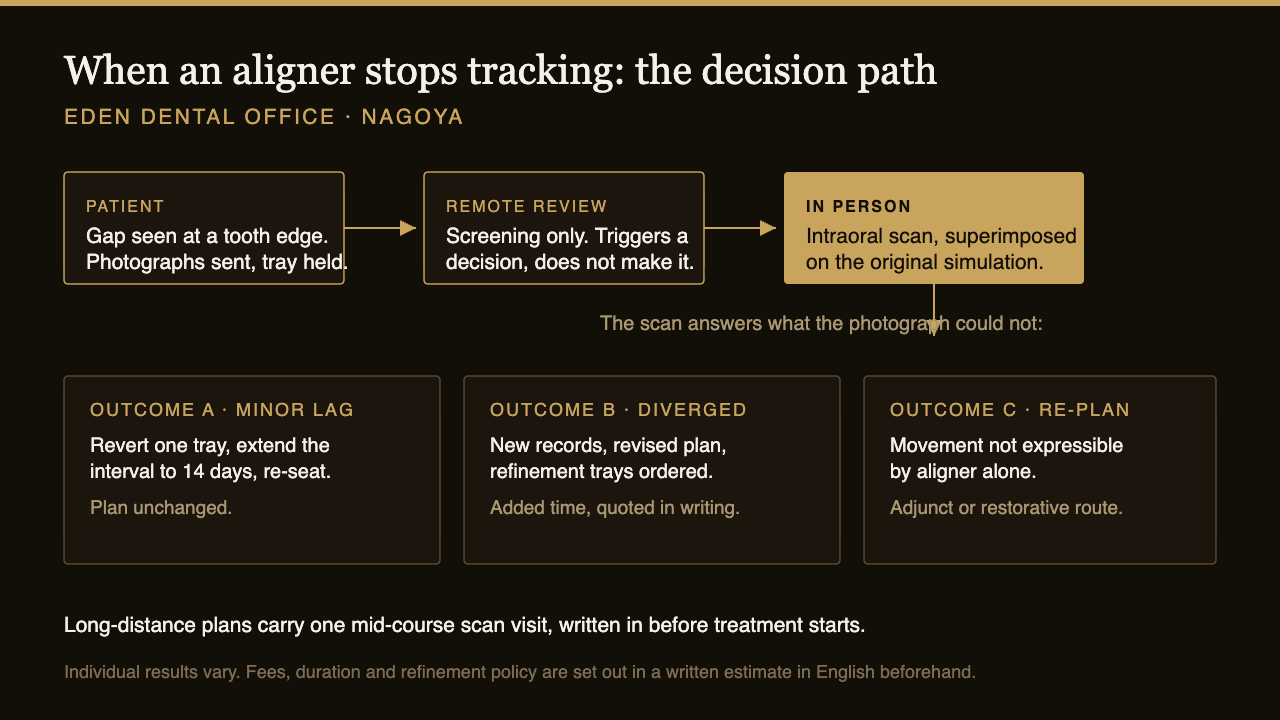
First, we build slack into the plan where the literature says expression is weakest: canine and premolar rotations and second molar movement get conservative staging and a 14-day change interval from the outset for patients who cannot return quickly — the same rotations that make interproximal reduction planning conservative rather than aggressive. Second, remote photograph review triggers a decision, never makes one — when images suggest a fit problem, the outcome is a scheduled intraoral scan, not a verdict typed into a message. Third, every long-distance plan has one mid-course scan appointment written into it before treatment starts, at roughly the one-third point, and it appears in the written estimate. Patients usually fold that visit into the trip structure described in our guide to planning a dental treatment trip to Nagoya; Nagoya is roughly 100 minutes from Tokyo by shinkansen and about 40 minutes from Chubu Centrair International Airport, which is what makes a one-day scan visit realistic.
If the scan shows the case has diverged, the honest answer is a refinement: new records, a revised plan, additional trays. That costs time. It is still cheaper than finishing a course built on a wrong assumption at stage 14. Cases that combine aligner movement with crowns, veneers or implant restorations carry an extra reason to catch divergence early, since a restorative step waiting on final tooth position is exactly what sequencing aligners with restorative work is built to avoid disrupting.
What this costs
Whether a mid-course scan and any resulting refinement sit inside the original fee or are billed separately is a question to settle before treatment, not after. Our published packages — a check-up package at ¥40,000, a whitening package at ¥75,000, membership tiers from ¥88,000 to ¥288,000 per year — are on our fee page. Aligner course fees depend on the number of stages, the complexity of the movements prescribed and whether restorative work follows, so they are quoted in a written estimate in English before treatment begins, with the refinement policy on its own line. Patients still deciding between moving teeth and restoring them may find our comparison of aligning teeth versus ceramic restoration useful first.
Tray condition affects fit between visits, as covered in our aligner cleaning guide.
Frequently Asked Questions
How do I know if my aligner is not tracking?
The usual sign is a visible gap between the tray and the edge of a tooth when the tray is fully seated, most often on a canine or premolar. Photograph it in daylight and send it before advancing to the next tray.
Can a remote check tell me how far off-track I am?
No. Photographs can show that a gap exists. Quantifying the shortfall in millimeters or degrees requires an intraoral scan superimposed on the original plan.
Should I go back a tray if a tooth stops tracking?
Sometimes, and only on instruction. Reverting can re-seat a mildly lagging tooth, but if the movement was beyond what the appliance expresses, reverting simply delays the revised plan.
How often should a long-distance aligner patient be seen in person?
We build at least one mid-course scan into the plan for patients living abroad, in addition to the records and fitting visits. Cases with heavy rotation or molar movement need more.
Does a refinement mean the treatment failed?
No. Refinements are a normal part of aligner treatment and are expected in a substantial share of cases. What matters is catching the divergence early enough that the revision is small.
Risks, limits, and what remains uncertain
Clear aligner treatment carries real downsides: root resorption, gum recession where teeth are moved through thin bone, transient speech changes, decalcification if hygiene lapses, relapse if retention is not maintained. Some prescribed movements are not fully expressed, and a proportion of cases need refinement trays and additional months. A case that finishes tracking correctly still depends on consistent retainer wear to hold the result. Remote review reduces the number of trips a long-distance patient makes; it does not make treatment safer, and the 2023 repeatability figures are a reason to hold automated instructions loosely. Fees, duration and refinement policy are set out in a written estimate in English before treatment begins. Individual results vary.
If you are mid-course elsewhere and suspect a tooth has stopped tracking, send the photographs and the original plan and we will tell you whether a scan is needed to answer it. Our treatment overview shows how aligner work fits alongside restorative planning; WhatsApp is the fastest way to reach the clinic in English.
Related: Clear aligner attachments in Japan covers how a lost attachment can cause an aligner to stop tracking.
A gap that shows between teeth after treatment is a different issue from tracking; see black triangles after clear aligners.
More on this topic: Aligner Guides — every article we have published in this cluster, grouped by stage.