
Clear Aligners With Crowns, Veneers or Implants in Japan
Reviewed by Dr. Ryosuke Murai, DDS, MSD — Prosthodontist, trained at Indiana University School of Dentistry (U.S.). Last updated September 2026.
A patient arrives in Nagoya with four porcelain veneers placed in London eight years ago, a molar crown, and an implant replacing a lower first molar. She wants her lower front teeth straightened, and has been told clear aligners are not an option for her. That is the wrong answer, but close to a right one. Clear aligners can move restored teeth. What changes is which teeth move, how the aligner grips them, and what happens to the restorations afterwards. This is for self-pay patients in Japan who already have crowns, veneers, or implants and want an honest aligner plan before they commit.
What actually moves when some teeth are restored
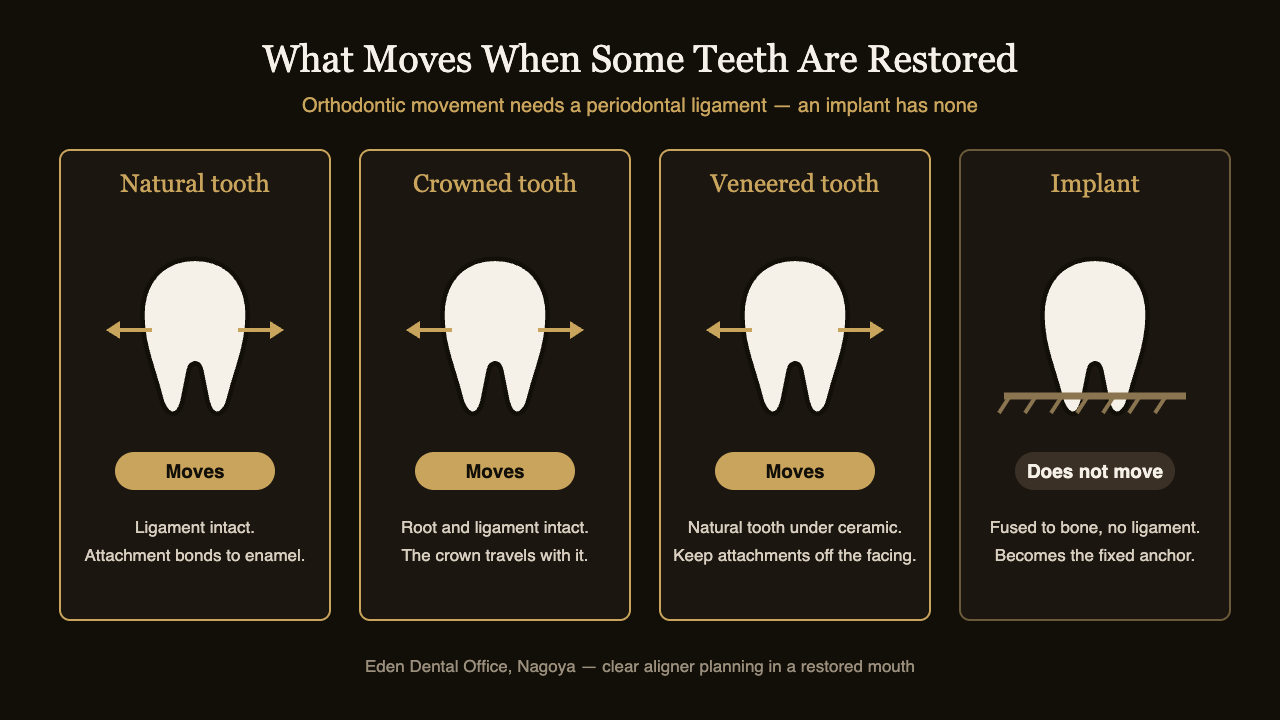
Orthodontic movement happens in the bone, not in the tooth. A tooth moves because pressure on the periodontal ligament triggers bone to resorb on one side and rebuild on the other. Anything with a ligament can move; anything without one cannot.
That single distinction sorts almost every case. A crowned tooth still has its root and ligament, so it moves normally and the crown travels with it. A veneered tooth is a natural tooth with a thin ceramic facing, so it moves normally too. An implant is fused directly to bone with no ligament, so it does not move under orthodontic force and never will.
| What is in the mouth | Can it be moved? | The practical consequence |
|---|---|---|
| Natural tooth | Yes | Reference case; attachment bonds to enamel |
| Crowned tooth | Yes | Crown follows the root; review contacts after |
| Veneered tooth | Yes | Keep the attachment off the ceramic if possible |
| Root canal treated tooth | Yes | Ligament intact; brittleness affects restoring, not moving |
| Implant | No | Becomes a fixed anchor; plan is built around it |
| Bridge | Not as a unit | Splinted teeth move together or not at all |
Rossini and colleagues (Angle Orthodontics, 2015;85(5):881–9) found aligners control some movements considerably better than others — tipping and derotation of round-rooted teeth are handled well, while bodily movement and extrusion are the weak points. In a restored mouth that matters twice over, because the movements most often needed near a crown or an implant are exactly the controlled, bodily ones.
This article assumes you already know the basics of how aligner treatment runs; if not, start with our guide to clear aligner treatment in Japan.
Implants are the fixed point in the arch
An implant that will not move is not automatically a problem. Orthodontists have spent decades trying to create stable anchorage; an osseointegrated implant gives it for free. The plan simply has to treat that implant as a landmark rather than a variable.
The real complication is the opposite one. The natural teeth around an implant continue to drift slowly throughout adult life, while the implant stays exactly where it was placed. Polymeri and colleagues (International Journal of Oral & Maxillofacial Implants, 2020;35(2):342–349) followed adults with implant restorations long-term and documented measurable occlusal migration of the adjacent teeth. If your implant crown was fitted years ago and its neighbors have since moved, aligner treatment may reopen a contact that quietly closed, or leave a visible step at the implant crown once the natural teeth reach their new positions. That is an argument for measuring before you start, and for agreeing in writing whether the implant crown will be remade at the end.
Attachments do not grip ceramic the way they grip enamel
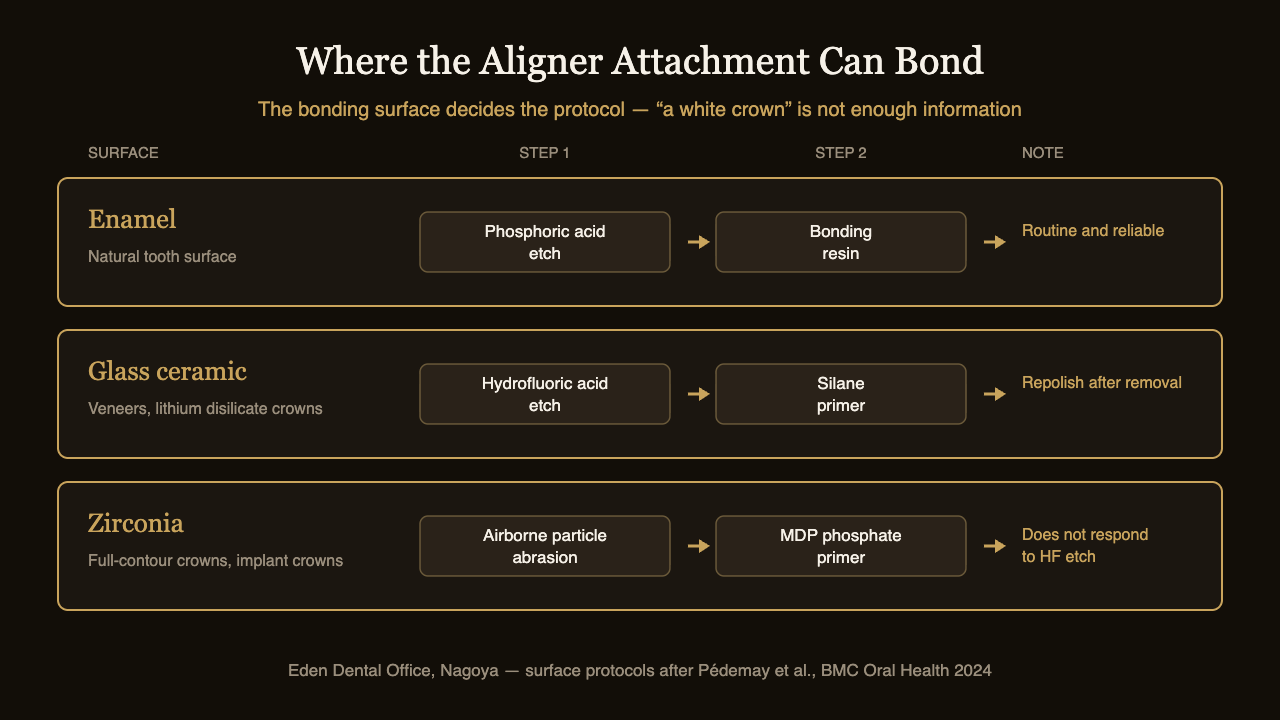
Clear aligners rarely work on the tray alone. Small tooth-colored composite attachments are bonded to selected teeth to give the aligner something to push against. Bonding composite to etched enamel is routine and reliable. Enamel is also the resource that interproximal reduction draws on to make space, so a tooth already restored at the contact offers neither. Bonding it to a glazed ceramic crown or a veneer is a different problem, and the surface has to be prepared for it.
Protocol decides the outcome. Pédemay and colleagues (BMC Oral Health, 2024;24(1):1567) compared surface treatments for bonding to glazed glass ceramics and to zirconia, and found bond strength varies widely with whether the surface is etched, sandblasted, or primed — and that zirconia behaves nothing like glass ceramic. Glazed lithium disilicate generally needs hydrofluoric acid etching and a silane primer; zirconia does not respond to that at all and needs airborne particle abrasion with a phosphate monomer primer instead.
Two practical points follow. An attachment bonded onto a veneer means roughening the polished surface of a restoration you paid for, then repolishing it at the end — so where the case allows, we place the attachment on an adjacent unrestored tooth. And if an attachment must sit on ceramic, the clinician has to know which ceramic. “A white crown” is not enough information.
When the existing restoration has to be replaced anyway
This is the part patients are least often told, and the part that most affects the budget.
A crown or veneer was made to fit a tooth in a particular position, with particular contacts against its neighbors and a particular relationship to the gum. Move the tooth and some of those relationships change. A veneer designed to disguise a rotated tooth may look too wide once the tooth is straight. A crown built with an unusual contour to close a gap may leave a space when the gap is closed orthodontically instead.
Restorations placed within the last few years, on teeth needing only minor movement, usually survive treatment unchanged. Older aesthetic work on front teeth being significantly repositioned frequently does not. The right time to decide is at planning — because if a veneer is going to be remade anyway, the aligner plan can aim for the ideal tooth position rather than working around the existing ceramic.
How we plan this at Eden
A restored mouth is a prosthodontic problem before it is an orthodontic one, which is why we plan these cases the way we do. Every case starts with an intraoral scan and a CBCT, so we can see root positions, bone, and implant angulation rather than inferring them from the crowns. We record what each restoration is made of and roughly when it was placed, and we ask patients to bring their previous clinic’s notes.
We then run the proposed movements against the planned final restorations in our Digital Smile Design workflow, so the aligner target position and the prosthetic design are decided together rather than sequentially. Because we have an in-house digital laboratory and 3D printers, a provisional restoration can be printed and tried in before anyone commits to a final ceramic. Patients receive a written English treatment plan stating explicitly which restorations are expected to be remade and which are not.
What this costs in Japan
Eden publishes package prices for the treatments that can be priced as packages: a comprehensive check-up at ¥40,000, a whitening package at ¥75,000, and annual membership tiers from ¥88,000 to ¥288,000. Aligner treatment combined with restorative work cannot be quoted from a price list, because the cost is driven by how many aligner stages the case needs, how many attachments have to be bonded to ceramic, and above all how many existing restorations are replaced at the end.
What we can commit to is the process. You receive an itemized written estimate in English before any treatment begins, separating the orthodontic fee from the restorative fee. Where a restoration might need replacing, the estimate says so as a named contingency with a figure attached, rather than appearing as a surprise in month nine. Our published fee information explains the structure, and interest-free monthly payment is available for self-pay treatment.
Cases that combine aligner movement with restorative work carry an extra reason to catch a stalled tooth early, since a crown or veneer waiting on final tooth position is exactly what can go wrong; see our note on recognizing when a tray has stopped tracking.
If you have restorations, hygiene under trays is part of the plan; see what works and what warps when cleaning aligners.
Frequently asked questions
Can I have clear aligners if I have a dental implant?
Usually yes. The implant will not move, so it becomes a fixed anchor. What needs checking first is whether its neighbors have drifted since the crown was fitted.
Will aligners damage my veneers or crowns?
The trays do not. The risk sits with bonding and removing attachments on ceramic, which is why we keep attachments off restorations where the case allows.
Do I have to replace my veneers afterwards?
Not always. Recent work on teeth needing small movements usually survives unchanged; older front-tooth work being significantly repositioned often needs remaking.
What if I have a bridge?
Teeth joined by a bridge move as one unit or not at all. It may be sectioned first, or replaced with separate restorations afterwards.
Can this be planned if I live outside Nagoya?
Yes. Records can be reviewed remotely before you travel. A video consultation before booking a flight is the usual first step.
Risks, limits and what to expect
Orthodontic treatment carries risks whether or not the mouth is restored: root shortening, gum recession, temporary discomfort after each aligner change, and relapse if retainers are not worn as instructed. Retention is lifelong, not a phase, and our guide to how long retainers are worn and what they cost covers that commitment in detail. Two further risks are specific to these cases — the bond site on a ceramic restoration may need repolishing or repair, and a restoration may look or fit differently once the tooth beneath it has moved. Aligners also handle some movements less predictably than fixed appliances, and a case needing substantial bodily movement or extrusion may be better served by another approach.
No outcome can be promised in advance, and we do not promise one. Individual results vary. If you have crowns, veneers, or implants, the useful starting point is a prosthodontic assessment of what you already have rather than an orthodontic opinion in isolation. You may also want to read how we weigh aligning teeth against restoring them, what the difference between a veneer and a crown means for tooth structure, and how a single front tooth is shade-matched when restorative work follows movement. Our treatment planning page explains how the assessment works, and WhatsApp is the fastest way to reach us in English.
Whitening is a common companion to this treatment, and we explain the order in our guide to whitening while wearing clear aligners.
Related: Clear aligner attachments in Japan covers how bonded attachments work alongside existing restorations.
Where gum shape matters for the final restoration, read how black triangles are handled after aligners.
Grinding adds another reason to plan carefully around existing restorations: aligners when you grind your teeth.
More on this topic: Aligner Guides — every article we have published in this cluster, grouped by stage.