
Clear Aligners and Teeth Grinding: What to Know in Japan
Reviewed by Dr. Ryosuke Murai, DDS, MSD — Prosthodontist, trained at Indiana University School of Dentistry (U.S.). Last updated October 2026.
If you grind or clench your teeth, clear aligners are usually still an option, but the plan has to be built differently. The current evidence says aligners neither cure nor cause bruxism for most people; what they change is how the load is distributed and what happens to your teeth and restorations while you wear them. For self-pay adults in Japan who want straight teeth without wearing down a finished result, the real question is what protects the outcome afterwards. This article explains what the research shows, what we check before starting, and why the night guard decision belongs at the beginning of treatment rather than the end.
A boundary first. How clear aligner treatment works in general, including trips and in-person visits, is covered in our guide to clear aligner treatment in Japan for English-speaking adults. Retainers after the final tray have their own article on retainer options after aligners. This piece is specifically about patients who already grind.
What grinding and clenching actually are
Bruxism is repetitive jaw-muscle activity, either asleep or awake, and it is not a single condition. Sleep bruxism is rhythmic or sustained contraction during the night; awake bruxism is mostly clenching, often during concentration or stress. Many people do both without knowing. The usual clues are flattened or chipped edges, a morning-tight jaw, sore chewing muscles, or a partner who hears it.
This matters for aligners because the two behaviours load a tray differently. A tray worn all day sits on teeth that are clenching in daylight; the same tray worn overnight meets sleep grinding. Neither is the situation the appliance was designed around, which is movement of teeth under light, steady force.
What the evidence says about aligners and bruxism
A systematic review in the Journal of Oral Rehabilitation (2026) pooled eleven studies covering 818 patients and asked whether clear aligners were protective, neutral or a risk factor. Most studies suggested a neutral effect. Some found reduced sustained muscle contraction while aligners were worn, some found higher bursts of activity, and self-reported symptoms pointed in both directions. The authors concluded that aligners cannot yet be classified as protective or harmful and that better studies are needed. The review is indexed on PubMed.
A smaller controlled experiment from the University of Otago, also in the Journal of Oral Rehabilitation (2026), had 21 participants complete a stressful arithmetic task with and without passive aligners while jaw-muscle activity was recorded. Wearing aligners did not significantly change measured muscle activity or perceived clenching. That study is on PubMed. Twenty-one people for ten minutes is a small window, so we read it as reassurance about short-term stress clenching, not a verdict on years of night-time grinding.
Put together, the honest summary is that aligners are unlikely to make a grinder worse, will not stop the grinding, and are not built to take the hit. The practical consequences sit in the tray, the teeth and the finished bite.
What grinding does to a clear aligner treatment plan
Aligner plastic is thin by design. Under heavy night-time loading it can wear through, crack or distort, and a tray that no longer fits stops moving teeth on schedule. Patients who grind sometimes report cracked trays or a new tray that seems to seat poorly, which can look like an aligner not tracking when the cause is the tray itself. Attachments, the small tooth-coloured bumps that give the tray grip, also see more stress; our article on aligner attachments and their removal explains what they are and why they sometimes debond.
The larger risk is to what exists already. A grinder with veneers, crowns, bonding or an implant restoration is loading ceramic and composite that cannot repair itself. Moving teeth underneath those restorations changes the contacts they were made to meet, and sequencing matters, as set out in our piece on combining aligners with crowns, veneers and implants.
| Finding at examination | Why it matters for aligners | How we usually respond |
|---|---|---|
| Flattened or chipped edges | Suggests long-standing heavy loading | Record baseline wear, plan a night guard before treatment ends |
| Tender chewing muscles or jaw joint | Symptoms may be confused with aligner discomfort | Document at the start so changes can be compared |
| Existing veneers, crowns or bonding | Cannot adapt to new tooth contacts | Plan restorative and orthodontic steps together |
| Tray cracked or worn through | Treatment stalls and fit is lost | Review the cause, replace the tray, consider a night-time protocol |
| No signs of grinding at all | Lower risk, not zero | Standard plan, with retention agreed in advance |
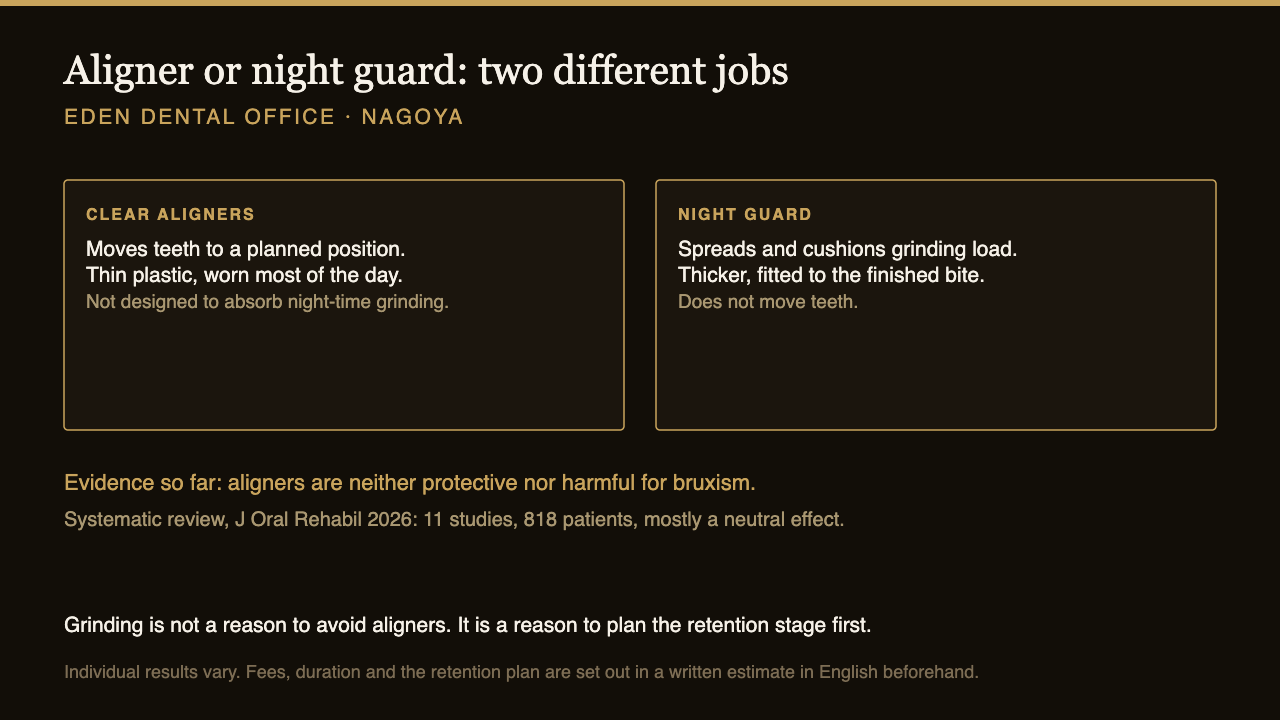
A tray worn at night is not a night guard. A night guard is a thicker appliance made to the finished bite, intended to spread load across the arch. A clear aligner is intended to move teeth. If grinding is the concern, the two jobs should not be handed to one appliance. Existing patients with veneers will recognise the same logic from our article on veneer care and night guards.
How we plan aligner cases for patients who grind
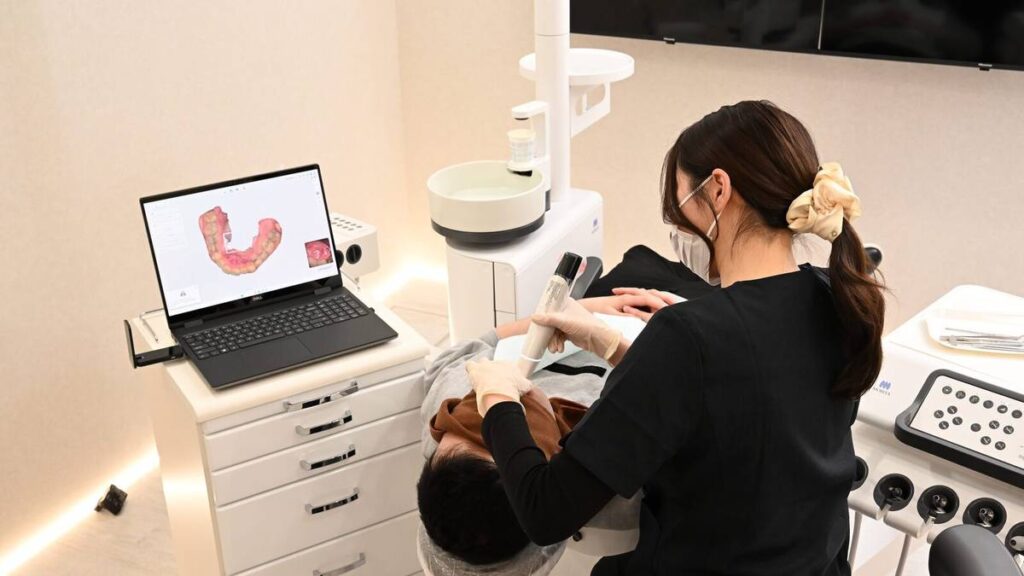
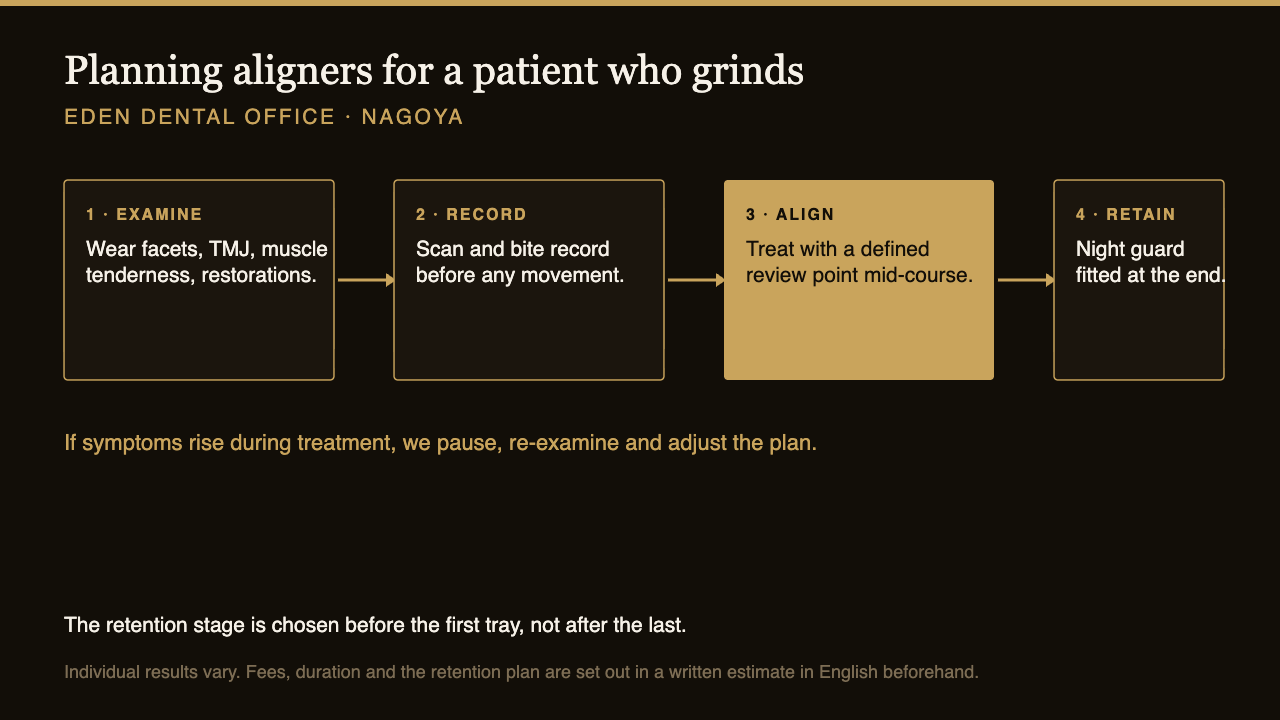
Because our practice is prosthodontic, we begin from the finished bite and the condition of the teeth already present, the same approach that shapes our prosthodontic treatment planning. At Eden, we examine wear facets, muscle tenderness and the jaw joint before any scan, then take digital records and a bite record that become the reference point for treatment. Where wear is evident we do not leave the question of a night guard until the last tray; it is agreed in writing as part of the plan, and the guard is made once teeth are in their final positions.
For patients living overseas, one mid-course review is built into the schedule, alongside the usual fitting visits. If jaw symptoms increase, we pause, re-examine and decide whether to continue, slow the staging or change approach. Those visits fit into a trip described in our guide to planning a dental treatment trip to Nagoya.
What this costs
Our published packages, a check-up at ¥40,000, a whitening package at ¥75,000 and membership tiers from ¥88,000 to ¥288,000 per year, are on our fee page. Aligner fees depend on the number of stages, the movements required and whether restorative work follows, so they are quoted in a written estimate in English before treatment begins. A night guard is a separate line in that estimate, which is why we raise it at the first appointment. If you are still deciding between moving teeth and restoring them, our comparison of aligning teeth versus ceramic restoration is a useful first read.
Frequently Asked Questions
Can I wear clear aligners if I grind my teeth?
Usually yes. Current evidence suggests aligners have a mostly neutral effect on grinding. The plan should include a baseline examination and an agreed night guard for after treatment.
Will clear aligners stop me grinding at night?
No. Studies show no reliable protective effect, so grinding should be managed with an appliance made for it.
Can I sleep in a night guard while wearing aligners?
Not as a rule. A night guard is made to the finished bite, so we normally introduce it once teeth are in their final positions.
Why does my aligner crack at night?
Heavy night-time loading can wear or fracture thin plastic. Tell us promptly so we can check whether the cause is grinding or fit.
Does grinding make my aligner treatment take longer?
It can, if cracked or poorly seated trays interrupt staging. A baseline record and mid-course review help us catch this early.
Risks, limits, and what remains uncertain
Clear aligner treatment carries real downsides: root resorption, gum recession where teeth move through thin bone, transient speech changes, decalcification if hygiene lapses, and relapse if retention is not maintained. In patients who grind, there is added risk of cracked trays, delayed staging, and wear or damage to existing restorations. The research on aligners and bruxism is limited and inconsistent, and nothing here should be read as a promise that grinding will stay unchanged or improve. A night guard reduces load on teeth but does not stop the habit. Fees, duration and the retention plan are set out in a written estimate in English before treatment begins. Individual results vary.
If you grind and are weighing aligners, send us your questions and any photographs of wear or cracked trays; our treatment overview shows how orthodontic and restorative planning fit together, and WhatsApp is the fastest way to reach the clinic in English.
More on this topic: Aligner Guides — every article we have published in this cluster, grouped by stage.