
Internal Bleaching in Japan: Whitening a Dark Front Tooth
Reviewed by Dr. Ryosuke Murai, DDS, MSD — Prosthodontist, trained at Indiana University School of Dentistry (U.S.). Last updated September 2026.
A single upper front tooth that has slowly turned grey or brown, years after a root canal, is one of the few dental complaints that is purely about appearance and still worth treating carefully. Internal bleaching in Japan treats that tooth from the inside, through the access cavity the root canal already left, rather than bleaching the whole arch. Done well it lightens the tooth without removing any enamel, which is what separates it from a veneer or a crown. This article covers how the technique works, what sixteen-year follow-up shows about relapse, what it costs at a self-pay clinic in Japan, and the point at which a ceramic restoration becomes the more honest recommendation.
Why a root-treated tooth darkens, and why surface gel does not reach it
The discoloration of a non-vital tooth comes from inside the dentine, not from the enamel surface. Blood breakdown products left in the dentinal tubules after trauma or root canal treatment, along with pigments from older root filling materials, stain the tooth from the core outward. The enamel is a window onto that stained dentine.
A hygiene appointment removes only deposits sitting on the surface, and the difference between cleaning and whitening turns entirely on where the color sits. Arch whitening with peroxide gel reaches enamel and outer dentine, but the concentration arriving at the core of a heavily stained non-vital tooth is low — and the neighboring teeth lighten at the same time, so the gap often looks worse afterwards rather than better. Internal bleaching inverts the geometry: the agent sits inside the pulp chamber, against the stained dentine, and works outward.
The walking bleach technique, visit by visit
The conventional approach is the walking bleach, in which the agent is sealed inside the tooth and left to work between appointments rather than activated in the chair. At Eden the sequence runs over three or four short visits.
It begins with records: photographs, a shade recorded with a spectrophotometer rather than by eye, and a periapical radiograph to confirm the existing root filling is sound. Bleaching a tooth with a failing root canal underneath it treats the symptom and leaves the disease; if the radiograph raises a question, the root canal is revised first.
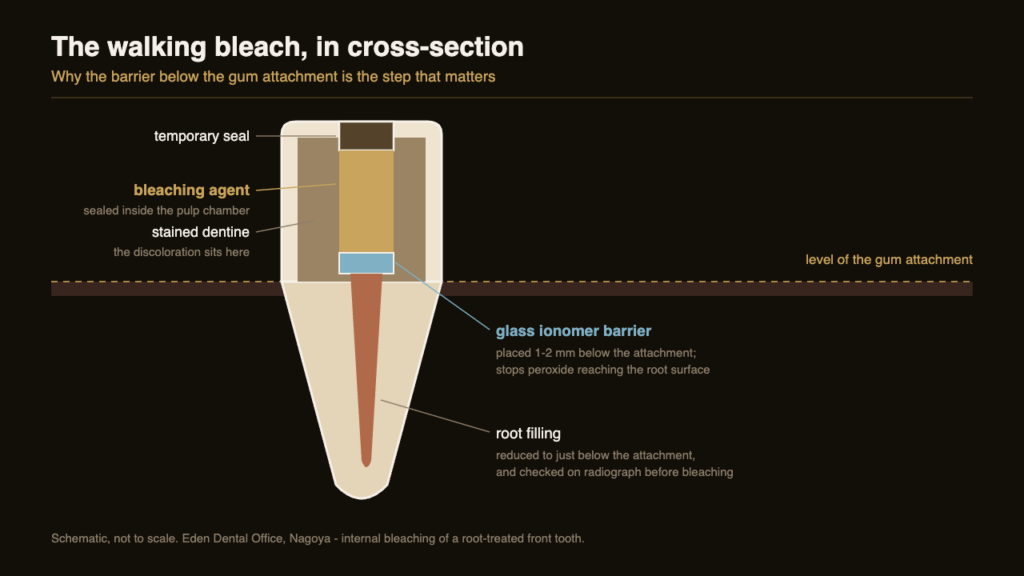
The access cavity is then reopened, the root filling reduced to roughly 1–2 mm below the level of the gum attachment, and a glass ionomer barrier placed over it. That barrier is the single most important step in the procedure and the one most often skipped: it is what stops peroxide traveling down the root surface toward the cervical tissues.
The agent then goes into the chamber behind a temporary seal, and the tooth is reviewed every five to seven days, the agent refreshed while the shade is still moving. Most teeth need two or three changes; some stop responding and say so clearly. Once the shade settles, the chamber is restored with composite — deliberately about two weeks after the last dressing, because adhesive bonds to peroxide-saturated dentine are measurably weaker and the shade is still drifting during that window.
What the evidence shows about shade change and relapse
Two numbers are worth knowing before agreeing to this treatment, and they point in different directions.
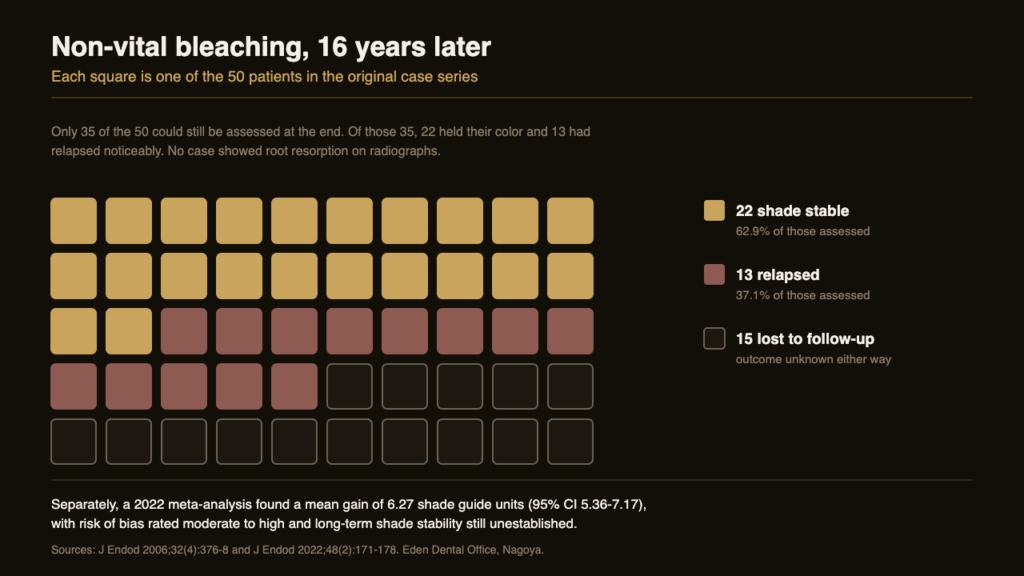
The first is efficacy. A 2022 systematic review and meta-analysis in the Journal of Endodontics pooled clinical trials of internal bleaching on endodontically treated discolored teeth and found a mean improvement of 6.27 shade guide units (95% CI 5.36–7.17). Carbamide peroxide and hydrogen peroxide outperformed sodium perborate used alone. The authors rated the risk of bias as moderate to high and concluded that longer recalls are still needed before shade stability can properly be assessed — the part most clinics leave out.
The second is relapse. A case series in the same journal followed non-vital bleaching for sixteen years. Of the fifty patients originally treated, thirty-five could still be assessed at the end. Twenty-two of those (62.9 per cent) had color that stayed stable and matched the neighboring teeth; the remaining thirteen (37.1 per cent) had relapsed noticeably. No case showed internal or external root resorption on radiographs.
Read together: the procedure reliably produces a large shade change, and roughly one treated tooth in three drifts back far enough over a decade to bother the patient — with fifteen of the original fifty lost to follow-up, so the true figure could sit either side of that. It is a treatment with a good chance of a long result and a real chance of needing repeating, and it should be presented that way. The same drift logic governs arch whitening, where how long a whitened shade holds decides the maintenance interval.
The resorption question
The concern attached to this procedure is external cervical resorption — a lesion beginning at the neck of the tooth below the gum and hollowing out dentine from the outside in. It has been linked in the literature to intracoronal bleaching, particularly where heat was applied, where high-concentration peroxide was used without a barrier, and where the root filling sat at or above the attachment level.
The size of that risk is worth keeping in proportion. A 2026 narrative review in the International Endodontic Journal describes external cervical resorption as a relatively rare form of resorption, graded either on two-dimensional radiographs using Heithersay’s classification or on cone-beam CT using the Patel classification. Because the grading depends on the imaging, we record a baseline radiograph before bleaching and review the tooth at recall. A small cervical lesion caught early is a restorable problem; a late one often is not.
When bleaching is the wrong instrument
Internal bleaching removes no sound tooth structure, which makes it the conservative option and the reasonable thing to try first. It is not always the right answer.
| Option for one dark front tooth | Enamel removed | Control over final shade | Reversible |
|---|---|---|---|
| Internal bleaching | None | Moderate — the tooth lightens as far as it lightens | Yes, in the sense that nothing is lost |
| Composite resin over the labial surface | Minimal | Good, but the resin picks up stain over time | Largely |
| Porcelain veneer | Modest, and irreversible | Good, provided the stump beneath is not very dark | No |
| Full-coverage crown | Substantial, and irreversible | High, including over a dark or metal-cored stump | No |
The decision turns on how dark the stump remains after bleaching, which is why the sequence matters: bleach, wait, reassess, then decide. A thin ceramic layer has limited masking capacity, and matching a single front-tooth veneer to its neighbors is considerably harder over a stump that is still grey. Where the tooth is heavily restored, carries a post, or has lost a large volume of dentine, the honest comparison is no longer bleaching against a veneer but a veneer against a crown. If a clinic has proposed porcelain veneers across several teeth to resolve what is really one dark tooth, that is a reasonable moment to ask for a second opinion in writing.
What internal bleaching costs in Japan
Bleaching a non-vital tooth is self-pay treatment in Japan. National health insurance does not cover it, because the indication is aesthetic rather than functional, and that holds for residents and visitors alike.
Eden publishes fixed figures where a figure can honestly be fixed: a comprehensive check-up package at ¥40,000, a whitening package at ¥75,000, and annual membership from ¥88,000 to ¥288,000 — the range is set out with the rest of our whitening and shade services. Single-tooth internal bleaching is quoted per case rather than from a menu, because the number of dressing changes is not knowable in advance and because a meaningful share of these teeth need the root canal revised first. What we commit to is a written estimate in English before anything is opened, showing the assessment, each anticipated dressing change, the final restoration, and what happens to the figure if the tooth stops responding; our fee and payment information sets out how that works. This treatment does not compress into a single visit — the waiting between dressings is the treatment — so planning a dental treatment trip to Nagoya around it takes some thought.
Frequently Asked Questions
Does internal bleaching hurt?
The tooth has no nerve, so the bleaching itself is not felt. Some patients notice tenderness on biting for a day or two after a dressing change, which settles.
How many visits does it take?
Usually three or four over three to five weeks: assessment and access, one to three dressing changes about a week apart, then the final restoration roughly two weeks after the last dressing.
Will the tooth match my other teeth exactly?
Often closely, sometimes not. A tooth dark for twenty years may lighten substantially and still read slightly different in photographs. Shade is recorded with a spectrophotometer so the comparison is measured rather than argued.
Can it be repeated if the color comes back?
Yes, and repeating it is straightforward — part of why it is worth trying before any ceramic work. Each repeat means reopening the access cavity and replacing the composite.
Should I whiten my other teeth at the same time?
Frequently, yes, and arch whitening should finish and settle first so the single tooth is matched to the final result. Our guide to teeth whitening in Japan covers the sequencing.
Risks, limits and individual variation
Internal bleaching carries a small risk of external cervical resorption, a risk that the tooth fails to lighten enough to satisfy the original complaint, and a documented tendency toward color relapse over years. Because the tooth has no live pulp left, it does not carry the transient cold sensitivity that comes with whitening a tooth that still has its nerve — a different risk profile worth knowing before choosing between the two. Reopening a tooth also carries the ordinary risks of disturbing an existing root filling and of fracture in a tooth already weakened by previous treatment. Where the root canal is unsound, the cost and time of revising it come before any aesthetic work and belong in the estimate rather than arriving later. No clinic can state in advance how many shades a particular tooth will move or how long it will hold. Individual results vary.
If one front tooth no longer matches and you would like to know whether bleaching it from the inside is realistic, the whitening page sets out how we assess it, and WhatsApp is the quickest way to reach the clinic in English. The answer is usually clear at the first radiograph.
If you already have crowns, veneers or visible fillings, read how whitening works around existing restorations before starting a course.
More on this topic: Whitening Guides — every article we have published in this cluster, grouped by stage.