How Long Teeth Whitening Lasts in Japan, and Why It Fades
Reviewed by Dr. Ryosuke Murai, DDS, MSD — Prosthodontist, trained at Indiana University School of Dentistry (U.S.). Last updated September 2026.
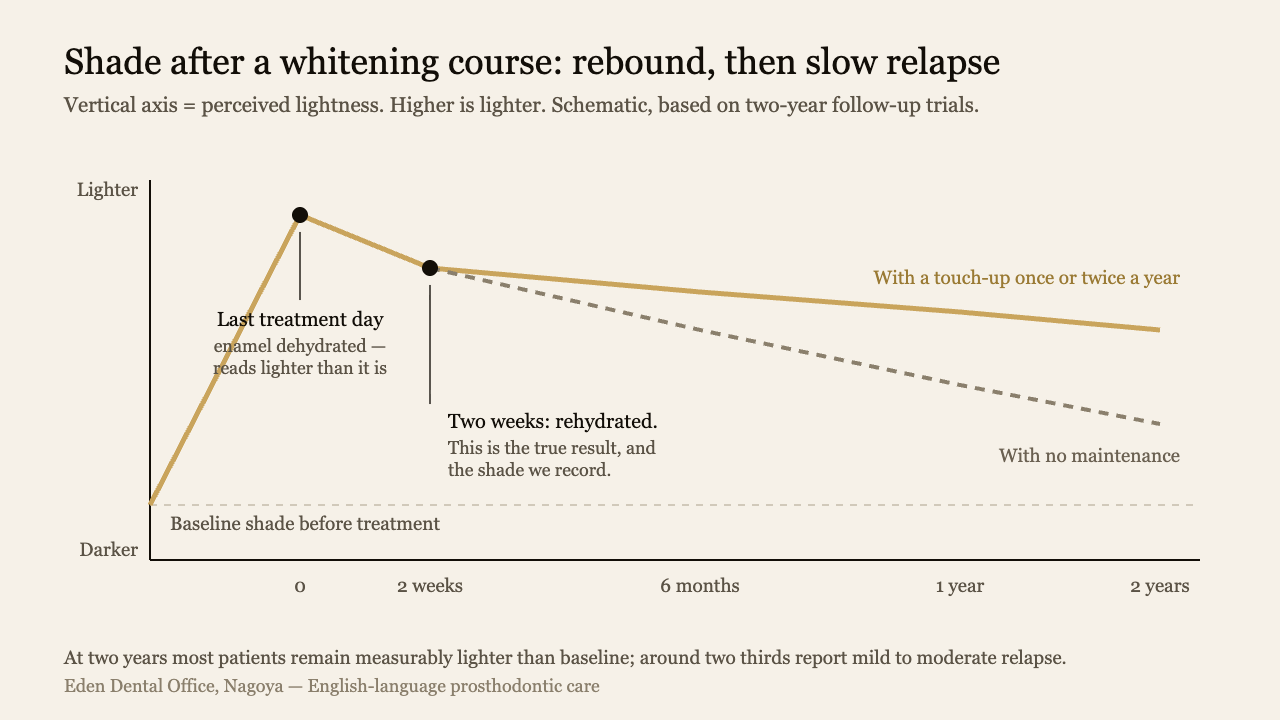
Two years after a course of at-home bleaching, 83% of patients in one North Carolina clinical trial still held a shade change of two tabs or more — the threshold the American Dental Association used to define an effective result. That is the honest headline on how long teeth whitening lasts in Japan: the color does not snap back, but it does drift, and roughly two-thirds of patients notice the drift within two years. This page is for self-pay patients who want the figures before they commit — what controlled follow-up studies measured, what puts the color back, and what holding a shade costs in yen.
If you are still deciding between procedures, our guide to teeth whitening in Japan covers the options themselves. This article starts the day your whitening course ends.
What the follow-up trials actually measured
Most claims about whitening longevity are marketing. A small number of trials followed patients past twelve months with shade guides and spectrophotometers, and their findings are consistent enough to plan around.
In a two-year evaluation of nightly 10% carbamide peroxide published in the Journal of Esthetic Dentistry, the median shade of the upper incisors was still six increments lighter than baseline at two years, and 20 of 24 recalled patients retained a change of at least two shade units. The authors described the loss of lightness as gradual for most patients rather than sudden, and were careful to say that the true endpoint of the effect remained undetermined.
A larger double-blind randomized trial in the Journal of Dentistry followed 92 patients treated with either 10% or 16% carbamide peroxide and recalled 88% of them at two years. Shade remained significantly lighter than baseline in both groups. But more than 66% of participants in each group reported a mild to moderate shade relapse, and the relapse tracked with rising a* and b* color values — the red and yellow axes — in patients who kept consuming staining food and drink at the same rate.
Two points follow. Higher peroxide concentration did not buy longer-lasting color, and the variable separating patients was not the gel but what they drank afterwards.
The first two weeks are not relapse
Patients often message us around day ten convinced the result is already going. Almost always it is not.
Peroxide temporarily dehydrates enamel, and dehydrated enamel reads lighter and more opaque than hydrated enamel. As the tooth rehydrates over one to two weeks, some of that apparent brightness leaves. The tooth is not re-staining; it is returning to its true post-treatment shade. This is why we do not record a final shade on the last treatment day. At Eden we photograph and instrument-record the shade at least two weeks after the course finishes, and that later reading is what we plan any ceramic work against — a habit that matters when matching a single front tooth to its neighbors.
Genuine relapse is slower and looks different: it creeps in over months, reads warmer rather than merely duller, and concentrates on the surfaces your diet touches most.
What actually puts the color back
The trials above point at diet, and clinical experience agrees. The main contributors, roughly in order of how often they matter for our patients:
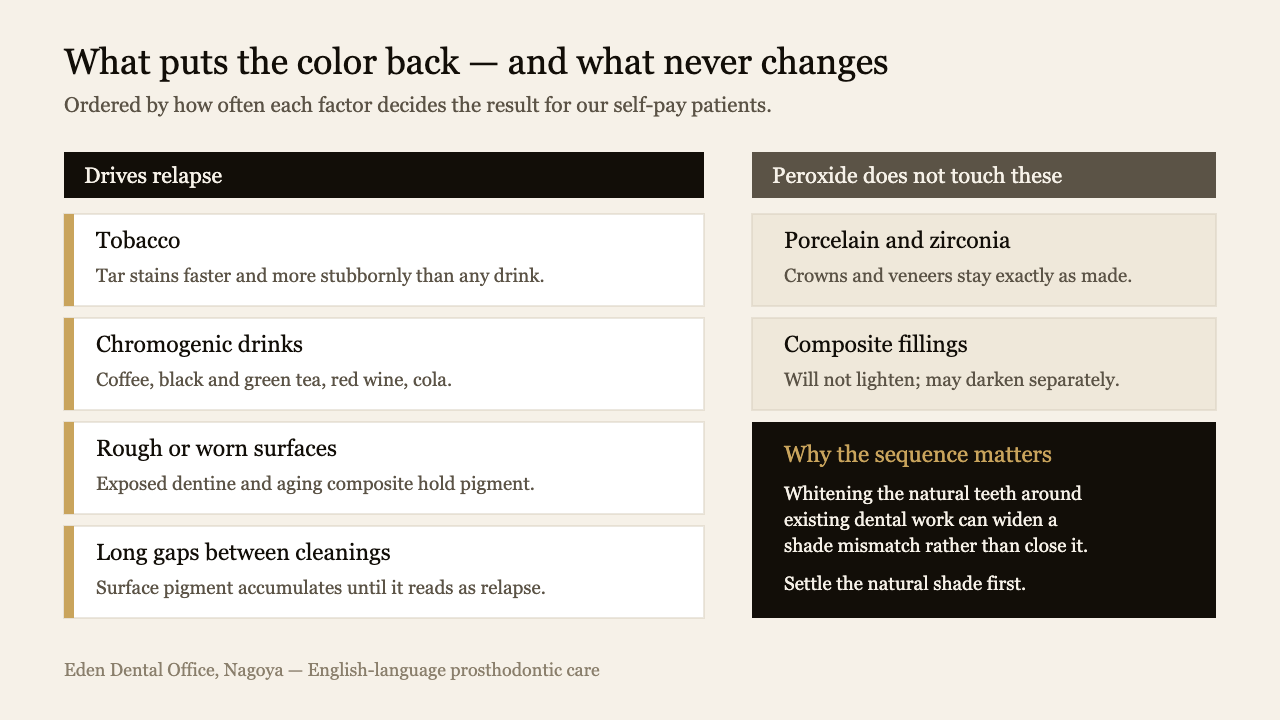
Chromogenic drinks. Coffee, black and green tea, red wine and cola carry pigments that bind to the enamel pellicle. Japan is a tea-heavy environment, and patients who move here often raise their intake without registering it.
Tobacco. Tar staining is both faster and more stubborn than dietary staining, and it is the single strongest predictor of a short-lived result.
Surface roughness. Worn enamel, exposed dentine at the gumline and older composite fillings hold pigment more readily than smooth intact enamel — one reason a whitening course sits better after restorative problems are dealt with.
Time between professional cleanings. Pigment removed every few months never accumulates into something that reads as relapse. Where discoloration is genuinely surface-level a cleaning reaches it; where it is internal it does not — the distinction our article on whitening versus a cleaning is built around.
What does not put the color back is your existing dental work. Porcelain, zirconia and composite neither darken nor lighten from peroxide — they stay where they were, which is why whitening around old restorations can widen a mismatch. A single tooth that has darkened after a root canal is a different case again: it needs internal bleaching from inside the tooth rather than more gel on the outside. Anyone considering porcelain veneers in Japan should settle the natural shade first.
A touch-up protocol that does not over-bleach
The practical answer to fading is not a second full course every year. It is a small, planned touch-up using trays you already own.
Custom trays are the reusable asset from the original treatment. At Eden they are scanned and produced through our in-house digital lab, so a replacement set does not mean starting over. For a patient who drinks coffee daily, a short touch-up once or twice a year is typical — timed to follow a professional cleaning rather than precede it, since surface pigment will otherwise absorb gel meant for the enamel.
| Approach after the initial course | Typical interval | What it addresses | Main limitation |
|---|---|---|---|
| Cleaning only, no gel | Every 3–6 months | Surface pigment from diet and tobacco | Cannot reverse internal color drift |
| Short tray touch-up after a cleaning | Once or twice a year | Both surface pigment and gradual internal relapse | Needs trays that still fit; mild transient sensitivity |
| Repeat full whitening course | Rarely before 2–3 years | Substantial relapse, or a changed target shade | Highest cost; unnecessary for most patients |
| No maintenance at all | — | Nothing | Two-thirds report noticeable relapse within two years |
One caution on frequency. An 18-month randomized trial comparing a low-concentration tray technique with an over-the-counter strip technique found both produced significant and comparable shade improvement, with similar transient side effects — evidence that more peroxide, more often, is not the lever people assume. In Japan the difference is regulatory rather than clinical: peroxide bleaching is carried out under dental supervision, so the gel comes from a clinic rather than a drugstore shelf.
What maintaining a whitened shade costs in Japan
Our published whitening package is ¥75,000 and includes the assessment, the in-office session and custom trays. A comprehensive check-up and cleaning package is ¥40,000. Maintenance gel is quoted separately, in writing and in English, before anything is dispensed — the quantity depends on how many teeth you treat and how often.
Patients maintaining a shade over years often find the arithmetic works out differently under our membership structure, which runs from ¥88,000 to ¥288,000 per year by tier and folds scheduled cleanings into one annual figure. That model is set out in our article on structured preventive care at Eden. For a broader sense of how these figures sit against dentistry elsewhere, see how Japanese dental costs compare internationally, or go straight to the professional whitening page for what is included.
Frequently Asked Questions
How long does teeth whitening last?
Controlled two-year follow-ups found most patients still measurably lighter than baseline at two years, with around two-thirds reporting mild to moderate relapse over that period. Diet and smoking separate the patients who hold their result from those who do not far more than the strength of the gel does.
Why do my teeth look darker two weeks after whitening?
Peroxide dehydrates enamel, and dehydrated enamel looks lighter than it truly is. Rehydration over one to two weeks removes that artificial brightness. The shade at two weeks is the real result, which is why we record it then rather than on the last treatment day.
How often can I safely touch up with whitening gel?
For most patients a short tray touch-up once or twice a year is sufficient, ideally following a professional cleaning. Repeating a full course more often than every two to three years is rarely warranted and increases the chance of sensitivity.
Will whitening lighten my crowns or veneers over time?
No. Peroxide does not change porcelain, zirconia or composite. As the natural teeth around them relapse, the match can actually appear to improve or worsen, which is why restorative shades should be selected against a settled whitened shade.
Can I buy touch-up gel myself in Japan?
Peroxide bleaching agents are handled through dental clinics in Japan rather than sold over the counter, so maintenance gel is dispensed after an examination. Your existing trays can usually be reused if they still seat accurately.
Limits, risks and individual variation
Whitening lightens natural tooth structure only. It does not change the color of restorations, and it responds poorly and unpredictably to some intrinsic discoloration such as banded tetracycline staining. Transient sensitivity during and shortly after treatment is common and usually resolves within days; gingival irritation can occur where trays overextend. We cover what a normal sensitivity timeline looks like, and when it is not, in a dedicated article on post-whitening sensitivity. Neither the initial result nor its longevity can be promised in advance — the evidence quoted here comes from pooled groups of other patients, and enamel thickness, diet and smoking all shift the outcome. Individual results vary. Costs, expected timeline and the risks relevant to your own teeth are set out in a written English estimate before any treatment begins.
For a considered read on what your shade is likely to do over the next few years, our whitening consultation starts by recording where it actually is today.
If you already have crowns, veneers or visible fillings, read how whitening works around existing restorations before starting a course.
More on this topic: Whitening Guides — every article we have published in this cluster, grouped by stage.