
Tetracycline-Stained Teeth in Japan: Can They Be Whitened?
Reviewed by Dr. Ryosuke Murai, DDS, MSD — Prosthodontist, trained at Indiana University School of Dentistry (U.S.). Last updated September 2026.
Tetracycline-stained teeth can be whitened in Japan, but not on the schedule most whitening is sold on. The gray, yellow or banded color sits inside the dentin, laid down while the teeth were forming, and lightening it takes months of nightly tray wear rather than one or two chairside sessions. Most patients see real improvement; the darkest banded cases do not fully respond, and for those the answer is ceramic rather than more gel. This article is for adults weighing that decision — including those whose stain arrived later in life from minocycline taken for acne — and covers the long-term evidence, how we choose between extended bleaching and veneers, and what each costs.
Why this stain does not behave like other discoloration
Ordinary whitening works on pigment that has soaked into enamel from diet and tobacco, or on the gradual yellowing of dentin with age. Tetracycline is different in kind: the drug binds calcium, and taken while teeth are mineralizing it becomes part of the tooth itself. A review in the International Journal of Dermatology describes how tetracyclines chelate calcium ions and are incorporated into developing teeth, cartilage and bone, producing a discoloration that ranges from yellow or gray to brown depending on the dose, the drug and the age at exposure. The classic pattern is horizontal bands, because each course of the antibiotic marked whichever part of the crown was forming at the time.
Japan adds a second route. Minocycline is widely prescribed here for adult acne, and adult-onset staining after prolonged use is documented. A case report and literature review in Dental Update notes that staining of fully formed adult teeth appears to involve the enamel surface itself and can be clinically indistinguishable from the developmental form. If your teeth darkened in adulthood after months of minocycline, that history belongs in the first conversation, because it changes where the color sits and what can reach it.
Grading the stain before promising anything
Dentists sort tetracycline discoloration into four degrees, and the grade is the strongest predictor of how a course will go. Ask which grade your teeth are before anyone quotes a result.
| Degree | Appearance | Response to extended bleaching | Usual direction |
|---|---|---|---|
| First | Light yellow or light gray, evenly spread, no bands | Good; often close to an ordinary whitening result | Extended tray bleaching alone |
| Second | Darker or more saturated yellow-gray, still without distinct banding | Substantial lightening over 3–6 months | Extended tray bleaching; veneers rarely needed |
| Third | Dark gray or blue-gray with visible horizontal bands | Lightens, but bands usually remain faintly visible | Bleach first, then decide on veneers for the front teeth |
| Fourth | Deep purple-gray or brown, heavy banding | Limited; tone lifts but the pattern persists | Ceramic veneers or crowns, planned after a short bleaching trial |
Two things the table cannot show. The cervical third of a tooth — nearest the gum — carries the most dentin and the least enamel, so it lightens least and last. And existing crowns, veneers and fillings do not change color at all, which is where our guide to teeth whitening in Japan begins its list of what peroxide cannot do.
What the long-term evidence actually shows
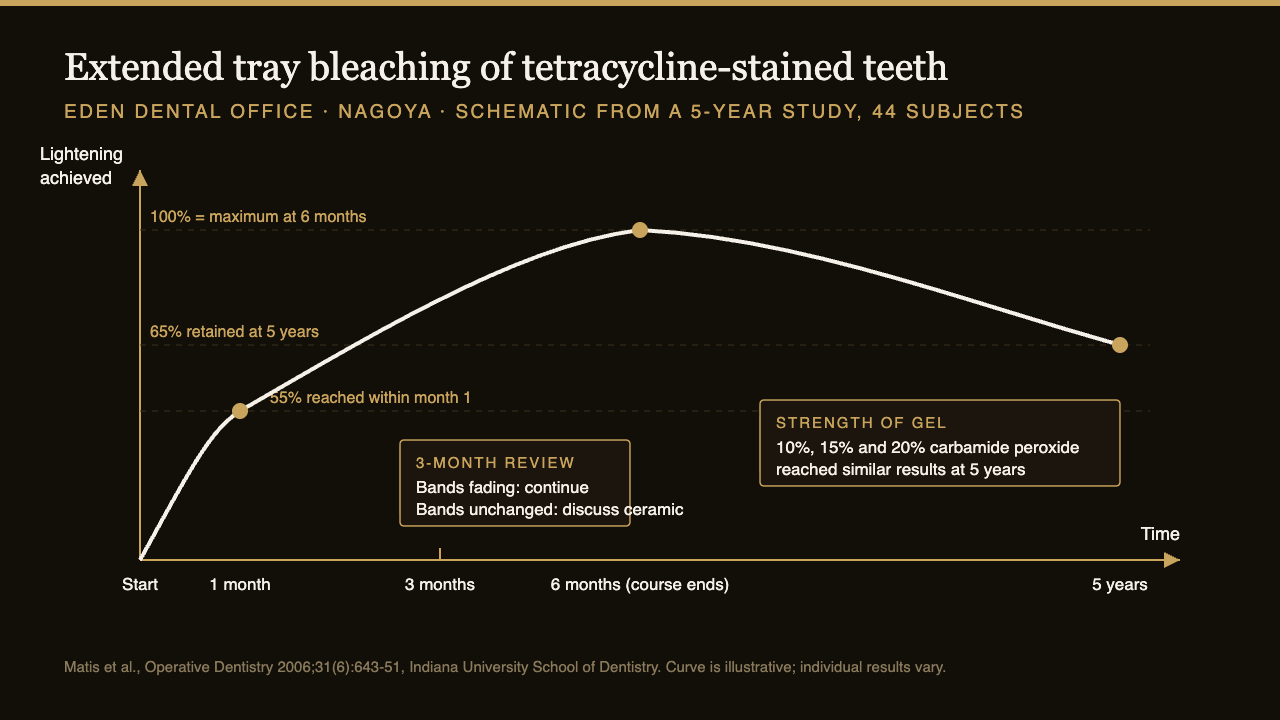
The most useful data come from Indiana University School of Dentistry, where the reviewing prosthodontist of this article trained. Forty-four subjects with tetracycline-stained teeth wore trays with reservoirs overnight for six months, using 10%, 15% or 20% carbamide peroxide in a half-mouth design, and were followed for five years. More than 55% of the total lightening occurred within the first month, and more than 65% of the maximum whitening remained after five years for all three concentrations. Any of the three strengths worked, so there is no reason to accept the extra sensitivity of a stronger gel for speed the data do not support.
A separate group at the University of North Carolina followed patients who had bleached tetracycline-stained teeth with 10% carbamide peroxide for six months and surveyed them ninety months — seven and a half years — later. Nine of the fifteen respondents reported no obvious shade change or only a slight darkening not noticed by others, and none reported a return to the original shade, although four had re-treated their teeth in the interim. Only fifteen of twenty-one original participants could be reached, so read the figures as encouraging rather than precise.
Set against the relapse pattern of ordinary whitening, this is a slower gain that holds unusually well, because the color lifted came from deep in the tooth and surface pigment from diet does not put it back.
How we run an extended course at Eden
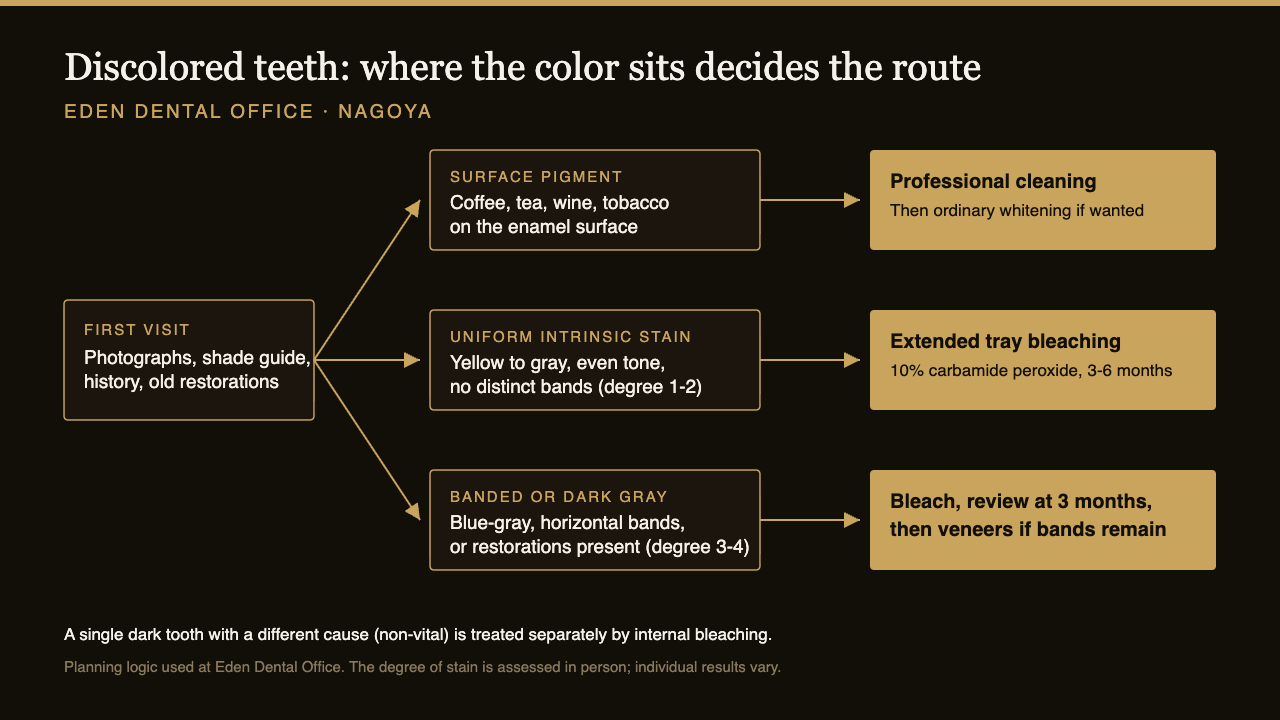
The first visit is diagnostic. We photograph the teeth under standardized lighting against a shade guide, record any banding, and separate intrinsic stain from surface pigment that a professional cleaning would remove on its own. We check every front tooth for old restorations and for a single darker tooth with a different cause, because a non-vital tooth needs internal bleaching, not more tray time. Then we scan the arches, print the models on our in-house 3D printers and make custom trays with small reservoirs over the front teeth, so the gel stays in place for a full night’s wear.
The gel is 10% carbamide peroxide, worn overnight. We review at four to six weeks, when most of the early gain has arrived, and again at three months. The three-month review is the decision point for banded cases: if the bands are fading, the course continues toward six months; if the tone has lifted but the pattern is unchanged, we stop and talk about ceramic while the teeth are at their lightest. Sensitivity is managed as our whitening page describes — potassium-nitrate toothpaste, alternate nights when needed.
Because a tetracycline course runs longer at a lower concentration than a routine whitening course, sensitivity tends to build more gradually; see our general guide to whitening sensitivity for what is normal over a multi-month course.
Because the treatment happens at home, it suits patients outside Nagoya. Two visits are needed in person — assessment with tray fitting, and one review — and the other check-ins work by video consultation with standardized photographs. Gel refills are dispensed at the fitting visit for the whole course.
When ceramic is the better answer
Third- and fourth-degree stain, blue-gray tones, and front teeth that already carry crowns or large fillings usually call for porcelain veneers rather than an open-ended bleaching course. Even then, bleaching first is often worthwhile: a lighter underlying tooth lets the ceramist use thinner, more translucent ceramic instead of an opaque masking layer. Our porcelain veneer guide covers materials and longevity, and the shade-matching challenge of a single dark tooth among bleached neighbors is the subject of a separate article on front-tooth veneer shade. As a more reversible interim step, composite bonding can mask moderate banding for a few years.
What this costs in Japan
Our published whitening package is ¥75,000 and covers assessment, custom trays and gel for a standard course. An extended tetracycline course uses considerably more gel over three to six months and adds reviews, so its fee is quoted in writing after the first visit, once the grade of stain and the number of teeth are known. Veneers are priced per tooth; the drivers are set out on our fee page, and every treatment plan is given as a written estimate in English before anything begins. Whitening is elective and not covered by Japanese health insurance.
Frequently Asked Questions
How long does bleaching tetracycline-stained teeth take?
Plan on three to six months of nightly tray wear. Most of the visible change arrives in the first month, and the remaining months work on the deeper, cervical part of the tooth and on any banding.
Will the bands disappear completely?
Light bands often fade to the point that others do not notice them. Distinct dark gray or blue bands usually remain faintly visible after bleaching, which is why we reassess at three months rather than continuing indefinitely.
Does the result last, or will the gray come back?
The published follow-up is encouraging: at five years more than 65% of the maximum lightening remained, and at ninety months no surveyed patient reported a return to the original shade. Some patients choose a short touch-up course after several years.
Is a stronger gel faster for tetracycline stain?
The five-year study found no advantage for 15% or 20% carbamide peroxide over 10% in final result. Stronger gels bring more sensitivity, which matters over a six-month course, so we start at 10%.
Can minocycline taken as an adult stain teeth?
Yes. Adult-onset staining after long-term minocycline is documented and can look identical to childhood tetracycline stain. Tell us about any long course of the drug, and speak to the prescribing physician before stopping it.
Limits, risks and individual variation
Extended bleaching lifts the color of natural tooth structure only; crowns, veneers and fillings will not change and may need replacing to match. Sensitivity is more likely over a months-long course, and a few patients cannot tolerate nightly wear even at 10%. Banding, blue-gray tones and the gumline third respond least, results can be uneven between teeth, and some relapse over years is normal. Veneers after bleaching mean irreversible preparation of the teeth involved. Fees, duration and visits depend on the grade of stain and are confirmed in writing before treatment. Individual results vary.
If your teeth have carried this color since childhood, or darkened after a long course of minocycline, our whitening page explains how an assessment is booked, and WhatsApp is the fastest way to reach the clinic in English. A photograph in daylight is enough for us to say whether an extended course, ceramic, or both is the realistic starting point.
More on this topic: Whitening Guides — every article we have published in this cluster, grouped by stage.