
Replacing Old Veneers in Japan: When and How It’s Done
Reviewed by Dr. Ryosuke Murai, DDS, MSD — Prosthodontist, trained at Indiana University School of Dentistry (U.S.). Last updated October 2026.
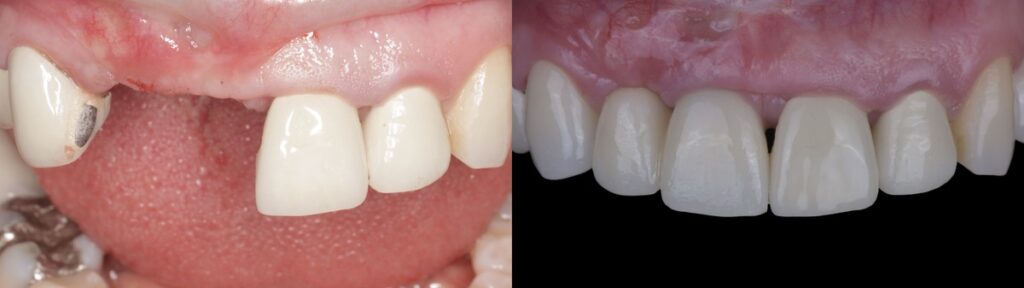
Porcelain veneers are not a one-time purchase; they are a restoration with a service life, and sooner or later most patients wonder whether the ones they have are due for replacement. If you have veneers that are chipped, stained at the edges, or no longer match the smile you want, replacing old veneers in Japan is a routine but technically demanding procedure, and the right answer is often smaller than a full redo. This article is for self-pay patients, including those who had veneers placed abroad, who want to know how to tell a cosmetic annoyance from a real failure, what removal involves, and how we plan a replacement so that the second set outlasts the first.
How long veneers realistically last
The published evidence is encouraging. A 2025 systematic review and meta-analysis of twenty-nine clinical studies in the Journal of Esthetic and Restorative Dentistry reported pooled survival of 96.13 percent for feldspathic, 93.70 percent for leucite-reinforced and 96.81 percent for lithium disilicate veneers at about ten years, with no difference between materials. That is survival, meaning the veneer was still in the mouth. The same review counted complications separately, and they were common: technical problems such as chipping or debonding, esthetic changes, and a smaller share of biological events like decay at the margin.
The distinction matters. In a methodological paper in Dental Materials, Anusavice argued that studies disagree about whether a chip counts as a failure or merely a complication, which is why reported success rates for ceramic restorations depend heavily on how failure is defined. For a patient, the practical reading is simple: a veneer can be “surviving” in a study and still be worth repairing or replacing in your mouth.
Signs it may be time to replace
Not every flaw calls for replacement, and not every veneer that looks fine is sound. We separate the signs into three groups. Structural signs are the ones that cannot wait: a veneer that has debonded or rocks, a fracture that reaches the margin, or decay detected under or beside the restoration on a radiograph or with magnification. Biological signs include gum inflammation that persists around a margin despite good cleaning, and recession that exposes the edge of a veneer or the darker tooth beneath it. Esthetic signs are a visible line at the gumline, a shade that no longer matches neighboring teeth, a shape or length the patient has outgrown, and bonding-cement discoloration at the margins.
Gum recession is the most common reason we see in patients who are otherwise happy with their veneers. The ceramic does not change, but the tooth shows through where the gum has moved, and what looked seamless at placement does not look that way ten years later. Grinding is the second: small chips along the biting edge are often the first sign that clenching is loading ceramic that was never meant to carry that force, which is why we cover night guards and daily habits separately.
Repair, replace, or leave alone
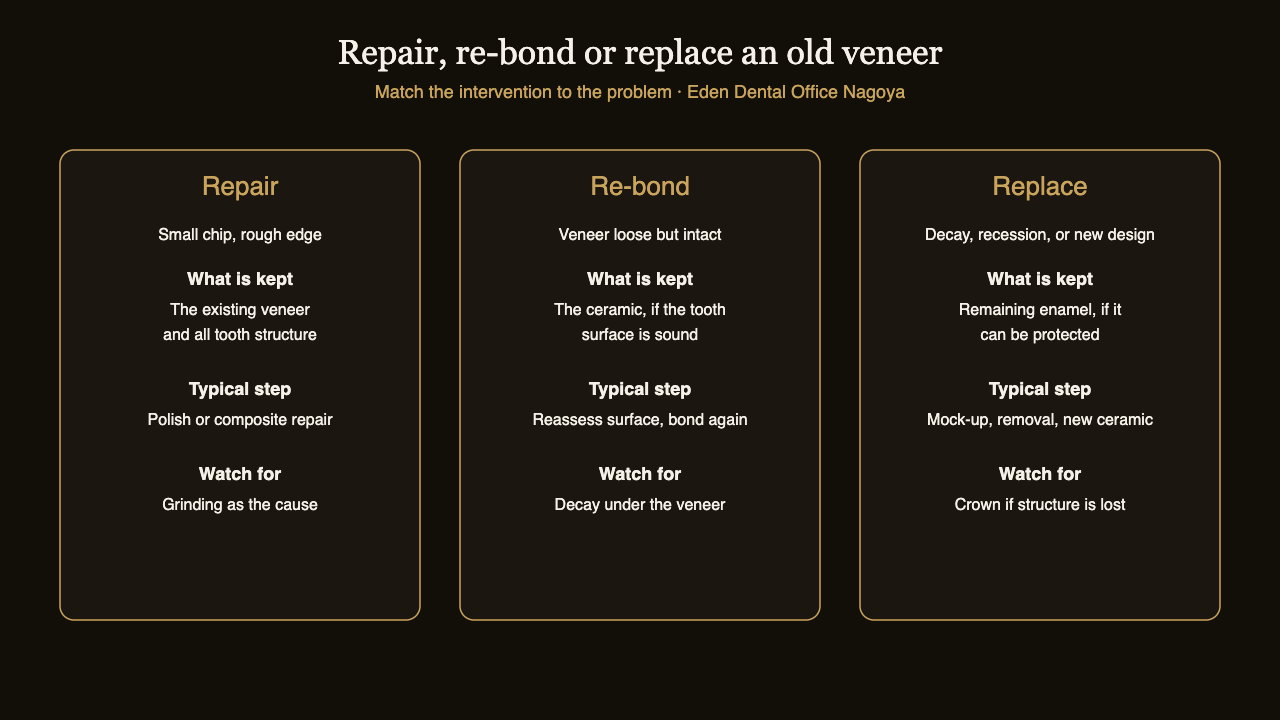
Before recommending replacement we ask whether a smaller step solves the problem. A small chip can often be polished or repaired with composite. A single veneer that has debonded and is intact can sometimes be re-bonded after the tooth surface is reassessed. A mismatched single veneer beside whiter natural teeth is a shade problem that may call for the planning we describe in single front tooth veneer shade matching. If the underlying teeth have been whitened since placement, the same logic applies, and our note on whitening with crowns, veneers and fillings explains why the ceramic does not follow.
| Situation | Usual first step | Replacement likely? | Main consideration |
|---|---|---|---|
| Small chip at the biting edge | Polish or composite repair | Rarely | Look for the cause, usually grinding |
| Veneer debonded but intact | Assess tooth surface, re-bond | Sometimes | Decay or a failed bond layer under it |
| Gum recession exposing the margin | Monitor, consider gum treatment | Often, for the visible teeth | Root exposure and tooth color beneath |
| Decay at or under the margin | Remove veneer, treat the tooth | Yes | May need a crown if structure is lost |
| Shape or shade no longer wanted | Digital mock-up of options | Patient’s choice | Each replacement removes a little more tooth |
What replacement involves
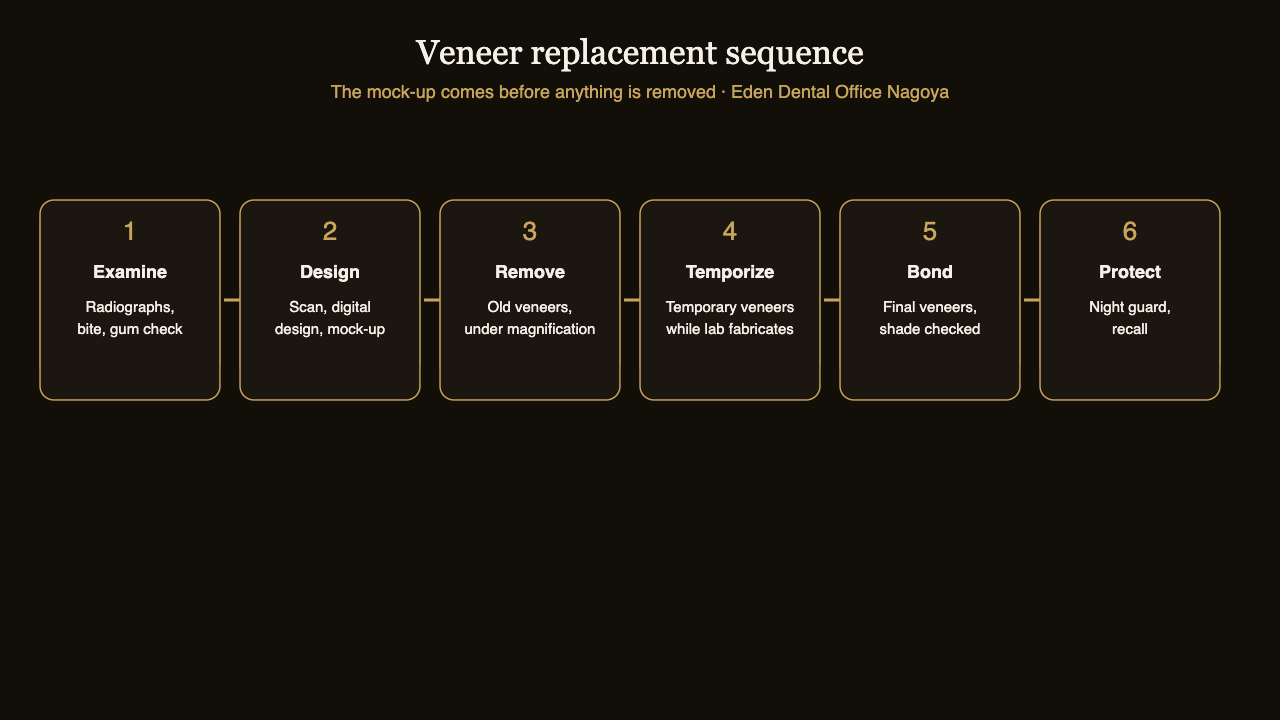
Removing a bonded veneer is not like taking off a crown. The ceramic is fused to the tooth by resin cement, so it is sectioned and removed with magnification, working carefully to avoid taking healthy enamel with it. What lies beneath decides the next step. If the original preparation was conservative and enamel remains, a new veneer can bond to it very reliably. If the preparation was deep and dentin is exposed, bonding is harder and the case may move toward a crown, a point we also weigh in veneers versus crowns. Patients who began with no-prep veneers often have the most enamel left to bond to, which is one reason that approach is worth understanding.
At Eden we begin with an intraoral scan and photographs, then build a digital smile design and a try-in mock-up before any ceramic is removed, so the patient sees the new proportions on their own teeth. Temporary restorations are placed while the final veneers are made in our in-house laboratory, where we can adjust shade and surface texture with the patient present. Replacing a full set takes several visits over a few weeks; a single veneer is usually quicker. Patients traveling from abroad can read how we compress treatment in our guide to a dental trip to Nagoya.
Planning so the second set lasts longer
A replacement is a chance to correct why the first set aged. We review the bite and, where clenching is evident, plan a night guard before the new veneers are bonded. We check gum margins and decide whether contouring or gum treatment should come first, as described in our article on gum contouring before veneers. We choose the ceramic and thickness for the tooth in front of us rather than repeating the earlier choice, and we agree on a maintenance schedule: professional cleaning, a bite check, and photographs for comparison. Patients who also wonder about the alternative of leaving natural teeth and using resin will find the lifespan trade-offs in veneers versus composite bonding.
Frequently Asked Questions
How often do veneers need replacing?
There is no fixed interval. Reviews show most ceramic veneers remain in place for a decade or longer, but chips, margin changes and gum recession often prompt repair or replacement sooner. Condition, not age, decides.
Can old veneers be replaced without damaging the teeth?
Removal always involves some risk to enamel, which is why it is done under magnification and why the first set matters. Teeth with intact enamel beneath bond well again; teeth prepared deeply may need a crown.
Can veneers placed overseas be replaced in Japan?
Yes. Send radiographs and photographs by WhatsApp before you travel, and we can say whether the problem looks like repair, re-bonding or replacement. Records from abroad are most useful if they include the material used.
Will new veneers match my natural teeth better?
They can, because shade is chosen against your current teeth and fabricated with you present. Whitening natural teeth first changes the target, so any whitening should be done before the new veneers, not after.
Does Japanese health insurance cover veneer replacement?
Not for cosmetic veneers. Treatment is self-pay, and a written estimate in English is provided before any work begins.
What replacing veneers costs in Japan
Replacement is self-pay and not covered by national health insurance. The total depends on the number of teeth, ceramic type, whether gum treatment or a night guard is added, and whether any tooth needs decay treatment or a crown instead. We do not publish a flat per-veneer price here because the range is wide; you receive a written estimate in English at the consultation, before any treatment. Our general fee structure is on the fee page, and the cost drivers for new veneers are laid out in our guide to porcelain veneers in Japan.
Risks and limitations
Removing veneers can thin enamel, and each replacement uses up some of the tooth’s capacity to be bonded again. Ceramic can chip or debond, particularly in patients who grind, and a night guard reduces but does not eliminate that risk. Recession may continue after replacement and expose margins again. A tooth found to have decay or lost structure may require a crown or additional treatment that was not in the original plan. Individual results vary.
If you have veneers you are unsure about, send photographs and any records you have through WhatsApp or book an English-language consultation via our aesthetic treatment page. We will tell you whether to repair, replace, or leave them alone.
More on this topic: Veneer and Cosmetic Guides — every article we have published in this cluster, grouped by stage.