
White Spots After Braces in Japan: Bleach or Infiltrate?
Reviewed by Dr. Ryosuke Murai, DDS, MSD — Prosthodontist, trained at Indiana University School of Dentistry (U.S.). Last updated September 2026.
The braces come off, or the last aligner tray goes in the bin, and the teeth are straight — but the enamel around where the brackets sat is chalky white in patches. Patients in Japan usually ask us one of two things about these white spot lesions: will whitening make them disappear, and is there a way to fix them without drilling. The short answers are that whitening softens the contrast but does not remove the spots, and that resin infiltration, a needle-free and drill-free procedure, can make most early lesions nearly invisible in a single visit. This article is written for adults who finished orthodontic treatment here or abroad and want to understand what the white marks are, why bleaching alone often disappoints, and how we sequence bleaching, infiltration and, occasionally, ceramic work so the result holds up.
What a white spot lesion actually is
A white spot lesion is the first visible stage of tooth decay: enamel that has lost mineral just beneath an intact surface. Plaque trapped around brackets, or under aligners that were worn over unbrushed teeth, produces acid; the acid dissolves calcium and phosphate from the subsurface enamel; and the resulting porous layer scatters light differently from sound enamel, which is why it looks opaque white instead of translucent. The surface is not broken, so the tooth is not cavitated, but it is weaker than it looks.
This is not a rare complication. A meta-analysis of fourteen studies in the Journal of International Society of Preventive and Community Dentistry reported that new white spot lesions formed during fixed orthodontic treatment in 45.8 percent of patients, with a prevalence of 68.4 percent among those in treatment. Clear aligners are kinder to enamel in this respect because they are removed for brushing, but they trap saliva and anything sugary against the teeth for twenty-two hours a day, and we still see the pattern in aligner patients who snacked with trays in.
Why whitening on its own tends to disappoint
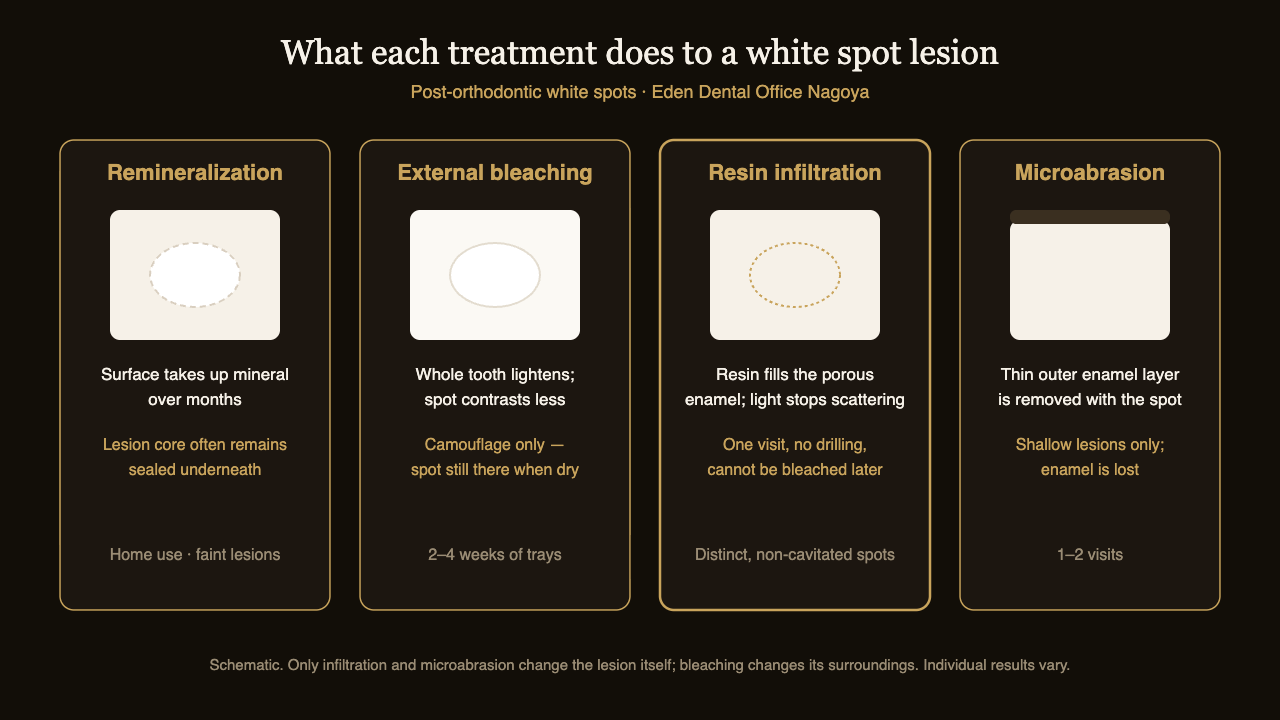
Peroxide whitening lightens the whole tooth. It does not fill the porous enamel or change its optical structure, so the spot remains a spot; it simply sits on a lighter background. In some patients that is enough. A study in The Angle Orthodontist measured color before and after one hour of daily home bleaching and found that the sound enamel lightened more than the lesion, narrowing the difference between the two, and the authors concluded that external bleaching can satisfactorily camouflage lesions left after fixed appliances. The word to notice is camouflage. The spot is still there when the surface dries, when the light is harsh, and in a close-up photograph.
One more thing patients rarely hear before buying a whitening course: demineralized enamel can look more chalky for a few days after bleaching, because peroxide dehydrates the tooth and dehydration exaggerates the opacity of porous enamel. It settles, but it is disconcerting if no one warned you.
Resin infiltration: the drill-free option that changes the lesion itself
Resin infiltration was developed in Germany in the 2000s and is sold under the name Icon. The tooth is isolated, the intact surface layer is opened with a hydrochloric-acid gel for about two minutes, the lesion is dried with ethanol, and a very low-viscosity resin is drawn into the pores by capillary action and then light-cured. Because the resin has a refractive index close to that of enamel, the lesion stops scattering light and takes on the color of the surrounding tooth. There is no anesthetic, no drilling and no tooth structure removed beyond a few microns of surface.
Two randomized trials define what a patient can expect. In a split-mouth trial published in the American Journal of Orthodontics and Dentofacial Orthopedics, 231 post-bracket lesions were treated and followed for six months; the color match between infiltrated lesions and adjacent sound enamel was stable over six months, while untreated control lesions did not change. A separate randomized trial in the Journal of the American Dental Association found a 61.8 percent reduction in visible lesion area immediately after infiltration and 60.9 percent eight weeks later, against essentially no change in untreated teeth. Neither trial reported meaningful adverse events.
Infiltration has limits. It suits early, non-cavitated lesions with a sound surface; a spot that has broken down, or a brown lesion stained over years, may need a small composite restoration instead. Very deep lesions improve without vanishing. And the resin cannot be bleached later, which is why sequence matters.
Comparing the options
| Approach | What it changes | Visits | Typical fit | Main limitation |
|---|---|---|---|---|
| Remineralization (fluoride, CPP-ACP paste) | Rebuilds some mineral from the surface inward over months | Home use, months | Very early, faint lesions caught soon after debonding | Slow; often the surface remineralizes and seals the opaque core underneath |
| External bleaching | Lightens the whole tooth so the spot contrasts less | 2–4 weeks of trays | Diffuse, mild mottling where the patient also wants a lighter shade | Spot remains visible on close inspection; transient chalkiness |
| Resin infiltration | Fills the porous lesion with resin that matches enamel optically | 1 visit, no anesthetic | Distinct, well-defined post-orthodontic spots with an intact surface | Cannot be bleached afterward; deep or stained lesions may not fully blend |
| Microabrasion | Removes a thin layer of outer enamel with acid and abrasive | 1–2 visits | Very shallow surface lesions and some fluorosis | Removes enamel; not suitable for deeper lesions |
| Composite or ceramic | Covers the lesion with a restoration | 1–3 visits | Cavitated or heavily stained lesions, or teeth already planned for veneers | Most invasive; restoration needs maintenance over decades |
How we sequence treatment at Eden
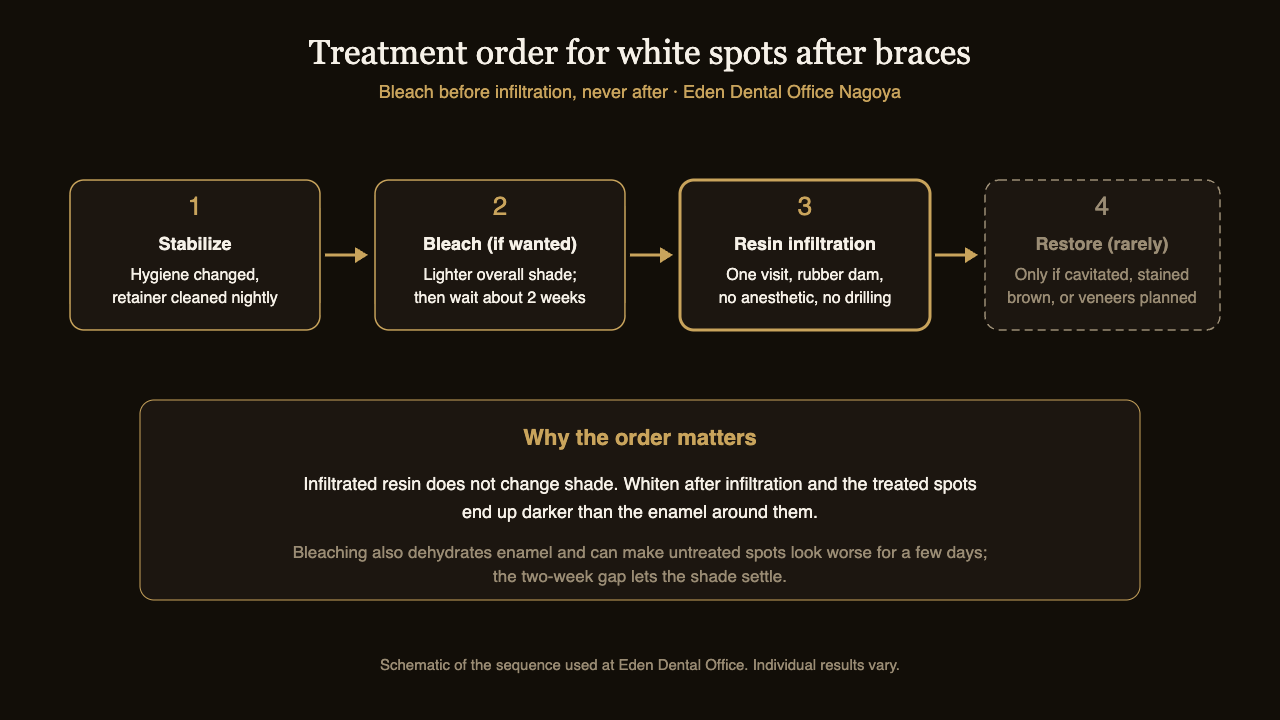
The order is not arbitrary, and getting it wrong wastes money. Our usual sequence for a patient who arrives from orthodontic treatment with white spots on the front teeth is: stabilize, then bleach, then infiltrate, then — only if still needed — restore.
Stabilizing means confirming that the plaque control that caused the lesions has changed; we check the retainers, because a poorly cleaned clear retainer worn every night recreates the trapped-acid environment that produced the spots. Bleaching comes next if the patient wants a lighter shade, because infiltrated resin does not whiten: infiltrate first and bleach second, and the treated spots end up darker than the enamel around them. We wait about two weeks after the last bleaching session before infiltrating, so the peroxide has cleared and the shade has settled. In our clinic the infiltration is done under rubber dam with magnification, and we photograph each tooth wet and dry before and after; the dry photograph is the honest one. Six lesions on the upper front teeth are typically finished in one ninety-minute visit.
Ceramic enters the conversation only when lesions are cavitated or deeply stained, or when the same teeth have shape or spacing problems the patient wants corrected — at which point the decision becomes the one in our comparison of veneers and composite bonding, with the white spots handled inside that plan.
Frequently Asked Questions
Will white spots go away on their own after braces?
Faint lesions sometimes fade over the first six to twelve months as saliva remineralizes the surface, especially with fluoride toothpaste and good cleaning. Distinct, well-defined spots usually stay. If a spot is still obvious three months after debonding, it is unlikely to disappear without treatment.
Does resin infiltration hurt or need an injection?
No. The procedure uses an acid gel on the enamel surface, ethanol and a light-cured resin; no drilling and no anesthetic are involved. Patients describe a mild sour taste and some tooth sensitivity to cold for a day or two at most.
Can I whiten my teeth after resin infiltration?
The natural enamel will still whiten, but the infiltrated area will not, so it can end up looking darker than its surroundings. This is why we bleach first and infiltrate afterward. If you have already had infiltration and want whitening, tell your dentist so the risk can be assessed tooth by tooth.
Are white spots from clear aligners treated the same way?
Yes. The lesions form by the same mechanism — acid from plaque held against enamel — and respond to the same treatments. Aligner patients tend to have fewer and shallower lesions, so remineralization and a short bleaching course resolve a larger share of cases.
How long does resin infiltration last?
Trials have followed patients for six months to several years with stable color. The resin does not dissolve, but it can pick up surface stain over time, and a lesion that continues to be exposed to plaque can progress around it. Regular professional cleaning and retainer hygiene protect the result.
What treating white spots costs in Japan
White spot treatment after orthodontics is cosmetic and not covered by Japanese national health insurance, whether the orthodontic work was done here or abroad. Costs depend on the number of teeth, lesion depth and whether bleaching is included. Our published take-home whitening package is ¥75,000; resin infiltration is priced per tooth, and a combined plan is quoted as one written estimate in English at the consultation. Patients told their spots need veneers are welcome to bring that plan for review; a proportion of those teeth can be treated far more conservatively. Our fee structure is on the fee page, and how whitening costs compare across the country is in our guide to teeth whitening in Japan.
Risks and limitations
Resin infiltration can leave a deep lesion partly visible, cannot be reversed, and will not respond to future bleaching. Bleaching can cause temporary sensitivity and make untreated lesions look more prominent for a few days. Microabrasion removes enamel. All of these fail cosmetically if the plaque control that produced the lesions does not change, and cavitated or heavily stained lesions may need a restoration with the maintenance that entails. A dark single tooth is a different problem, discussed in our article on internal bleaching; surface stain is covered in whitening versus cleaning, and how long results last in our piece on whitening longevity. Individual results vary.
If you have just finished braces or clear aligners and the white marks bother you, send us a dry-mouth photograph by WhatsApp or book an English-language consultation through our whitening page. We will tell you honestly which of the options above fits your teeth, and in what order.
If you plan to whiten once the aligners are finished, this guide to whitening around aligner attachments covers the timing.
More on this topic: Whitening Guides — every article we have published in this cluster, grouped by stage.