
Whitening Teeth With Crowns, Veneers or Fillings in Japan

Reviewed by Dr. Ryosuke Murai, DDS, MSD — Prosthodontist, trained at Indiana University School of Dentistry (U.S.). Last updated October 2026.
Teeth whitening in Japan works on natural tooth structure only. Crowns, porcelain veneers and most fillings do not change shade when they are exposed to peroxide, so whitening a mouth that already contains restorative work can make a once-invisible match suddenly visible. This article is for self-pay patients who want a lighter smile but already have crowns, veneers or fillings in the front of the mouth, and who need to know what to do first, what to leave alone, and which restorations may have to be refreshed afterwards. For the general picture of options and timing, start with our complete guide to teeth whitening in Japan.
Why restorations stay the same shade
Peroxide whitening works by releasing oxygen radicals that break down pigment molecules lodged in the enamel and the dentin beneath it. That chemistry needs a mineralized, organic-containing tooth to act on. A porcelain crown is a fired ceramic with a glazed surface and no pigment trapped inside it; a zirconia crown is denser still; a gold or metal-ceramic restoration contains nothing for peroxide to bleach. Resin composite fillings contain some organic matrix, but in practice they brighten little, if at all.
The result is simple and often a surprise. Natural teeth move lighter, while every restoration in the same smile stays exactly where it was.
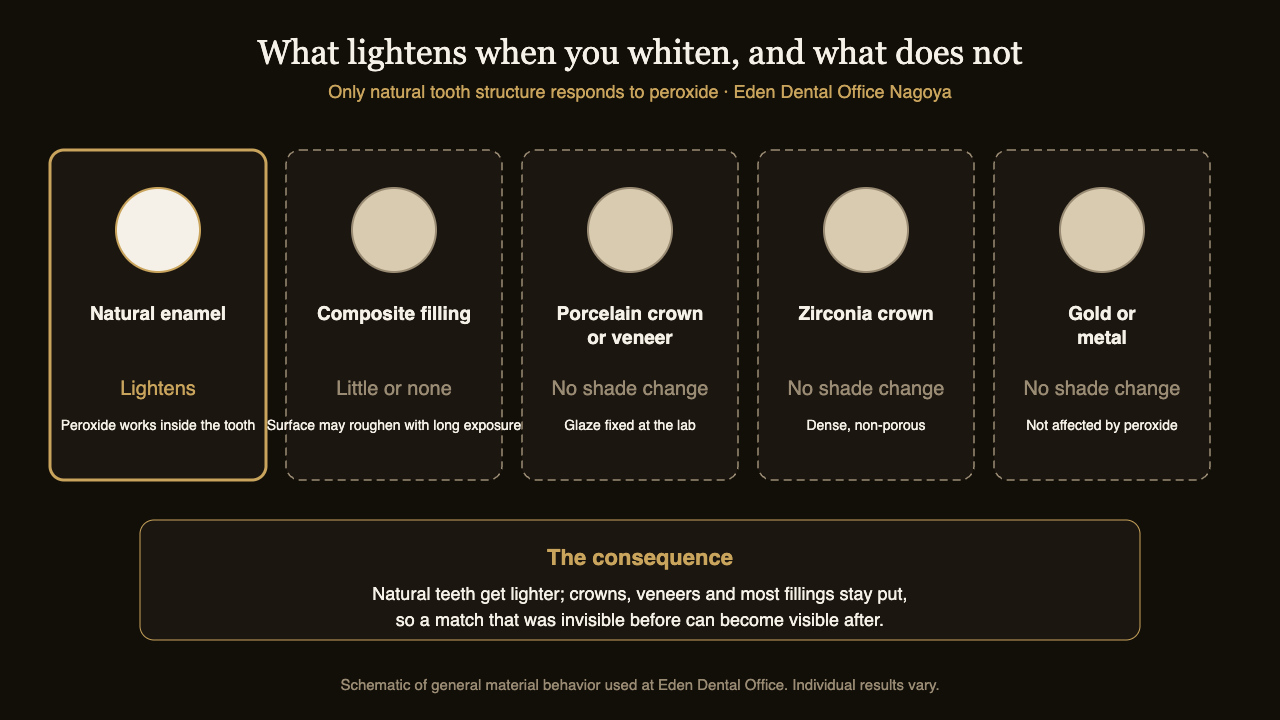
| What is in the smile | Does whitening lighten it? | What it means in practice |
|---|---|---|
| Natural enamel and dentin | Yes | The only structure that changes |
| Composite (tooth-colored) filling | Little or none | May look darker beside lightened teeth; can be re-polished or replaced |
| Porcelain veneer or crown | No | Sets the ceiling; natural teeth are lightened to meet it |
| Zirconia crown | No | Shade is fixed in manufacture |
| Metal-ceramic or gold | No | Unaffected; margins need protecting |
| Dental implant crown | No | Treated like any other crown |
What peroxide does to the surface of a restoration
Shade is one question; surface is another. In a laboratory study, Moraes and colleagues (Clinical Oral Investigations, 2006;10:23–8) exposed enamel, feldspathic porcelain and two types of composite to 10% and 35% carbamide peroxide for up to 21 days. Surface roughness rose significantly for the porcelain and for the microhybrid composite by the end of that period, while the microfilled composite showed no significant change. A second laboratory study, ElSayad and colleagues (Saudi Dental Journal, 2018;30:219–25), measured color and translucency of coffee-stained nano-filled composite and giomer before and after in-office bleaching, confirming that restorative resins respond to bleaching differently from enamel.
Both are in-vitro studies with specimens held in gel for far longer than a typical course, so they show a tendency rather than a clinical certainty. The practical lesson is modest: restoration surfaces can be altered by repeated exposure, which is one reason we limit gel contact to the natural teeth and re-polish composite work after the course rather than assume it is unaffected.
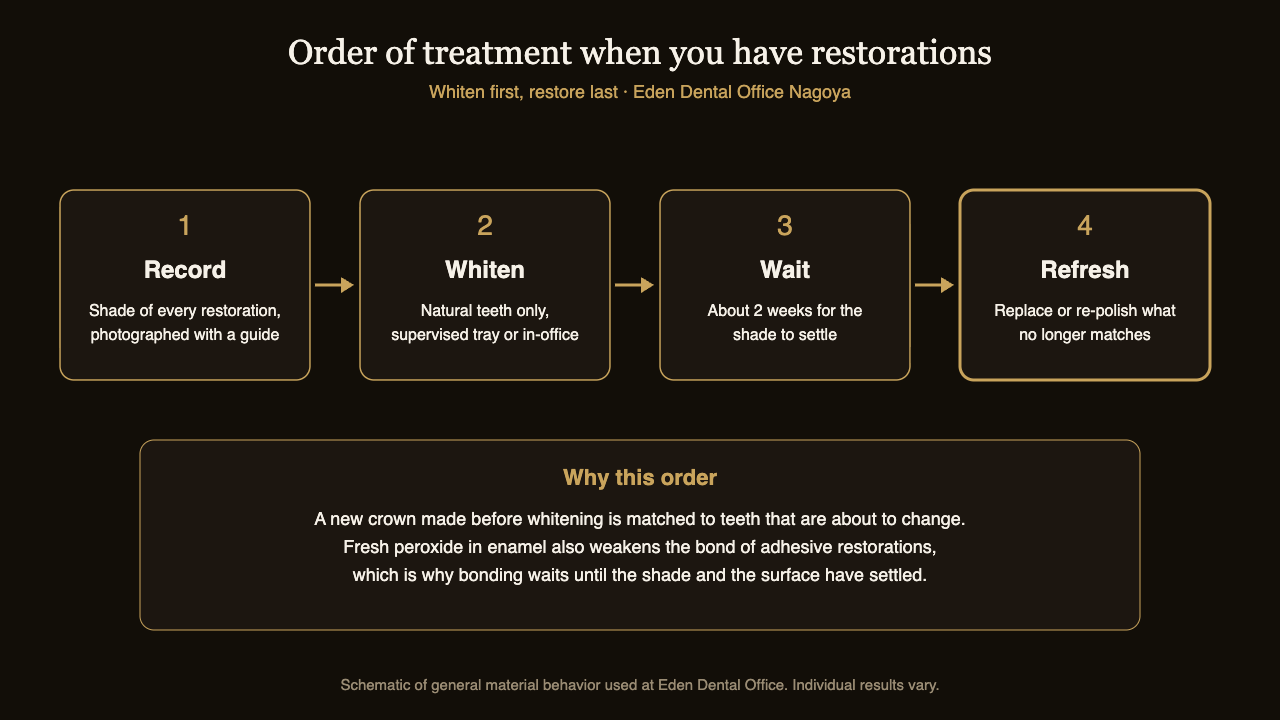
Whiten first, restore last
The sequence matters more than the material. If a new crown or veneer is made before whitening, the lab matches it to teeth that are about to get lighter, and the crown ends up too dark within weeks. If whitening comes first, the restoration is made to the final shade.
There is a second reason. Peroxide left in enamel interferes with how well adhesive restorations bond, which is why bonded work is delayed until the shade has settled, commonly around two weeks. In a mouth that has existing veneers, the order reverses its logic: the existing veneers are the reference, and the natural teeth are whitened until they meet them.
Three common situations
Veneers on the front, natural teeth behind. Veneers define how light the front can look. Natural premolars and canines next to them can be brought up to meet them, but whitening the natural teeth past the veneers produces the reverse mismatch. How a veneer shade is chosen in the first place is covered in our article on matching a single front-tooth veneer.
One crown among natural teeth. This is the classic problem. If the crown is on a visible tooth, the usual outcome is whitening the natural teeth modestly and remaking the crown afterwards to the new shade. Remaking is a prosthodontic decision, not a cosmetic upsell, and it should be stated in the written plan before whitening begins.
Tooth-colored fillings at the front. Old composite stains and ages differently from enamel. After whitening it often looks darker or more yellow than before, and the usual solution is to replace the filling with one chosen for the new shade.
Margins, exposed roots and sensitivity
Crowns and veneers end at the gumline, and where gums have receded a thin band of root surface may be exposed. Whitening gel that seeps onto exposed dentin is a common source of sharp sensitivity, and a crown with a leaking margin lets gel reach the inside of the tooth. We check every margin before whitening and protect any exposed root with a barrier or by using a custom tray that stops short of the gum. If you are prone to sensitivity, our guide to sensitivity after whitening explains what is normal and what should prompt a call.
How we plan it at Eden
At Eden, we begin with a shade record. Every visible restoration is compared against a shade guide and photographed, so we know exactly what the natural teeth have to match and which restorations are likely to fall behind. Because the dental laboratory is in-house, a replacement crown or veneer can be made or adjusted to the final whitened shade without sending it overseas or waiting weeks for a courier. Planning is carried out as a prosthodontic case rather than a cosmetic one: Digital Smile Design on screen, a written sequence, and the restoration decisions made before the first tray is fitted.
The aim is a result that looks even rather than merely lighter. For how long a lightened shade tends to hold, see why whitening fades and what extends it, and for a single dark tooth that does not respond to external whitening at all, internal bleaching of a dark front tooth. The whitening treatment page sets out the available options.
What this costs in Japan
Eden publishes package prices where treatments can be priced that way: a whitening package at ¥75,000, a comprehensive check-up at ¥40,000, and annual membership tiers from ¥88,000 to ¥288,000. Whitening combined with restorative work cannot be priced from a list, because the total depends on how many visible restorations no longer match and whether they are polished, replaced, or remade as crowns or veneers. You receive an itemized estimate in English before treatment, with whitening and restorative work separated and any possible remake shown as a named contingency. Our fee information page explains how estimates are structured.
Frequently asked questions
Will whitening change the color of my crowns?
No. Porcelain, zirconia and metal restorations do not lighten, so only the natural teeth around them change.
Can I whiten if I have veneers?
Yes, but the veneers set the target. Natural teeth are lightened to meet them, not beyond.
Should I replace my crown before or after whitening?
After. A crown made first is matched to teeth that are about to change shade.
Do tooth-colored fillings whiten?
Usually little or not at all, so they may need re-polishing or replacing to match the new shade.
Can this be planned before I travel to Nagoya?
Yes. Photographs and records can be reviewed first, and a video consultation before booking is the usual first step.
Risks, limits and what to expect
Whitening can cause temporary sensitivity and gum irritation, and results depend on the starting shade and cause of discoloration. Restorations do not lighten, may need re-polishing or replacement, and any replacement carries its own cost and risks, including preparing a natural tooth for a crown or veneer. Whitening is also not recommended for everyone, and some conditions require treating or restoring a tooth first. No result can be promised in advance. Individual results vary. If you have crowns, veneers or visible fillings, the useful starting point is a whitening consultation that assesses your existing restorations before any gel is used, and WhatsApp is the fastest way to reach us in English.
More on this topic: Whitening Guides — every article we have published in this cluster, grouped by stage.