
Teeth Whitening During Clear Aligner Treatment in Japan
Reviewed by Dr. Ryosuke Murai, DDS, MSD — Prosthodontist, trained at Indiana University School of Dentistry (U.S.). Last updated October 2026.
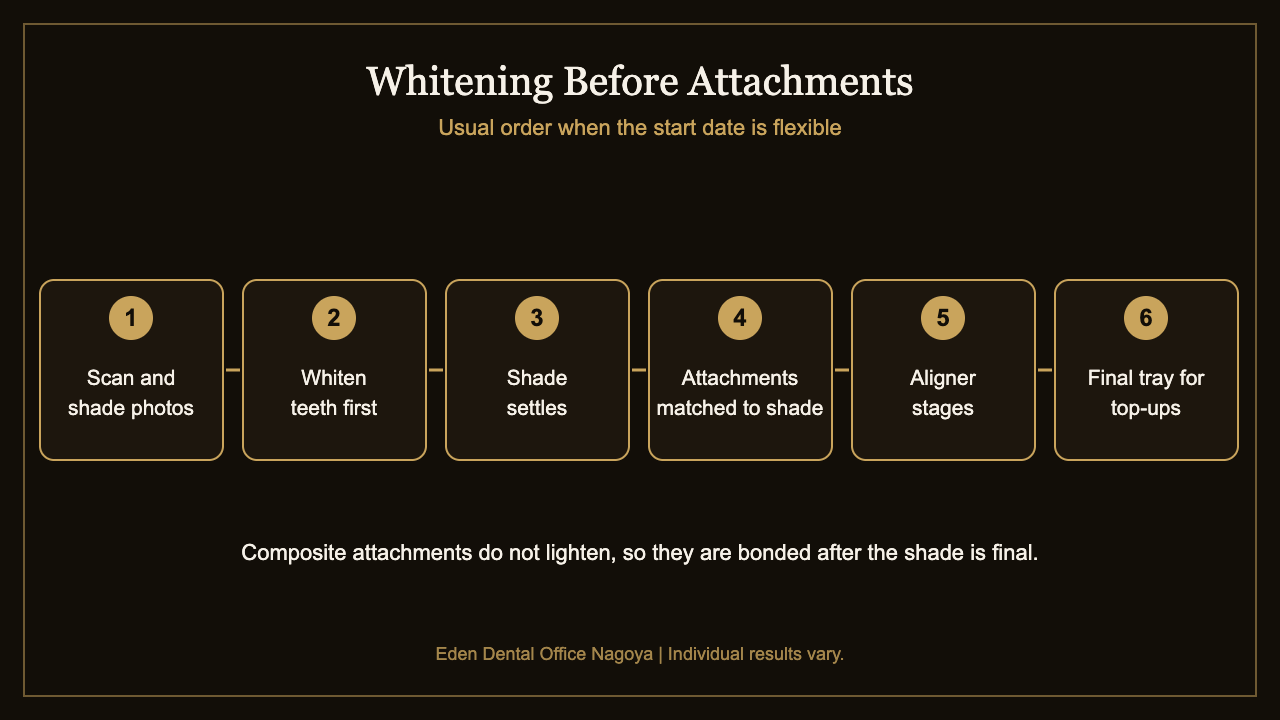
Should you whiten before your clear aligners, while you wear them, or after the last tray? In most cases we advise whitening first, finishing before any attachments are bonded, so that the small tooth-colored bumps on your teeth are matched to the shade you will actually keep. This is written for self-pay patients in Japan who are starting, or already partway through, aligner treatment and want a brighter result without compromising either one. If you are still weighing up the whitening itself, our teeth whitening page sets out the options.
Why the order matters more than the method
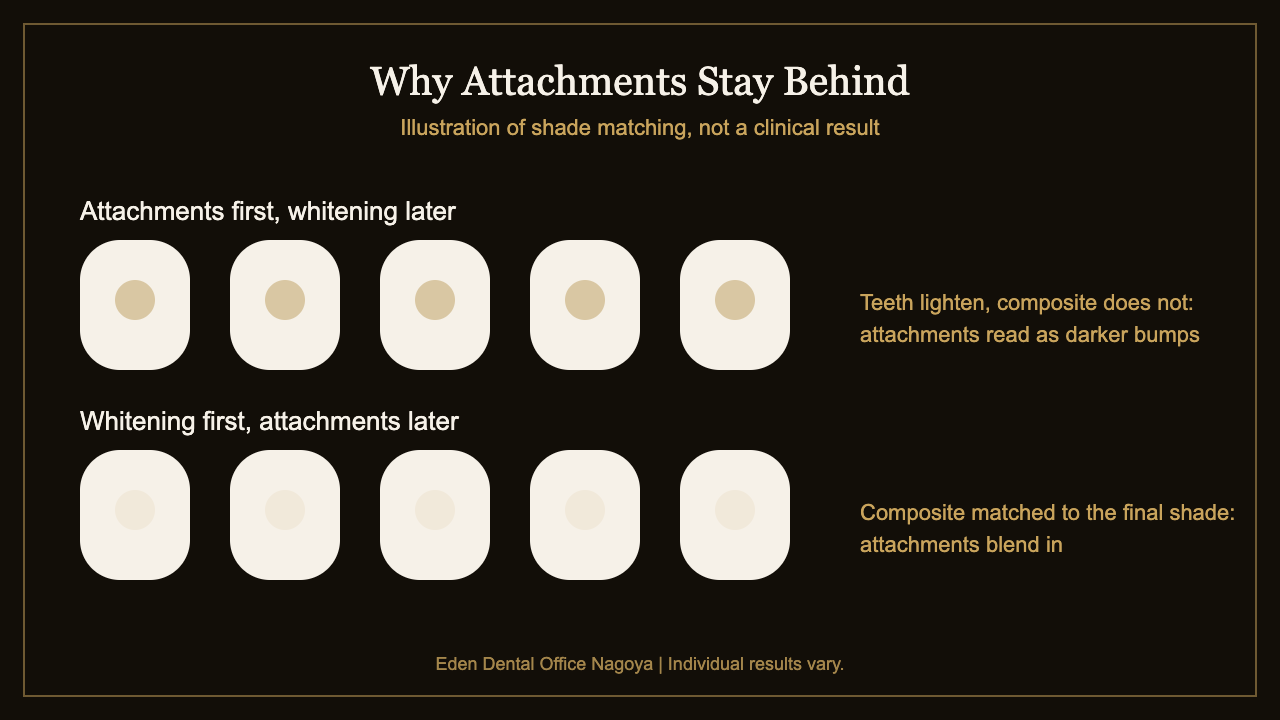
Peroxide lightens natural tooth structure. It does nothing to composite. Clear aligners usually rely on attachments, small composite shapes bonded to selected teeth that give the tray something to push against, and the composite shade is chosen to match your teeth on the day they are bonded.
If the teeth then lighten by a few shades, the attachments stay where they were. On canines and premolars, which sit in the smile line, they can read as slightly darker bumps. Gel also acts unevenly on enamel that is covered by composite. This is the same mismatch that appears around fillings and crowns, which we explain in our article on whitening alongside crowns, veneers and fillings. The aligner version is easier to avoid, because attachments are placed on a schedule you can control.
Four ways to sequence whitening and aligners
| Sequence | Suits you when | Advantage | Watch for |
|---|---|---|---|
| Whiten before aligners | Teeth are stained and the start date is flexible | Attachments are matched to the final shade | Aligner start is delayed by the whitening period |
| Whiten during treatment with a separate thin tray | Aligners are already running and you do not want to pause | No delay to tooth movement | The tray must fit over attachments; shade can lag under them; sensitivity may overlap with aligner soreness |
| Whiten at refinement or the final stage | Attachments are due to be removed anyway | An even, uncovered enamel surface | You wait until the end for the result |
| Whiten after, with a tray made for retention-era top-ups | You want to maintain the result over time | Tray is made from the final tooth positions | Retainer wear takes priority over whitening |
Whitening before treatment is the cleanest route and the one we recommend when there is no urgency. The retainer-stage option ties in with how you hold the result afterwards, which we cover in our guide to retainers after clear aligners.
If you are already partway through treatment
Many patients only think about whitening once the first trays are in and the attachments are already on their teeth. That does not rule it out. It means the plan has to account for the composite that is there: we photograph the current shade, agree which teeth matter most in your smile, and decide whether to whiten now and replace a few visible attachments afterwards, or to wait for the refinement stage when they are due to come off anyway. Neither is wrong. The cost of acting too early is a patchy result; the cost of waiting is only time.
Can the aligner itself be the whitening tray?
It is sometimes proposed, and the clinical literature does discuss whitening in association with clear aligner treatment (Oliverio and colleagues, Journal of Clinical Orthodontics, 2019;53(9):508–517). It is not our default. A tray designed to move teeth is built to fit tightly and has no gel reservoir, so the gel spreads unevenly and it is hard to control how much reaches the gum margin. Gum irritation is the most common complaint when that happens.
What the trials show, and what they do not
There is far less direct evidence for aligners than for braces, so it helps to be clear about what each source tested. A randomized clinical trial in BMC Oral Health (2023;23:602) gave 30 adults aged 18 to 40 either a fixed orthodontic appliance, in-office bleaching with 35% hydrogen peroxide, or both. Bleaching did not raise the inflammatory markers measured in patients wearing the appliance. However, the shade change was smaller on teeth carrying the appliance than on teeth without it.
Two cautions apply. The appliance in that trial was fixed, not removable, and the peroxide was a high-concentration in-office gel, so the results cannot be transferred directly to aligners. Our reasoning, which is an inference and not a trial result, is that removable trays leave most of the crown exposed, so the practical obstacle is the attachment, not the tray. That is why we plan around attachments.
On sensitivity, a systematic review by Kielbassa and colleagues, Quintessence International (2015;46(10):881–897) found 18 eligible papers from 136 identified, most at high risk of bias, with no evidence-based explanation for bleaching sensitivity and a conclusion that it remains unsolved. In plain terms: sensitivity is something we expect and manage, not something anyone can reliably prevent. Our article on tooth sensitivity after whitening covers how.
When whitening should wait
Whitening is not the first step if there is active decay, inflamed gums, or exposed root surfaces from recession, because peroxide aggravates all three. White marks left on enamel around attachments also need assessing first. Plaque collects around attachments, so lesions are a real possibility, and our article on white spots after braces and aligners explains how to tell them apart from stain. If a restoration is also in the plan, aligners with crowns, veneers or implants sets out how that changes the order.
How we sequence it at Eden
At Eden we start with an intraoral scan and standardized shade photographs, and we plan tooth movement in our Digital Smile Design workflow so the target smile is visible before anything is bonded. When the case allows, whitening is completed first. We then let the shade settle before attachment day and pick the composite shade against the settled color, not the starting one.
Because we have an in-house digital laboratory and 3D printers, a thin whitening tray can be printed from the current scan, and a fresh one can be made from the final scan when treatment ends. You receive a written English plan that states the order of treatment. Whitening results also fade over time, which we explain in our article on how long whitening lasts, and our teeth whitening guide for Japan covers the options in detail.
What this costs in Japan
Eden publishes a whitening package at ¥75,000, alongside a comprehensive check-up at ¥40,000 and annual membership tiers from ¥88,000 to ¥288,000. Aligner treatment cannot be priced from a list, because the cost depends on how many stages the case needs and what else is planned. When both are combined, you receive an itemized written estimate in English before treatment, with whitening and aligner fees on separate lines. Our fee information page explains how estimates are structured.
Frequently asked questions
Can I whiten while wearing clear aligners?
Often yes, but not by simply adding gel to the tray you are moving teeth with. A separate thin tray, planned around attachments, is the safer route.
Do aligner attachments whiten with my teeth?
No. Composite does not respond to peroxide, so attachments keep the shade they were bonded in.
Will whitening make aligner soreness worse?
It can overlap with it. Both cause short-lived tooth tenderness, so we avoid starting whitening in the same week as a new aligner set.
How long should I wait after whitening before attachments?
We set it case by case. The principle is to let the shade settle first, then match the composite to it.
I have white marks near my attachments. Can I still whiten?
Have them assessed first. Some are early enamel changes that need remineralization, not stain.
Risks, limits and what to expect
Whitening can cause tooth sensitivity and gum irritation, and shade change varies between people and between teeth. Teeth under or beside attachments may lighten less evenly, and the result fades over time, so top-up whitening may be needed. Aligner treatment itself carries risks, including root shortening, gum recession, temporary discomfort after tray changes and relapse if retainers are not worn as instructed. No outcome can be promised in advance, and we do not promise one. Individual results vary.
If you would like a plan that sequences both treatments, our whitening page is the place to start, and our treatment planning page explains how an assessment works. WhatsApp is the fastest way to reach us in English.
More on this topic: Whitening Guides — every article we have published in this cluster, grouped by stage.