
Teeth Whitening or Cleaning in Japan: Which Removes Stain?
Reviewed by Dr. Ryosuke Murai, DDS, MSD — Prosthodontist, trained at Indiana University School of Dentistry (U.S.). Last updated September 2026.
Two of our published packages sit ¥35,000 apart: a comprehensive check-up with professional cleaning at ¥40,000, and a whitening package at ¥75,000. Patients flying in from Tokyo, Singapore or London routinely book the second when the first is what their teeth need — or book the first and wonder afterwards why the color barely moved. The distinction is not commercial. A cleaning removes material sitting on the enamel; whitening changes the color of the enamel and the dentine underneath. Different substrates — and picking the wrong one costs a visit a patient who traveled for it may not be able to repeat. What follows is the diagnostic step that belongs before either booking.
If what you want is the evidence review on peroxide itself — in-office versus take-home, sensitivity, how long results hold — that sits in our guide to teeth whitening in Japan. This article is narrower and comes first.
Where the color sits decides which procedure can reach it
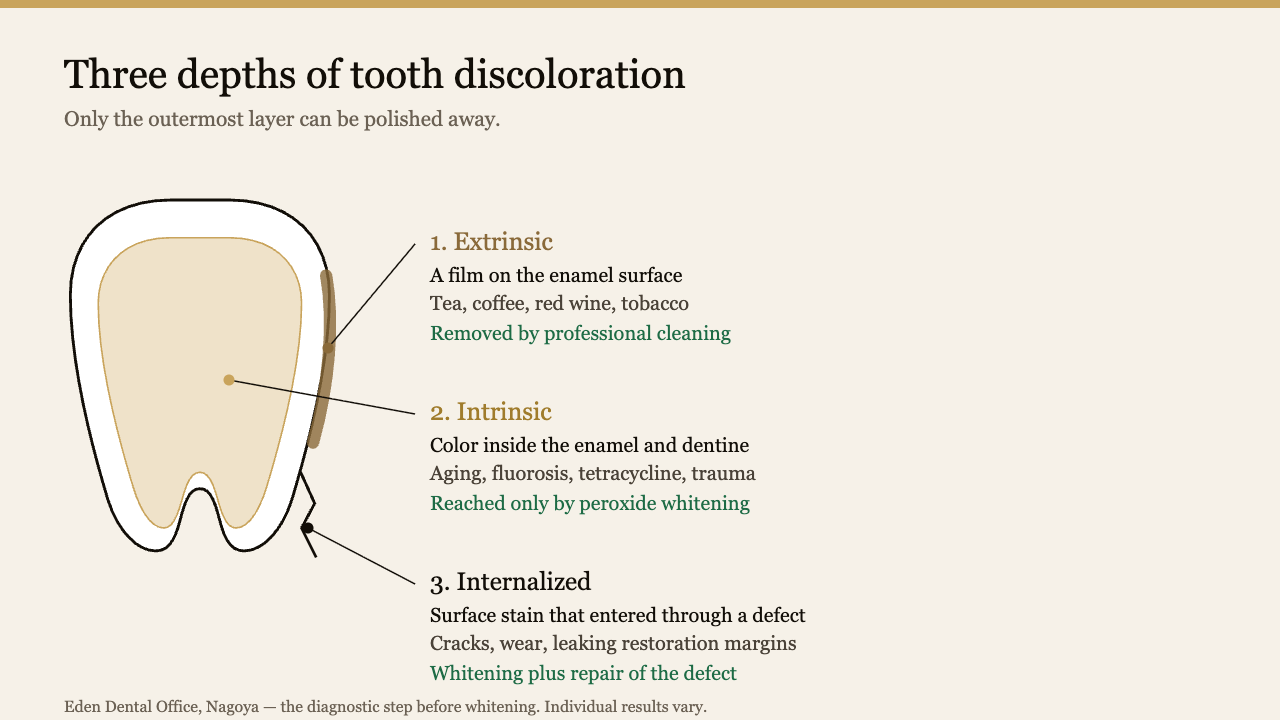
The dental literature sorts discoloration into three groups, and the boundaries are practical rather than academic. Sulieman’s overview in Dental Update separates extrinsic staining — chromogens deposited on the outer surface from tea, coffee, red wine, tobacco or chlorhexidine — from intrinsic discoloration incorporated into enamel or dentine during tooth development or after trauma, and from internalized stain, where surface chromogens have traveled into the dentine through cracks, wear facets or leaking restoration margins. A single tooth darkened from within after trauma or root canal treatment is the case none of these three routes reaches, and is treated instead by bleaching that tooth from the inside. The full paper is An overview of tooth discoloration: extrinsic, intrinsic and internalized stains.
That three-way split maps almost directly onto three different appointments.
| Type of discoloration | Where the color physically is | What typically causes it | What actually addresses it |
|---|---|---|---|
| Extrinsic | A film on the enamel surface, above the tissue | Tea, coffee, red wine, tobacco, chlorhexidine rinses, some iron supplements | Professional cleaning and polishing |
| Intrinsic | Within the enamel and dentine, laid down in the tooth | Aging and dentine thickening, fluorosis, tetracycline exposure, trauma, root-canal history | Peroxide whitening; ceramics where whitening cannot reach |
| Internalized | Surface chromogens that have entered the dentine | Cracks, wear, exposed dentine, leaking or aged restoration margins | Whitening plus repair of the defect that let it in |
| Restorative mismatch | In the crown, veneer or composite, not in tooth tissue | Existing dental work that has aged, or was matched to a darker baseline | Replacement — no cleaning or whitening will move it |
What a professional cleaning actually removes — and what the evidence says it does not do
A scale and polish removes calculus, plaque and the extrinsic film with it. That part is mechanical and reliable: the chromogen layer is physically lifted off, and teeth photographed before and after a thorough cleaning often read one to two shade tabs lighter with no peroxide involved. Neither procedure reaches a lesion sitting under an intact enamel surface, which is the category white spots left after braces belong to.
The claim worth examining is the other one — that a routine cleaning on a fixed six-month interval protects the gums of a healthy adult. Lamont and colleagues’ 2018 Cochrane review, Routine scale and polish for periodontal health in adults, found little to no difference in gingivitis or probing depths over two to three years between scheduled scale-and-polish treatment and none, in adults without severe periodontitis, although participants consistently reported that their teeth felt cleaner afterwards.
Read that precisely, because it is often quoted too broadly: it concerns periodontal endpoints in low-risk adults on a calendar interval. It says nothing about stain, and it is not an argument against cleaning someone whose risk is high. We set recall intervals from risk rather than the calendar, the reasoning set out in our piece on risk-based maintenance instead of automatic six-month recalls.
What whitening does that no amount of polishing can
Peroxide works by diffusing through enamel into dentine and oxidizing the chromogen molecules held there, breaking them into smaller, less pigmented fragments. Carey’s review, Tooth whitening: what we now know, describes the mechanism and the reason the effect is reversible over time: the substrate keeps taking up new color after treatment.
Two consequences follow. Whitening reaches color no instrument can touch, because the agent travels into tissue rather than across it. And it is inert on everything that is not tooth — porcelain, zirconia, composite and cement do not lighten. Whiten around a single aging crown on an upper central incisor and the match improves only by accident, and worsens by default.
Three questions that settle it before you book
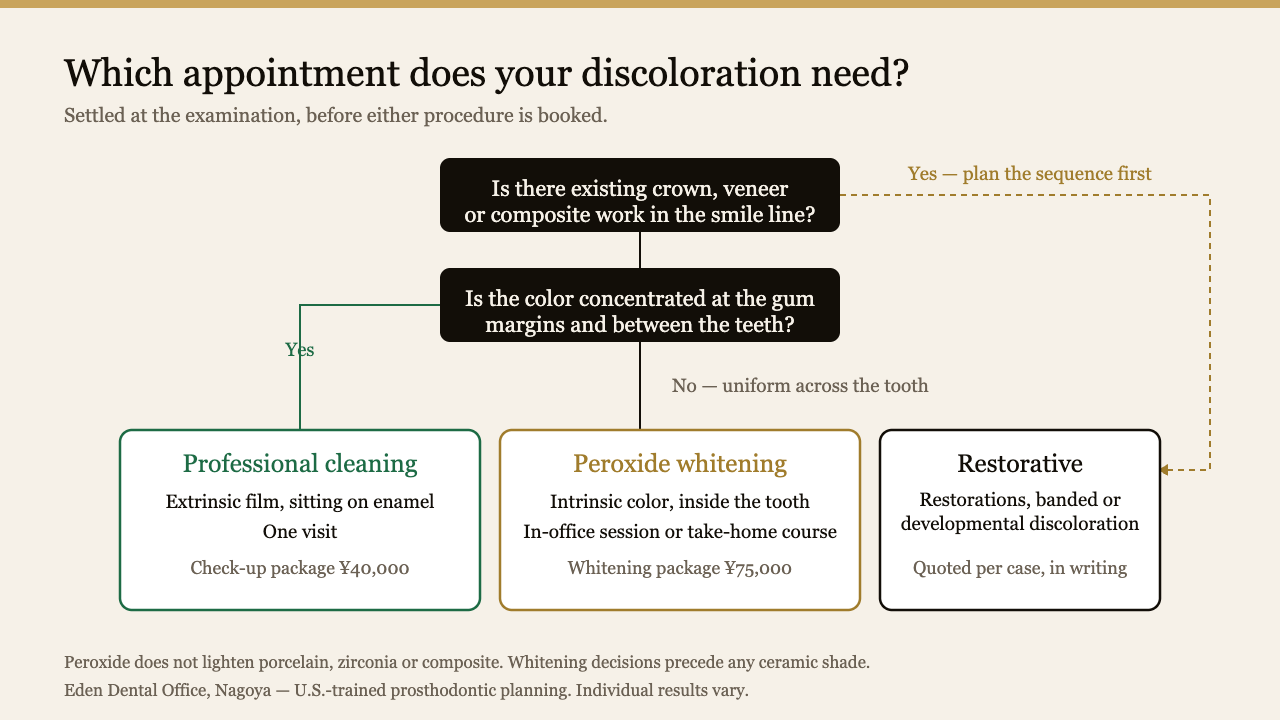
Does the discoloration sit at the gum margins and between the teeth, or across the whole face of the tooth? Color concentrated where a brush does not reach is extrinsic almost by definition. Uniform color across the labial surface, matched on every tooth, is usually intrinsic.
Has it appeared over months, or has it been there as long as you can remember? A film accumulates. Developmental color does not arrive.
Is there existing dental work in the smile line? If there is, the sequence matters more than the procedure, because the restoration fixes the ceiling on the final result.
At Eden we settle this at the examination, not at the whitening chair. The comprehensive check-up includes photographs taken against a shade reference under consistent lighting, so the baseline is recorded before polishing removes the surface layer — afterwards, nobody can say how much of the change was stain removal and how much was bleaching. Where a plan may end in ceramics, those photographs feed the Digital Smile Design workup in our in-house lab, because the whitening decision has to precede the shade chosen for any porcelain. The same problem in restorative form is set out in our article on matching a single front-tooth veneer to the teeth beside it.
Cleaning, whitening and ceramics compared
| Professional cleaning | Peroxide whitening | Ceramic restoration | |
|---|---|---|---|
| Acts on | Deposits on the tooth surface | Color inside enamel and dentine | Replaces the visible surface entirely |
| Typical visits | One | One in-office session, or a take-home course over two to three weeks | Multiple, across several weeks |
| Changes existing crowns or veneers | Removes film from them | No effect whatsoever | Yes — they are remade |
| Addresses shape or alignment | No | No | Yes |
| Reversibility of the color change | Stain returns with the same habits | Color relapses gradually; maintenance sessions are usual | Stable, but the restoration itself ages |
| Main limitation | Cannot reach color inside the tooth | Cannot correct shape, alignment or restorations | Irreversible removal of tooth structure |
What this costs
Our published anchors are the comprehensive check-up package, which includes the examination, photographs and professional cleaning, at ¥40,000, and the whitening package at ¥75,000; membership runs from ¥88,000 to ¥288,000 per year. Restorative work is quoted per case — unit count, material and laboratory time drive it — and you receive a written estimate in English, itemized by stage, before anything begins. We do not invoice a whitening package for a patient whose discoloration turns out to be extrinsic; the examination exists to prevent exactly that. Fees are published in full on our fee page, and the course itself on our whitening treatment page.
Frequently Asked Questions
Should I have a cleaning before whitening?
Yes, and in that order. Peroxide has to reach enamel; a chromogen film sits in the way, and any color the cleaning removes is color the whitening does not have to work on.
How much lighter do teeth get from a cleaning alone?
Where the staining is genuinely extrinsic, one to two shade tabs is common. Where it is intrinsic, close to none, however thorough the appointment.
Will whitening lighten my crown or veneer?
No. Peroxide has no effect on porcelain, zirconia or composite. Whitening around existing work usually widens the mismatch rather than closing it.
Can tetracycline or fluorosis staining be whitened?
Partially and unpredictably. Banded tetracycline discoloration in particular responds slowly and incompletely, and is often a restorative question rather than a bleaching one.
Can both be done in one trip to Japan?
Frequently, yes. The examination and cleaning can be scheduled ahead of an in-office whitening session, and the sequencing is what we plan around for patients traveling from outside Nagoya.
Costs, risks and limitations
Professional cleaning can cause transient gum tenderness and bleeding where inflammation is already present, and short-lived sensitivity where dentine is exposed at the necks of the teeth. Peroxide whitening commonly causes sensitivity and gingival irritation during and shortly after a course; it does not lighten restorations, responds poorly to some developmental discoloration, and relapses gradually over the following years, so maintenance sessions are the norm. Neither procedure corrects shape, alignment or worn edges. Ceramic treatment removes tooth structure irreversibly and carries its own risks of chipping, debonding and eventual replacement. All of this assumes active decay and gum disease have been treated first. Shade estimates are illustrative, not undertakings. Individual results vary.
Deciding which of the three your case is belongs to the examination, not to a website. Our consultations run in English and the written estimate comes first. Message us on WhatsApp, or start with the whitening options we offer in Nagoya.
More on this topic: Whitening Guides — every article we have published in this cluster, grouped by stage.