
Clear Aligners and Wisdom Teeth: Remove Before Treatment?
Reviewed by Dr. Ryosuke Murai, DDS, MSD — Prosthodontist, trained at Indiana University School of Dentistry (U.S.). Last updated November 2026.
Whether to remove wisdom teeth before clear aligner treatment depends on three things: whether the third molars are diseased or likely to become so, whether your plan needs space at the back of the arch, and what the scan shows. The popular idea that wisdom teeth push the front teeth crooked is weaker than many people assume, so removal is not automatic. This guide is for self-pay patients in Japan who want the reasoning explained in English before they commit to a plan, and who prefer a decision made on their own images rather than on a rule of thumb.
Do wisdom teeth crowd the front teeth?
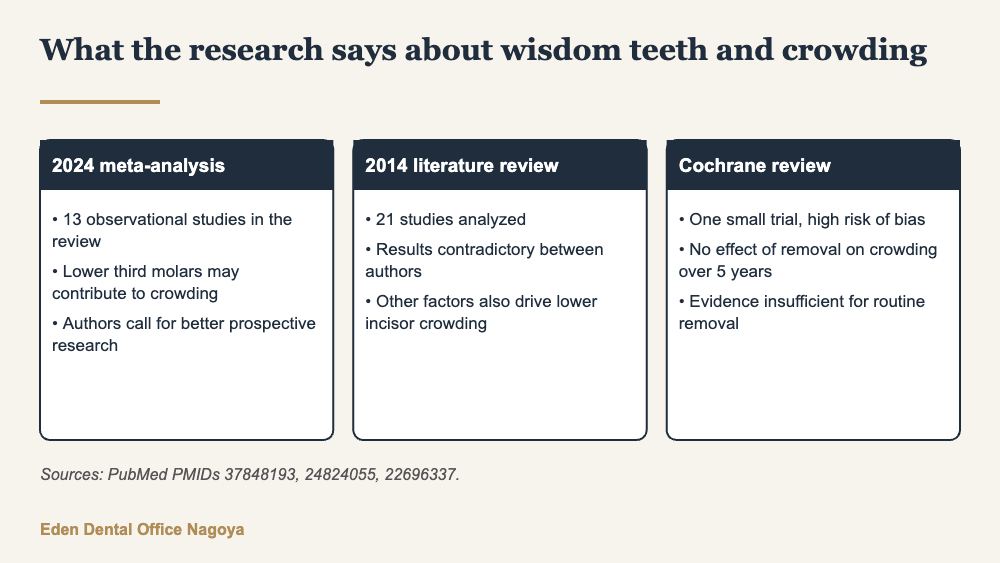
A 2024 systematic review and meta-analysis of 13 observational studies found that people without lower third molars had less crowding, a lower irregularity index and a longer arch than those who kept them, and concluded that lower third molars may contribute to crowding, while calling for better prospective research (PubMed 37848193). An earlier literature review of 21 studies described the results as contradictory and listed other drivers of lower incisor crowding, including crown size, loss of arch length, gum condition, growth and age (PubMed 24824055).
The Cochrane review of prophylactic removal found one small randomised trial, at high risk of bias, with no effect of extraction on late lower incisor crowding over five years, and judged the evidence insufficient to support or reject routine removal of symptom-free impacted wisdom teeth (PubMed 22696337). The honest summary is that the link is possible but unproven, and that the decision should rest on disease risk and treatment mechanics, not on a fear of relapse alone.
When wisdom teeth do matter for aligner planning
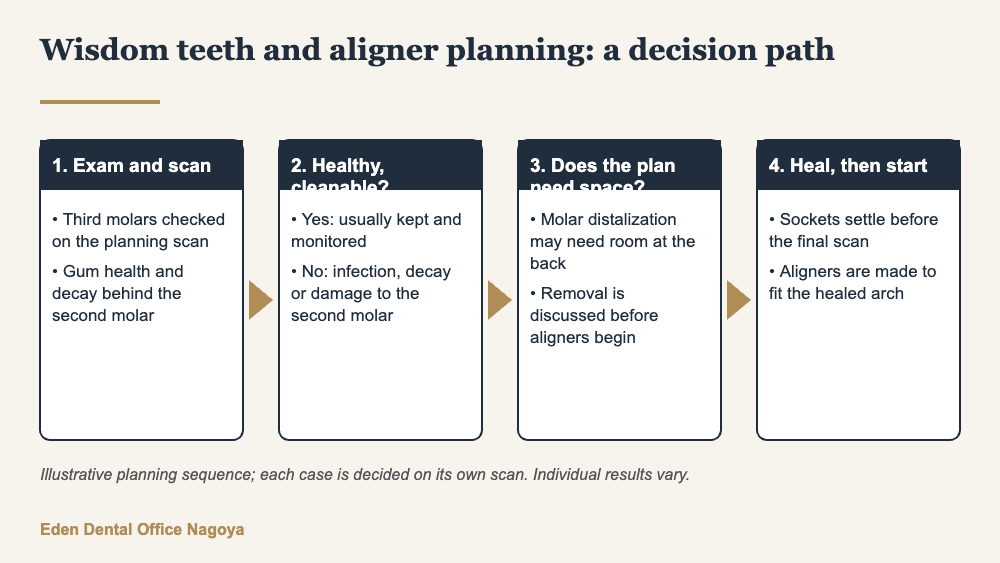
Clear aligners move teeth by pushing them into space, so the back of the arch matters when a plan calls for moving molars backward. If a third molar sits directly behind the second molar, it can limit that movement, and it is usually the first thing we look at when planning. Other reasons to act are practical: a partly erupted tooth with a flap of gum that repeatedly swells, decay on the distal surface of the second molar that is hard to clean, or a tooth in a position that damages its neighbour. A tooth that is healthy, fully erupted and easy to brush rarely needs to go.
| Situation | Usual approach | What we check |
|---|---|---|
| Fully erupted, healthy, cleanable | Keep and monitor | Cleanability and the opposing tooth |
| Partly erupted with recurrent gum swelling | Discuss removal, ideally before aligners start | Infection history and gum pocket depth |
| Impacted, no symptoms, no damage | Often monitored with periodic imaging | Position on the scan and the second molar root |
| Plan needs molars moved backward | Third molars reviewed first; removal may be advised | Space behind the second molar |
| Decay or damage to the second molar | Removal usually advised | Extent of damage on the scan |
Before, during or after aligners
If removal is advised, it is generally easier to do it before aligners begin, so that swelling has settled and the final scan reflects a healed arch. Trays made while the gum is swollen can fit poorly. If a tooth is only being monitored, we agree in advance what would change that decision, for example a new area of swelling or decay found at a later visit. Our guide to what to do when aligners stop tracking explains how fit problems are handled during treatment, and our article on retainers after aligners covers how results are held.
Questions worth asking before you start
Ask which wisdom teeth are present, erupted or impacted, and where they sit relative to the second molar. Ask whether the planned movement involves the back teeth and, if it does, whether the third molars would limit it. Ask what would make the dentist change the recommendation later, because a clear answer shows the decision is tied to findings and not to habit. If removal is suggested, ask what the alternative of monitoring would involve, how often images would be repeated, and what warning signs should prompt an earlier visit. Patients who move between countries should also ask for copies of the scan and the treatment plan in English, so that care can continue elsewhere without repeating every step; our guide to sending dental records lists what travels usefully.
It also helps to separate two questions that are often merged. The first is whether a wisdom tooth is a problem now, which is answered by the exam and the scan. The second is whether it might become a problem later, which is a judgement about risk, age and how well you can clean the area. A young adult with a deeply impacted tooth and no symptoms is in a different position from someone in their forties with a half-erupted tooth that has swollen twice this year. Treating both the same way is the mistake a good plan avoids, and it is why we would rather look at your images than quote a general rule.
How we plan it at Eden
At Eden, the third molars are reviewed on the images taken at the planning visit, together with the gum condition around each tooth, before any aligner design is approved. Dr. Murai, a prosthodontist trained at Indiana University, leads the plan from the first consultation, and appointments are by reservation so that the discussion is not rushed. Where removal is advised, we explain the options and coordinate with the surgeon who performs it. You can read the full overview of clear aligner treatment in Japan, and the treatments page shows how it fits into the rest of care.
What this costs
The first visit is ¥15,000. The cost of aligners depends on the complexity of your case and the length of treatment, and any wisdom tooth removal is a separate procedure with its own fee. After assessment we give a written estimate in English before treatment begins; our note on how to read a dental estimate in Japan explains what a complete one contains.
Frequently asked questions
Do I have to remove wisdom teeth before clear aligners?
No. Healthy, cleanable wisdom teeth are often kept. Removal is discussed when there is disease, damage to the second molar, or a plan that needs space at the back of the arch.
Do wisdom teeth cause crowding after treatment?
The evidence is mixed. A 2024 meta-analysis suggests lower third molars may contribute to crowding, while a Cochrane review found no trial evidence that removal changes it.
Can I wear clear aligners while my wisdom teeth are coming through?
Usually yes, but a tooth erupting behind the second molar can change fit and comfort, so we review it on the scan before ordering trays.
How long after wisdom tooth removal can aligners start?
That depends on healing. We confirm at review that swelling has settled and the sockets are comfortable before taking the final scan.
What does the first visit cost?
The first visit is ¥15,000. Any further plan, including aligners, is given as a written estimate in English.
Risks and limits
Removing wisdom teeth carries risks including pain, swelling, bleeding, dry socket, infection and, rarely, nerve injury, and leaving them in carries the risk of later infection or decay. Clear aligners can cause temporary soreness, tooth movement that differs from the plan, and the need for refinement, and teeth can drift without retainers. Research on wisdom teeth and crowding is mixed, so we do not promise a particular outcome. Individual results vary.
To discuss your own case, message the clinic on WhatsApp or call 052-265-8996. You can also see why patients look for an English-speaking dentist in Nagoya for planning that needs careful explanation.
More on this topic: Aligner Guides — every article we have published in this cluster, grouped by stage.