
Dental Planning for a Nagoya Work Assignment: A Timeline

Reviewed by Dr. Ryosuke Murai, DDS, MSD — Prosthodontist, trained at Indiana University School of Dentistry (U.S.). Last updated November 2026.
A posting in Nagoya, whether it lasts two years or five, is long enough for a small dental problem to become a large one and short enough that big treatment needs a schedule. The most useful thing an assignee can do is arrive with a plan: a baseline exam in the first weeks, treatment sequenced around home leave, and a clean hand-over before leaving Japan. This guide sets out that timeline for people relocating to the city for work, and for the families who move with them. It is written for patients who value unhurried, private care in English, and who want one dentist to follow their mouth from arrival to departure.
The first 60 days: a baseline, not a treatment plan
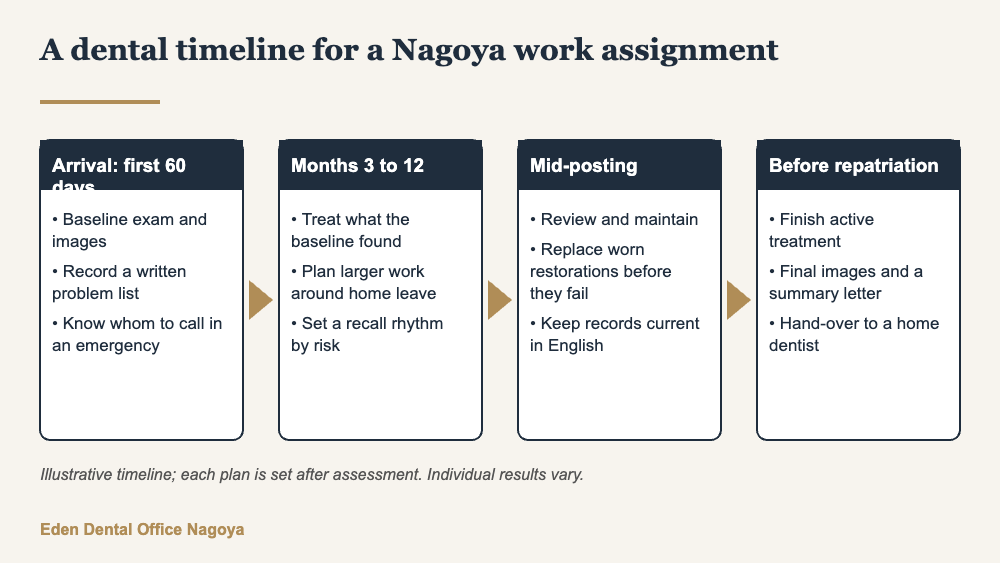
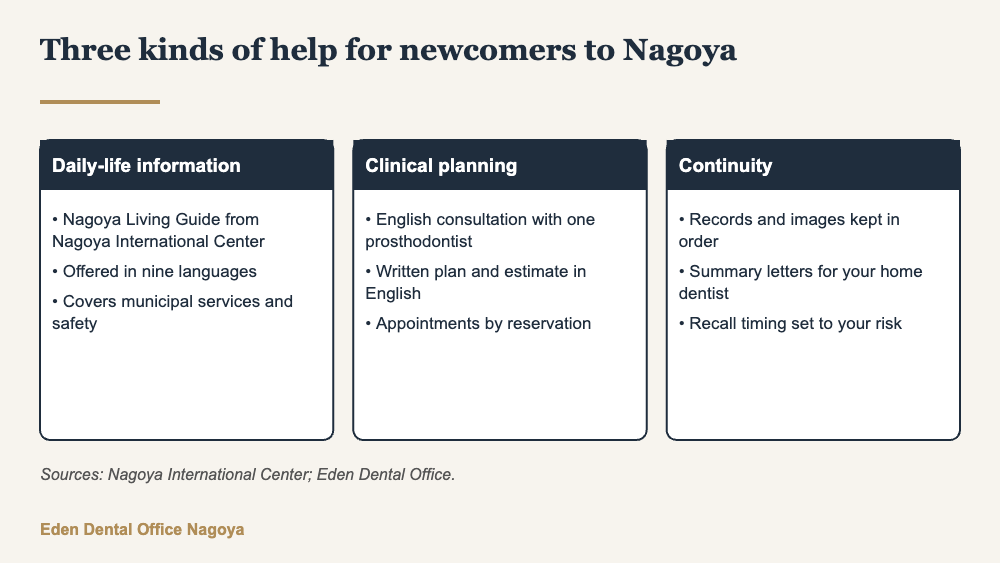
Start with an examination and a set of images, and ask for a written list of what was found, ranked by urgency. At this stage nothing needs to be decided beyond what is painful or failing. A baseline matters because teeth change slowly and a stranger cannot judge change without a starting point. It also tells you which problems can wait for home leave and which should be handled here. Settle the practical questions at the same time: how to book, how to reach the clinic after hours, and whom to call in an emergency. Our guide to what to do in a dental emergency in Nagoya covers the second point, and the city publishes a daily-life guide for newcomers (Nagoya Living Guide, Nagoya International Center), which is a useful companion for everything that is not dental.
It is also worth gathering your history before you arrive: the name of your previous dentist, any implant cards, a list of medications and allergies, and recent images if you have them. Bring night guards, retainers or aligners with you. A new dentist can work far more precisely with that background, and the first appointment can then focus on decisions and not on reconstruction of the past.
Months 3 to 12: treat what the baseline found
This is the right window for work that needs several visits, such as replacing a failing crown, treating gum disease or restoring a missing tooth. Staging matters more than speed. A crown or a bridge needs planning, a temporary period and a final fit, and an implant needs healing time between stages. If a long-haul trip is booked, tell us early, because the date can change what is sensible. Our article on flying after dental surgery explains the timing, and the overview of a dental treatment trip to Japan shows how multi-visit care is organised for people who travel.
| Stage of the posting | Goal | What we do |
|---|---|---|
| First 60 days | Establish a baseline | Examination, images, written problem list |
| Months 3 to 12 | Treat what matters | Staged treatment planned around travel and home leave |
| Mid-posting | Maintain and review | Recall visits set by risk; early repair of worn work |
| Final 6 months | Finish and hand over | Complete active treatment, final images, summary letter |
How often to come back
Many people assume a check-up every six months, but the evidence for any one interval is thinner than that habit suggests. A systematic review of recall intervals for periodontal maintenance found only cohort studies and no randomised trials, with shorter intervals of three to six months favouring tooth retention in some studies and not in others (PubMed 26698003). The authors of a large UK trial began from the point that evidence for fixed six-monthly recall in adults was lacking and set out to test risk-based intervals (PubMed 30086747). For an assignee, the practical reading is that recall should follow your own risk: gum health, cavity history, grinding, and any implants or large restorations. A quieter mouth may need fewer visits, and a mouth with a history of gum disease or heavy restorations usually needs more. Our approach to preventive care describes the membership structure for patients who want a steady rhythm, and our published check-up package is ¥40,000.
Families, children and the first month
Moving with a family adds scheduling, not complexity. Children’s check-ups and a parent’s treatment can be arranged around the same trip into the city, and decisions are explained in English to whoever is making them. Many assignees live outside the centre of Nagoya, so travel time is part of the plan; our note on getting to the clinic from Centrair or the Shinkansen sets out the routes, and Fushimi Station is a short ride from Nagoya Station. Because appointments are by reservation, the clinic is not crowded, and you can choose times that fit a working day.
The last six months: finish and hand over
A common mistake is starting something large too close to departure. If you have six months left, treatment that needs healing time, such as an implant, is a conversation about whether it can be completed and reviewed before you go. Some stages can safely be passed to a dentist at home; others should be finished by the person who started them. We aim to complete active treatment, take final images, and write a summary letter so that your next dentist knows what was done and with which materials. Our guide to sending dental records lists what is most useful to include.
Why one prosthodontist from start to finish
Dr. Murai is a prosthodontist trained at Indiana University, and he leads the plan from the first consultation to the final restoration. Continuity is the point: the same person sees your baseline, decides what to treat, and writes the hand-over. You can read about him on the About page, or see why newcomers and travelling patients choose an English-speaking dentist in Nagoya for care that is planned in advance.
Frequently asked questions
When should I book a dental visit after moving to Nagoya?
Within the first two months is sensible. A baseline exam and images give you a written starting point, so later problems are compared with something.
How often should I have a check-up while on assignment?
It depends on your gum health and cavity risk. The evidence for one fixed interval is limited, so we set the rhythm from your own findings.
Can I start major treatment shortly before my posting ends?
Only if there is time to finish and review it. We plan around your departure date and say plainly when a stage should wait.
Can my records be sent to my home dentist?
Yes. We prepare images and a summary letter in English so a dentist at home can continue without repeating every step.
What does the first visit cost?
The first visit is ¥15,000. Our check-up package is ¥40,000, and any further plan comes as a written estimate in English.
Costs, risks and limits
The first visit is ¥15,000 and the check-up package is ¥40,000; membership ranges from ¥88,000 to ¥288,000 a year. Other treatment is quoted after assessment, as a written estimate in English before anything begins. Dental treatment carries risks, including discomfort, the need for repeat work and, for surgery, swelling and infection, and these are discussed at consultation. Recall intervals are a judgement and not a rule. Individual results vary.
To arrange a first visit, message the clinic on WhatsApp or call 052-265-8996.
Related: dental visits near Fushimi Station.
More on this topic: Trip Planning Guides — every article we have published in this cluster, grouped by stage.