
Screw-Retained vs Cemented Implant Crowns in Japan Explained
Reviewed by Dr. Ryosuke Murai, DDS, MSD — Prosthodontist, trained at Indiana University School of Dentistry (U.S.). Last updated August 2026.
Almost nobody asks how their implant crown will be held in place. Yet the choice between a screw-retained and a cemented implant crown shapes how easily the tooth can be serviced in ten years, how much cement ends up under your gum, and whether a small repair means a new crown. In Japan this decision is usually made silently by the clinic, and it is rarely explained in English. This article is for self-pay patients who want to understand what they are buying: what each retention method physically is, what the published survival and complication data show, when cement is genuinely the better answer, and how the access hole is planned before the implant is ever placed. If you are earlier in the process, our overview of implant treatment planned by a U.S.-trained prosthodontist covers the ground before this one.
The Two Ways a Crown Attaches to an Implant
An implant is not a tooth with a crown glued on top. It is a three-part assembly: the fixture in the bone, an abutment that emerges through the gum, and the crown itself. Retention describes how the crown joins that assembly.
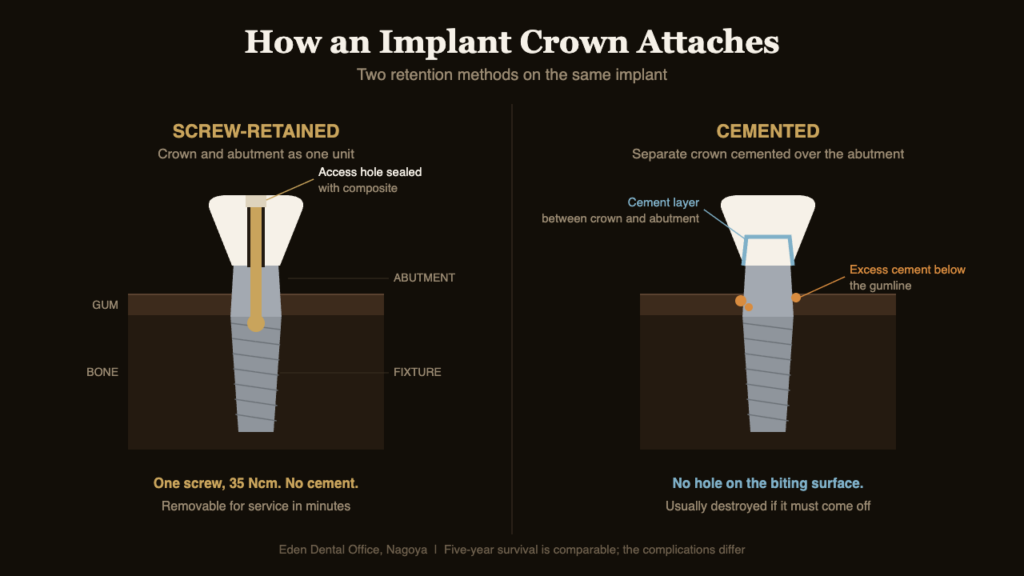
In a screw-retained crown, the crown and abutment are effectively one unit, and a single screw passes up through the middle of the crown into the implant, tightened to the manufacturer’s figure — 35 Ncm for the Straumann connections we use. The screw head sits in a small access opening on the biting surface, which is then sealed with a plug and tooth-colored composite. Nothing is bonded to anything. The crown comes off in about two minutes by removing that composite and loosening one screw.
In a cemented crown, the abutment is screwed to the implant first, and a separate crown is then cemented over it exactly as a conventional crown is cemented over a prepared tooth. There is no hole in the biting surface, which is the method’s genuine advantage. The trade is that the cement margin often sits below the gumline, and cement that squeezes out during seating has to be found and removed from a space you cannot see into.
Screw-Retained vs Cemented, Side by Side
| Factor | Screw-retained crown | Cemented crown |
|---|---|---|
| How it is held | One screw, 35 Ncm, through the crown | Dental cement over a screwed abutment |
| Removal for service | Routine — minutes, no damage | Usually destructive; crown often remade |
| Visible feature | Small composite-sealed hole on the biting surface | None |
| Residual cement risk | None — no cement used | Real, and greatest with deep margins |
| Passive fit demands | High — the framework must seat without strain | Cement absorbs minor discrepancies |
| Typical failure mode | Screw loosening, ceramic chipping | Loss of retention, peri-implant inflammation |
| Where it struggles | Tilted implants, access hole on a front-tooth face | Margins deeper than about 1 mm below the gum |
| Typical indication | Molars, premolars, most single units, full arches | Angulation problems and short crown height |
What the Evidence Actually Shows
Survival is not the discriminating variable. A systematic review of 73 qualifying studies calculated five-year survival of 96.03% for cemented and 95.55% for screw-retained reconstructions, a difference that was not statistically significant, with no significant difference either when the analysis was restricted to single crowns. The same review found that screw-retained reconstructions showed fewer technical and biological complications overall, with significant differences in loss of retention, abutment loosening, porcelain fracture or chipping, and the presence of a fistula or suppuration (Int J Oral Maxillofac Implants 2014). In other words: both methods keep the tooth in your mouth, but they fail differently, and screw retention fails in ways that are easier to fix.
The strongest single argument against routine cementing concerns what is left behind. In a prospective endoscopic study, 39 consecutive patients with implants showing signs of peri-implant disease were examined with a dental endoscope alongside inflammation-free control implants. Excess cement was found at 34 of the 42 affected implants and at none of the 20 controls; thirty days after the cement was removed, 25 of 33 treated sites had no remaining clinical or endoscopic signs of inflammation (J Periodontol 2009). The finding is not that cement is toxic. It is that cement you cannot see is cement you cannot reliably remove, and that the gum around an implant reacts to it. This is also why the ten-year maintenance picture for implants looks different depending on how the crown was attached.
When Cement Is Still the Right Answer
A screw has to come out somewhere. If an implant is angled such that the screw channel would exit through the front surface of an upper incisor, a screw-retained crown would put a composite patch in the most visible part of the smile. Angulated screw-channel abutments can redirect the opening by roughly 15 to 25 degrees depending on the system, which rescues many of these cases, but not all of them. Very short clinical crown height is the other classic indication: when there is little vertical room, a cemented crown can borrow retention from the abutment walls in a way that a thin screw-retained ceramic cannot.
Where cement is chosen, the margin position is the whole game. We treat any planned cement margin deeper than about 1 mm below the gum as unacceptable and change the design instead, because below that depth removal stops being a matter of care and becomes a matter of luck. A custom abutment that lifts the margin to a level a probe and an explorer can actually reach converts a hidden problem into a visible one — which is the point of paying for a custom abutment at all, and something worth checking in the line items of any implant quote you are given.

How the Access Hole Is Planned Before Surgery
The retention decision is not made at the crown appointment. It is made at the planning appointment, months earlier, because the position and angle of the fixture determine where a screw could exit. At Eden we merge the CBCT scan of your bone with an intraoral scan and a digital wax-up of the intended tooth, then place the virtual implant so that the screw channel emerges through the biting surface or the palatal side of the finished crown. The surgical guide is 3D printed in our own laboratory from that plan, so the fixture goes where the restoration needs it rather than where the bone is merely convenient.
Our default is a screw-retained crown on a titanium base — a Straumann Variobase, with zirconia milled and bonded to it in-house — and we deviate from that default only for the angulation and crown-height reasons above. The practical consequence for you is retrievability. If the screw ever loosens, if the gum contour needs refining, if an adjacent tooth is later treated, or if the crown needs cleaning under a microscope, we remove it and replace it the same day rather than destroying it. For full-arch cases the same logic applies with more force, which is why All-on-4 bridges are designed to be unscrewed for professional cleaning.
One consequence matters especially to patients who fly in: there is no cement-cleanup visit, because there is nothing to clean up — useful when the sequence has to be compressed, as we describe in our guide to the implant procedure, healing and recovery in Japan. None of this changes how you look after the implant in the first two weeks, which depends on the surgery rather than the crown.
What This Costs
Retention method is not usually a separate line on a Japanese estimate; it is folded into the abutment and crown fees, and a custom abutment costs more than a stock one for the reason described above. Every case at Eden starts with a comprehensive examination and records (check-up package ¥40,000), and our fee page sets out how self-pay pricing is structured here. Because implant restorative fees depend on the abutment type, the ceramic and the number of units, we do not publish a single figure — you receive a written estimate in English, itemized by stage, before anything is started. If you are comparing quotes between clinics, ask each one which retention method it plans and whether the abutment is stock or custom; the answer explains more of the price difference than the brand of ceramic does.
Before retention is even decided, the tissue around the implant has to be shaped and the position recorded — see how impressions and gum shaping set up the crown that gets screwed or cemented.
Retention is one variable; the soft tissue collar is another. Our article on peri-implant gum tissue width and thickness covers the phenotype assessment that precedes both decisions.
Frequently Asked Questions
Can you see the screw hole in an implant crown?
On a molar or premolar, rarely — the opening is sealed with shade-matched composite on the biting surface. On front teeth the channel is redirected or cement is used instead.
Does a screw-retained crown come loose more often?
Screw loosening is its characteristic complication, but it is a ten-minute retightening rather than a remake. Correct torque and a passive fit make it uncommon.
What happens if cement is left under the gum?
It can provoke peri-implant inflammation. In one endoscopic study, most affected implants had residual cement and most improved within 30 days of its removal.
Can a cemented implant crown be removed if needed?
Sometimes, but usually not without damaging it, so a replacement crown should be budgeted for. This is the main practical argument for screw retention.
Which method lasts longer?
Published five-year survival is comparable — about 96% for both. They differ in complication type, not in whether the tooth survives. Individual results vary.
Risks and limitations. All implant restorations carry risk regardless of retention: screw loosening or fracture, ceramic chipping, loss of cement retention, peri-implant mucositis and peri-implantitis, and in a minority of cases loss of the implant itself. Screw-retained crowns require an access opening whose composite seal may discolor over years and occasionally needs refreshing. Cemented crowns carry the residual-cement risk described above and are difficult to retrieve intact. Smoking, uncontrolled diabetes, untreated gum disease and heavy grinding raise the complication rate for both. Individual results vary. A consultation with a CBCT scan and records is the only way to know which design your case allows.
If you are planning implant treatment from elsewhere in Japan or from abroad and want the restorative design explained before you commit, our implant treatment page outlines how cases are planned here, and our English-speaking team answers questions directly on WhatsApp.
Related reading in this cluster
These articles cover the neighbouring decisions referred to above in more detail than this page allows:
More on this topic: Implant Guides — every article we have published in this cluster, grouped by stage.