Dental Membership Plans in Japan: Boutique Preventive Care
Reviewed by Dr. Ryosuke Murai, DDS, MSD — Prosthodontist, trained at Indiana University School of Dentistry (U.S.). Last updated August 2026.
A dental membership plan in Japan replaces pay-per-problem dentistry with a fixed annual relationship: scheduled preventive care, unhurried appointments, and one clinician who tracks your mouth over years rather than visits. At Eden Dental Office, a private, English-speaking practice in Nagoya, membership tiers run from ¥88,000 to ¥288,000 per year and are designed for self-pay patients — Japanese and international — who want boutique preventive care rather than a queue.
This guide explains what a membership model actually buys, what three decades of research say structured maintenance delivers, why the ritual six-month cleaning is not the point, and how the numbers work. It is written for people comparing private dentistry in Tokyo, Singapore, or back home — not for readers looking for the cheapest cleaning in town.
What “boutique preventive care” actually means
Most dental care in Japan is organized around volume: many patients per day, short visits, and treatment delivered item by item as problems appear. It works, in the sense that problems get fixed. What it rarely produces is a longitudinal view — a clinician who has watched your gum measurements, your bite, and your enamel wear move over five or ten years and intervenes before the drill is needed.
A boutique preventive model inverts those economics. The practice keeps its patient panel deliberately small, books hygiene and examination visits at a length that allows actual work to happen, and charges an annual fee for the relationship rather than a fee per rescue. The membership is not a discount club. It is a different production model: fewer patients, more time per patient, and an incentive structure where the practice does well when your teeth stay boring.
The people who choose this model are usually not dental enthusiasts. They are executives, professionals, and internationally mobile families who manage their health the way they manage anything else that compounds — with a system, a schedule, and someone accountable for the long view.
The 30-year case for structured maintenance
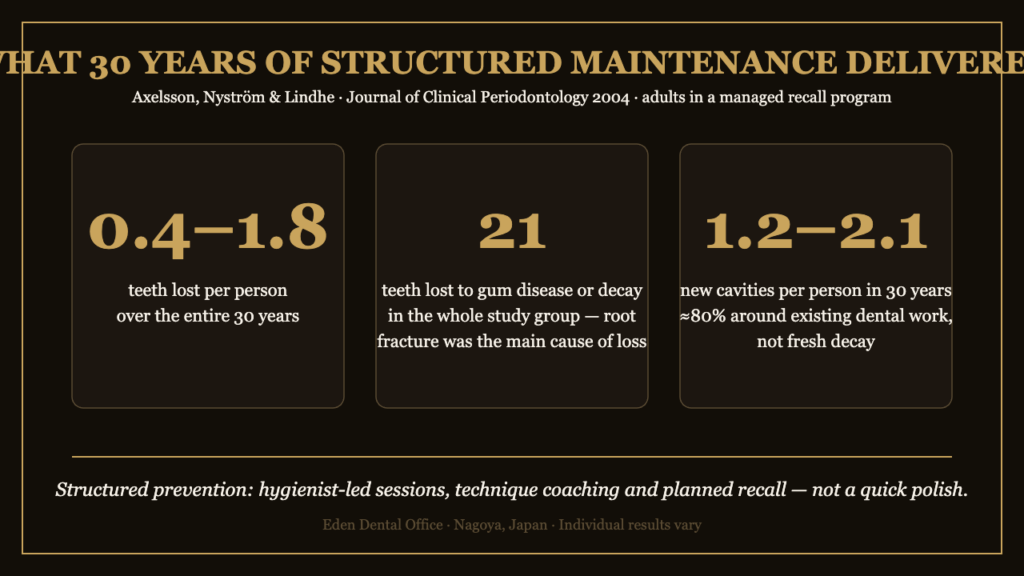
The strongest long-term evidence for organized preventive care comes from Sweden. Axelsson, Nyström and Lindhe followed adults enrolled in a carefully managed plaque-control and recall program — hygienist-led sessions, individualized oral-hygiene training, and professional cleaning on a planned cycle — and reported the outcome after 30 years of maintenance in the Journal of Clinical Periodontology.
The results remain remarkable reading. Participants lost on average just 0.4 to 1.8 teeth per person over the entire 30-year period, depending on age cohort. The main reason for losing a tooth was root fracture — a mechanical event — not gum disease or decay; across the whole group, only 21 teeth were lost to progressive periodontitis or caries. New cavities averaged 1.2 to 2.1 per person over three decades, and roughly 80% of those were recurrent lesions around existing dental work rather than fresh decay on untouched enamel. Most tooth surfaces showed no loss of periodontal attachment at all.
Two honest caveats. These were motivated patients who stayed in a program for decades, so the study shows what structured maintenance plus committed patients can achieve — not what any individual is promised. And the program’s content mattered as much as its calendar: disclosure of plaque, technique coaching, and professional cleaning, not a quick polish. Both caveats argue for, not against, doing prevention seriously if you are going to pay for it at all.
Six-month cleanings are not the point — risk-based intervals are
If prevention works, does everyone need a cleaning every six months? The largest randomized trial ever run on the question says no. The UK INTERVAL trial randomized 2,372 adults across 51 dental practices to fixed six-month recalls, fixed 24-month recalls, or intervals set individually by risk, and followed them for four years. Published in the British Dental Journal in 2021, it found no significant difference in gingival bleeding or oral-health-related quality of life between the arms — the risk-based versus six-month difference in bleeding sites was 0.78% with a confidence interval spanning zero.
The practical reading is not “skip the dentist for two years.” Trial participants were regular attenders healthy enough to be randomized, and the trial measured averages, not the outlier year when things go wrong. The reading is that the fixed six-month ritual has no special magic. What matters is that your interval is set from your actual risk — periodontal status, decay history, smoking, diabetes, dry mouth, and how much engineered dentistry (implants, veneers, full-arch bridges) you are carrying — and that the visit itself is thorough enough to change your trajectory.
That is precisely what a membership structure is built to deliver: an interval chosen clinically rather than by habit, and a visit long enough to matter.
How risk actually sets the interval
“Risk-based” sounds abstract until you see what goes into it. At a baseline assessment, a handful of measurable factors do most of the predictive work, and each one pushes the sensible recall interval in a known direction.
| Factor | What we measure | Effect on monitoring |
|---|---|---|
| Periodontal status | Pocket depths, bleeding on probing, bone levels | Active or treated gum disease shortens the interval more than any other factor |
| Decay history | New and recurrent lesions over recent years | Recent activity means shorter cycles; long stability earns longer ones |
| Existing dentistry | Implants, veneers, crowns, full-arch bridges | Engineered work needs scheduled inspection — margins, screws, occlusion, night guards |
| Medical and lifestyle | Diabetes, smoking, dry mouth, medications | Each independently raises risk and argues for closer follow-up |
| Mechanical load | Grinding, clenching, wear patterns on scans | Drives protective appliances and shorter photo-and-scan comparison cycles |
Two patients paying for the same tier can therefore be on quite different calendars, and the same patient’s calendar should change as results come in. Stability is rewarded with longer intervals; instability is caught early because the system is designed to notice it. That feedback loop — measure, compare, adjust — is the actual product, and it is what a per-visit payment model struggles to fund.
Routine care under insurance vs a membership model
Japan’s national health insurance covers a defined menu of dental treatment at regulated fees, and it does that job well: when something hurts, care is accessible and inexpensive. But the system pays clinics per item of treatment, which typically means short appointments, rotating providers, and prevention delivered in the gaps. Time — the main ingredient of serious preventive work — is the one thing the fee schedule cannot buy.
A private membership sits outside that system and sells exactly that missing ingredient. The comparison below is a general one; individual clinics vary.
| Typical insurance-based routine visit | Boutique membership care | |
|---|---|---|
| Appointment length | Often 15–30 minutes | Scheduled long enough to complete charting, cleaning, and review without haste |
| Continuity | Provider may change visit to visit | Same clinician and hygienist team across years |
| Diagnostics | Problem-focused X-rays as needed | Baseline periodontal charting, calibrated photos, digital scans compared year over year |
| Orientation | Treat what has broken | Track risk and intervene before breakage |
| Language and records | Japanese documentation | English consultations, English written records you can take anywhere |
| Payment | Per item, per visit | Fixed annual fee, scope agreed in writing |
Neither column is “wrong.” They are different products. The question is which one matches how you want to manage a part of your body where small problems become expensive ones quietly. For a wider view of how Japanese fees compare internationally, see our guide to comparing dental costs across countries on real value.
At Eden: what a membership year looks like
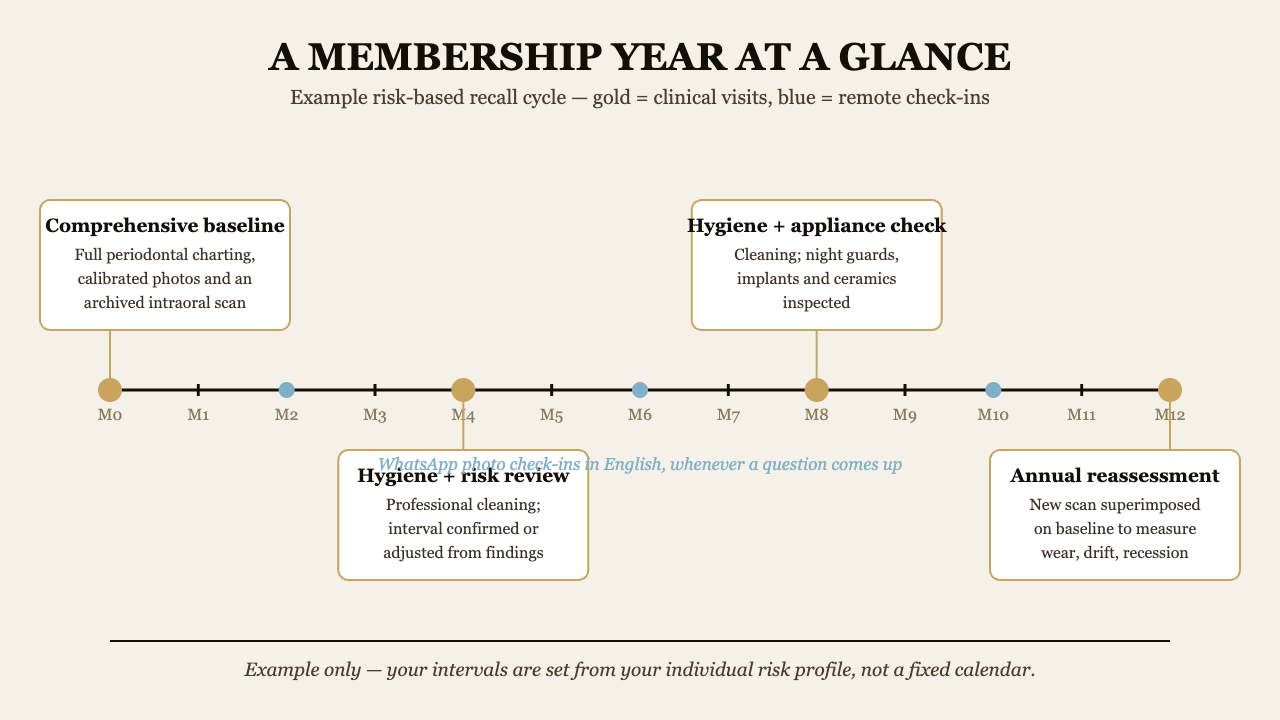
At Eden, a membership year opens with a comprehensive baseline, because prevention without measurement is guesswork. We record full periodontal charting, standardized clinical photographs, and an intraoral scan that is archived digitally — at the following year’s review we superimpose the new scan on the old one and can see wear, recession, or drift developing long before it is visible in a mirror. Because our laboratory, milling unit, and 3D printers are in-house, anything the preventive exam reveals — a night guard for a grinder, a worn splint for a veneer patient — is designed and made on site rather than ordered from a distant lab.
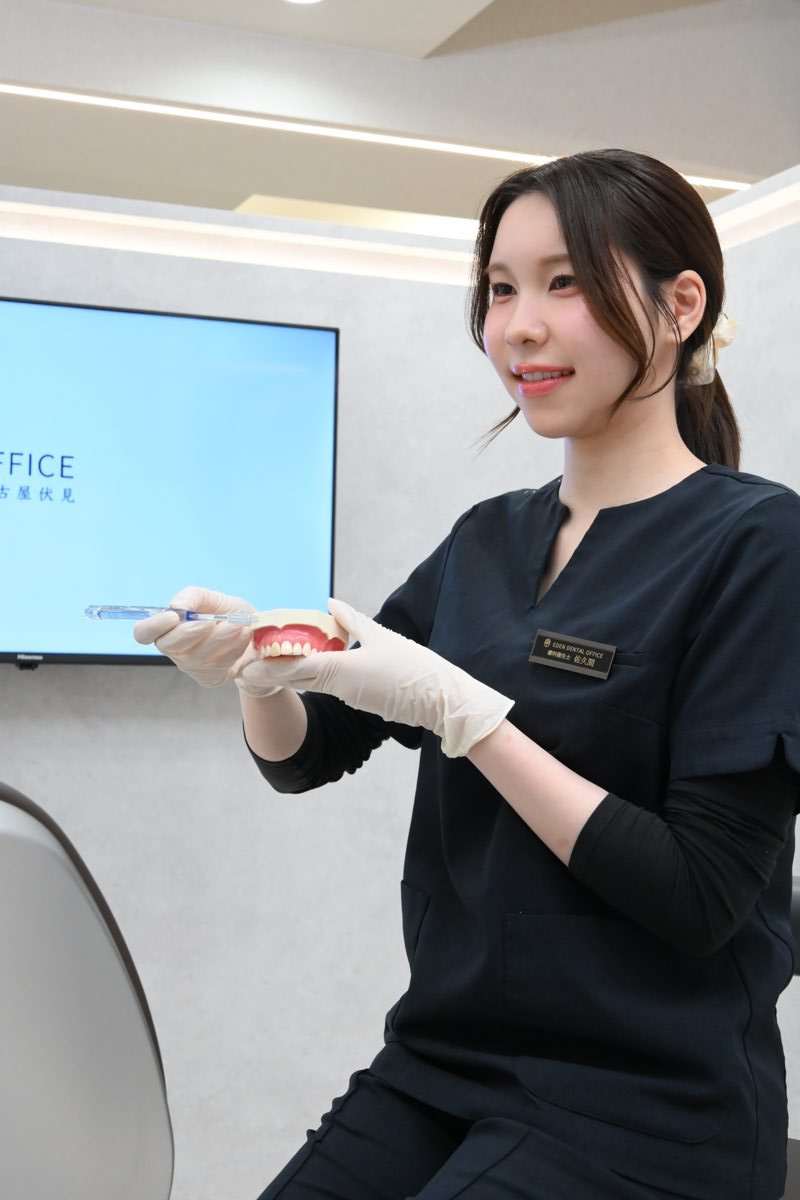
Hygiene visits then follow at whatever interval your risk assessment justifies — not a calendar default. Patients carrying implants have their Straumann fixtures probed and their bite checked at each recall; veneer patients have margins and night guards inspected; everyone leaves knowing what changed since last time, in plain English. Between visits, members reach us on WhatsApp, in English, for scheduling or a quick photo question, which is how small concerns stay small. Nothing about this is exotic technology; the difference is that the time to use it properly is built into the fee rather than squeezed out of it. The rhythm of a typical year is sketched below.
What this costs
Eden’s published anchors are straightforward. A single comprehensive check-up package is ¥40,000. Annual membership tiers range from ¥88,000 to ¥288,000 per year, depending on the scope of care included; the professional whitening package, at ¥75,000, is an example of the kind of service that sits alongside rather than inside basic prevention — our whitening guide covers the options and evidence separately.
Which tier fits you depends on how much dentistry you are maintaining and how much monitoring your risk profile calls for — a 30-year-old with intact teeth and a 60-year-old with two implant bridges are not buying the same year. Before you enroll, you receive a written scope and fee breakdown in English, and the current schedule is always on the published fee page. We do not quote treatment prices that are not published; anything beyond the anchors above is estimated in writing after examination. Members who eventually need restorative work also come to it with an unusual advantage: years of records. If you ever want an outside view first, that documentation travels — the same records support an independent second opinion in English.
One cost comparison worth making explicitly: implant patients who skip structured maintenance risk peri-implant disease, and treating that is far more expensive than preventing it — we have broken down what implant maintenance costs over the long term in a dedicated article.
For international residents and fly-in patients
The membership model suits internationally mobile patients unusually well, because the thing it produces — organized, portable, English-language records — is exactly what expatriate life keeps demanding. If you relocate, your baseline charting, photos, and scan history leave with you. If you live in Tokyo or Osaka and treat Nagoya as your dental base, recall visits compress efficiently into a day trip — the clinic is two minutes from Fushimi Station and about 100 minutes from Tokyo by Shinkansen — and our guide to planning treatment visits from outside Nagoya covers the logistics. Between visits, WhatsApp photo check-ins in English handle the questions that would otherwise wait months. Patients maintaining porcelain work can pair recalls with the routines in our article on daily care and night guards for veneers.
Frequently Asked Questions
Is a dental membership worth it if nothing hurts?
“Nothing hurts” is the cheapest moment to act. Gum disease and decay around existing dental work progress silently, and the 30-year Swedish data above shows what systematic maintenance achieves in exactly that quiet phase. Membership is priced for the years when you feel fine.
How often will I actually be seen?
Your interval is set from your periodontal status, decay history, medical factors, and the dentistry you already carry — then adjusted as the data comes in. Some members are seen every three to four months, others less often. The trial evidence supports tailoring, not a universal six-month rule.
Can I still use Japanese health insurance for other treatment?
Membership care at Eden is fully private and sits outside the national insurance system. Whether a specific future treatment can be received under insurance depends on the treatment and the setting, so we map that boundary for you in writing before you commit to anything.
Does a membership include whitening or cosmetic treatment?
The tiers differ in scope, which is exactly why the scope is documented before you enroll. Whitening, for example, is a separate published package at ¥75,000. You will never discover mid-year that something you assumed was included is not — it is on paper from the start.
Can I join if I do not live in Nagoya?
Yes. A meaningful share of the patients this model attracts live in Tokyo, Osaka, or overseas. Visits are scheduled to match travel, records are kept in English, and WhatsApp handles the interim. The practical question is whether you can commit to the recall rhythm — distance itself is manageable.
Limits, risks and a note on individual results
It is also worth saying who this model is not for. If you prefer to visit a dentist only when something hurts, a membership will feel like paying for appointments you would rather not attend, and the national insurance system already serves that pattern at low cost. If you are mid-way through a large restorative project elsewhere, finish it first — a preventive relationship works better as the custodian of completed work than as a second opinion running in parallel. And if the annual fee would strain your budget, a single ¥40,000 check-up package each year captures a useful fraction of the benefit; membership adds continuity and time, not magic.
Prevention shifts probabilities; it does not abolish them. Teeth still fracture — root fracture was the leading cause of loss even in the 30-year maintenance cohort — restorations age, and a membership does not make you immune to biology or accidents. Preventive care also cannot retroactively fix problems that arrive established: the earlier the baseline, the more the model can do. Fees above are current published anchors and may be revised; the scope of each tier is defined in your written agreement, not in this article. Individual results vary.
If a structured, English-speaking preventive relationship sounds like the way you already run the rest of your life, learn more about Eden Dental Office and message us on WhatsApp to arrange a consultation. We will examine first, put the options in writing, and let you decide without pressure.