
Sore Teeth With Clear Aligners in Japan: What Is Normal
Reviewed by Dr. Ryosuke Murai, DDS, MSD — Prosthodontist, trained at Indiana University School of Dentistry (U.S.). Last updated November 2026.
Almost every adult who starts clear aligner treatment asks the same question in the first week: is this ache normal? In most cases it is. Aligners move teeth by applying light, steady pressure, and a new tray makes that pressure noticeable for a day or two. What matters is the pattern. A dull, general tightness that eases as the tray settles is expected. Sharp pain in a single tooth, a tray that will not seat, swelling or soreness that lingers is not. This guide explains what the research reports, how to read your own symptoms, and when to contact your dentist, written for patients having clear aligner treatment in Japan or planning to.
What clear aligner soreness usually feels like
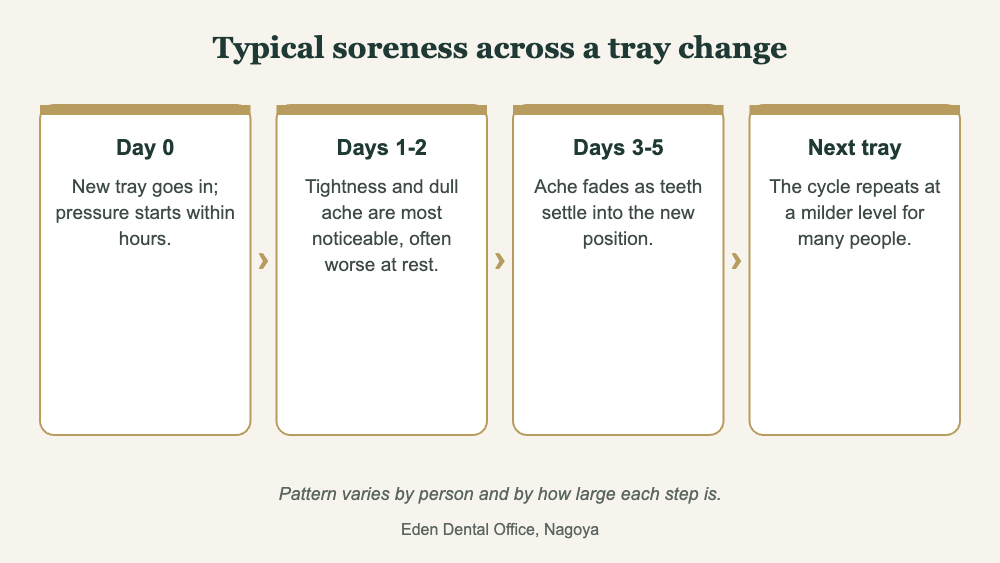
Patients typically describe a pressure or tightness across several teeth rather than a pinpoint pain. It tends to begin within hours of inserting a new tray, is most noticeable on the second day, and settles over the following few days. Teeth that are moving most in that stage, often crowded or rotated front teeth, feel it more. Soreness is often more obvious when you are not eating, because biting on a tray can actually distract from it, and some people notice it at night. This is a normal response of the ligament around the tooth to controlled force. It is not damage.
Our overview of clear aligners in Japan covers the full timeline, and tray changes are one reason a treatment plan spaces its steps the way it does.
What the research shows
A 2020 systematic review in Progress in Orthodontics pooled seven comparative studies and concluded, with moderate certainty, that patients treated with one branded aligner reported lower pain than those with fixed braces during the first few days, and that differences were not noted afterwards, up to three months (PMID 31956934). It also cautioned that the included cases were mostly mild malocclusions. A more recent prospective study of 87 adults in the American Journal of Orthodontics and Dentofacial Orthopedics compared pain over six months and found similar pain at the first appointment, with aligner pain intensity remaining minimal while braces pain rose whenever a new wire was introduced (PMID 39078353). Neither study means that aligners are comfortable for everyone; they describe averages.
| Stage | What patients commonly report | What to do |
|---|---|---|
| First 24 hours of a new tray | Pressure, tightness, mild tenderness | Keep wearing the tray as prescribed; eat soft food |
| Days 2 to 3 | Peak ache, sometimes at rest or at night | Cool or soft food; avoid biting hard on the tray |
| Days 4 to 7 | Ache fading | Continue as planned |
| Beyond a week, or sharp pain in one tooth | Not a typical adjustment pattern | Contact your dentist and send photos |
The first tray is not always the sorest
One carefully designed prospective study followed 27 adults across a week with no appliance, a week with a passive “dummy” aligner, and then two active aligners. Tooth pain was mild throughout and was actually greater with the passive tray than with the first and second active trays; masticatory muscle soreness was mild and clinically not relevant, and both were influenced by stress and trait anxiety (PMID 32898936). The sample was small, so it should be read as a signal rather than a rule. The practical message is that expectation and stress shape how sore a tray feels, which is one reason a clear explanation in your own language at the start of treatment matters.
Jaw and muscle soreness
The same study linked frequent oral behaviours with more muscle soreness during aligner therapy. If you clench or grind, a tray can make the habit more noticeable, and a sore jaw on waking is worth mentioning at your review. We cover this separately in clear aligners and teeth grinding. Attachments, the small tooth-coloured shapes bonded to teeth, can also create a localized pressure point; see aligner attachments in Japan for what they do and when they are adjusted.
When soreness is not normal
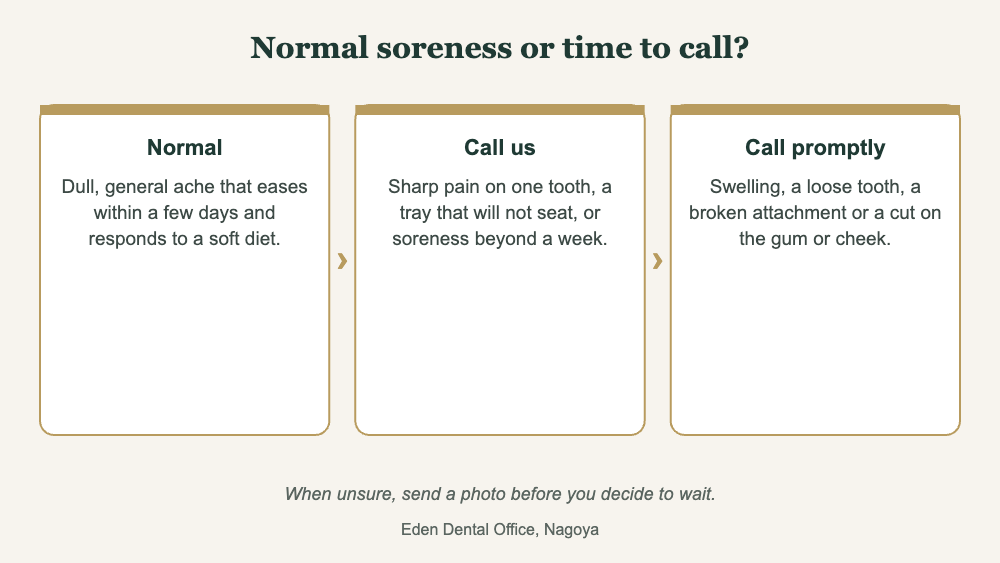
Contact your dentist if any of the following occurs: a sharp, localized pain that does not ease; a tray that no longer seats fully after a change; swelling of the gum or face; a tooth that feels loose; a cut or ulcer from a rough tray edge; or an attachment that has broken or come off. These are mechanical or biological problems that wait poorly. A tray that was fabricated from an older scan can also fit badly, and the answer is a review of the plan rather than pushing on. If you compare approaches, our article on clear aligners versus braces for adults sets out where each has strengths.
Managing soreness sensibly
Soft food and cool drinks help many people, as does changing trays at a time when you can rest, such as in the evening. Wear the tray for the hours your plan specifies; removing it for long periods to avoid soreness tends to prolong the adjustment and can set the schedule back. If you want to take a pain reliever, ask your dentist or a pharmacist in Japan which one suits your health and medications; we do not give dosing advice in articles. Chewable seaters, if prescribed, are used for short periods and not as a substitute for a properly seated tray.
How we approach it at Eden
Treatment planning at Eden is led by Dr. Murai, a prosthodontist, from the first consultation through your final retainers, in unhurried appointments and with a written plan and estimate in English. Soreness is part of the conversation from the start: we explain what to expect at each tray change, and you can message the clinic with photos between visits. The first visit is ¥15,000. Learn more about our dentist on the About page, or see why patients choose an English-speaking dentist in Nagoya for treatment that needs several visits.
Frequently asked questions
Is it normal for my teeth to hurt with clear aligners?
Yes. Mild soreness or pressure is expected, especially in the first two days after a new tray. Studies describe it as mild and short-lived for most adults, though individual experience varies.
Are clear aligners less sore than braces?
In the first days of treatment, several studies found less pain with clear aligners than with fixed braces. A 2020 systematic review found the difference did not persist beyond the early period.
Why does my jaw feel sore and not only my teeth?
Chewing and clenching muscles can ache while you adapt to a tray, particularly if you clench or grind. Frequent oral habits were linked with more muscle soreness in one prospective study.
How long should aligner soreness last?
For most people the ache fades within a few days of each tray change. Soreness that is sharp, localized or lasts beyond about a week deserves a review.
Can I send a photo if a tray feels wrong?
Yes. Patients can message the clinic on WhatsApp with photos of the tray and teeth, and we tell you whether it can wait for your next visit or needs to be seen.
Cost, risks and limits
This page is general information and does not replace an examination. Clear aligners can cause temporary soreness, gum irritation, tooth sensitivity and, in some cases, a need for additional trays or refinement. The fees on this site are published figures: the first visit is ¥15,000, and a written estimate for aligner treatment is given in English after assessment. Research cited here describes groups of patients, and the findings come from studies of different designs and sizes. Individual results vary.
If your teeth are sore and you want an opinion in English, message the clinic on WhatsApp or call 052-265-8996.
More on this topic: Aligner Guides — every article we have published in this cluster, grouped by stage.