
Clear Aligners vs Braces for Adults in Japan: How to Choose
Reviewed by Dr. Ryosuke Murai, DDS, MSD — Prosthodontist, trained at Indiana University School of Dentistry (U.S.). Last updated October 2026.
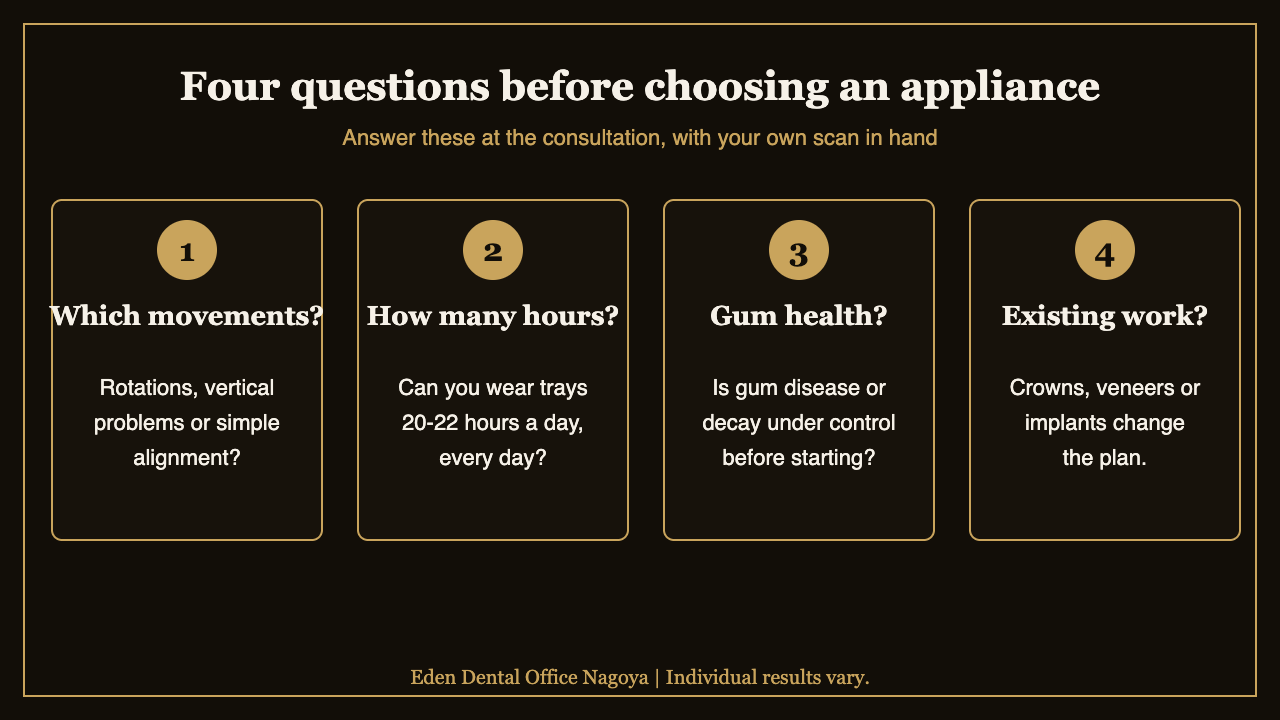
Adults who ask “aligners or braces?” are usually asking two questions at once: which looks better along the way, and which will actually finish the job. The honest answer to the second question depends on what your teeth need to do, not on which appliance you would rather wear. This guide compares clear aligners and fixed braces for self-pay adults in Japan who want a trustworthy plan before they commit. It is the framework we use when a patient raises the question at the consultation table, and our treatment overview shows where aligner care sits among our other services.
Start with the tooth movement, not the appliance
Every orthodontic appliance does the same biological job: it applies a steady, gentle force so that bone remodels around a tooth. What differs is how precisely the appliance can steer the tooth while that happens. A fixed bracket is bonded to the tooth and holds the wire’s shape around the clock. A clear aligner is a plastic shell that pushes from the outside, and it can only push on surfaces it can grip.
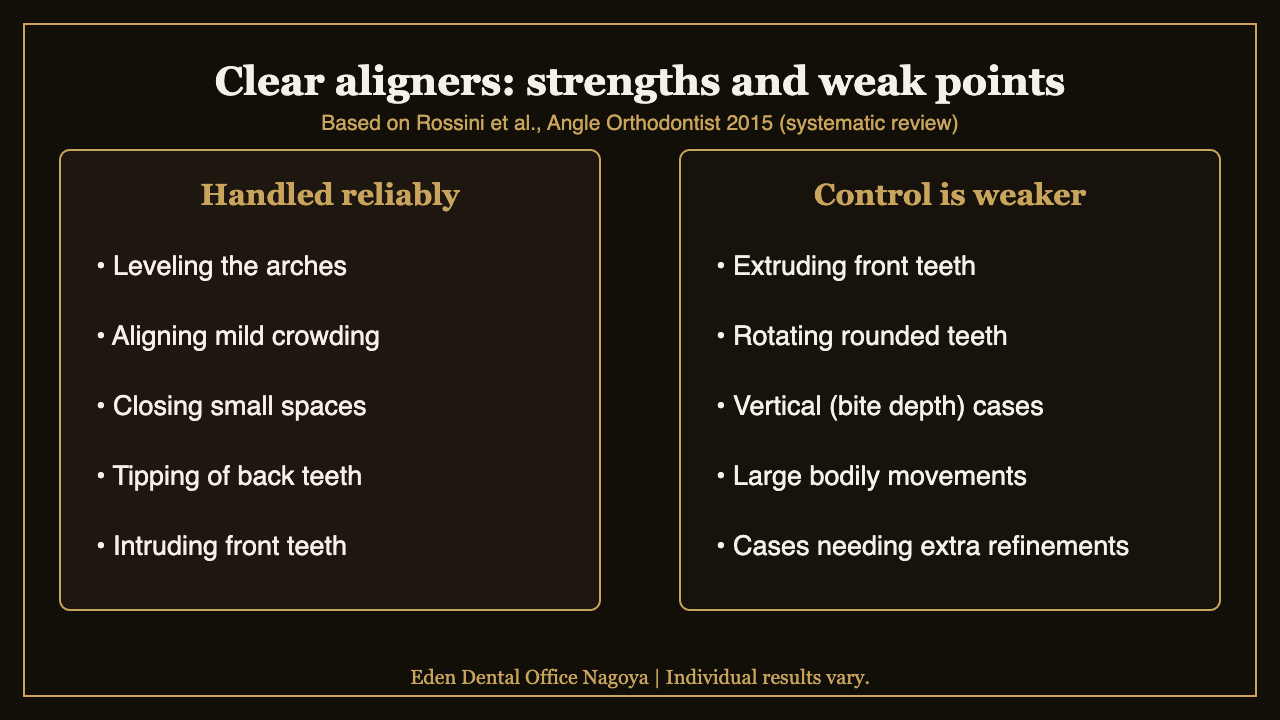
That is why the published evidence reads the way it does. In a systematic review of aligner studies, Rossini and colleagues (Angle Orthodontist, 2015;85(5):881–889) found that aligners level and align the dental arches reliably, but that control is weaker when front teeth need to be extruded and when rounded teeth such as canines and premolars need to rotate. The authors also cautioned that the studies behind the review were few and uneven in quality, which is worth remembering whenever a brochure sounds certain.
Where each appliance tends to fit
The table is a starting point for a conversation, not a diagnosis. Your own scan and bite decide which row applies to you.
| Situation | Clear aligners | Fixed braces |
|---|---|---|
| Mild to moderate crowding or spacing | Usually a good fit | Works, but more visible |
| Rotated canines or premolars | Possible; often needs extra attachments and refinements | Generally more predictable |
| Vertical problems (deep or open bite) | Depends on the pattern; extrusion is a weak point | More direct control |
| Appearance during treatment | Nearly invisible and removable | Brackets show (ceramic options exist) |
| Eating and cleaning | Trays out for meals and brushing | Food traps; interdental brushes needed |
| Reliance on daily discipline | High: works only when worn | Low: always on |
| Teeth with crowns, veneers or implants | Workable with careful planning | Restoration material affects bonding |
Gum health should not be the deciding factor
Patients are often told that aligners are healthier for the gums because the trays come out. The evidence is more modest. A systematic review of systematic reviews by Di Spirito and colleagues (Healthcare, 2023;11:1340) found that aligners showed slightly better plaque, gum inflammation and probing-depth results at some follow-up points, but that the differences were clinically negligible. It concluded that periodontal health with the two approaches should be considered comparable, and it found no evidence to support aligners as the first-line choice for people at risk of gum disease.
The practical reading is that your brushing and professional cleaning habits matter more than the appliance. Removable trays make cleaning easier; they do not remove the need for it. Active gum disease needs treating before any appliance goes on.
Compliance is the variable people underestimate
Fixed braces work whether or not you remember them. Clear aligners work only for the hours they are in your mouth, and clinicians typically ask for roughly 20 to 22 hours a day, with the trays out only to eat, to drink anything other than water, and to clean. For an executive who travels every week or eats out most nights, that is a real constraint rather than a footnote. When trays spend too many hours in a case, they stop fitting and the plan drifts, which is the situation we describe in our guide to aligners that stop tracking and the limits of remote review.
An honest self-assessment helps here. If you know you will lose trays, skip evenings, or need long gaps between visits, say so at the first consultation. Choosing the right appliance at the start costs far less than rescuing the wrong one in month eight.
Combined and finishing approaches
The choice is not always either-or. Some cases start with fixed appliances to solve a difficult rotation or vertical problem and finish with aligners for the final detailing; others use aligners throughout, with bonded attachments and small refinements along the way. Either route ends in the same place: retainers. Our guide to retainers after aligner treatment explains what to expect once the active phase is over.
How we decide at Eden
A prosthodontist looks at an arch differently from a purely orthodontic eye. We start from where the teeth need to end up for a stable bite and a natural-looking smile, then work backwards. Every case begins with an intraoral scan, and where roots, bone or restorations matter we add a CBCT scan. We then simulate the planned movements digitally in our Digital Smile Design workflow, and our in-house digital laboratory and 3D printers let us produce retainers and provisional restorations on site.
If the simulation shows movements that aligners handle poorly, we tell you in writing, and you are free to take the plan to an orthodontist of your choice. The same conversation covers the less visible parts of a plan: attachments, the small amount of enamel reduction that creates space in some cases, and what changes if you already have crowns, veneers or implants. For the full overview of how we approach aligner care, see our guide to clear aligners in Japan.
What this costs in Japan
Adult orthodontic treatment for appearance generally falls outside Japan’s national health insurance, so with either appliance it is a self-pay decision. We publish package prices only for treatments that can be priced as packages: a comprehensive check-up at ¥40,000, a whitening package at ¥75,000, and annual membership tiers from ¥88,000 to ¥288,000. Orthodontic cost cannot be read from a list, because it depends on the number of aligner stages or months in braces, the number of attachments or brackets, the refinements a case needs, and the retainers at the end.
What we commit to is the process: an itemized written estimate in English before treatment begins, with retainers listed as their own line. Our published fee information explains the structure, and interest-free monthly payment is available for self-pay treatment.
Frequently asked questions
Are clear aligners as effective as braces for adults?
For mild to moderate alignment problems, often yes. For rotations of rounded teeth and some vertical movements, fixed braces can be more predictable, and the research on aligners is still limited.
Which is faster, aligners or braces?
Neither wins by default. Duration depends on the movements required and, for aligners, on how consistently the trays are worn. Ask for the planned number of stages in writing.
Do aligners hurt less than braces?
Both can cause soreness after a new tray or an adjustment. How much varies from person to person, so we do not promise a particular experience.
Can I switch from braces to aligners partway through?
Sometimes, usually as a finishing step. It needs a fresh scan and a revised plan rather than a simple swap.
Do I need retainers with either appliance?
Yes. Teeth tend to drift back toward their old positions without retention, whichever appliance moved them.
Risks and limits
Both approaches can cause tooth soreness, gum irritation, small changes at the enamel where attachments or brackets are bonded, gum recession in susceptible mouths, and, rarely, shortening of tooth roots. Teeth can relapse without retainers, and some cases need refinements that add time and cost. Treatment is not suitable until gum disease and decay are under control. Individual results vary.
If you would like a plan built around your own scan and schedule, our treatments page explains how to begin, and you can message us on WhatsApp in English to arrange a consultation.
More on this topic: Aligner Guides — every article we have published in this cluster, grouped by stage.