Dental Emergency in Nagoya: What to Do, in English

Reviewed by Dr. Ryosuke Murai, DDS, MSD — Prosthodontist, trained at Indiana University School of Dentistry (U.S.). Last updated November 2026.
A dental emergency in Nagoya is stressful when you do not speak Japanese, but the city has a clear system for it. Life-threatening swelling or bleeding goes to 119, advice on whether you need an ambulance is available on #7119 in English, and Nagoya City runs holiday dental centres for Sundays and public holidays. For pain, a broken tooth or a lost crown on an ordinary clinic day, an English-speaking dental office can usually see you sooner and explain the options in plain language. This guide sets out who to call, where to go, and what to do in the first hour.
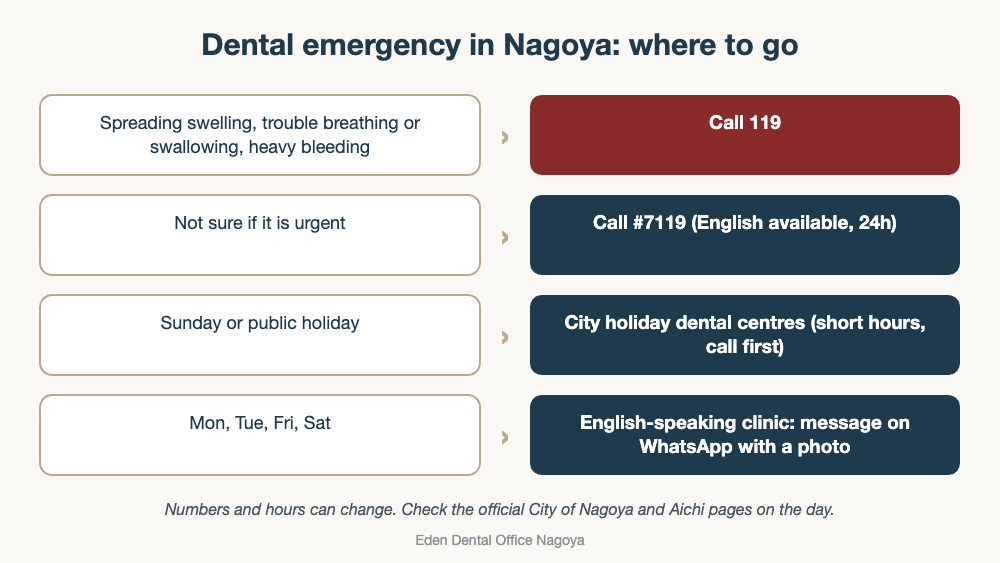
First: is it a medical emergency?
Some dental problems are not dental emergencies at all, but medical ones. Swelling that spreads to the eye, neck or floor of the mouth, difficulty breathing or swallowing, high fever with facial swelling, or bleeding that does not stop after 20 minutes of firm pressure need a hospital, not a dental chair. In Nagoya, call 119 for an ambulance; the city reports that 119 calls can be handled in 22 languages. If you are unsure whether to call an ambulance, the Kyukyu Anshin Center on #7119 gives advice 24 hours a day in 21 languages, including English, according to the Nagoya International Center.
For a facial injury after a fall or a sports accident, rule out a head injury first. A chipped tooth can wait an hour; a concussion cannot.
Where to go, by situation
| Situation | Where to go | Notes |
|---|---|---|
| Spreading swelling, trouble breathing or swallowing | Call 119 | Hospital emergency care |
| Unsure whether it is urgent | #7119 (or 052-951-7119) | 24 hours; English available |
| Tooth pain or broken tooth on a Sunday or public holiday | Nagoya City holiday dental centres | Short hours; call first |
| Pain, broken tooth or lost crown on a weekday or Saturday | A dental clinic, ideally English-speaking | Message ahead with a photo |
| Knocked-out adult tooth | A dentist immediately | Keep the tooth moist; time matters |
Sundays and public holidays: the city dental centres
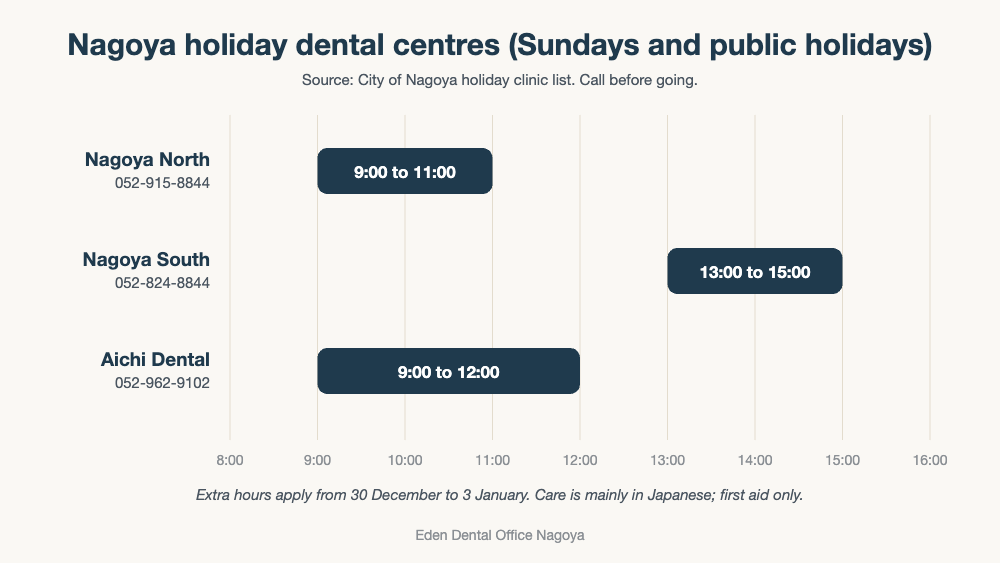
Nagoya City lists three dental centres that open on Sundays, public holidays and over the New Year break. The Nagoya North Dental Center (052-915-8844) opens from 9:00 to 11:00, the Nagoya South Dental Center (052-824-8844) from 13:00 to 15:00, and the Aichi Dental Medical Center (052-962-9102) from 9:00 to 12:00, with extra hours from 30 December to 3 January (City of Nagoya holiday clinic list). These centres provide first aid such as pain relief or a temporary dressing, with short opening windows, and they work mainly in Japanese, so it helps to have a Japanese speaker call ahead. For a full examination and an explanation in English, the next clinic day is usually the better choice.
For night-time and holiday medical care across the prefecture, the Aichi Emergency Medical Care Guide is available in English and lists hospitals with foreign-language support. Hours change, so always check the official page on the day.
The first hour: what you can do yourself
A knocked-out adult tooth is the one dental injury where minutes change the outcome. The International Association of Dental Traumatology guidelines treat avulsion as one of the most serious dental injuries and stress prompt, correct emergency management (Dent Traumatol 2020). Pick the tooth up by the crown, not the root, rinse it briefly in cold water if it is dirty without scrubbing, and either place it gently back in the socket or keep it in milk or in the cheek. Then go to a dentist straight away. Baby teeth are not put back in.
For a broken tooth, keep the fragment if you can find it. For a lost crown, keep the crown, avoid chewing on that side, and do not glue it back with household adhesive. For a toothache with facial swelling, a cold compress on the outside of the face and over-the-counter pain relief taken as labelled can help until you are seen, but swelling that spreads is a reason to call 119, as above. Fractures and loosened teeth are covered in a separate IADT guideline (Dent Traumatol 2020).
Urgent visits at an English-speaking clinic
On clinic days, an English-speaking practice saves you the step of translating symptoms and consent. At Eden, an English-speaking dentist in Nagoya two minutes from Fushimi Station, the same prosthodontist who examines you explains the findings and options in English and carries out any temporary treatment. We are open Monday, Tuesday, Friday and Saturday, and we try to make room for urgent problems when the schedule allows. The quickest route is a WhatsApp message with a photo, when the problem started, and whether there is swelling or fever.
In our clinic, the aim of an emergency visit is to stop pain and protect the tooth, not to start a large treatment on the spot. Where a crown, implant or root canal is needed later, we plan it separately with a written estimate in English. If you are visiting Nagoya and fly soon, read flying after dental treatment in Japan, and for planning a longer course of care see planning dental treatment in Nagoya. Clinic background and the dentist’s training are on our about page.
What an emergency visit costs
Our emergency consultation is ¥25,000 for 30 to 45 minutes, as listed on the fees page. The time is reserved for you alone, and the examination, explanation and any first-stage treatment are carried out by the prosthodontist personally. X-rays, temporary treatment and medication are charged separately and explained before we do them, so there are no surprises on the invoice. Care at Eden is entirely private, which is what allows an unhurried appointment and a full explanation in English. For how we work with international patients more generally, see English-language dental care in Japan.
Frequently Asked Questions
What should I do if I have a dental emergency in Nagoya at night?
For severe swelling, difficulty breathing or swallowing, or heavy bleeding, call 119. For advice on whether you need an ambulance, call #7119, which offers consultations in English and other languages, 24 hours a day.
Is there an emergency dentist open on Sundays in Nagoya?
Yes. Nagoya City lists holiday dental centres that open on Sundays, public holidays and over the New Year period for limited morning or early-afternoon hours. Call before going, as hours are short.
Can Eden Dental Office see me the same day for tooth pain?
On clinic days (Monday, Tuesday, Friday and Saturday) we try to make room for urgent problems when the schedule allows. Message us on WhatsApp with a photo and a short description, and we will reply with what we can offer.
How much is an emergency dental visit at Eden?
Our emergency consultation is ¥25,000 for 30 to 45 minutes. X-rays, temporary treatment or medication are charged separately, and we explain any additional cost before doing it.
What should I do if an adult tooth is knocked out?
Hold it by the crown, not the root, rinse it briefly if dirty, and keep it moist in milk or in your mouth. See a dentist as quickly as possible, ideally within the hour.
If you are travelling in from the airport or by train, see our route guide on getting to a Nagoya dental office from Centrair or the Shinkansen.
Limits and what to expect
This page is general information and does not replace an examination. Emergency phone numbers, holiday clinic hours and services can change, so confirm them on the official City of Nagoya and Aichi pages on the day. Temporary treatment relieves symptoms but often needs follow-up care, and outcomes after injuries such as a knocked-out tooth depend on the time elapsed and how the tooth was stored. Individual results vary.
If you have pain or a broken tooth and would like to be seen in English, message the clinic on WhatsApp and we will tell you what we can offer.
If you are in Nagoya on a work assignment, see dental planning for a Nagoya work assignment for a timeline.
Related: reaching the clinic from Fushimi Station.
More on this topic: Trip Planning Guides — every article we have published in this cluster, grouped by stage.