Nagoya Tap Water and Fluoride Toothpaste: An Expat Guide
Reviewed by Dr. Ryosuke Murai, DDS, MSD — Prosthodontist, trained at Indiana University School of Dentistry (U.S.). Last updated November 2026.
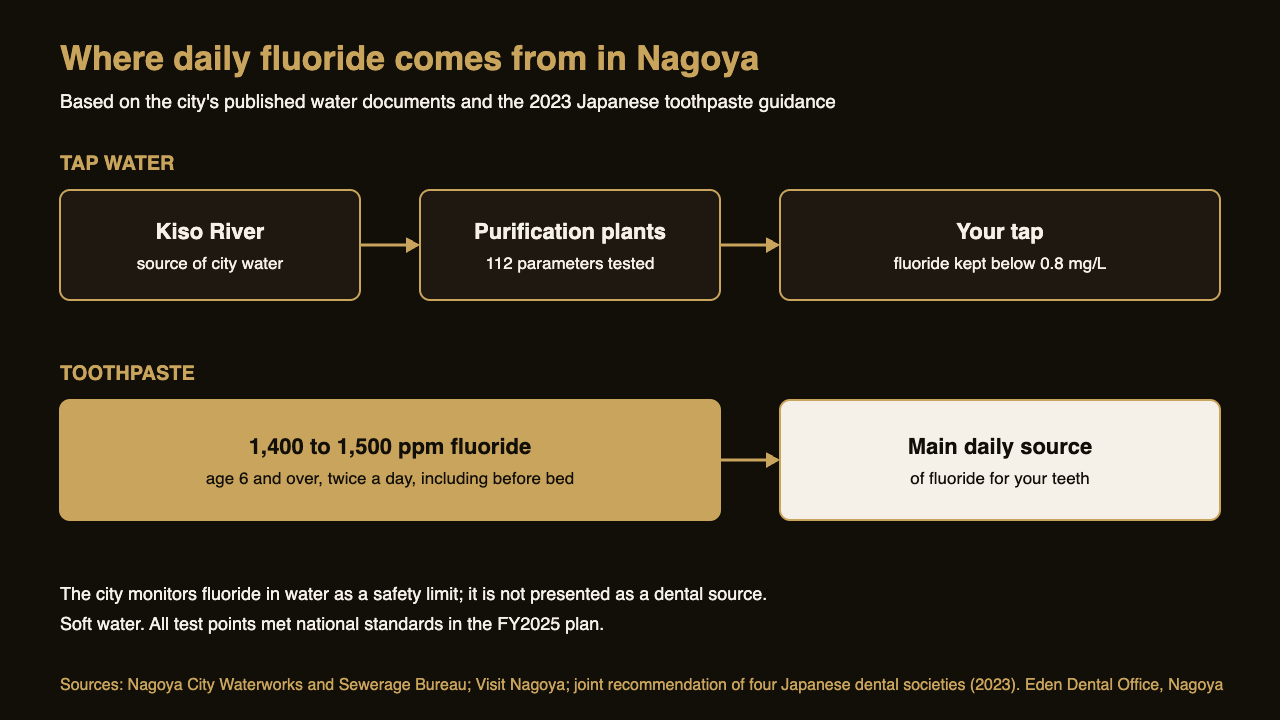
Is Nagoya’s tap water fluoridated, and should you change your toothpaste after moving here? Nagoya’s water is drawn from the Kiso River, it is soft, and the city monitors fluoride against an upper limit of 0.8 mg/L as part of routine safety testing. If you grew up with fluoridated tap water, the practical step in Nagoya is to rely on toothpaste for your daily fluoride: Japanese dental societies recommend 1,400 to 1,500 ppm fluoride toothpaste for everyone aged six and over. This guide explains what the city’s own documents say, how to read Japanese toothpaste packaging in English terms, and how home care fits around private appointments with an English-speaking dentist in Nagoya.
Where Nagoya’s tap water comes from
The city’s official tourism and information site describes Nagoya’s tap water as purified water drawn from the Kiso River, which rises in the mountains of Nagano Prefecture. The city tests 112 water quality parameters: 52 required under Japan’s Water Supply Act and 60 set by the city itself (Visit Nagoya, City of Nagoya). Public refill stations across the city let residents and visitors fill their own bottles.
For most newcomers the first question is simply whether the tap water is safe to drink. The city’s position is that it is, and many long-term residents drink it daily. The dental question is slightly different: whether that water is contributing fluoride in the way it might have at home.
What the city’s testing plan says about fluoride
The Nagoya City Waterworks and Sewerage Bureau publishes an annual water quality testing plan. The plan for fiscal 2025 lists fluoride and its compounds among the regulated items, with a standard of 0.8 mg/L, tested twelve times a year both at household taps and at the outlets of the purification plants. It states that all test points met the national standards, and it describes Nagoya’s water as soft (Nagoya City Waterworks and Sewerage Bureau, FY2025 testing plan, PDF in Japanese).
In other words, fluoride appears in the plan as something kept below an upper limit, alongside other naturally occurring elements. The plan does not present the water as a source of fluoride for dental health. For anyone used to community water fluoridation, it is sensible to plan as though your daily fluoride now comes mainly from toothpaste.
Fluoride toothpaste in Japan: the 2023 recommendation
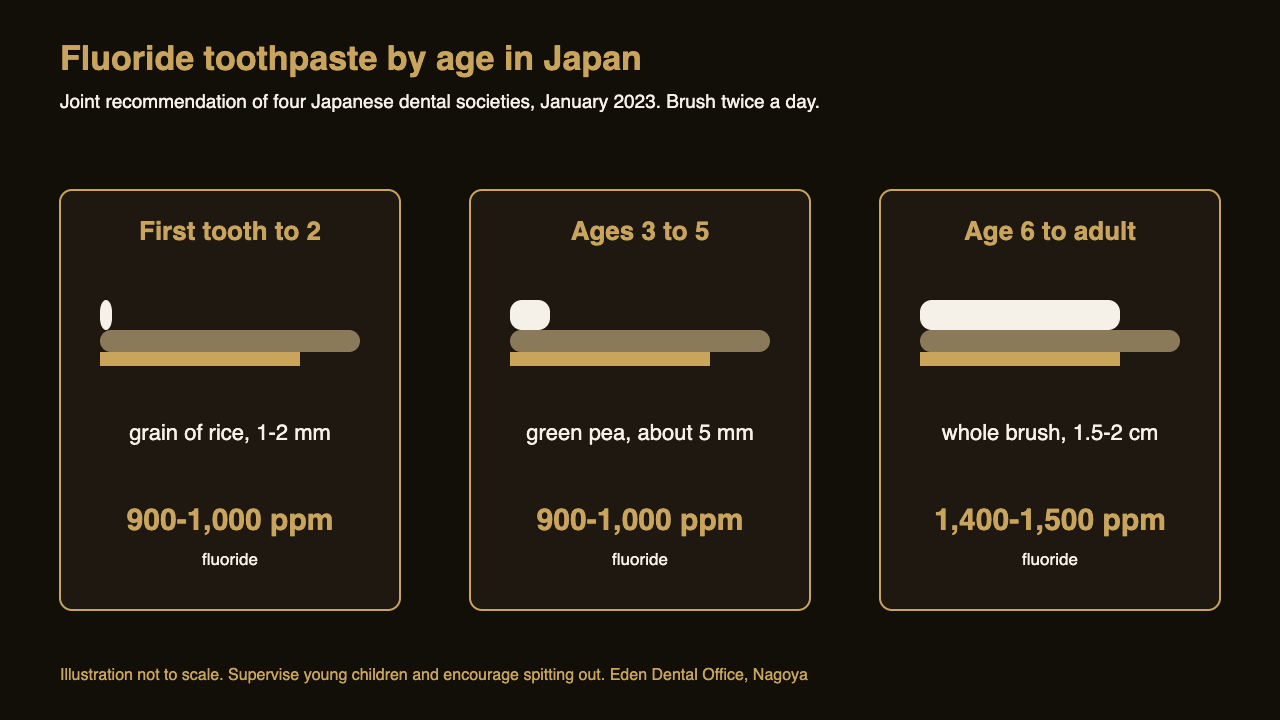
On 1 January 2023, four Japanese dental societies, the Japanese Society for Oral Health, the Japanese Society of Pediatric Dentistry, the Japanese Society of Conservative Dentistry and the Japanese Society of Gerodontology, issued a joint recommendation on fluoride toothpaste by age. The Tokyo Metropolitan Government republished it for residents (Tokyo Metropolitan Government, PDF in Japanese). The guidance is summarised below.
| Age | Amount of toothpaste | Fluoride concentration |
|---|---|---|
| First tooth to age 2 | About the size of a grain of rice (1 to 2 mm) | 900 to 1,000 ppm |
| Ages 3 to 5 | About the size of a green pea (around 5 mm) | 900 to 1,000 ppm |
| Age 6 to adults and older adults | Across the whole brush head (1.5 to 2 cm) | 1,400 to 1,500 ppm |
The societies recommend brushing twice a day for every age group, including once before bed. Japanese packaging usually prints the fluoride level as a number in ppm, often 1,450 ppm on adult products, so the figure is easy to find even if the rest of the label is in Japanese.
Buying dental products in Nagoya
Drugstores around Nagoya Station, Sakae and Fushimi stock adult fluoride toothpaste, children’s toothpaste, floss and interdental brushes in several sizes. Department stores and larger variety stores carry a wider range, and electronics retailers sell electric toothbrush replacement heads. A few practical points help:
Check the ppm figure rather than the brand name, since familiar international brands may be sold in Japanese formulations. Interdental brushes are sized by number; if you used them at home, bring an old one so the size can be matched, or ask us to measure the spaces between your teeth at your visit. If you have crowns, bridges or implants, ask which brushes suit them before buying in bulk.
Families and children
Children follow the smaller amounts in the table above. Families with school-age children will also receive a Japanese school dental examination form each year; our guide to school dental check-up results in Nagoya explains how to read it. For the wider picture of settling in, see dental planning for a Nagoya work assignment and our page on English dental and medical help in Nagoya.
How we look at home care at Eden
In our clinic, home care is planned around what we find at the examination, not a generic leaflet. The same prosthodontist examines your teeth, reviews your restorations and sets out a written plan in English, including which toothpaste strength, brush and interdental sizes suit your mouth. Appointments are private and unhurried, which leaves time to go through products you have bought locally. Patients who visit from outside Nagoya can read how a visit fits into a day in our guide to dental visits near Fushimi Station, and more about planning in the Nagoya dental visit guide.
What it costs
The first visit is ¥15,000 and the check-up package is ¥40,000. Annual memberships range from ¥88,000 to ¥288,000 per year. Any treatment found to be needed is quoted as a written estimate in English before it begins.
Frequently asked questions
Is Nagoya tap water fluoridated?
The city’s testing plan monitors fluoride against an upper limit of 0.8 mg/L as part of water safety. It does not describe the water as a source of fluoride for dental health, so it is sensible to rely on fluoride toothpaste.
Is Nagoya tap water safe to drink?
The city tests 112 parameters and reports that all test points meet the national standards. Many residents drink it daily, and refill stations are available across the city.
What fluoride toothpaste should adults use in Japan?
The 2023 joint recommendation from four Japanese dental societies advises 1,400 to 1,500 ppm fluoride toothpaste for everyone aged six and over, about 1.5 to 2 cm on the brush, twice a day.
How do I find the fluoride level on Japanese toothpaste?
Look for a number followed by ppm on the box or tube. Adult products commonly show 1,450 ppm. Children’s products are usually lower.
Can I bring my usual toothpaste from home?
Yes. Check its fluoride level against the table above. If you use special products for sensitivity or around implants, bring them to your first visit so we can review them with you.
Risks and limits
Fluoride toothpaste lowers the risk of decay but does not remove it; diet, saliva, existing restorations and cleaning between the teeth all matter. Young children should use the small amounts shown and be supervised so they spit rather than swallow. Water quality information here is taken from the city’s published documents and may change; check the Waterworks and Sewerage Bureau for current data. This article is general information, not a personal diagnosis. Individual results vary.
To arrange a first visit, message the clinic on WhatsApp or call 052-265-8996. You can read more about Dr. Murai and the clinic before you come.
More on this topic: Trip Planning Guides — every article we have published in this cluster, grouped by stage.