What to Eat After Teeth Whitening in Japan: Is a White Diet Needed?
Reviewed by Dr. Ryosuke Murai, DDS, MSD — Prosthodontist, trained at Indiana University School of Dentistry (U.S.). Last updated November 2026.
What can you eat after teeth whitening, and do you really need a strict “white diet”? Two reviews of clinical studies have found that coffee, tea, red wine, cola and even an unrestricted diet did not measurably reduce the colour change achieved by peroxide whitening. For most people in Japan, that means a calm, sensible approach for the first 48 hours after an in-office session rather than weeks of plain rice and milk. This guide explains what the evidence shows, which Japanese foods and drinks are worth timing with a little care, and how we plan aftercare as part of private aesthetic treatment at our Nagoya practice.
Where the white diet idea came from
Peroxide gels change the enamel surface for a short time. Straight after a session the teeth are slightly dehydrated, which makes them look whiter than they will a week later, and the enamel is a little more permeable while it rehydrates. From this, many clinics reasoned that pigments in food would soak in more easily, and patients were told to avoid anything darker than a white shirt for days or even the whole course of treatment.
The reasoning came largely from laboratory work, where enamel slabs are left in coffee or wine for hours at a time. The mouth is a different place. Saliva dilutes and clears what you drink within minutes, a thin protein film called the pellicle re-forms quickly, and contact with any one food is brief. The clinical question is whether people who keep eating normally end up with a less white result. That has now been studied directly.
What the clinical studies found
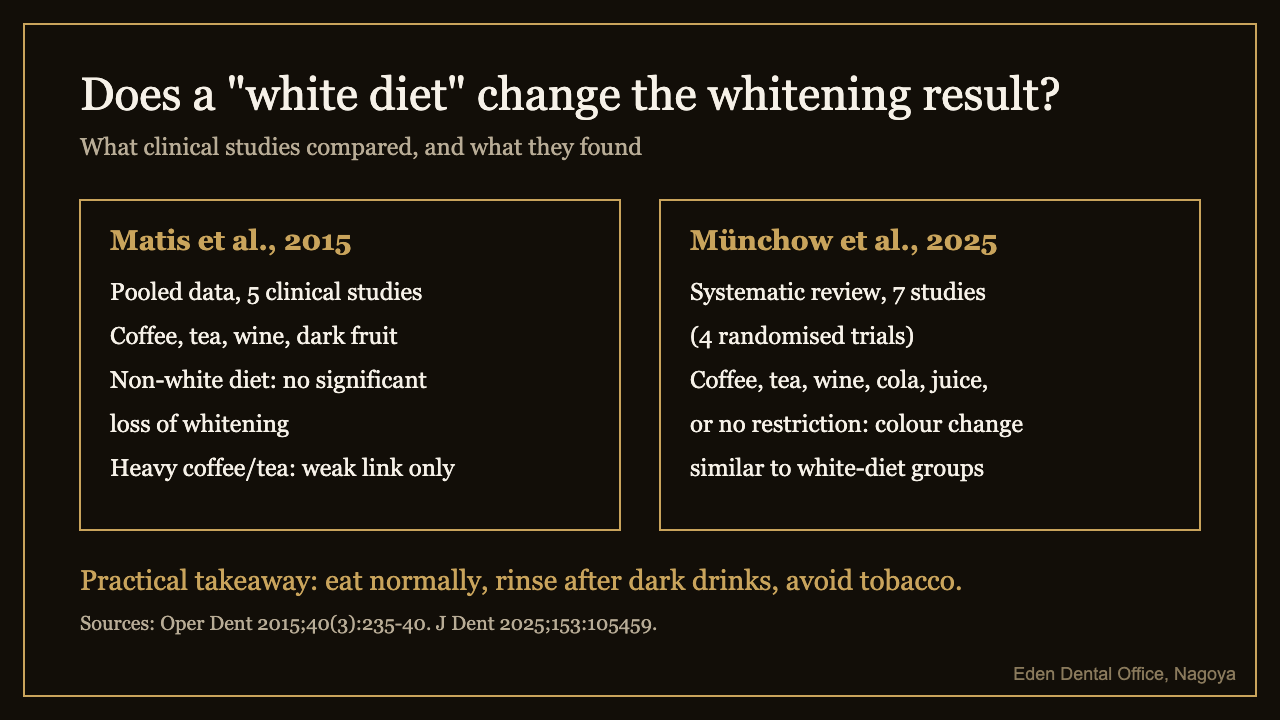
An analysis in Operative Dentistry pooled data from five clinical whitening studies and compared patients who did and did not consume coffee, tea, wine and dark fruits during treatment. A non-white diet was not significantly associated with less whitening; among people who drank large amounts of coffee or tea there was only a weak association (Matis et al., 2015).
A 2025 systematic review and network meta-analysis in the Journal of Dentistry included seven clinical studies, four of them randomised trials. Groups that drank grape juice, coffee, tea, red wine or cola, or who ate without restriction, reached a colour change similar to control groups, and the authors rated the evidence as moderate in quality (Münchow et al., 2025).
These studies have limits. Follow-up was mostly short, participants generally had healthy enamel, and the gels and protocols varied. They tell us that ordinary eating does not undo the whitening process itself. They do not say that dark drinks have no long-term effect: surface stain still builds up over months, which is a separate question covered in our article on how long whitening lasts and why it fades.
A practical 48-hour plan instead of a strict diet
We no longer ask patients to give up coffee or matcha for weeks. We do suggest a little care in the first two days, mainly for comfort and because rinsing is an easy habit to start. The table compares the first 48 hours with the period afterwards.
| Food or drink | First 48 hours after an in-office session | After 48 hours |
|---|---|---|
| Coffee and black tea | Fine if you want it; drink rather than sip over hours, then rinse with water | Normal; the water rinse helps slow surface stain |
| Matcha and strong green tea | Fine; matcha is the drink we most often suggest rinsing after | Normal |
| Red wine | Moderate amounts; it is both acidic and pigmented | Normal |
| Soy sauce, curry, tomato sauces | Fine as part of a meal | Normal |
| Iced drinks, very hot soup, citrus, carbonated drinks | Limit if your teeth feel sensitive | Normal once sensitivity settles |
| Tobacco | Avoid | Avoid; it is the strongest driver of stain return |
Sensitivity changes the menu more than colour does
If anything shapes what you eat in the first two days, it is sensitivity rather than staining. After an in-office session, sensitivity usually peaks in the first 24 to 48 hours and then fades. Temperature extremes and acidic drinks are what most often set it off, so lukewarm tea, room-temperature water and softer meals make the evening more comfortable. Our guide to tooth sensitivity after whitening explains why it happens and what helps, including potassium nitrate toothpaste.
Take-home trays: eating between sessions
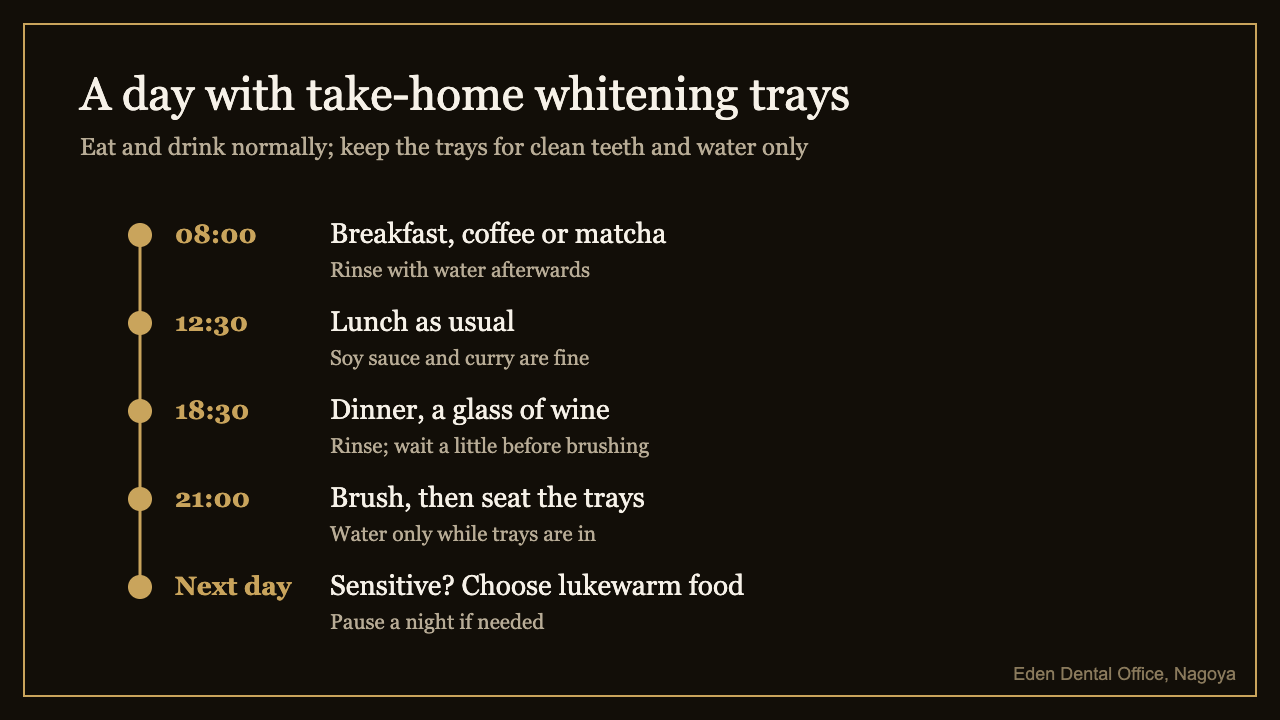
With custom trays used at home over about two weeks, the practical rules are simple. Do not eat or drink anything other than water while the trays are in. Brush and rinse before you seat them, so you are not sealing food against the teeth. After an acidic drink such as wine, cola or citrus juice, it is reasonable to rinse with water and wait a little before brushing. Coffee in the morning and trays in the evening is a routine that works well for many patients. If you are deciding between trays and a clinic session, our comparison of at-home and in-office whitening sets out the differences.
Keeping the shade after the first week
The shade you see on the first day is not the shade you keep. Over roughly a week the teeth rehydrate and settle, which is normal and not a sign of stain. Over the following months, colour returns slowly with diet, smoking and age. Rinsing after coffee and tea, regular professional cleaning, and an occasional short touch-up keep the result steady. Whitening toothpaste can help with surface stain, as discussed in whitening toothpaste for coffee and wine stains, and our article on whitening versus cleaning explains which one removes what.
How we plan aftercare at Eden
In our clinic, we record a baseline shade with a shade guide and photographs under consistent lighting before whitening begins. We review the colour at about one week, after the teeth have rehydrated, so that the comparison is fair. Dr. Murai sees each patient from the first assessment to that review, in unhurried private appointments, and you receive written instructions in English that reflect your own habits: a daily matcha, an evening glass of wine, or a long-haul flight home. For a full overview of options and timelines, see our guide to teeth whitening in Japan. Patients travelling in for treatment can read how to reach us in getting to our Nagoya office from Centrair or the Shinkansen.
What it costs
The first visit is ¥15,000 and the whitening package is ¥75,000. The check-up package is ¥40,000, and annual memberships range from ¥88,000 to ¥288,000 per year. If a front filling or crown would no longer match after whitening, any replacement is quoted after assessment as a written estimate in English before it begins. Details of the whitening service are on our aesthetic treatment page.
Frequently asked questions
Do I need a white diet after teeth whitening?
Clinical studies have not found that a strict white diet improves the final shade. Normal eating is generally fine; we suggest rinsing with water after dark drinks and avoiding tobacco.
Can I drink coffee after teeth whitening?
Yes. In the clinical studies, coffee drinkers reached a colour change similar to people who avoided it. Drinking it in one go and rinsing with water afterwards helps limit surface stain over time.
Is matcha or green tea a problem after whitening in Japan?
No more than coffee or black tea. Matcha is strongly pigmented, so a water rinse afterwards is a sensible habit, especially in the first two days.
How long should I wait to eat after an in-office whitening session?
There is no strong evidence for a fixed waiting period. Most patients eat their next meal as usual. If your teeth feel sensitive, choose lukewarm, non-acidic food for the rest of the day.
Does smoking affect whitening results?
Smoking is one of the main causes of stain returning after whitening. Stopping, or at least reducing it, has more effect on how long the result lasts than any food rule.
Risks and limits
Whitening can cause temporary sensitivity and gum irritation, and it does not change the colour of crowns, veneers or fillings. How much the colour changes, and how long it lasts, depends on the starting shade, the cause of discolouration, enamel thickness and habits such as smoking. The research summarised here covers short-term results with healthy enamel; people with exposed roots, worn enamel or existing restorations need individual assessment. This article is general information, not a personal diagnosis. Individual results vary.
To arrange a first visit, message the clinic on WhatsApp or call 052-265-8996. You can read more about Dr. Murai and the clinic before you come.
More on this topic: Whitening Guides — every article we have published in this cluster, grouped by stage.