School Dental Check-Up Results in Nagoya: Reading the Form
Reviewed by Dr. Ryosuke Murai, DDS, MSD — Prosthodontist, trained at Indiana University School of Dentistry (U.S.). Last updated November 2026.
A small slip comes home in your child’s school bag, written in Japanese, with letters such as C, CO or GO beside a chart of teeth. For many international families in Nagoya this is the first contact with the Japanese school dental check, and the form raises more questions than it answers. This guide explains what the codes mean, which ones usually call for a visit and which simply ask you to keep an eye on things, and how to bring the form to a dental appointment conducted in English.
How the school dental check works in Nagoya
Children enrolled in Nagoya’s municipal schools — usually through the ward office, as the Nagoya International Center explains for elementary school enrolment — take part in a dental examination by the school dentist during the school year. The results are sent home to families. A May 2025 press release from the Nagoya City Board of Education reported that, in fiscal 2024, schools sent results notices home between one and three times, most commonly twice, and that schools encouraged families to follow up with a dentist where needed (Nagoya City Board of Education).
The same release gives useful context: the average number of adult teeth affected by decay at age 12 was 0.30 in Nagoya in 2024, against a national average of 0.53. In other words, most children’s results are fine, and the notice is a screening tool rather than a diagnosis. Its job is to flag what deserves a closer look.
What the codes on the form mean
The codes follow guidance published by the Japan Association of School Dentists (JASD flowchart and points of oral health diagnosis). The table below summarises them in plain English.
| Code | What the school dentist saw | Usual next step |
|---|---|---|
| C | An untreated cavity with a visible hole | Book a dental visit for treatment |
| CO | Early signs such as white or brown spots, without a hole | Watch closely; brushing and diet advice |
| G | Gum disease that needs a dentist’s examination | Book a dental visit |
| GO | Plaque and mild gum inflammation, no tartar | Better daily cleaning and a recheck |
| 0 / 1 / 2 | Scores for jaw joint, bite and alignment, and plaque | 2 usually means a visit; 1 means observe |
| ○ / △ / × | Treated tooth / adult tooth lost to decay / baby tooth to review | Discuss at the visit |
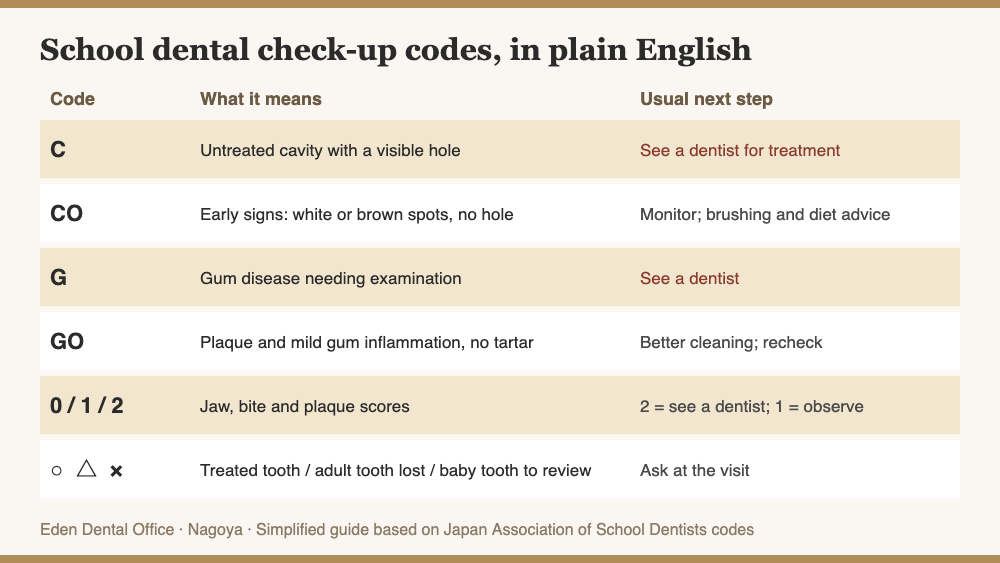
Two points tend to reassure parents. First, CO and GO describe things to watch, not things to treat today; the JASD guidance pairs them with monitoring and advice. Second, a school dentist may still write a note recommending a consultation — for example, where there are several early spots or discolouration next to an existing filling. If the slip includes a handwritten note you cannot read, bring it along and we will go through it with you.
Helping CO and GO improve at home
Because CO and GO are early, reversible-stage findings, the most useful response is often at home rather than in the chair. Plaque left along the gum line is what drives GO, so the focus is a careful brush where the teeth meet the gums, twice a day, with flossing where teeth touch. Younger children usually need a parent to finish the brushing for them, especially at night. For CO spots, how often sugary snacks and drinks are taken matters more than the amount: grazing through the afternoon keeps teeth under acid attack for longer than a single treat after a meal.
Toothpaste strength matters for these codes. Our guide to Nagoya tap water and fluoride toothpaste explains what the city’s water does and does not do for teeth, and how to read fluoride levels on Japanese tubes.
We look at these early findings at the first visit, explain what we see with photos where helpful, and suggest a recheck interval that fits the result rather than a fixed schedule. A child whose spots are stable may need little more than a review; a child with several active areas may benefit from closer follow-up and professional cleaning. The aim is that the next school notice comes home with fewer codes on it.
When to book, and what to bring
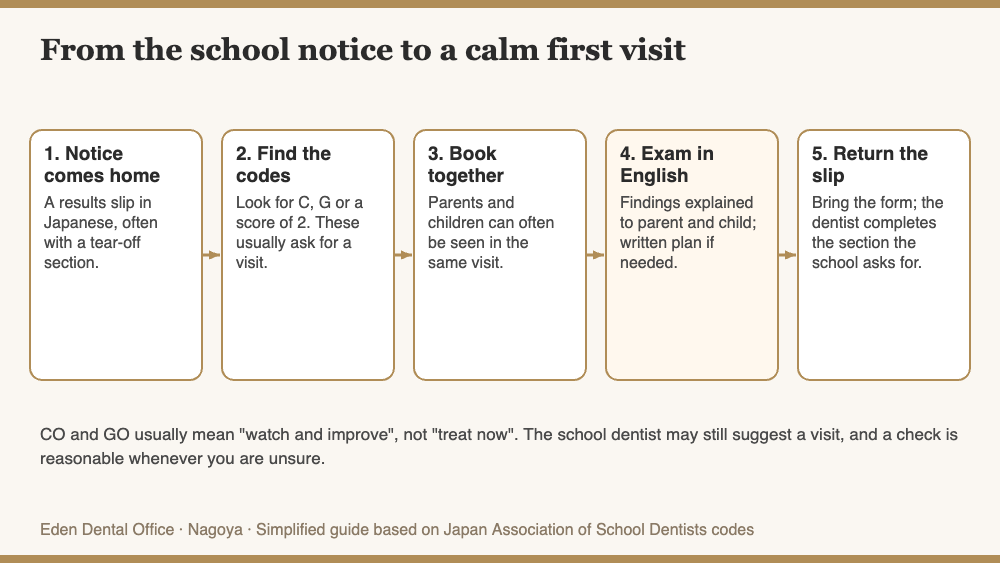
A C, a G or a score of 2 is a clear reason to book. A CO or GO is a reason to look more carefully at brushing, snacks and drinks, and to book if you are unsure, if the spots seem to be spreading, or if your child mentions sensitivity. Bring the whole notice, including any tear-off section, and a note of anything your child has complained about. If your child has had dental care abroad, records help too; our guide to sending dental records to Japan explains what is useful.
What the visit looks like at Eden
Appointments are by reservation and unhurried, so there is time to explain each finding to both parent and child in English. Where possible, we schedule family members together so one trip to Fushimi covers everyone — useful when school, work and travel calendars are already full. The clinic is two minutes’ walk from Fushimi Station; see fitting dental visits around a Nagoya workday for timing.
If treatment is advised, you receive a written plan and estimate in English before anything begins, and the same dentist sees the family from the first visit onward. We complete the section of the school form that asks for the dentist’s findings so you can return it. Families planning a few years in the city may also find dental planning for a Nagoya work assignment helpful, and for urgent problems outside a routine check, see what to do in a dental emergency in Nagoya. More background on the clinic is on our about page, and the home page explains why families choose an English-speaking dentist in Nagoya for ongoing care.
What it costs
The first visit is ¥15,000 and the check-up package is ¥40,000. Families who prefer a planned year of care can choose an annual membership from ¥88,000 to ¥288,000 per year. Any treatment is quoted after assessment as a written estimate in English.
Frequently asked questions
Does CO on the school form mean my child has a cavity?
Not a cavity with a hole. CO marks early signs such as white or brown spots that are watched and helped by brushing and diet changes. A visit is still reasonable if you are unsure.
What does GO mean on a Japanese school dental check?
GO means plaque and mild gum inflammation without tartar. It usually calls for better cleaning and a recheck rather than treatment.
Do I need to return the slip to the school?
Many notices include a section for the dentist to complete. Bring the whole form to the appointment and we will fill in what the school asks for.
Can parents and children be seen at the same visit?
Where possible, we schedule family members together so one trip covers everyone. Ask when you book.
Does an international school check-up work the same way?
International schools set their own requirements and forms. Bring whatever form you have been given and we will complete it in English.
Risks and limits
A school check is a brief screening in a classroom setting and can miss problems or flag areas that turn out to be minor; a full examination, sometimes with X-rays, is needed for a diagnosis. Early spots coded CO can harden with good habits or progress without them. This article explains common codes in general terms and is not a diagnosis for any individual child. Individual results vary.
To arrange a family visit, message the clinic on WhatsApp or call 052-265-8996.
More on this topic: Trip Planning Guides — every article we have published in this cluster, grouped by stage.