
Planning a Dental Treatment Trip to Japan: Visits & Costs
Reviewed by Dr. Ryosuke Murai, DDS, MSD — Prosthodontist, trained at Indiana University School of Dentistry (U.S.). Last updated August 2026.
A dental treatment trip to Japan is a scheduling problem before it is a clinical one. Biology sets the pace — bone takes months to integrate an implant, gums take weeks to settle after a tooth is shaped — and no clinic can compress that. What a clinic can compress is everything else: the waiting, the outsourced laboratory turnaround, the repeated appointments that exist only because someone else’s schedule is inconvenient. This guide is for self-pay patients flying in from Tokyo, Osaka, Singapore, London or the United States who want to know how many visits their case realistically needs, how long each stay has to be, when it is safe to board a plane afterwards, and where the genuine risks of treating abroad sit. It is a planning document, not a sales page; if you want the shorter version of who we are and how to reach us, that lives on the clinic and access page.
Who travels to Japan for dental care, and why
Three groups make up most of the English-speaking patients who fly to us. The first are residents of Japan — corporate transferees, academics, diplomats, long-stay founders — who are not travelling far at all but are travelling out of their prefecture because they want treatment planned and explained in English rather than translated after the fact. The second are patients based overseas who already know Japan, often through work, and would rather have complex prosthetic work done in a system with strict device regulation and a strong laboratory culture than in the cheapest market available. The third are patients who received treatment somewhere else, are unhappy with it, and want a considered second look before anything else is removed or replaced.
What these groups have in common is that price is not their first filter. It is a filter — nobody enjoys being overcharged — but it sits behind planning quality, materials, and whether anyone will still be answering their email in three years. That ordering matters, because the international conversation about dental travel is dominated by a very different customer. A 2025 review in the British Dental Journal analysed 131 UK newspaper articles about dental tourism and found the coverage clustered around five themes, including social-media amplification and the shaming of patients who had travelled. Whatever you think of the press, the finding is useful: the loudest version of dental travel online is a discount-driven one, and it is not the version described on this page.
The three shapes a treatment trip can take
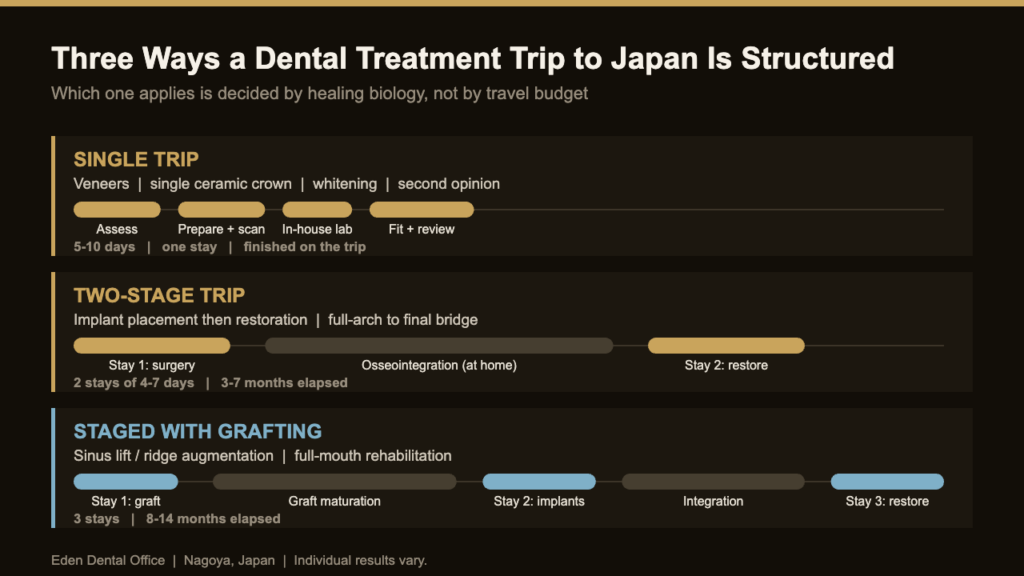
Almost every case we plan for an out-of-town patient collapses into one of three structures. Which one applies to you is decided by the biology of your case, not by your travel budget, and an honest clinic will tell you which one you are in before you book anything.
| Trip shape | Typical cases | Visits | Time in Nagoya | Total elapsed time |
|---|---|---|---|---|
| Single trip | Veneers on a healthy bite, single ceramic crown, whitening, hygiene reset, second-opinion assessment | 1 stay, 2–4 appointments | 5–10 days | Same trip |
| Two-stage trip | Implant placement then restoration, full-arch provisional to final bridge, larger aesthetic cases with a mock-up phase | 2 stays | 4–7 days each | 3–7 months |
| Staged with grafting | Sinus lift or ridge augmentation before implants, periodontal stabilisation first, full-mouth rehabilitation | 3 stays | 4–7 days each | 8–14 months |
The single trip is genuinely a single trip only when nothing has to heal underneath. Ceramic work on teeth that are structurally sound is the clearest example: prepare, scan, mill, fit, review. The two-stage trip is the honest structure for most implant patients, and it is worth understanding why. An implant needs osseointegration — the bone growing into the roughened titanium surface — and that takes the time it takes. Our detailed walk-through of the timeline, pain and recovery of a single implant sets out those intervals. The third structure exists because bone graft maturation cannot be argued with. Anyone who tells you a sinus lift and a loaded final crown can share one holiday is selling optimism.
Why an in-house laboratory changes the arithmetic
Most dental practices send impressions or scan files to an external laboratory and wait. In Japan a typical outside-lab turnaround for a ceramic restoration is one to two weeks, which is precisely the interval that makes a compressed trip impossible: you arrive, the tooth is prepared, and then you are asked to come back in a fortnight.
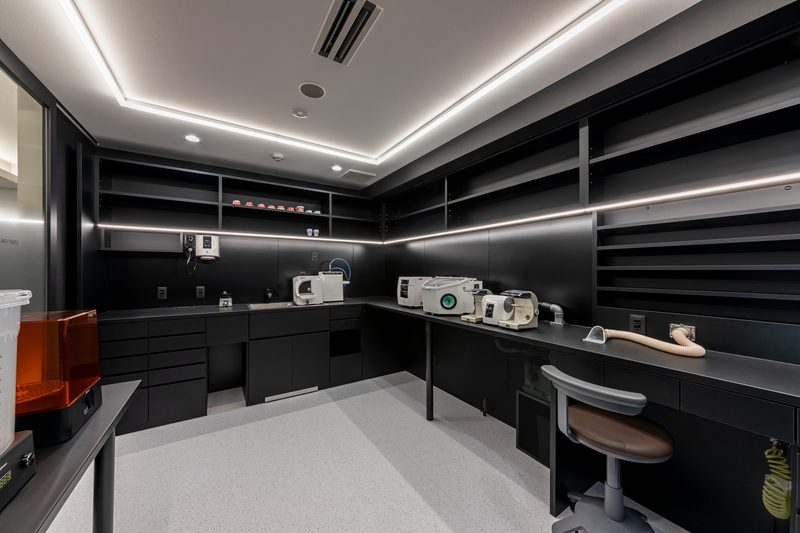
At Eden we design, mill and 3D-print in the building. For a patient who has flown in, that turns a two-week wait into a same-week appointment, and it lets us do something a remote laboratory cannot: adjust the shape in the patient’s mouth, walk twenty steps, and re-mill. When we plan a full-arch case with guided surgery, the surgical guide is printed here from the CBCT and intraoral scan rather than couriered in. The clinical benefit is precision; the logistical benefit, for someone with a return flight booked, is that the schedule is ours to control.
This is also why we ask fly-in patients to send records before they arrive. A recent panoramic radiograph or CBCT, photographs, and a short written history let us build a provisional plan and a written fee range in English before you commit to a date. If your existing scan is recent and diagnostically adequate we will use it — the article on what a CBCT scan actually shows before implant surgery explains what makes a scan reusable and what makes it worthless.
What a treatment week actually looks like
A first visit runs long by Japanese standards — 60 to 90 minutes — because the diagnostic work is front-loaded. Photographs, an intraoral scan, periodontal charting, imaging where indicated, and then a conversation in English about what we found and what the options cost. Nothing irreversible happens on day one unless there is an emergency, and we say so explicitly, because patients who have flown a long way sometimes feel obliged to consent to treatment simply because they are in the chair.
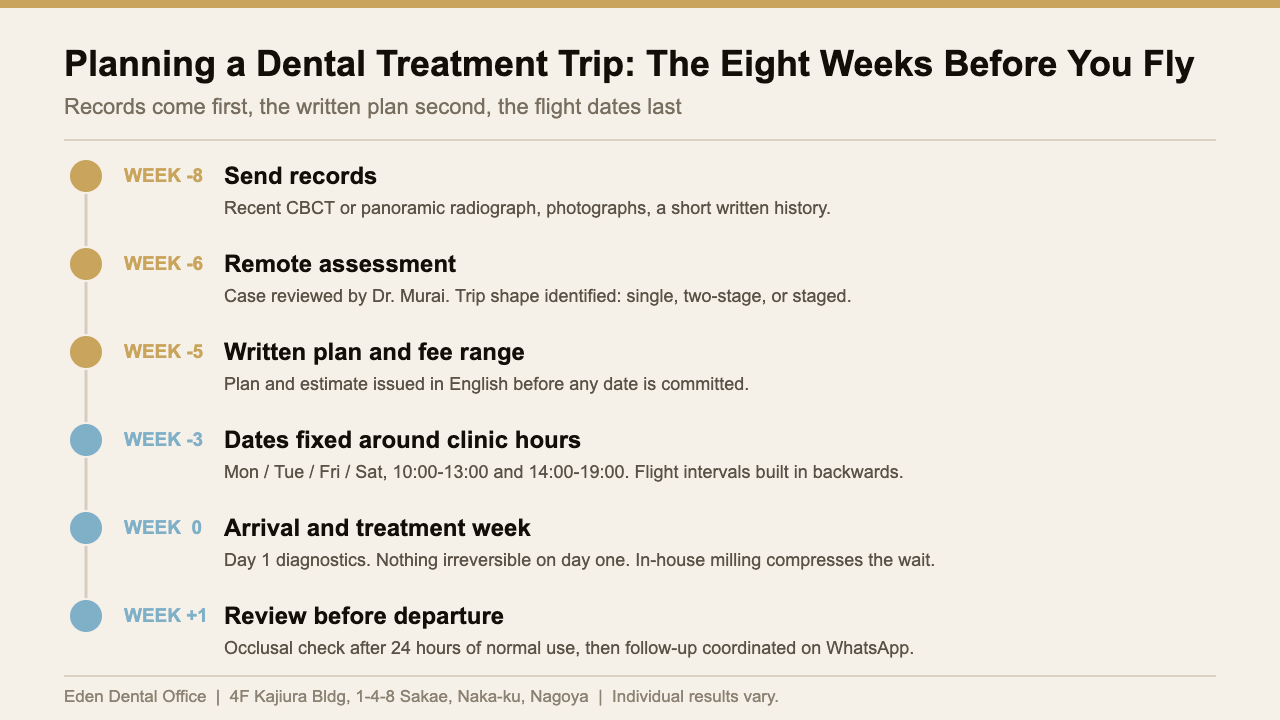
The reason the timeline above starts eight weeks out is not bureaucracy. It is that a plan built from real records can be costed honestly, and a plan built from a description over email cannot.
From there a compressed week typically alternates working days and rest days: preparation and scanning on day two, laboratory fabrication on day three while you are elsewhere in the city, try-in and adjustment on day four, fit and occlusal refinement on day five or six. We build in a review appointment before you fly out rather than after, because a bite that feels acceptable on the day of fitting sometimes does not after twenty-four hours of normal use, and that is a five-minute adjustment in Nagoya and a serious inconvenience from Heathrow.
Clinic hours are Monday, Tuesday, Friday and Saturday, 10:00–13:00 and 14:00–19:00, which is a real constraint on planning: a trip landing Tuesday night has fewer usable days than one landing Sunday. English-language coordination runs through WhatsApp, including while you are in the air.
How long after dental treatment can you fly?
This is the question most often asked too late. Pressure changes in a cabin can produce barodontalgia — tooth pain triggered by altitude — and, after surgical procedures, barotrauma at the treated site. A 2023 paper in the British Dental Journal reviewed the available evidence and proposed minimum intervals between dental procedures and air travel. The authors are explicit that much of the underlying research comes from military aircrew, whose flight profiles differ from commercial aviation, so these are starting points for a clinical decision rather than rules.
| Procedure | Minimum interval before flying | Recommended interval |
|---|---|---|
| Restorative treatment (fillings, bonded work) | 24 hours | About one week after most dental intervention |
| Simple extraction | 24–48 hours | |
| Non-surgical root canal treatment | 72 hours | |
| Surgical extraction or implant placement | 72 hours | |
| Sinus lift | At least two weeks | Six weeks |
In practice we plan backwards from these intervals rather than forwards from your arrival date. If a sinus lift is part of the plan, it goes at the end of a stay with a long gap before the next flight, not in the middle of a compressed week. The same logic applies to swelling, which peaks around 48 to 72 hours after surgery and is unpleasant to experience in seat 34B. Our guidance on the first two weeks after implant surgery covers what the recovery actually feels like day by day.
Getting to Nagoya, and why it is not a compromise
Nagoya sits in the middle of the country, which is an advantage patients underestimate until they are trying to schedule four appointments around a work calendar. Chubu Centrair International Airport is roughly 40 minutes away. Tokyo is about 100 minutes by Shinkansen, Kyoto around 35 minutes, Osaka under an hour. The clinic is on the fourth floor of the Kajiura Building at 1-4-8 Sakae, Naka-ku, two minutes’ walk from Fushimi Station and one stop from Nagoya Station.
For a patient in Tokyo, that geometry often means treatment in Nagoya is a day trip rather than an overnight stay — and day trips make the two-stage structure far less painful than it sounds. For patients flying internationally, Centrair is quieter and faster to clear than the Tokyo airports, and the surrounding city is a functioning business centre rather than a resort, which tends to suit people who are working between appointments. If you are weighing the two cities on cost as well as convenience, we have written a direct comparison of what actually moves implant pricing between Tokyo and Nagoya.
What a treatment trip costs
Published anchors first, because these are the figures on our own fee page and not estimates: a comprehensive check-up package is ¥40,000, a whitening package is ¥75,000, and annual membership tiers run from ¥88,000 to ¥288,000. Everything else — implants, full-arch work, ceramics, grafting — is quoted case by case, and the honest answer to “how much?” before we have seen your records is that we do not know yet. What we can tell you is what moves the number: how many units, which materials, whether bone or soft tissue has to be rebuilt first, how much of the existing work has to be removed, and whether the case needs guided surgery. Our fee page sets out the published packages, and every fly-in patient receives a written estimate in English before any treatment begins, not after.
The costs that patients forget are the travel-side ones. A two-stage implant case means two sets of flights. A staged graft case means three. Build those into the comparison when you are weighing Japan against treatment at home, because a headline fee that looks lower can invert once four long-haul tickets and eleven hotel nights are added. We would rather you did that arithmetic before you book than after, and we will tell you frankly if your case does not justify the travel. Related reading: our breakdown of what is and is not included in a Japanese implant quote.
The risks of treating abroad — including with us
The central risk of any cross-border treatment is not the surgery. It is continuity. If something needs adjusting eight months later, the person who planned the case is on the other side of an ocean. We manage that in three ways: by planning conservatively so that fewer adjustments are needed, by writing every plan and material specification in English so that a local dentist can read it, and by staying reachable on WhatsApp. None of that is the same as being down the road from you, and you should weigh it accordingly.
The second risk is schedule compression. Pressure to finish before a flight is how corners get cut, and it is the failure mode we watch for most carefully in our own planning. If a case needs another week of healing, it needs another week, and the correct response is to change the plan rather than the biology. The third is expectation. Photographs on the internet are selected; a case that resembles yours superficially may have had different bone, different bite forces and a different starting point.
Before finalizing an itinerary, it helps to understand what dental treatment in Japan costs compared with other destinations — and what budget package prices typically leave out.
Orthodontic cases travel especially well: most monitoring between milestones runs remotely, which is why doing Invisalign in Japan from Tokyo or overseas typically needs only three to five in-person visits.
Many traveling patients start not with a booking but with a question about a plan proposed elsewhere — see how an English-language second opinion works in Japan before you plan the trip itself.
Patients who visit repeatedly often formalize the relationship — a boutique preventive membership keeps records, recalls and English support organized between trips.
Patients often ask at the planning stage how soon after treatment they can board. That question is answered procedure by procedure in our guide to flying after dental surgery in Japan, including why we place the review appointment before your departure rather than after it.
Patients often ask what to send before the first appointment. Our note on which dental records travel usefully from abroad sets out what we can plan from and what has to be repeated here.
Frequently Asked Questions
How many days do I need in Japan for veneers?
For a straightforward veneer case on a healthy bite, five to ten days in one stay is usually enough, covering assessment, preparation, in-house fabrication, fitting and a review appointment before you fly.
Can dental implants be finished in one trip?
Rarely. The implant has to integrate with bone before it carries a restoration, so most patients need two stays separated by three to seven months. Some full-arch cases receive a provisional bridge during the first stay.
Is it safe to fly after implant surgery?
Published guidance suggests a minimum of 72 hours after implant placement and about a week for comfort. After a sinus lift the recommended interval is considerably longer — at least two weeks, and preferably six.
Do I need to speak Japanese to be treated at Eden?
No. Consultation, planning, written estimates and follow-up are handled in English, and coordination before and after your trip runs through WhatsApp.
Can you use scans and records from my dentist at home?
Often, yes. Send a recent CBCT or panoramic radiograph and photographs before you travel. If the imaging is too old or the field of view is inadequate, we will say so and rescan here. What that review can and cannot conclude is set out in our note on the pre-travel video consultation and its limits.
Risks, limitations and what we cannot promise
Every procedure described here carries risk. Implant surgery can involve swelling, bruising, infection, nerve disturbance or failure of integration. Ceramic restorations can chip or debond. Grafted bone can resorb. Treating on a compressed schedule adds a logistical risk to the clinical ones: if healing does not proceed as expected, the plan changes and so does your travel. Published survival figures describe populations studied over years, not predictions for one person, and no clinic can commit to an outcome in advance. Individual results vary. Fees quoted on this site are the published packages; all other treatment is quoted in writing, in English, after examination.
If you are weighing a treatment trip and want to know which of the three structures your case falls into, send records and we will tell you before you book a flight. You can read more about the clinic, the team and how we work with patients travelling from outside Nagoya on our about the clinic page, and the same page explains how to reach us on WhatsApp in English.