
Clear Aligners and Speech: How Long a Lisp Lasts in Japan
Reviewed by Dr. Ryosuke Murai, DDS, MSD — Prosthodontist, trained at Indiana University School of Dentistry (U.S.). Last updated November 2026.
If you speak in meetings, on calls or in more than one language, the first question about clear aligners is often not about teeth at all: will they change how I sound? The short answer from the published evidence is that a slight lisp or slurring is common in the first days, it mainly affects /s/ sounds, and it usually settles within about one to two weeks. This guide sets out what the research reports, what helps, and when a persistent change deserves a check, for patients in Nagoya and elsewhere in Japan who want a planned, private course of treatment explained in English.
What the research reports about speech
A systematic review of clear aligners and speech (PubMed 35522548) is summarized in a 2024 commentary in Evidence-Based Dentistry (Al-Dboush and colleagues). The commentary reports seven studies, five cohort and two randomized, with 332 patients. The studies were too different from one another to pool, and the overall certainty of the evidence was rated low, so the findings should be read as a guide and not a promise.
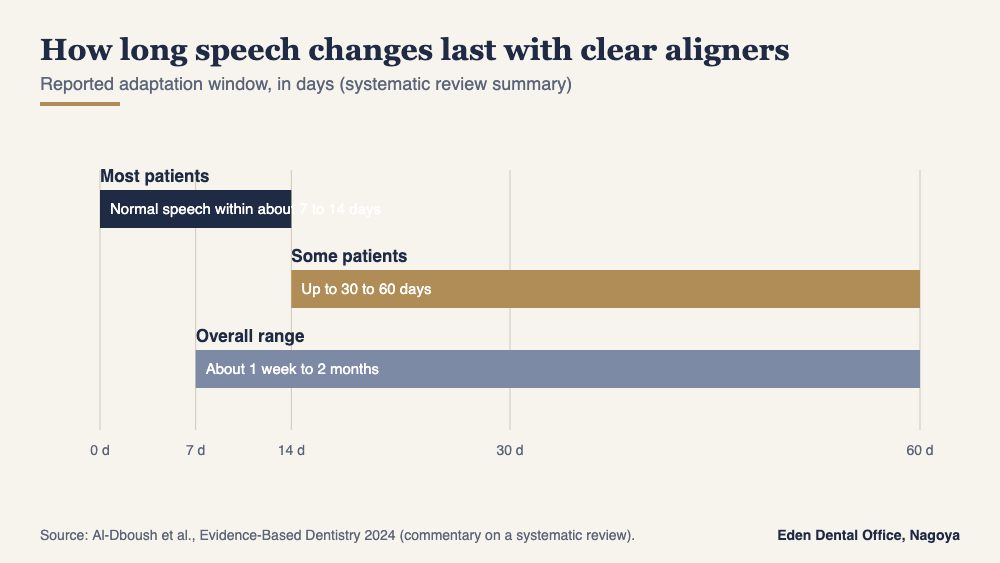
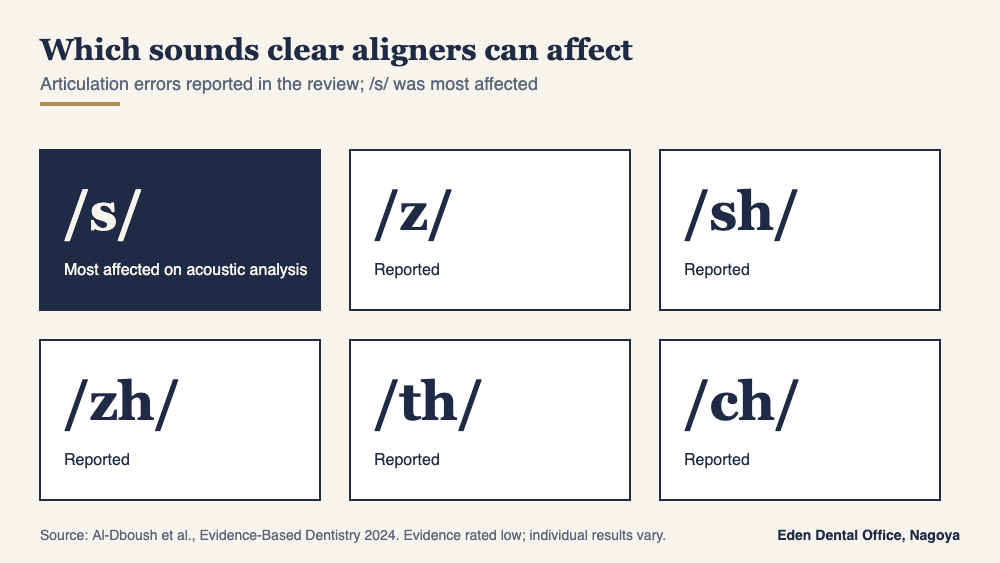
Within those limits, the picture is consistent. Clear aligners and fixed braces both caused altered speech, including slurring, lisping and a nasal quality. Errors involved /s/, /z/, /sh/, /zh/, /th/ and /ch/, and acoustic analysis found /s/ was the most affected sound. The difficulties were temporary: most people normalized within 7 to 14 days, some took 30 to 60 days, and the overall recovery ranged from about a week to two months.
Why aligners affect speech
Speech depends on precise contact between the tongue, the front teeth and the palate. An aligner adds a thin layer of plastic over the teeth and covers part of the palatal surface, so the tongue has slightly less space and touches a slightly different surface. For /s/ and /z/ the tongue tip sits close to the back of the upper front teeth, which is why those sounds change first. The tongue adapts quickly, in the same way it adapts to a new retainer or a dental restoration, but it needs a few days of ordinary use to do so.
| Appliance | Where it sits | Speech difficulty reported in the review |
|---|---|---|
| Clear aligners | Over the teeth, thin plastic | Temporary; similar to fixed braces |
| Labial fixed braces | On the outer tooth surface | Temporary; similar to clear aligners |
| Lingual fixed braces | On the tongue side of the teeth | More difficulty than either of the others |
What helps while you adapt
Wear the aligners as planned, because the tongue learns fastest with consistent use, and taking them in and out for every conversation tends to prolong the adjustment. Read aloud for a few minutes each day, concentrating on words with /s/ and /sh/, and speak a little more slowly than usual for the first week. Drink water during the day, because a dry mouth makes the plastic feel more intrusive. If you have a presentation or an important call in the first days of a new aligner, it is sensible to start a new stage the evening before a quiet day and not the morning of an event.
Speech effects are most noticeable at the start of treatment and can return briefly when a new set of aligners or a new attachment changes the contour. Our notes on aligner attachments and soreness with clear aligners describe what to expect at each change.
How we plan around speech at Eden
At Eden, Dr. Murai plans each case personally, and we review how the aligner edges and attachments sit in relation to the tongue and palate during planning, since smooth contours are easier to speak with. Patients who rely on their voice, such as teachers, presenters and people who work in several languages, tell us at the first visit, and we plan the timing of stages with that in mind. You receive the plan and the estimate in writing in English, and appointments are by reservation, so there is time to ask questions. If you are weighing aligners against other options, see our overview of clear aligners in Japan and the comparison of clear aligners and braces for adults.
Speaking more than one language
Many of our patients move between English, Japanese and a third language during the week, and they often ask whether adaptation has to happen separately for each. The studies do not answer that directly, because they measured speech in a single language, usually with standard test words. In practice, the sounds that depend on the tongue tip against the front teeth, such as /s/, /z/ and /th/ in English, are the ones people describe as different at first. Languages with fewer sibilant contrasts may feel less affected, and languages with more may feel more so, but the tongue adapts in both cases, and most people find that the language they speak most often settles first. If your work depends on a particular sound, mention it when we plan treatment, so that we can allow for it in the timing of the first stages and in how we check the aligner contours.
It is also worth separating three things that patients sometimes confuse: a change in how you sound, a change in how comfortable the aligner feels, and a change in how it fits. A lisp is a change in sound and is usually temporary. Soreness is a change in comfort and fades as the teeth move. A gap between the aligner and a tooth is a change in fit, and that is the one to report promptly, because it can affect how treatment proceeds.
When a speech change needs a check
A lisp that has not improved after a few weeks, an edge that irritates the tongue, or a sound that seems to be getting worse rather than better are all reasons to contact the clinic. We check the fit, the trimline and the attachments, and, where an aligner is not tracking as planned, the cause may be unrelated to speech; our guide to aligners that are not tracking covers that. If you grind your teeth, see clear aligners and teeth grinding, and for the stage after treatment, retainers after aligners. You can read more about the clinic on the About page.
What it costs
The first visit is ¥15,000 and the check-up package is ¥40,000. Clear aligner treatment is quoted after assessment as a written estimate in English before anything begins, and the fee depends on the complexity of the case and the length of treatment.
Frequently asked questions
Will clear aligners give me a lisp?
Some people notice a lisp, slurring or a change in /s/ sounds at first. A systematic review summarized in Evidence-Based Dentistry found these effects were usually temporary.
How long does an aligner lisp last?
Most patients in the review returned to normal speech within 7 to 14 days. Some took 30 to 60 days, so the overall range was about one week to two months.
Do I need to wear aligners while speaking to adapt?
Wearing them as planned is what lets the tongue adapt. Reading aloud for a few minutes a day can help, and we review the fit if a problem persists.
Is the effect different from braces?
The review found speech difficulty with clear aligners and fixed braces was similar, and lingual braces caused more difficulty than either.
When should I call the clinic?
If speech has not settled after a few weeks, or an edge irritates your tongue, message us so we can check the aligner and attachments.
Risks and limits
Clear aligner treatment carries risks, including tooth sensitivity, gum irritation, root resorption in rare cases, and the need for refinements or retainers afterwards. The speech findings above come from a small, varied body of evidence rated low in certainty. Individual results vary.
To arrange a first visit, message the clinic on WhatsApp or call 052-265-8996.
More on this topic: Aligner Guides — every article we have published in this cluster, grouped by stage.