
Flying After Dental Surgery in Japan: Safe Timing by Case
Reviewed by Dr. Ryosuke Murai, DDS, MSD — Prosthodontist, trained at Indiana University School of Dentistry (U.S.). Last updated August 2026.
The return flight to London is Thursday and the implant goes in on Tuesday. Is that a problem? Usually not — but the question most patients ask, “how many hours after surgery can I fly?”, is the wrong one. Cabin pressure is seldom the trouble. What decides the answer is whether you would still be inside the window in which a complication typically declares itself, and whether you would be somewhere a clinician can deal with it. This is how we think about flying after dental surgery in Japan, procedure by procedure, for the self-pay patients our international patient practice is built around. How a case is grouped into visits is a separate question, covered in our guide to planning a dental treatment trip. This article is about the last appointment before you board, and where we place it.
What actually changes at altitude
A commercial cabin is not sea level. Most airliners hold cabin altitude between roughly 1,800 and 2,400 meters, putting ambient pressure at about 75–80% of the pressure on the ground. Gas in a closed space expands accordingly as you climb, then compresses again on descent. Blood does not boil, sutures do not fail, and a healing implant does not move. Three narrower mechanisms are what a plan has to respect: gas trapped where it should not be, a clot that has not yet matured, and swelling that is still building.
None of those follow the clock in the way people expect. They follow the procedure. A single-tooth extraction and a bilateral sinus floor elevation should not share a rule.
The bleeding window is longer than the first night
Patients expect oozing on the day of surgery, and infer that once the evening passes the risk has passed too. Data on secondary bleeding says otherwise. In a series of 443 tooth extractions at Osaka University in patients kept on their oral antithrombotic therapy, the postoperative hemorrhages that did occur clustered within six days, at a median of three days — 16 of 17 events fell in that range (Morimoto Y et al., J Oral Maxillofac Surg 2011). Surgical extraction and acute inflammation were the two factors showing a significant association.
Two readings follow. If you are on warfarin, a direct oral anticoagulant or dual antiplatelet therapy, the interesting days are two to five — precisely when a fly-in patient is often in the air or already home. For a healthy patient having one straightforward extraction, the same study is quietly reassuring: 17 events across 443 extractions in an anticoagulated population is not a reason to rebook out of anxiety alone. Whether medication is adjusted at all is decided before surgery, not at the airport; that conversation is described in our note on medications and medical conditions before implant treatment.
Trapped gas, sinuses, and why the trouble happens on descent
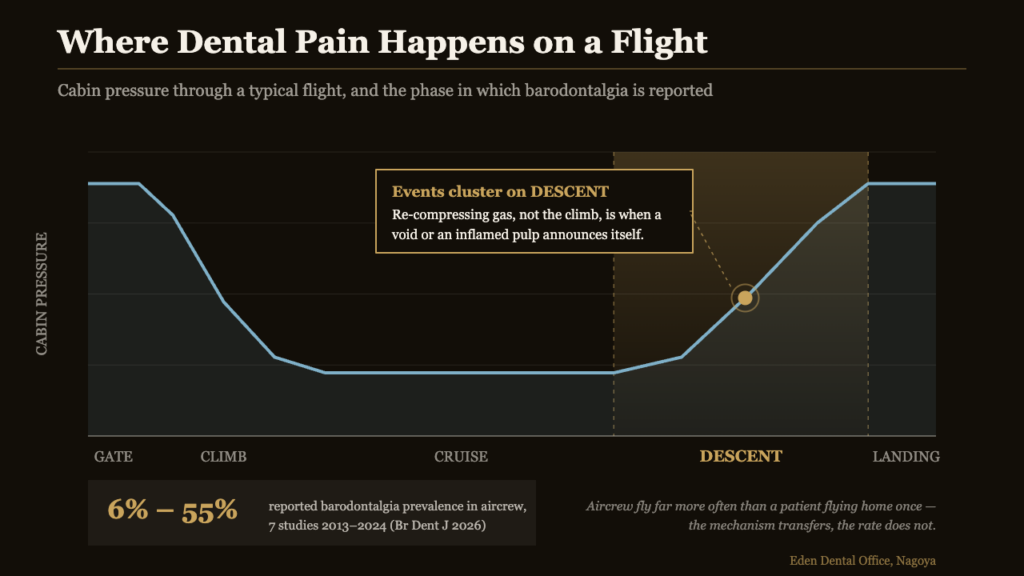
Barodontalgia — dental pain provoked by pressure change — is the mechanism people have in mind when they worry about flying. It is real, and it is not random. A 2026 systematic review in the British Dental Journal pooled seven cross-sectional studies of professional aircrew published between 2013 and 2024: reported prevalence ranged from roughly 6% to 55%, with events occurring predominantly during descent rather than climb (Duarte M et al., Br Dent J 2026). The spread is wide because case definitions differ, and the authors say so; the direction is the useful part. Descent is when expanded gas is re-compressed, and when a void under a restoration, in an inflamed pulp, or in a maxillary sinus makes itself known. The same review recommends pre-flight examination and defined return-to-flight restrictions after recent treatment.
Aircrew fly far more often than you do, so an occupational prevalence figure is not your risk on one flight home. The mechanism transfers, though, and it is why we treat procedures that approach an air space differently. A sinus floor elevation — lateral window or crestal approach — raises the sinus membrane and places graft material beneath it. Until that membrane has sealed and the graft has stabilized, pressure swings and forceful nose-blowing are worth avoiding; our sinus precautions run about two weeks. What that procedure adds to a quote is covered in our breakdown of bone graft and sinus lift fees in Japan.
Sedation, dehydration, and the honest size of the thrombosis question
If your surgery involved intravenous sedation, the flight question is answered by the sedation rather than the surgery. Residual impairment after midazolam-based sedation makes traveling alone the same day a poor idea, and airlines may refuse a visibly sedated passenger. We do not schedule intravenous sedation on a departure day; the recovery profiles are described in our overview of sedation choices for implant surgery.
Deep vein thrombosis deserves a straight answer rather than an alarming one, because the alarming version gets used to sell things. Travel is, per a Br J Haematol review, a weak risk factor for venous thromboembolism, more relevant to passengers already carrying other risk factors and related to duration rather than to aviation specifically; life-threatening pulmonary embolism is rare, evidence for compression stockings or prophylactic anticoagulation is limited, and no validated tool exists for deciding who benefits (Czuprynska J and Arya R, Br J Haematol 2020). Forty minutes in a dental chair for a single implant does not turn an ordinary flight into a high-risk one. A full-arch case under long sedation, in a patient with a clotting history, is a different conversation — and it belongs with your physician, not with us.
How we place the last appointment
The rule we work to at Eden: do not fly on the day of a surgical procedure, and do not fly on a day when nobody has looked at the site since. In practice a review appointment is built in before departure rather than after — usually 24 to 72 hours post-surgery and always at least one working day before the flight, so that if something needs attention there is a clinic day left to attend to it. Because our laboratory is in the building and our surgical guides are printed in-house, we can compress a case rather than stretch it, which is what makes that buffer affordable in trip terms.
We write the flight date into the plan at the records stage, before the schedule is fixed. If your ticket makes a sequence tight, we would rather move a stage into a second trip than move your flight, as our treatment-trip guide explains. What happens in the two weeks after you land is set out in our guide to the first two weeks after implant surgery, and the broader recovery picture in our implant procedure and recovery overview.
A working table, not a rule book
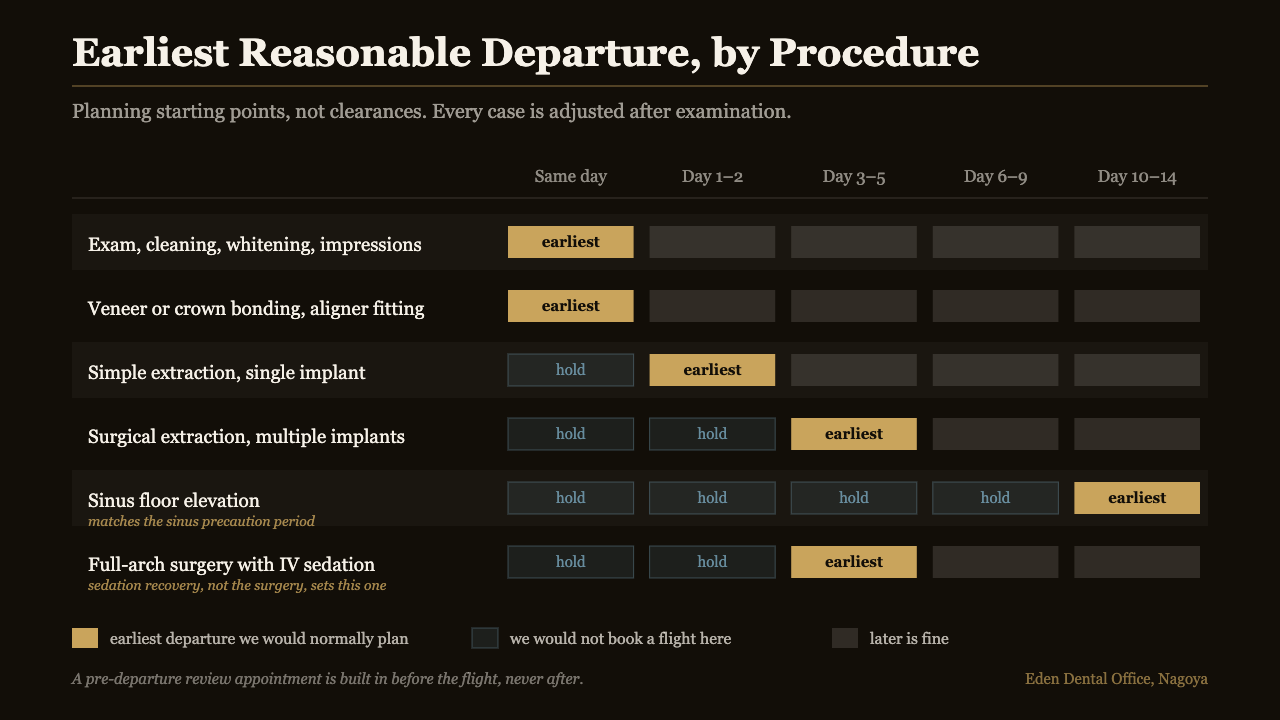
| Procedure | Earliest we would normally schedule a flight | What governs it |
|---|---|---|
| Examination, cleaning, whitening, impressions | Same day | Nothing is open; no gas space, no clot |
| Veneer or crown bonding, aligner fitting | Same day, after a bite check | Occlusion is the only variable; a high spot is easier to adjust here than at home |
| Simple extraction, single implant placement | 24–48 hours, with a review first | Clot maturity and the day two to five bleeding window |
| Surgical extraction, multiple implants, grafting at the site | 3–5 days | Swelling peaks around day two to three; higher secondary bleeding risk |
| Sinus floor elevation, or any procedure entering the sinus | 10–14 days | Membrane integrity and graft stability under pressure change |
| Full-arch surgery under intravenous sedation | Day 3 onward in practice, never the same day | Sedation recovery plus the surgical factors above |
Treat these as starting points, not clearances. A healthy patient with a two-hour hop to Seoul is not in the position of a patient with diabetes facing fourteen hours to Los Angeles, and we adjust in both directions after seeing the case.
What this costs
A pre-departure review adds no separate line to your estimate — it is part of the surgical fee, and it is one reason we ask for flight details before quoting. What it can change is the shape of the trip: an extra night in Nagoya, or a case split across two visits. Our published fixed fees, including the comprehensive examination at ¥40,000, are on the fee page, and every plan is issued as a written estimate in English, with stages and timing, before anything begins. Where a case cannot be completed safely inside the days you have, we say so at planning rather than after a deposit. The same directness applies to credentials — see the regulatory and language question behind “English-speaking dentist in Japan”.
What you send before you travel shapes the schedule as much as the flight home does — see sending your dental records to Japan in advance.
Frequently Asked Questions
Can I fly the same day as a dental implant?
For a single, uncomplicated placement it is often physically possible, but we do not recommend it. Flying the same day removes the chance for a post-operative check while you are still in reach of the clinic.
Does cabin pressure loosen a healing implant?
No. An implant is in contact with bone, not with a gas-filled space, and normal cabin pressure changes do not disturb it. Trapped air under restorations or in sinuses is the actual pressure concern.
Why do teeth hurt on descent rather than take-off?
Because descent re-compresses gas that expanded during climb. Published aircrew data show barodontalgia events occurring predominantly on descent.
How long after a sinus lift can I fly?
We usually plan for 10 to 14 days, matching the sinus precaution period. If a flight is unavoidable sooner, that changes what we are willing to do on that trip.
Should I take aspirin or wear compression stockings for the flight?
Not on our advice. Evidence for routine prophylaxis in travelers is limited, and aspirin has its own bleeding implications after oral surgery. Ask your physician if you have a clotting history.
Every surgical procedure carries risk regardless of travel: bleeding, infection, swelling, bruising, temporary numbness, sinus complications where the sinus is involved, and the possibility that a graft or implant fails to integrate and needs revision. Travel adds a non-clinical risk — that a problem appears when you are no longer near the clinician who treated you. That is why we build in the buffer described above, and why we will say plainly when a compressed schedule is the wrong plan. The timelines here are typical ranges from our practice and from published data; healing rates, medication and medical history all shift them. Individual results vary.
If you are holding a ticket and want a straight answer on what can be completed before it, send the dates with your records. Our international patient information explains how a case is assessed remotely and our note on assessing a case before you buy a ticket covers what that call decides, and English enquiries by WhatsApp reach the clinical team directly.
More on this topic: Trip Planning Guides — every article we have published in this cluster, grouped by stage.