
Clear Aligner Refinements in Japan: Why Extra Trays Happen
Reviewed by Dr. Ryosuke Murai, DDS, MSD — Prosthodontist, trained at Indiana University School of Dentistry (U.S.). Last updated November 2026.
Clear aligner refinements are additional sets of trays made after the first series, and they are a routine part of many aligner cases rather than a sign that something went wrong. Teeth rarely follow a digital plan exactly, so a second scan and a short run of new trays is often how the final few tenths of a millimetre are finished. This article explains why refinements happen, what the research says about aligner treatment time, and what to ask before you accept a quote in Japan. It is written for self-pay adults comparing clinics, including those travelling to Nagoya.
What a refinement actually is
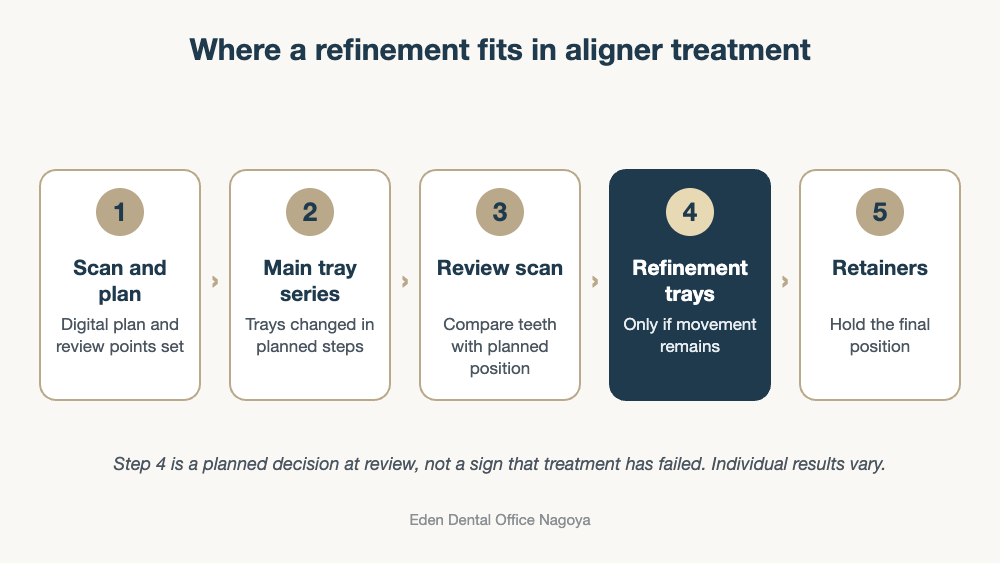
The original plan is a prediction. The software moves each tooth along a path in small steps, and every tray carries a fraction of that movement. In the mouth, tooth movement depends on biology, tray fit, attachments, and how many hours a day the trays are worn, so the result at the end of the series can differ from the prediction. A refinement starts with a new scan of the teeth as they are now, compares it with the planned end position, and designs a short additional series to close the gap.
That is different from a tracking problem, where a tray stops fitting during the series and the question is whether to continue, go back, or re-scan. We cover that case in clear aligners not tracking and the limits of remote review. A refinement is a planned decision at or near the end, and it is worth separating the two because the cost and the timing are handled differently.
Why teeth do not finish where the plan says
Some movements are simply harder for a removable tray to deliver. Rotating rounded teeth, closing extraction spaces, moving roots rather than crowns, and levelling the bite are common examples, and fixed appliances give more direct control of these. Attachments help the trays grip, as described in our guide to aligner attachments, but they do not remove the limit. Missed wear time, a broken or chipped attachment, and tooth contact with a restoration can also leave residual movement. Enamel reduction between teeth, when it is part of the plan, has to be carried out as designed, see aligner enamel reduction.
The research is consistent about this limit. A 2025 systematic review in the European Journal of Orthodontics pooled 15 trials with 1,084 patients. It found no significant difference in treatment quality or duration between clear aligners and fixed appliances in non-extraction cases, but in extraction cases fixed appliances gave better quality, which the authors attributed to better control of tooth movement (Eur J Orthod 2025). In plain terms, the harder the movement, the more likely a refinement or a combined approach becomes.
What the reviews say about treatment time
Patients usually ask how long aligners take, and the honest answer is that the evidence gives a range of situations rather than one number. A 2024 systematic review in Clinical Oral Investigations looked at crowding cases. It included ten studies, six of them randomized, and judged there was low-certainty evidence that treatment duration in mild to moderate crowding is similar for clear aligners and fixed appliances. The authors added that other patient and treatment factors can affect time substantially (Clin Oral Investig 2024).
An earlier review of four controlled studies with 252 participants reported shorter treatment and chair time with aligners in mild to moderate cases, while noting that evidence on effectiveness in general was limited (Orthod Craniofac Res 2017). Taken together, the reviews do not promise a faster result, and they do not treat refinement as a failure; they say that case complexity and patient cooperation decide the course.
| Situation | What the reviews report | What it means for refinements |
|---|---|---|
| Mild to moderate crowding, no extractions | Duration and quality similar to fixed appliances; low-certainty evidence | A refinement is possible but often small |
| Extraction cases | Fixed appliances gave better quality in the 2025 review | Refinements or a combined approach are more likely |
| Rotations, root movement, bite levelling | Harder for removable trays to control | Plan for a review scan from the start |
| Irregular wear | Compliance is a recognised variable | Extra trays are more likely, and treatment lengthens |
How we handle refinements at Eden
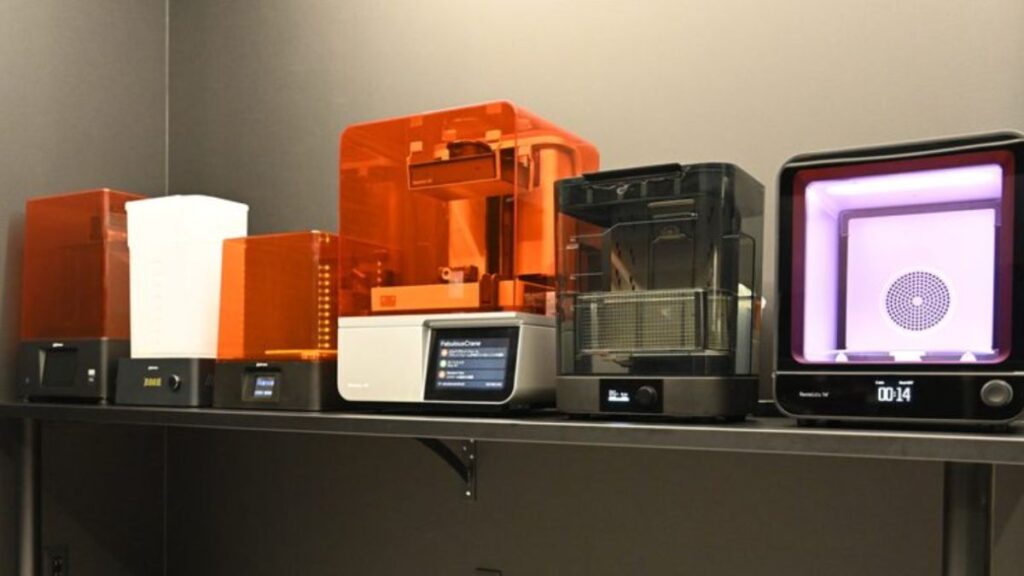
In our clinic, we scan with an intraoral scanner and plan aligner cases digitally, and because our digital lab is in-house we can review a case without waiting on an outside process. At the start we tell patients which movements are likely to need a check, set the review points, and compare each scan with the planned position before deciding to continue, pause, or design refinement trays. Where the case includes veneers, crowns or implants, we plan the aligner stage around the final restoration, as covered in aligners with crowns, veneers and implants. For a wider comparison of appliances, see clear aligners versus braces for adults.
What this costs and what to ask
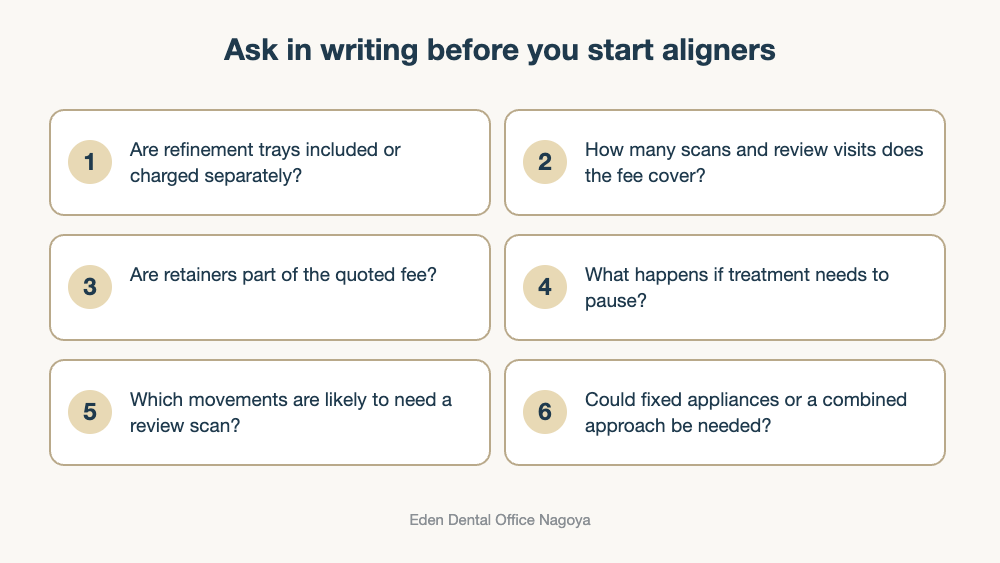
Aligner fees vary with the complexity of the case, the number of trays and the monitoring needed, and we do not publish a single price for them. Our general fees are listed on the fees page, and a written estimate in English is given before any treatment. The point that matters for refinements is what the quote includes. Ask whether refinement trays are included or charged separately, how many scans and review visits are covered, whether retainers are part of the fee, and what happens if you need to pause. Retainers are the last step and have their own rules, see retainers after clear aligners. The overall picture of cost and timeline is in our clear aligners in Japan guide, and the service is described on our treatments page.
Frequently Asked Questions
What is a clear aligner refinement?
A refinement is a new set of trays made after the main series ends or pauses, built from a fresh scan to finish movements that did not fully happen as planned.
Do refinements mean the treatment failed?
No. Reviews describe clear aligner outcomes as comparable to fixed appliances in many non-extraction cases, and a planned review with additional trays is a normal part of the process.
Are refinement trays included in the quote?
It depends on the clinic and the plan. Ask in writing whether refinement trays, extra scans and retainers are included before you start.
Can I do refinements if I live far from Nagoya?
Sometimes. A refinement needs a new scan and a clinical check, so we plan the review visits at the start and do not rely on photographs alone.
How long do refinements add?
It varies with how much movement remains. We give an expected range after the review scan rather than a fixed number in advance.
Risks, limits and what to expect
Clear aligners are not suitable for every case. Risks include root resorption, gum recession, tooth sensitivity, relapse without retainers, and the possibility that a case needs fixed appliances or a combined approach. Evidence on aligner outcomes comes from trials with differing designs and short follow-up, so the reviews describe averages and not your own teeth. Refinements can add time and, depending on the plan, cost. Individual results vary.
If you would like your teeth assessed and a plan with its review points explained, a consultation is the right first step. You can reach the clinic on WhatsApp, and we provide the estimate in English.
More on this topic: Aligner Guides — every article we have published in this cluster, grouped by stage.