
Teeth Whitening With Receding Gums: What to Know in Japan
Reviewed by Dr. Ryosuke Murai, DDS, MSD — Prosthodontist, trained at Indiana University School of Dentistry (U.S.). Last updated November 2026.
Can you whiten your teeth if your gums have receded? In most cases the enamel-covered part of each tooth can still be whitened, but the exposed root behaves differently: it has no enamel, it rarely matches the crown after bleaching, and it is a common source of sensitivity. Teeth whitening with receding gums is therefore less a question of which gel to use and more a question of order — what is examined, treated and protected before any gel is applied. This guide is written for English-speaking adults in Nagoya and elsewhere in Japan who want a brighter smile without trading comfort or gum health for it.
Why receding gums change the whitening picture
Gum recession is common in adults, and it tends to increase with age. A narrative review in the Journal of Periodontology notes that recession occurs in people with both high and low standards of oral hygiene, and that root exposure is frequently associated with impaired appearance, dentin hypersensitivity, and decay or wear at the neck of the tooth (Cortellini & Bissada, PubMed 29926948). The same review lists thin gum tissue, orthodontic treatment and fillings at the gum line as factors that may raise the risk of recession.
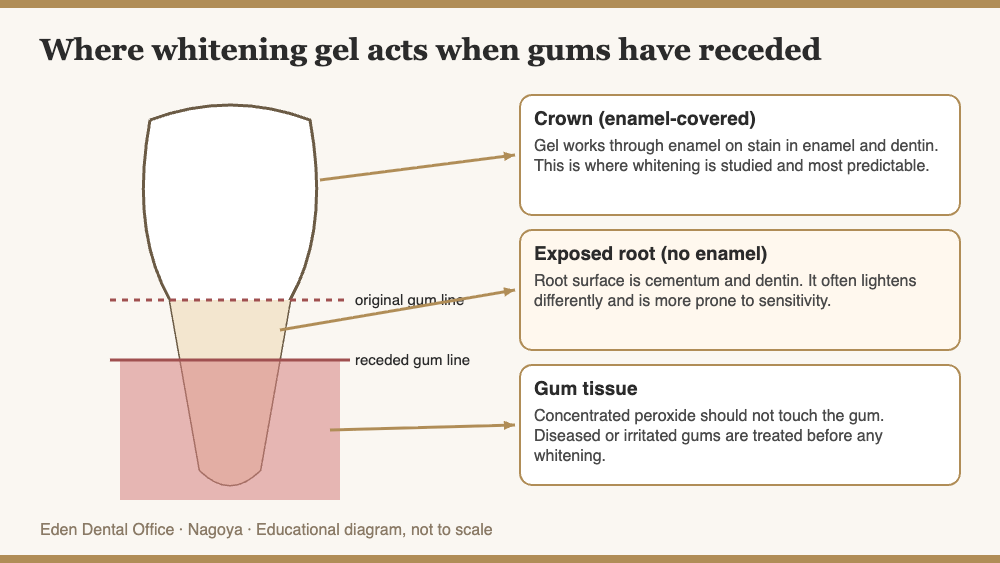
Each of those findings matters for whitening. The crown of a tooth is covered by enamel, and whitening gel works through that enamel on stain within the enamel and the dentin beneath. Once the gum has moved back, the newly visible surface is root — cementum over dentin, with no enamel layer. That surface often sits darker or more yellow than the crown to begin with, and its response to bleaching is less predictable.
What whitening can and cannot change
For many patients the honest outcome is this: the crowns become lighter, the roots change less, and the contrast between the two can become slightly more noticeable rather than less. Whether that matters depends on how much root shows when you speak and smile. Someone whose recession is only visible on the lower back teeth may notice nothing; someone with exposed roots on the upper front teeth may see a band at the gum line.
| Area | Typical response to whitening | What we plan around it |
|---|---|---|
| Enamel-covered crown | Usually lightens; the most studied situation | Gel strength and wear time set to your sensitivity |
| Exposed root surface | Less predictable; may stay darker than the crown | Assess how visible it is; protect sensitive areas |
| Notches or wear at the gum line | Can be sensitive; does not lighten like enamel | Assessed first; may need restoring before or after |
| Fillings, crowns and veneers | Keep their original shade | Matched after the new tooth shade settles |
| Inflamed or irritated gums | Peroxide can irritate soft tissue further | Gum health addressed before any whitening |
Whitening also does nothing for the gum itself. It does not cover a root, and it does not stop recession from progressing. If the appearance of the gum line is the main concern, that is a separate conversation about gum health and, in some cases, gum grafting — which we discuss alongside the shade goal rather than after it. For how restorations fit in, see whitening when you have crowns, veneers or fillings.
Sensitivity: the main practical issue
Exposed dentin is one of the most common reasons teeth feel sharp with cold drinks or air, and whitening can add to it. A review of hydrogen peroxide whitening products in the British Dental Journal reported tooth sensitivity in 15–78% of patients undergoing external bleaching, and recommended that concentrated hydrogen peroxide should not be used without gingival protection and that peroxide products be avoided where soft tissues are damaged or diseased (Tredwin et al., PubMed 16607324). For night-guard style whitening, the same authors preferred minimal amounts of low-dose peroxide.
A second review in Clinical Oral Investigations described local effects on teeth and gums during whitening, including pulp sensitivity and cervical resorption, and noted that most local effects depend on the technique and concentration used — and that repeated treatments add to them (Goldberg et al., PubMed 19543926). With exposed roots, that is a strong argument for a measured, supervised approach rather than repeated rounds of strong over-the-counter products. Our article on tooth sensitivity after whitening covers what to expect day to day, and how peroxide gel strength is chosen explains the trade-offs between concentrations.
How we plan whitening when roots are exposed
At Eden, the first appointment is an examination rather than a whitening session. We look at gum health, how far each area has receded, whether there is decay on the root surface, and whether there are worn notches at the neck of the tooth. Active gum inflammation or root decay is managed first, because whitening over either is uncomfortable and works against the result.
When whitening goes ahead, we generally favour lower-strength gel in custom trays made from an intraoral scan in our in-house digital lab. The trays are designed so that gel sits on the enamel of the crowns and is kept away from exposed root surfaces and the gum as far as practical. Wear times start short and are adjusted to how your teeth respond, with desensitising steps where needed. The comparison in at-home versus in-office whitening explains why trays often suit sensitive mouths.
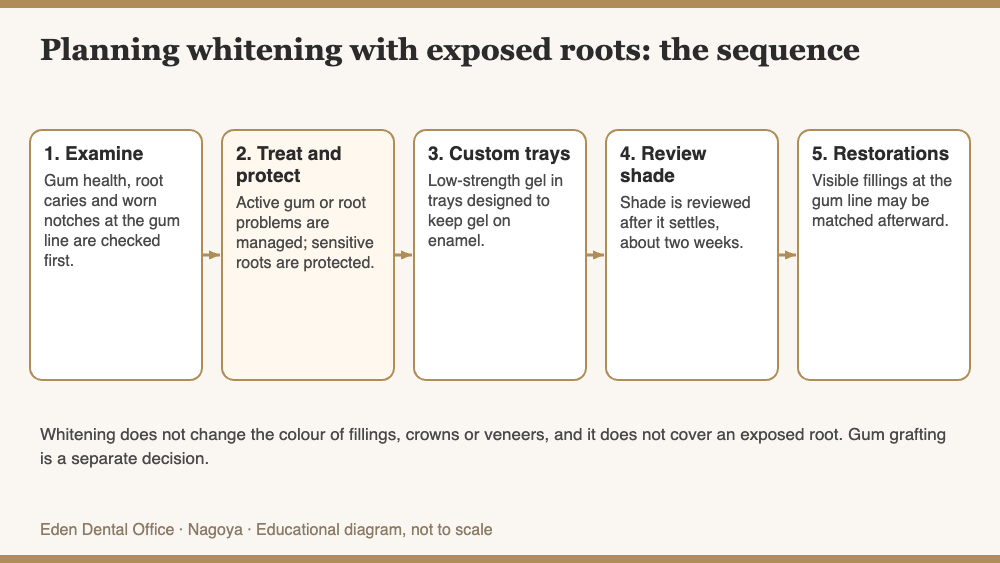
We review the shade after it has settled, usually around two weeks after the last application. Only then do we decide whether any visible fillings at the gum line should be replaced to match. The same prosthodontist plans and reviews each step, so the shade goal, the gum line and any restorations are considered together rather than by different people at different times. Our guide to teeth whitening in Japan sets out the wider options, and the aesthetic treatment overview shows how whitening fits with veneers and other work.
What it costs
The first visit is ¥15,000, the check-up package is ¥40,000 and the whitening package is ¥75,000. Gum treatment, restorations at the gum line or gum grafting, where relevant, are quoted after assessment as a written estimate in English before anything begins.
Frequently asked questions
Can teeth be whitened if my gums have receded?
Often, yes. The enamel-covered crowns can usually be whitened, provided the gums are healthy and exposed roots are assessed and protected first. The root surface itself tends to respond less predictably.
Will the exposed root turn as white as the rest of the tooth?
Not reliably. Roots have no enamel and are usually a different colour from the crown, so a visible band at the gum line can remain after whitening.
Is whitening more sensitive when roots are exposed?
It can be. Exposed dentin is a common source of sensitivity, and whitening adds to that. Lower-strength gel in custom trays, shorter wear times and desensitising steps help keep it manageable.
Should I have gum grafting before whitening?
Gum grafting is a separate decision based on gum thickness, progression and how the area looks. If it is planned, the order of treatment is decided at the consultation.
Do fillings at the gum line change colour with whitening?
No. Tooth-coloured fillings, crowns and veneers keep their shade, so visible fillings near the gum line may need to be matched after the new tooth shade settles.
Risks and limits
Whitening can cause tooth sensitivity and gum irritation, and exposed roots raise the likelihood of sensitivity. Root surfaces may not lighten to match the crown, and whitening does not change the colour of fillings, crowns or veneers or reverse gum recession. The studies cited are reviews of published research and do not predict individual outcomes. Individual results vary.
To arrange a first visit, message the clinic on WhatsApp or call 052-265-8996. You can read more about Dr. Murai and the clinic before you come.
More on this topic: Whitening Guides — every article we have published in this cluster, grouped by stage.