
Teeth Whitening in Japan: Options, Costs and Sensitivity
Reviewed by Dr. Ryosuke Murai, DDS, MSD — Prosthodontist, trained at Indiana University School of Dentistry (U.S.). Last updated August 2026.
Professional teeth whitening in Japan uses the same peroxide chemistry you would find in the United States, the United Kingdom, or Singapore — but the market around it is organized very differently, and the drugstore shortcuts many English speakers grew up with are largely absent here. If you are comparing professional whitening options in Japan, the practical questions are three: which delivery method fits your timeline, what result your particular type of discoloration will actually allow, and how whitening should be sequenced if ceramic work is part of a wider plan.
This guide is written for self-pay patients who want those questions answered before booking anything: how the chemistry works, what in-office and take-home protocols deliver according to the pooled evidence, why the Japanese over-the-counter shelf looks so unfamiliar, and what treatment costs at a boutique clinic in Nagoya.
How Peroxide Whitening Actually Works
Every method that changes tooth color — rather than polishing film off the surface — relies on one of two active agents: hydrogen peroxide, or carbamide peroxide, which breaks down into hydrogen peroxide in the mouth. The peroxide diffuses through enamel and releases reactive oxygen species that break apart chromogens, the long pigmented molecules that accumulate inside tooth structure over years of coffee, tea, red wine, and simple aging. Because the reaction happens within the tooth rather than on it, true whitening can lighten discoloration that no toothpaste can reach.
A widely cited review in the Journal of Evidence-Based Dental Practice (Carey, 2014) concluded that hydrogen peroxide and carbamide peroxide whitening is regarded as safe and effective when products are used as directed, with temporary tooth sensitivity and gum irritation the most common side effects — both of which typically resolve once treatment ends.
Two consequences follow from the chemistry. First, concentration and contact time are the only real levers: a strong gel applied briefly under clinical supervision and a mild gel worn in trays for weeks are converging on the same reaction. There is no secret ingredient separating one reputable system from another — which is why claims built around brand mystique deserve skepticism wherever you encounter them. Second, peroxide only acts on natural tooth structure — a point with real planning consequences that we return to below.
It is also worth separating whitening from the two things it is most often confused with. Professional cleaning removes stain sitting on the surface and routinely brightens teeth a step on its own, but it does not change the intrinsic shade. LED lamps and “light-activated” marketing add theater to the chairside experience; the working ingredient remains the peroxide, and the evidence for light itself adding meaningful, lasting whitening is weak. When a quote leans heavily on the lamp, ask what concentration of what agent is actually being used, for how long.
In-Office, Take-Home, or Over-the-Counter
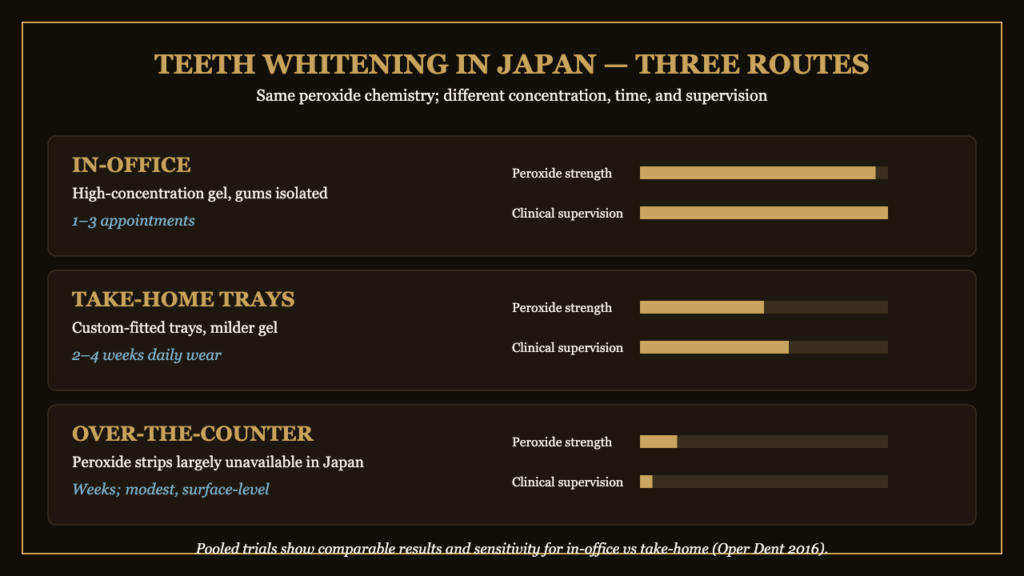
In-office whitening places a professional-strength gel on the teeth with the gums isolated and protected, typically across one to three appointments. It is the fastest route to a visible change and the right format when a clinician should be watching closely — for example, when there are areas of gum recession to protect or the starting shade is being documented for later ceramic work.
Take-home whitening uses custom-fitted trays made from a scan or impression of your teeth, loaded with a lower-concentration gel and worn for a few hours a day or overnight across two to four weeks. It asks more discipline of you and delivers its result gradually, which many patients find easier on sensitive teeth.
What surprises most patients is how the two compare. A systematic review and meta-analysis in Operative Dentistry (de Geus et al., 2016) pooled eight randomized trials and found no significant difference between at-home and in-office bleaching in either whitening efficacy or the risk and intensity of tooth sensitivity. The honest conclusion: the choice is about speed, supervision, and how reliably you will wear trays — not about one method being stronger medicine than the other.
| Route | Typical agent | Timeline | Supervision | Fits when |
|---|---|---|---|---|
| In-office | High-concentration hydrogen peroxide gel | 1–3 appointments | Full clinical control, gums isolated | You want speed, documentation, or have areas needing protection |
| Take-home custom trays | Lower-concentration carbamide peroxide | 2–4 weeks of daily wear | Dentist-prescribed, self-administered | You prefer gradual change and easier sensitivity management |
| Over-the-counter products | Varies by country; peroxide strips largely unavailable in Japan | Weeks, results modest | None | Surface stain only; not a substitute for either route above |
Why Japan’s Over-the-Counter Shelf Looks Different
In the United States, peroxide whitening strips are a supermarket purchase. Japan regulates peroxide differently: products with meaningful peroxide concentrations are handled within dental care rather than sold off the shelf, and the strips familiar from American drugstores are generally not available over the counter here. Most Japanese toothpastes marketed for whitening rely instead on abrasives, polishing particles, or stain-dissolving agents — genuinely useful against surface film from coffee and tea, but incapable of changing the underlying shade of the tooth.
For an international patient this has two practical implications. If you want a real shade change while living in or visiting Japan, it will run through a dentist. And importing high-concentration products for unsupervised use is worth reconsidering: gum protection, case selection, and knowing when not to whiten are precisely what the supervision exists to provide.
There is a quieter upside to the Japanese arrangement. Because whitening here is delivered almost entirely through clinics, it tends to arrive bundled with the things that make it predictable — an examination first, isolation done properly, documentation of the change — rather than as a tube of gel and a leaflet. The frustration for English speakers has historically been finding a clinic that delivers all of that in English, with fees stated in writing before anything starts. That, more than the chemistry, is what this site exists to solve.
What Whitening Cannot Change
Peroxide lightens enamel and dentin. It does not lighten porcelain, zirconia, or composite resin — so existing crowns, veneers, or composite bonding will stay exactly the color they were made, and a restoration that matched your teeth before whitening may stand out afterward. The cause of your discoloration matters just as much as the material question.
| Type of discoloration | Typical cause | Response to peroxide whitening |
|---|---|---|
| Surface stain | Coffee, tea, wine, tobacco | Good — often improved by professional cleaning alone |
| Generalized yellowing | Age-related dentin changes | Good — the classic whitening case |
| Gray or blue banding | Tetracycline exposure during tooth development | Partial and slow; ceramic solutions often serve better |
| Single dark tooth | Trauma or previous root canal | External gel alone rarely enough; internal bleaching or a crown |
| Restorations | Crowns, veneers, fillings | No change; may need replacement to match a new shade |
A careful examination sorts these cases out before any gel touches your teeth. That is not an upsell; it is the difference between a predictable result and a disappointing one.
Whitening Before Ceramic Work: Sequence Matters
If your plan includes porcelain veneers or a ceramic crown on a visible tooth, whitening comes first — always. Ceramics are matched to the shade your natural teeth will hold long-term, and that requires patience: immediately after whitening, teeth are mildly dehydrated and read lighter than they will settle. Selecting a ceramic shade in that window bakes an error into a restoration that cannot be bleached later.
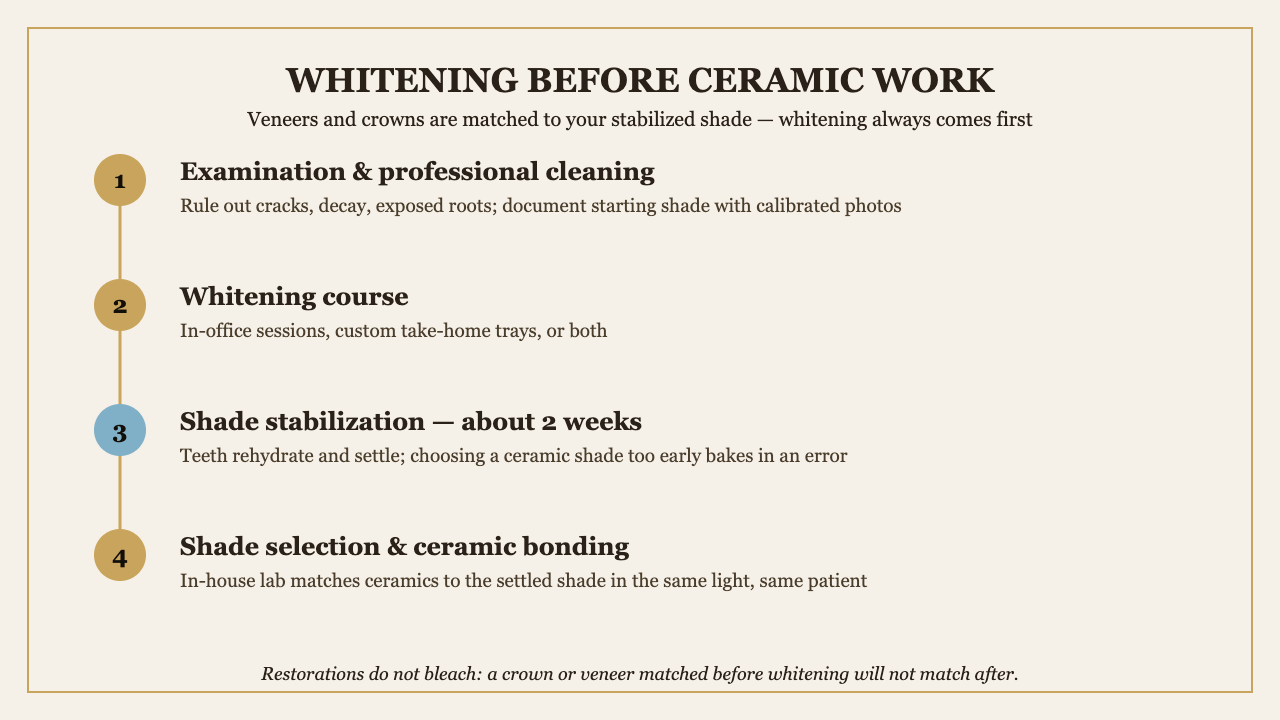
In our clinic, we photograph the starting shade under standardized lighting, complete whitening, and then re-photograph after a stabilization interval of roughly two weeks before any ceramic shade is chosen. Those records feed the same Digital Smile Design workflow we use to plan visible-tooth cases, and because our laboratory is in-house, the shade conversation happens with the technician and the dentist looking at the same patient in the same light — not through a courier bag of shade tabs.
What a Whitening Course at Eden Actually Involves
Whitening is often marketed as a walk-in commodity. Treated properly, it is a short clinical protocol with a defined start and finish, and it looks like this at our clinic in Nagoya.
It begins with an examination and professional cleaning — not as a formality, but because surface stain and calculus sit on top of the enamel the gel needs to reach, and because whitening over an undiagnosed crack, a leaking margin, or exposed root surface trades a cosmetic gain for a clinical problem. Your starting shade is then documented with calibrated photographs rather than memory; six weeks later, “it looks about the same” and “we moved four shade tabs” are very different conversations, and only one of them is useful.
The active phase depends on the route chosen. For in-office sessions, the gums are isolated with a protective barrier before any gel is placed, and the gel is refreshed in timed cycles within a single appointment. For take-home treatment, we scan your teeth and fabricate custom trays — sealed at the margins so gel stays on enamel rather than migrating onto the gums, which is the main failure of boil-and-bite internet trays. Most patients combining both formats start in the chair for the initial change and continue at home for depth and maintenance.
The finish matters as much as the start. We re-photograph after the shade has stabilized, review the result against the target set at the first visit, and agree a maintenance rhythm — usually occasional tray top-ups timed around your habits rather than a fixed calendar. During the treatment window itself, deeply pigmented food and drink work against you; coffee does not have to disappear, but the espresso-then-gel sequence is worth avoiding for a few weeks.
Managing Sensitivity
Transient sensitivity — usually to cold, during the treatment window — is the most commonly reported side effect of whitening, and it settles within days of finishing in the great majority of cases. The pooled data cited above found the risk comparable between in-office and at-home routes; what actually moves the needle is concentration, wear time, and your starting condition.
Practical management is unglamorous and effective: a potassium-nitrate desensitizing toothpaste for two weeks before and during treatment, spacing sessions further apart, shortening tray wear, or stepping down to a milder gel for a longer course. None of these measures meaningfully sacrifices the end result — remember that concentration and time trade off against each other — so there is no prize for enduring discomfort on the fastest possible schedule.
Just as important is what happens before treatment. Exposed root surfaces, cracked teeth, leaking fillings, and untreated decay all give peroxide a direct path to the nerve, turning a mild, predictable side effect into real pain. They make whitening inappropriate until addressed, which is why the examination and cleaning come before the gel rather than after — and why “whitening first, dentistry later” is the one sequencing mistake we routinely talk patients out of.
What Teeth Whitening Costs in Japan
Cosmetic whitening is a self-pay treatment in Japan — the national health insurance system does not cover cosmetic dentistry, whether or not you are enrolled in it. At Eden Dental Office, the published whitening package is ¥75,000, and a comprehensive check-up package is published at ¥40,000; current figures and inclusions are listed on our fee page. Beyond package treatments, the drivers of any whitening fee are the number of in-office sessions, whether custom take-home trays are included for maintenance, and whether whitening is folded into a larger aesthetic plan. You receive a written estimate in English before any treatment begins.
Some context helps when comparing quotes. Whitening prices vary less across countries than implant or veneer prices do, but quote completeness still varies — the same questions raised in our guide to comparing dental costs across countries apply in miniature here. And if you are considering whitening as part of a visit from Tokyo or overseas, the two-to-four-week rhythm of take-home protocols and the stabilization interval before ceramic work both reward a little scheduling forethought — our guide to planning a dental treatment trip to Japan covers how visits are typically structured. Patients finishing aligner treatment in Japan often schedule whitening immediately after attachment removal, when newly aligned teeth make an even shade change most visible.
If you would rather manage prevention as a structured annual relationship than as one-off visits, our guide to dental membership plans and boutique preventive care in Japan explains how that model works.
Whitening has to finish before any ceramic shade is recorded, since a bonded unit cannot be lightened afterwards — the sequencing is explained in our note on matching a single front tooth veneer.
Frequently Asked Questions
How long do teeth whitening results last?
Commonly one to three years before a noticeable rebound, depending on coffee, tea, wine, and tobacco habits. Custom trays make periodic top-ups simple and inexpensive, which is the most reliable way to extend a result.
Does whitening damage enamel?
Peroxide whitening used as directed is regarded as safe for enamel in the published evidence; the review cited above found temporary sensitivity and gum irritation to be the main side effects, resolving after treatment. Unsupervised overuse of strong products is where problems arise.
Can crowns, veneers, or fillings be whitened?
No. Restorative materials do not respond to peroxide. If a visible restoration no longer matches after whitening, it may need replacement — one more reason whitening comes before ceramic work, not after.
Can I buy whitening strips in a Japanese drugstore?
Generally no. Peroxide-based strips common in U.S. stores are not part of the Japanese over-the-counter market, and most whitening toothpastes here work on surface stain only. Dentist-provided whitening is the practical route to a real shade change in Japan.
How white will my teeth get?
It depends on the cause of discoloration. Age-related yellowing responds well; gray tetracycline banding responds partially and slowly; single dark teeth need their own plan. A shade assessment with photographs sets a realistic target before you commit.
Risks and limitations. Whitening can cause temporary tooth sensitivity and gum irritation. Results depend on the cause of discoloration and cannot be promised in advance; restorations will not change color and may need replacement to match a new shade; overuse of high-concentration products without supervision can harm gums and enamel. Whitening is a cosmetic, self-pay treatment not covered by Japanese national health insurance. Individual results vary. Suitability, timeline, and costs are confirmed at an in-person examination, with a written estimate in English provided before treatment.
If you are weighing whitening on its own or as the first step of a broader aesthetic plan, an unhurried English-language consultation is the right place to start — details of the treatment itself are on our whitening page, and you can reach us fastest on WhatsApp.