
At-Home vs In-Office Whitening in Japan: What Evidence Shows

Reviewed by Dr. Ryosuke Murai, DDS, MSD — Prosthodontist, trained at Indiana University School of Dentistry (U.S.). Last updated November 2026.
If you are weighing at-home whitening against an in-office visit, the evidence is more even than marketing suggests. An updated systematic review of randomised trials found shade change was comparable between the two, with sensitivity intensity reported lower for at-home courses, although the quality of that evidence was graded low. In practice, the better route is the one that suits your calendar, your teeth and your tolerance for supervision. This page sets out what the trials compare and how we decide, for patients in Japan who prefer an unhurried, private appointment with one dentist.
What the trials actually compare
The 2025 update of a systematic review included 32 studies and pooled 23 of them. It found no significant difference in the risk of tooth sensitivity or in shade change measured on a shade guide, while colour change measured by instrument slightly favoured at-home bleaching, and sensitivity intensity was lower at home (PubMed 40485133). The authors rated the evidence low, which means the true difference could be larger or smaller. A separate narrative review of dentist-supervised bleaching concluded that daily at-home use of 10% carbamide peroxide, or lower-strength hydrogen peroxide, over three to four weeks is effective, and that in-office results vary with gel strength and pH (PubMed 40082147).
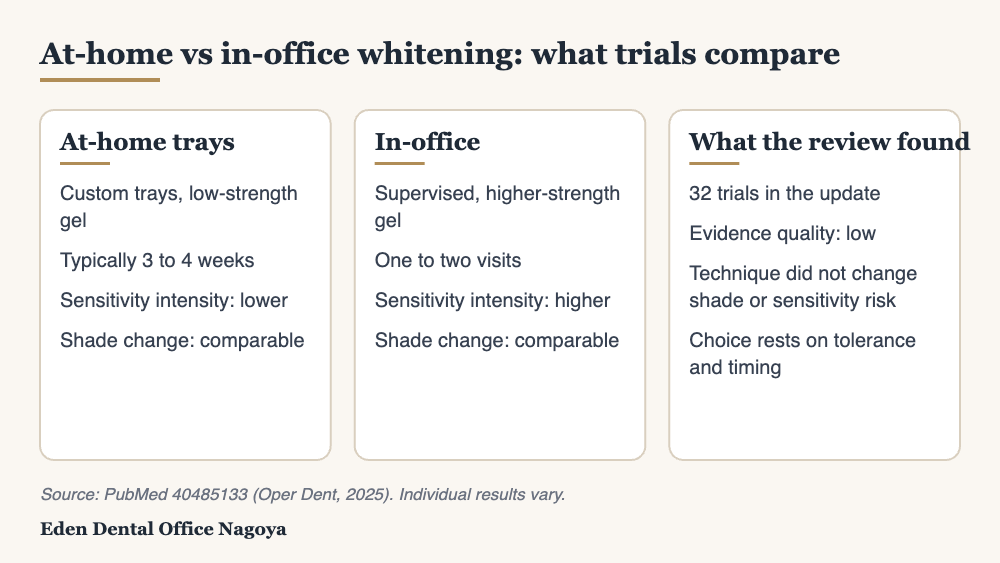
| Factor | At-home tray course | In-office visit |
|---|---|---|
| Time | Three to four weeks of daily wear | One or two scheduled visits |
| Gel strength | Lower, used for longer | Higher, used under supervision |
| Shade change in trials | Comparable | Comparable |
| Sensitivity intensity | Reported lower | Reported higher |
| Suited to | Steady progress, easy adjustment | A fixed date, such as an event |
Why concentration matters more than the setting
The setting is less important than what goes on the teeth. A network meta-analysis of at-home agents found that higher concentrations, such as 20 to 22% carbamide peroxide and 14 to 16% hydrogen peroxide, carried a higher risk of sensitivity than lower ones, although sensitivity was mild on average (PubMed 40484311). That is why we do not treat stronger as better. We read the same finding as a reason to start lower and extend the course if the teeth are comfortable. Our note on whitening gel strength in Japan goes through the numbers, and light-activated whitening covers what a lamp does and does not add.
How we decide at Eden
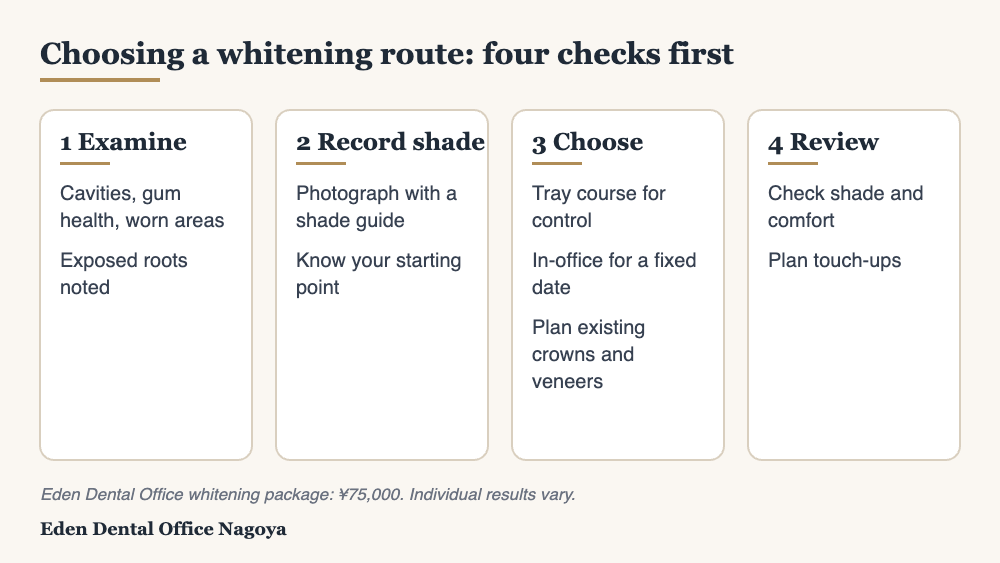
We begin with an examination, because whitening on teeth with untreated cavities, gum inflammation or exposed root surfaces is a poor idea. We then record your starting shade with photographs and a shade guide, so progress is measured and not remembered. Trays are made on our own equipment from digital scans, and we review fit before any gel is used. Patients who want a fixed date and are comfortable with a supervised visit can choose the in-office route; patients who want gradual change, or who have felt sensitivity before, are usually better served by a tray course that can be paused. Our guide to tooth sensitivity after whitening explains what to expect and what to do about it.
Check the rest of your mouth first
Whitening lightens natural enamel and dentine only. Crowns, veneers, bonding and fillings keep their colour, so a whitened tooth next to an older restoration can look mismatched. If you already have restorations in the smile zone, plan the shade first and any replacement second; see whitening with crowns, veneers and fillings. A professional cleaning removes surface stain but does not change tooth colour, a distinction explained in whitening versus cleaning. How long a result lasts depends on diet, smoking and habits, which we cover in how long whitening lasts. For the wider picture, start with our teeth whitening guide for Japan and the aesthetic treatment overview.
A realistic timeline
For a tray course, the first appointment is the examination, scans and shade photographs. Trays are ready for a fitting visit shortly afterwards, and we show you how much gel to use and how long to wear them. Most people then wear the trays daily for a few weeks, with a short review partway through so that we can check shade, comfort and gum health. If sensitivity appears, we pause, change the schedule or lower the strength before continuing. An in-office session is planned in the same way, with the examination and shade record first, and the supervised visit second. Neither route is rushed, and appointments are by reservation so that nobody is waiting in a crowded room.
Who should wait or choose differently
Some mouths are better prepared before whitening. Untreated cavities, inflamed gums and cracked or worn teeth should be dealt with first, because gel reaching an exposed area is uncomfortable. People who already notice sensitivity to cold usually do better with a gentler, slower tray course than with a single high-strength visit. If your teeth are discoloured from an internal cause, such as a darkened tooth after past trauma or staining from medication taken in childhood, ordinary whitening may not be enough and a different plan is needed; see internal bleaching for a dark tooth and whitening tetracycline-stained teeth. If you wear clear aligners, there is a sensible order to follow, set out in whitening during clear aligner treatment.
The first days after whitening
Teeth can be more porous to stain for a short period after bleaching, so we ask patients to be careful with strongly coloured drinks and foods for a few days, and to avoid smoking. Brush gently with a soft brush and a low-abrasion paste, and tell us about any lingering sensitivity so that we can adjust the plan. A touch-up tray session months later is common and is easier to manage when your starting shade has been recorded, which is why we photograph it at the beginning.
What whitening costs
Our published whitening package is ¥75,000. The first visit is ¥15,000 and our check-up package is ¥40,000. Any treatment beyond whitening, such as replacing an old restoration to match the new shade, is quoted after assessment as a written estimate in English before anything begins.
Frequently asked questions
Is at-home or in-office whitening more effective?
Trials show comparable shade change in clinical scoring. The choice usually turns on timing, comfort and how much supervision you want.
Does in-office whitening hurt more?
Not necessarily. The updated review found sensitivity risk similar, with lower intensity reported for at-home courses, but the evidence quality is low.
How long does a tray course take?
Three to four weeks of daily wear is typical with low-strength gel, adjusted to how your teeth respond.
Will whitening change my crowns or veneers?
No. Ceramic and resin do not lighten, so existing restorations are planned before the shade is chosen.
What does whitening cost at Eden?
Our whitening package is ¥75,000. Anything beyond that is quoted as a written estimate in English first.
Risks and limits
Whitening can cause temporary tooth sensitivity and gum irritation, and results depend on the starting colour, the cause of staining and how consistently trays are worn. It does not lighten restorations and is not suited to everyone, including people with active decay or untreated gum disease. The evidence summarised here is graded low in quality, so treat the comparisons as guidance and not as a promise. Individual results vary.
To plan a whitening course with one dentist from start to finish, read about Dr. Murai and the clinic, then message us on WhatsApp or call 052-265-8996.
More on this topic: Whitening Guides — every article we have published in this cluster, grouped by stage.