Hydrogen vs Carbamide Peroxide Whitening Gel in Japan
Reviewed by Dr. Ryosuke Murai, DDS, MSD — Prosthodontist, trained at Indiana University School of Dentistry (U.S.). Last updated October 2026.
Whitening gels come in two chemistries, hydrogen peroxide and carbamide peroxide, and the percentages printed on the packaging are not comparable between them. The published reviews suggest that both lighten teeth effectively, that stronger gels mainly add sensitivity rather than extra whitening, and that the choice should be made after an examination rather than from a label. This article explains the difference, what the latest systematic reviews report, and how a clinic in Japan decides which gel and which route suits your teeth. It is written for patients who want to understand the product before they commit to it.
Two gels, two different percentages
Hydrogen peroxide is the active bleaching agent. Carbamide peroxide is a compound that breaks down into hydrogen peroxide and urea, releasing roughly one-third of its weight as hydrogen peroxide. That is why a 10% carbamide gel and a 10% hydrogen gel are very different products, and why home tray gels are usually carbamide while strong in-office gels are usually hydrogen. Carbamide gels tend to release their active agent slowly, which suits hours of tray wear. Hydrogen gels act faster and are used for shorter, supervised applications.
When people compare “20% gel” with “6% strip,” they are often comparing different chemistries, different delivery methods and different wearing times at once. The reviews below are useful precisely because they group studies by gel type and strength.
What the reviews report on strength and sensitivity
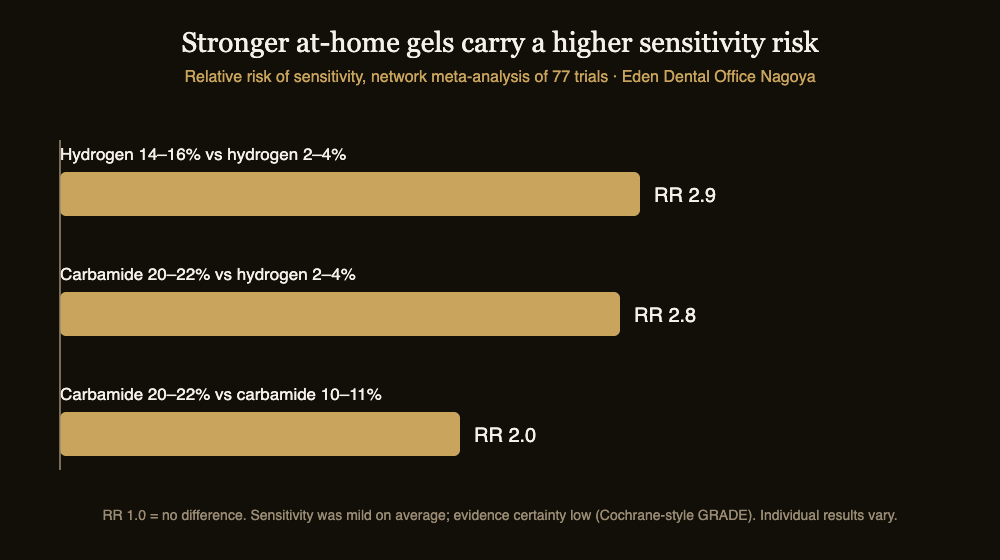
A 2025 systematic review and network meta-analysis of at-home bleaching included 77 randomized trials and compared sensitivity across hydrogen and carbamide peroxide strengths. It found a higher risk of sensitivity with 20 to 22% carbamide peroxide and 14 to 16% hydrogen peroxide than with 2 to 4% hydrogen peroxide, and a higher risk with 20 to 22% than with 10 to 11% carbamide peroxide. On average, sensitivity was mild for every agent and strength, but most trials had a high risk of bias and the certainty of evidence was low, so the authors advised that the strongest concentrations be prescribed with care and closer supervision (J Dent 2025).
On color change, a 2025 review comparing external bleaching gels reported that carbamide peroxide gels performed better than hydrogen peroxide gels on one colorimeter measure, while results on shade-guide units were comparable. It also reported that higher-strength carbamide gel caused less sensitivity than higher-strength hydrogen gel (Clin Oral Investig 2025). A 2024 review of 30 articles on in-office, at-home and combined bleaching found that all types changed tooth color effectively regardless of concentration, gel type or session length, and that sensitivity appeared higher with in-office and combined approaches, although the studies did not agree clearly (Bioengineering 2024).
| Question | What the reviews report | How firm is it |
|---|---|---|
| Do stronger gels whiten more? | All types change color; no clear advantage for higher concentration | Systematic review of 30 articles |
| Do stronger gels cause more sensitivity? | Yes at the highest at-home strengths; mild on average | Network meta-analysis, low certainty |
| Carbamide or hydrogen for color? | Carbamide ahead on one measure, comparable on another | Systematic review, moderate certainty for color |
| Which route lasts longer? | Home trays with carbamide showed less relapse in compared studies | Heterogeneous studies |
Strength is only one of three variables that decide how a whitening course feels. The others are how long the gel stays on the tooth and how closely the tray fits. A low-strength carbamide gel worn for hours in a precise tray exposes the tooth to the active agent for a long, steady period, while a high-strength hydrogen gel applied in the chair works in minutes under isolation of the gums. Neither is automatically gentler. This is why the reviews struggle to name a winner: the protocols in the trials differ in all three variables at once, and a result that holds for one protocol may not transfer to another. A dentist who sets all three together, and who can adjust them after the first week, will usually do better for you than any single label.
Matching gel and route to the tooth
The practical conclusion is that strength is a dial to be set per patient, not a goal in itself. A tooth with exposed root surface, a crack or an untreated cavity reacts more strongly to any peroxide. Existing crowns, veneers and fillings do not change color, so the shade of the natural teeth has to be planned around them; our guide to whitening with crowns, veneers and fillings covers that order of treatment. Patients who have reacted badly to strips in the past are often better served by a lower-strength carbamide gel in custom trays, worn on a schedule that is adjusted visit by visit.
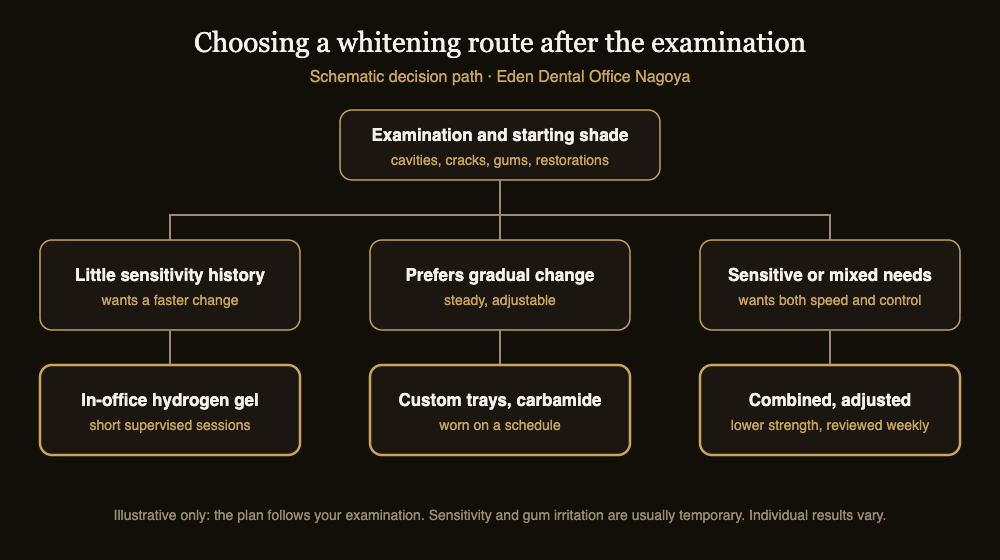
At Eden, the first visit is an examination with photographs of the starting shade. We then discuss in-office, custom-tray or combined whitening, and the gel type follows from that plan. If sensitivity appears, the options for managing it are set out in our article on sensitivity after whitening, and the broader question of tooth safety is covered in whether whitening damages enamel.
What this costs and how long it takes
The whitening package on our fees page is ¥75,000, and a check-up package is ¥40,000; any additional treatment found necessary at the examination is quoted separately in writing in English before it begins. The gel chosen does not change this package structure in itself. How long the result holds depends on diet and habits, which we discuss in how long whitening lasts, and the full range of options is described in our teeth whitening in Japan guide.
Whether adding a lamp changes the result of in-office gel is covered in light-activated whitening: what the evidence shows.
Frequently Asked Questions
Is carbamide peroxide weaker than hydrogen peroxide?
Carbamide peroxide breaks down into roughly one-third hydrogen peroxide by weight, so a 10% carbamide gel releases far less active agent than a 10% hydrogen gel. The two are used differently, which is why the percentages cannot be compared directly.
Does a higher concentration whiten better?
Not clearly. A 2024 review found all bleaching types changed color effectively regardless of concentration, gel type or session length, while stronger gels were linked to more sensitivity.
Which gel causes less sensitivity?
In the most recent network meta-analysis, 10 to 11% carbamide peroxide and 2 to 4% hydrogen peroxide carried a lower risk than the strongest at-home strengths. Sensitivity was mild on average for all of them.
Can I choose my own gel strength?
It is safer not to. Strength, tray fit and wearing time work together, and the right combination depends on your teeth, gums and any existing restorations, which an examination establishes.
Do stronger gels last longer?
The evidence does not show that. Duration of result depends more on the cause of discoloration, diet and habits than on the peroxide used.
For the wider question of which route suits you, read at-home versus in-office whitening and what the evidence shows.
Risks, limits and what to expect
Whitening commonly causes temporary sensitivity to cold and sometimes gum irritation, and both usually settle after treatment stops. Gel that leaks from an ill-fitting tray irritates the gums regardless of its strength. Peroxide does not lighten crowns, veneers or fillings, and results differ with the cause of discoloration. The reviews cited here are graded low to moderate in certainty by their own authors, mix many protocols, and cannot name one gel as superior for every patient. Individual results vary.
If you would like your teeth examined and a whitening plan explained before committing, a consultation is the right first step. We give a written estimate in English, and you can reach the clinic on WhatsApp. Our whitening page sets out the service, and visitors from overseas can arrange the examination and treatment within one trip using our guide to a dental treatment trip to Nagoya.
More on this topic: Whitening Guides — every article we have published in this cluster, grouped by stage.