
How Many Shades Whiter? Measuring Whitening Results in Japan
Reviewed by Dr. Ryosuke Murai, DDS, MSD — Prosthodontist, trained at Indiana University School of Dentistry (U.S.). Last updated November 2026.
“How many shades whiter will I get?” is the question most patients ask before teeth whitening, and it is a fair one. The difficulty is that a “shade” is not a fixed unit. It depends on which shade guide is used, the lighting in the room, how dry the teeth are at the moment of checking, and even the colour of the material held next to them. This guide explains how whitening results are actually measured, why teeth look whiter on the day than they will a week later, and how to make sure the change you paid for is documented in a way you can trust. It is written for English-speaking patients considering teeth whitening in Japan as part of private aesthetic care.
What a “shade” actually means
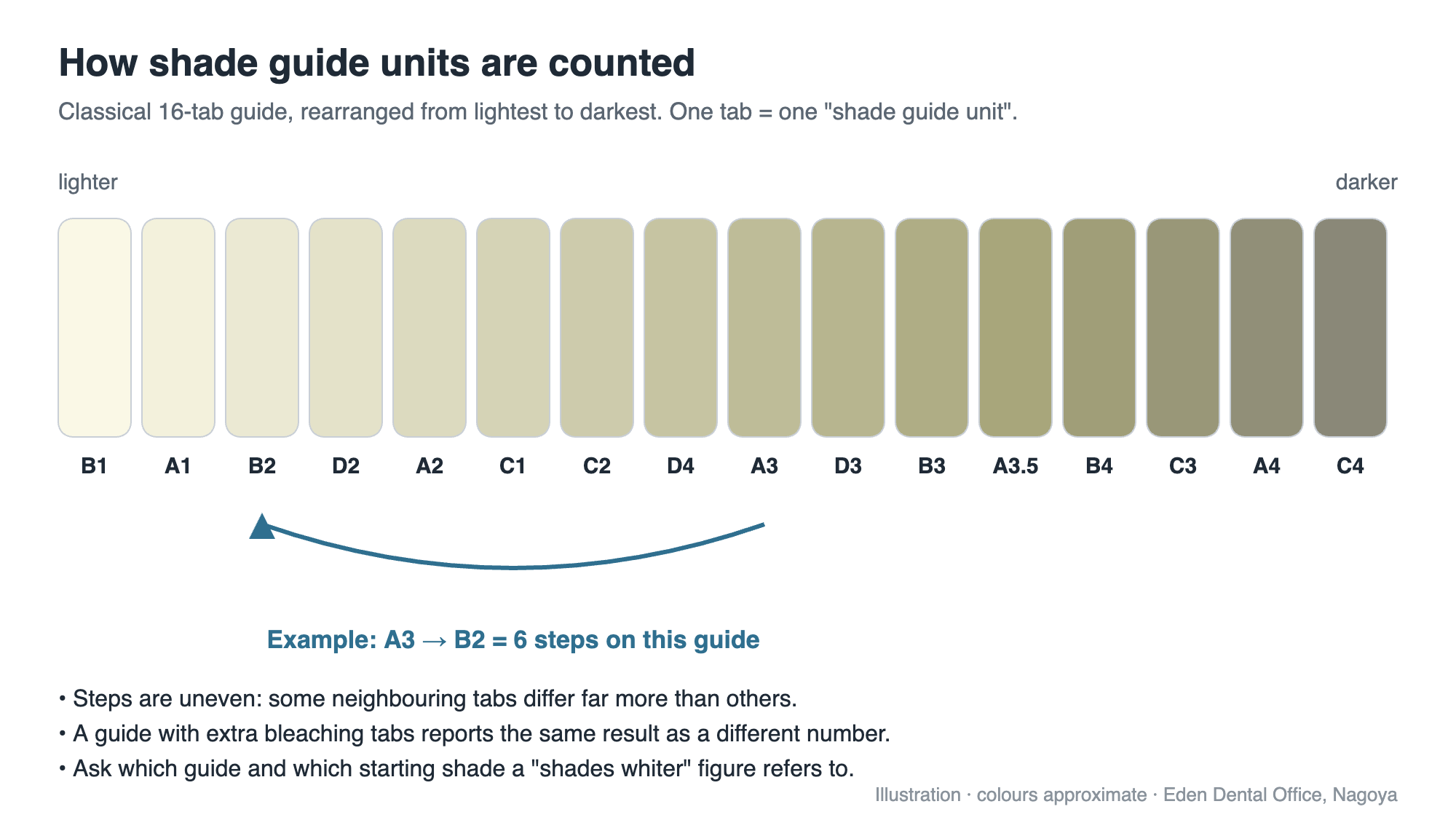
Most clinics describe tooth colour with a shade guide: a set of porcelain tabs held next to the teeth. The most widely used guide has 16 tabs with names such as A1, A2, B1 and C2. The letters describe hue (A is reddish-brown, B is yellowish, C is grey, D is reddish-grey) and the numbers describe depth. For whitening, the tabs are usually rearranged from lightest to darkest, and the result is counted as the number of steps moved along that line, often called shade guide units.
That counting method is useful but blunt. A move from A3 to A2 and a move from B1 to the lightest bleaching tab are both “one step”, yet they are not the same amount of visible change. Some guides add extra-light tabs for whitened teeth, which means the same result can be reported as a different number of shades depending on which guide was in the drawer. When a clinic quotes “up to eight shades whiter”, the honest follow-up question is: measured on which guide, from which starting shade?
Shade guide, photograph or spectrophotometer
There are three common ways to record whitening results, and each answers a slightly different question.
| Method | What it records | Strengths | Limits |
|---|---|---|---|
| Visual shade guide | The closest matching tab, judged by eye | Quick, easy to understand, shows the patient the comparison | Depends on lighting and the observer; steps are uneven |
| Standardised photograph | The teeth with a reference tab in frame, under the same light | Lets you compare before and after side by side, years later | Camera settings and angle must be repeated exactly |
| Spectrophotometer | Numerical colour values (lightness, red-green, yellow-blue) | Objective, sensitive to small changes | Reading varies with probe position and with how the device is held |
Research groups use instruments because the numbers are reproducible, but even instruments are not neutral. In a 2024 clinical trial in the European Journal of Oral Sciences, the colour of the silicone guide used to reposition the measuring probe changed the measured result: the same teeth read differently with a green guide than with a purple one. For patients, the practical lesson is simple. The method matters less than using the same method, the same way, before and after.
Why teeth look whiter on the day
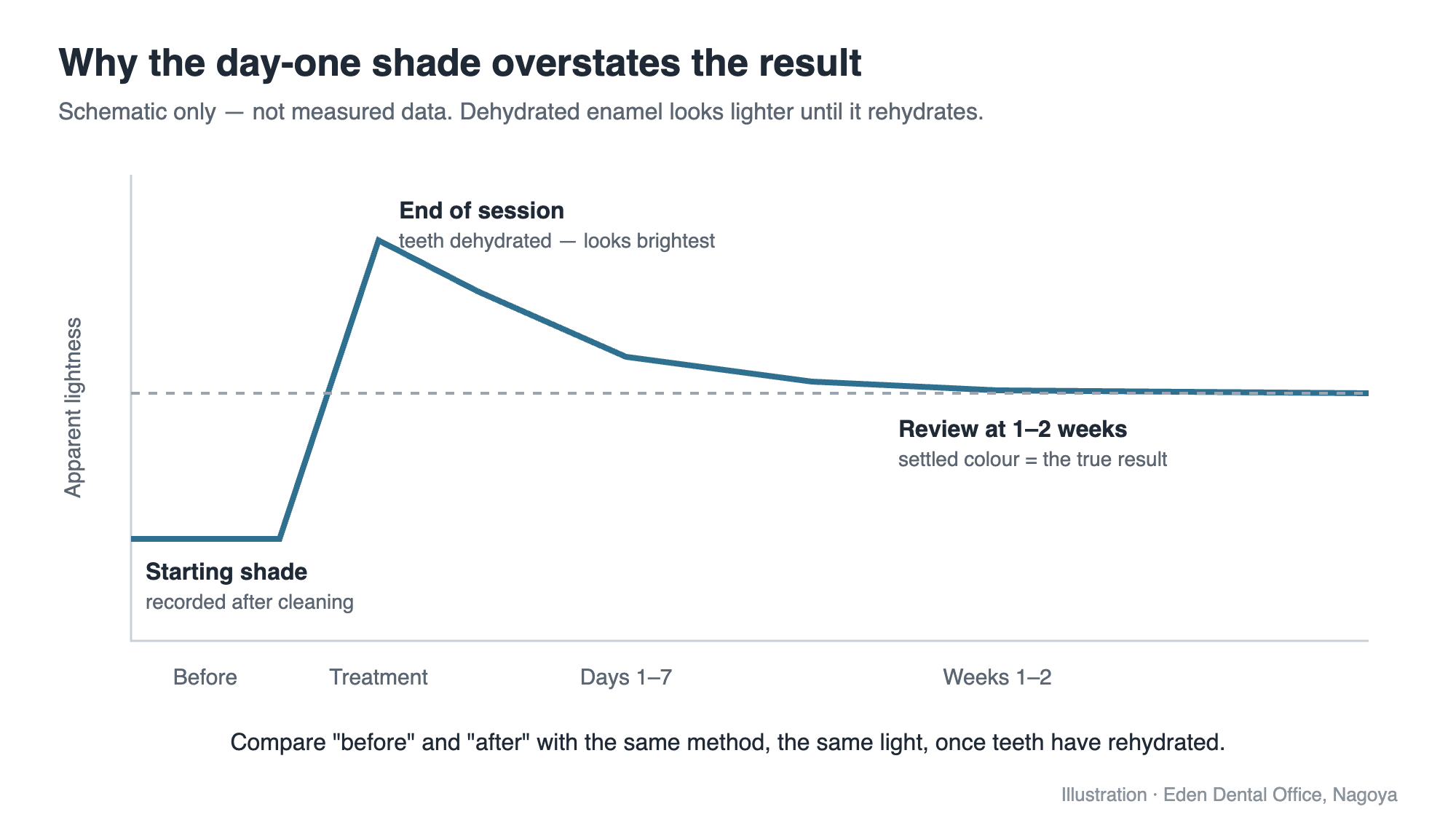
Immediately after an in-office session, teeth often look strikingly bright. Part of that brightness is temporary. Enamel loses water while the mouth is held open and isolated, and dried enamel scatters more light, so it looks lighter and more opaque. As the tooth rehydrates over the following days, some of that extra lightness fades back.
The effect is measurable. An in-vivo study in Operative Dentistry found that in younger and middle-aged adults, ten minutes of isolation was enough to shift the measured colour of front teeth beyond the level dentists treat as clinically acceptable, and the teeth took time to return to baseline afterwards. This is why a shade check taken at the end of a session overstates the result. A fair “after” record is taken at a review visit, usually around one to two weeks later, once the teeth have rehydrated and the colour has settled.
What decides how far your shade moves
No two mouths respond the same way. The factors that matter most are:
- Starting colour. Yellow-brown teeth usually lighten more readily than grey-toned teeth. Grey staining from medication or a single dark tooth after trauma needs a different approach.
- Age. Teeth tend to become darker and more chromatic with age, as a large clinical study of over 1,000 participants in the Journal of Esthetic and Restorative Dentistry confirmed. Older teeth often have more room to change, but enamel is thinner and the darker dentine shows through.
- Gel strength and time. Stronger in-office gels move colour faster; lower-strength home gels reach a similar place more slowly. A randomised study in Acta Odontologica Scandinavica found that all products tested produced a clearly visible change, with higher concentrations giving more change and more sensitivity.
- Existing crowns, veneers and fillings. These do not lighten. If they are on show, the final shade has to be planned around them.
The same study recorded something worth knowing in advance: most participants were happy with the colour they reached, but less happy with how well it held. Planning for maintenance is part of a realistic result, not an afterthought. Our guide to how long teeth whitening lasts covers what makes colour fade.
How we document a whitening result
At Eden, whitening begins with an examination and cleaning so that surface stain is not mistaken for tooth colour. The starting shade is recorded under consistent light and photographed with a reference tab in frame, before any gel is applied. Existing restorations are noted, because they set a practical limit on how far the natural teeth should go.
The result is checked again at a review visit once the teeth have rehydrated, using the same method and the same photograph set-up. You see the two images side by side. If you are preparing for a particular date, such as a wedding, the review needs to fall before that date, which is why we suggest starting whitening before an event several weeks ahead.
Whether in-office or take-home trays suit you better depends on your schedule and sensitivity; at-home versus in-office whitening compares the evidence. If you have crowns or veneers on front teeth, read whitening with crowns, veneers or fillings before deciding on a target shade. For an overview of our cosmetic work, see aesthetic treatment at Eden.
Frequently asked questions
How many shades whiter can teeth get with professional whitening?
It varies with starting colour, age and the method used. Many people see a clearly visible change, but a number of “shades” only means something when the guide and starting shade are stated. A recorded before-and-after comparison is more informative than a promised number.
Why do my teeth look less white a few days after whitening?
Teeth dry out during treatment and look lighter while dehydrated. As they rehydrate over the following days, some of that extra brightness settles. The colour at the one- to two-week review is the true result.
Is a spectrophotometer more accurate than a shade guide?
It is more sensitive to small changes, but readings still depend on how the probe is positioned. Either method works if the same one is used, the same way, before and after.
Will my crowns or veneers change colour with whitening?
No. Porcelain and composite do not lighten with whitening gel. If they are visible, the target shade is chosen so the natural teeth do not end up lighter than the restorations, or the restorations are replaced afterwards.
Can I bring a photo of the shade I want?
Yes. A reference photo helps, though lighting and screen settings change how colour appears. We compare it with shade tabs in the room so the goal is realistic for your teeth.
Cost, risks and limits
At Eden, the whitening package is ¥75,000 and includes a panoramic X-ray, oral examination, scaling and cleaning, and whitening of both arches, with no separate examination fee. A written estimate in English is provided before treatment begins.
Whitening can cause temporary sensitivity and gum irritation; both usually settle within days. It does not change the colour of crowns, veneers or fillings, and results fade gradually with coffee, tea, red wine and time. Grey or banded staining may respond only partly. Teeth with untreated decay, cracks or exposed roots may need treatment before whitening. Individual results vary.
To arrange a whitening consultation, message the clinic on WhatsApp or call 052-265-8996.
More on this topic: Whitening Guides — every article we have published in this cluster, grouped by stage.