
Toyota City, Kariya and Okazaki: Seeing a Dentist in Nagoya
Reviewed by Dr. Ryosuke Murai, DDS, MSD — Prosthodontist, trained at Indiana University School of Dentistry (U.S.). Last updated November 2026.
Many international families in Aichi live close to work in Toyota City, Miyoshi, Kariya, Anjo or Okazaki rather than in Nagoya itself. If you want private dental care in English, the trip to central Nagoya is shorter than it looks on a map: Toyota City is about an hour by train, and Kariya and Okazaki are well connected by JR and Meitetsu. The real question is not distance but how many trips a course of treatment needs. This guide covers the routes, how we plan treatment to keep visits few and well used, and the English support available closer to home. Our practice is two minutes from Fushimi Station, the stop for an English-speaking dentist in Nagoya reached directly from several West Mikawa lines.
Getting to Fushimi from West Mikawa
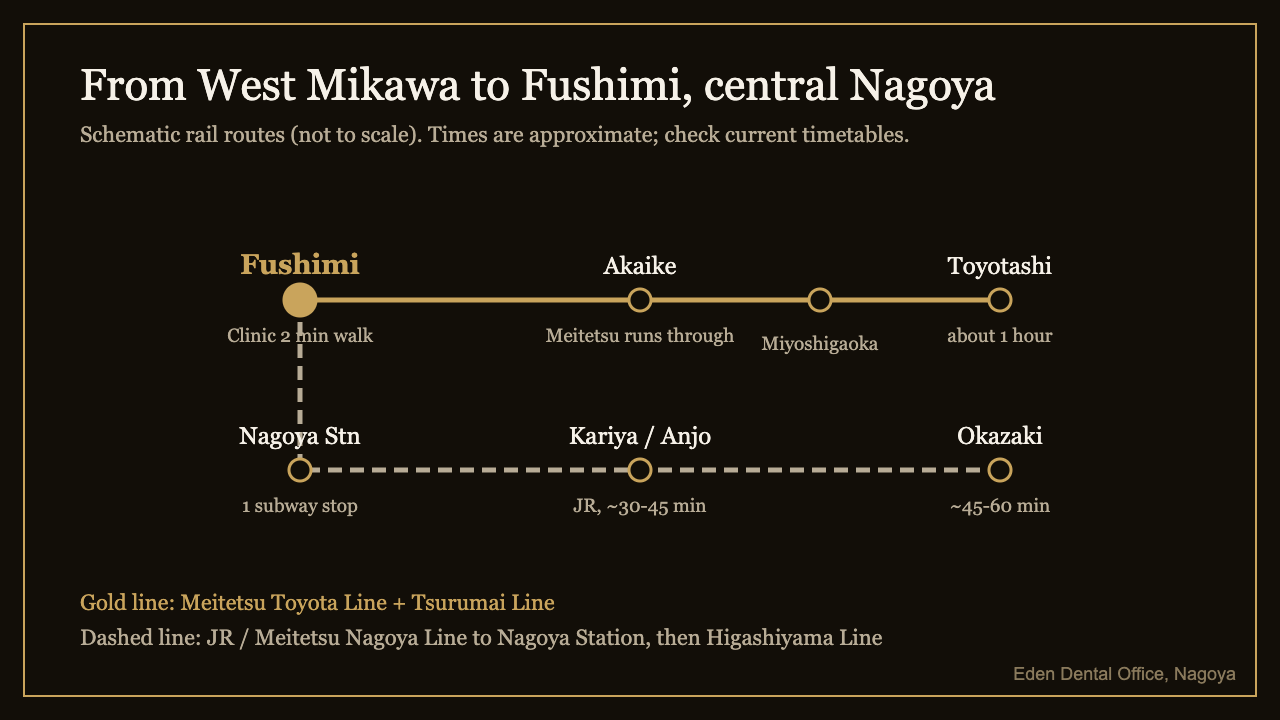
The West Mikawa area is the industrial heart of Aichi. A JETRO profile of Toyota City puts Nagoya at about 45 minutes by car and about an hour by train (JETRO). For a dental visit, the train is usually the easier choice, because central Nagoya parking is limited and paid by the hour. The table gives typical routes; times are approximate, so check the current timetable before you travel.
| Starting from | Typical rail route to Fushimi | Approximate journey | Practical note |
|---|---|---|---|
| Toyota City (Toyotashi) | Meitetsu Toyota Line, which runs through onto the Tsurumai Line at Akaike; stay on to Fushimi | About 1 hour | Many trains need no change, which suits longer appointments |
| Miyoshi (Miyoshigaoka) | Meitetsu Toyota Line, through onto the Tsurumai Line | About 45 minutes | Same line as Toyota City |
| Kariya and Anjo | JR Tokaido Line to Nagoya, then one stop on the Higashiyama Line | About 30 to 45 minutes | Rapid trains shorten the JR leg |
| Okazaki | Meitetsu Nagoya Line or JR to Nagoya, then one stop on the Higashiyama Line | About 45 to 60 minutes | Allow for the transfer at Nagoya Station |
If you are coming from further away, by Shinkansen or from Centrair airport, our guide to getting to our Nagoya office from Centrair or the Shinkansen covers those routes.
Why fewer, longer visits matter at this distance
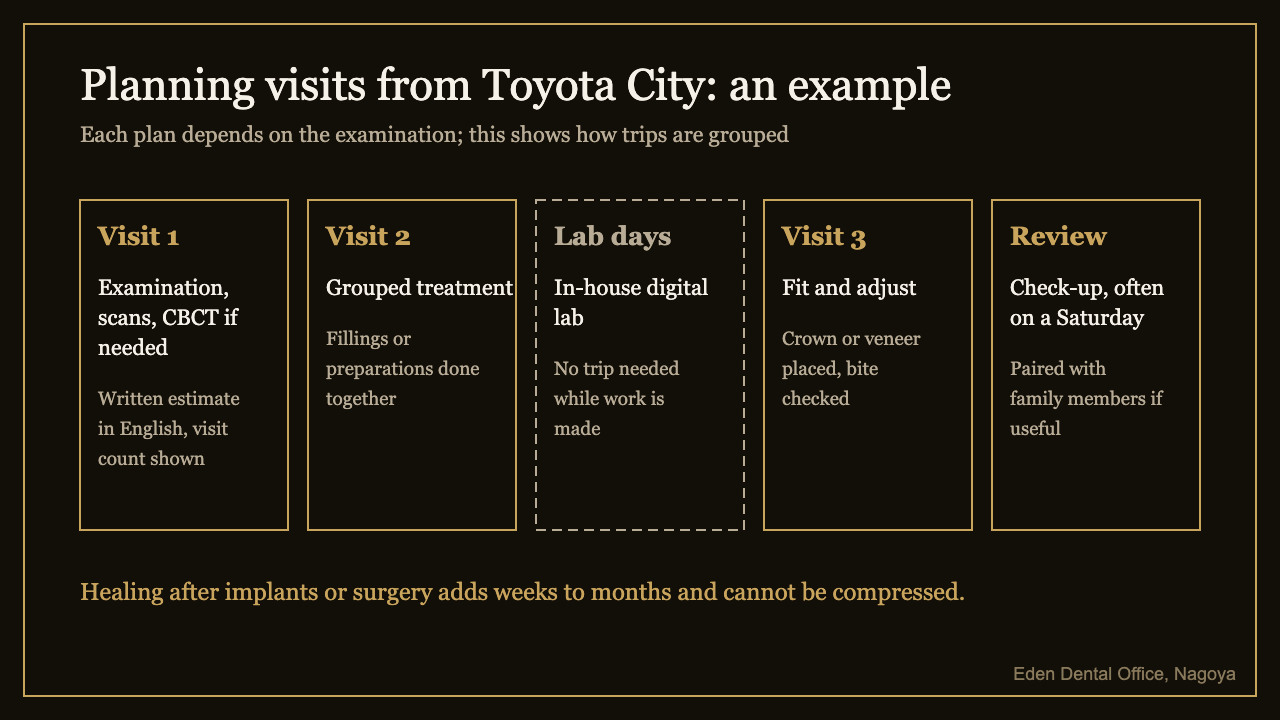
A one-hour journey each way is easy once. Repeated over many visits, the travel time adds up. So the first visit is designed to collect everything needed for a full plan in one sitting: an examination, digital scans, and a CBCT scan where implants or complex restorations are being considered. You leave with a written estimate in English that sets out the sequence of visits, so you can see from the start how many trips are involved.
From there we group work where it is clinically sound. Several fillings can often be done together; crowns and veneers are made in our in-house digital lab, which shortens the gap between preparation and fitting. Some steps cannot be compressed. Bone needs months to heal around a Straumann implant, and a tooth with active infection needs to settle before it is restored. We explain which waits are biological and which are only scheduling, so you can plan around them.
Fitting visits around plant shifts, school and Saturdays
The clinic is open on Monday, Tuesday, Friday and Saturday, from 10:00 to 13:00 and 14:00 to 19:00. Saturday appointments suit families travelling from Toyota City or Okazaki, because they avoid the weekday commute and school hours. Late afternoon slots on weekdays suit people whose shift ends early. Children’s check-ups can be paired with a parent’s visit, which also helps if you have a school dental form to follow up; our note on reading school dental check-up results in Nagoya explains what the codes mean.
If you have recently arrived on assignment, dental planning for a Nagoya work assignment sets out a sensible timeline from the first baseline visit to the last months before you leave.
What one trip can and cannot cover
A single visit can usually include the full examination and scans, a professional cleaning, small fillings, an urgent assessment, or the fitting of a finished crown or veneer. Treatment that depends on healing, such as implants, gum procedures or a root canal followed by a crown, needs a series of visits spaced over weeks or months. Knowing this in advance lets you book the long appointments for days when the journey is easiest.
English support closer to home
Aichi Prefecture lists the international associations and city hall consultation desks for each West Mikawa city. Toyota City Hall offers consultation in English, Portuguese and Spanish, Kariya and Okazaki also have English desks, and Toyota, Kariya, Okazaki and Anjo each have an international association (Aichi Prefecture). These are useful for everyday questions about living in the area. For urgent dental problems at night or on a holiday, our guide to a dental emergency in Nagoya explains where to go, and English dental and medical help in Nagoya lists the public services worth saving in your phone.
One prosthodontist, from first visit to final fit
In our clinic, the dentist who examines you is the one who plans, treats and reviews. Dr. Murai trained in prosthodontics at Indiana University School of Dentistry, and that continuity matters more when you travel: you do not repeat your history at each visit, and decisions are made by someone who has seen every stage. Appointments are private and unhurried, and explanations and estimates are in English. You can read more about Dr. Murai and how the clinic works, or see how other patients plan visits in our guide to planning a dental treatment trip to Nagoya. If you work near the station, dental visits near Fushimi Station shows how a visit fits into a working day.
What it costs
The first visit is ¥15,000, and an emergency consultation is ¥25,000. The check-up package is ¥40,000, and annual memberships range from ¥88,000 to ¥288,000 per year. Any treatment found to be needed is quoted as a written estimate in English before it begins, including the number of visits it requires.
Frequently asked questions
How long does it take to get from Toyota City to a dentist in central Nagoya?
About an hour by train. The Meitetsu Toyota Line runs through onto the Tsurumai Line at Akaike, and Fushimi is on the Tsurumai Line, so many trips need no change.
Is it better to drive or take the train from Kariya or Okazaki?
For most patients the train is simpler. Parking in central Nagoya is limited and paid by the hour, while JR and Meitetsu connect to Nagoya Station, one subway stop from Fushimi.
Can treatment be planned to reduce the number of trips?
Yes, within clinical limits. The first visit gathers scans and records for a full plan, work is grouped where it is sound, and the written estimate shows the number of visits in advance. Healing time after implants or surgery cannot be shortened.
Are Saturday appointments available?
Yes. The clinic is open on Saturdays from 10:00 to 13:00 and 14:00 to 19:00, as well as Monday, Tuesday and Friday.
Where can I get English help with daily life in Toyota City?
Toyota City Hall has a consultation desk with English support, and the Toyota International Association offers help for foreign residents. Aichi Prefecture keeps a list of these services for each West Mikawa city.
Risks and limits
Journey times in this article are approximate and depend on the train and time of day. The number of visits any treatment needs depends on your examination and on how your mouth heals; some treatments involve waiting periods that cannot be shortened safely. All dental treatment carries risks, which are explained before you agree to a plan. Public service details are taken from official sources and may change, so check them before relying on them. This article is general information, not a personal diagnosis. Individual results vary.
To arrange a first visit, message the clinic on WhatsApp or call 052-265-8996.
More on this topic: Trip Planning Guides — every article we have published in this cluster, grouped by stage.