All-on-4 Candidacy in Japan: Bone Loss, Health & Age Factors
Reviewed by Dr. Ryosuke Murai, DDS, MSD — Prosthodontist, trained at Indiana University School of Dentistry (U.S.). Last updated July 2026.
“You don’t have enough bone for implants” is one of the most common reasons patients give up on fixed teeth — and one of the least examined. All-on-4 candidacy in Japan is broader than many people assume, because the technique was designed specifically for jaws with significant bone loss. Tilted posterior implants use the dense bone that remains at the front of the jaw, often making bone grafting unnecessary. This guide is written for self-pay patients across Japan and abroad who have been told their bone is insufficient, or who are weighing full-arch implant treatment and want to know what actually decides candidacy: bone volume, medical history, gum health, and habits — roughly in that order of how often each one changes the plan.
Why “not enough bone” rarely ends the conversation
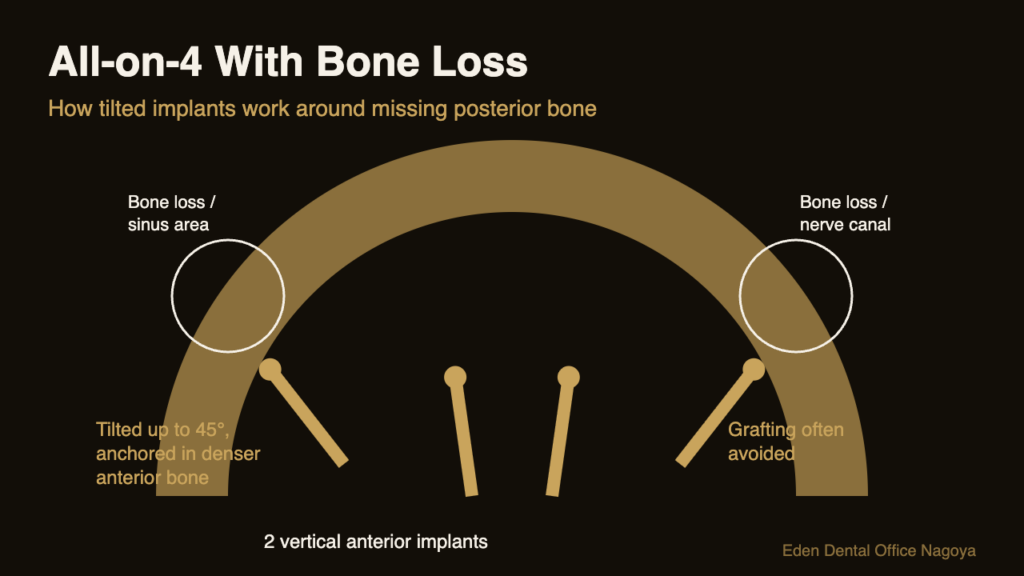
Conventional implant planning places fixtures vertically, one per missing tooth region. In a jaw that has been without teeth for years, the back sections — below the sinus in the upper jaw, above the nerve canal in the lower — are usually the first to lose volume. That is precisely the anatomy the All-on-4 protocol was built to work around: two anterior implants placed vertically, two posterior implants tilted at up to 45 degrees so they anchor in the stronger bone toward the front while still supporting the back of the bridge.
The clinical record behind this approach is substantial. A systematic review of axial and tilted implants in All-on-4 rehabilitations reported cumulative implant survival of roughly 94–98% over 6 to 11 years, with no significant difference between the tilted and the vertical fixtures. In other words, tilting an implant to avoid a sinus lift is not a compromise position; it performs on par with conventional placement in full-arch cases.
There are limits. If the front section of the jaw has also resorbed severely — something that happens after decades of denture wear — even tilted placement may not find enough anchorage, and staged grafting or other approaches enter the discussion. A CT scan settles this question in minutes; a panoramic X-ray alone cannot.
The factors that matter more than bone volume
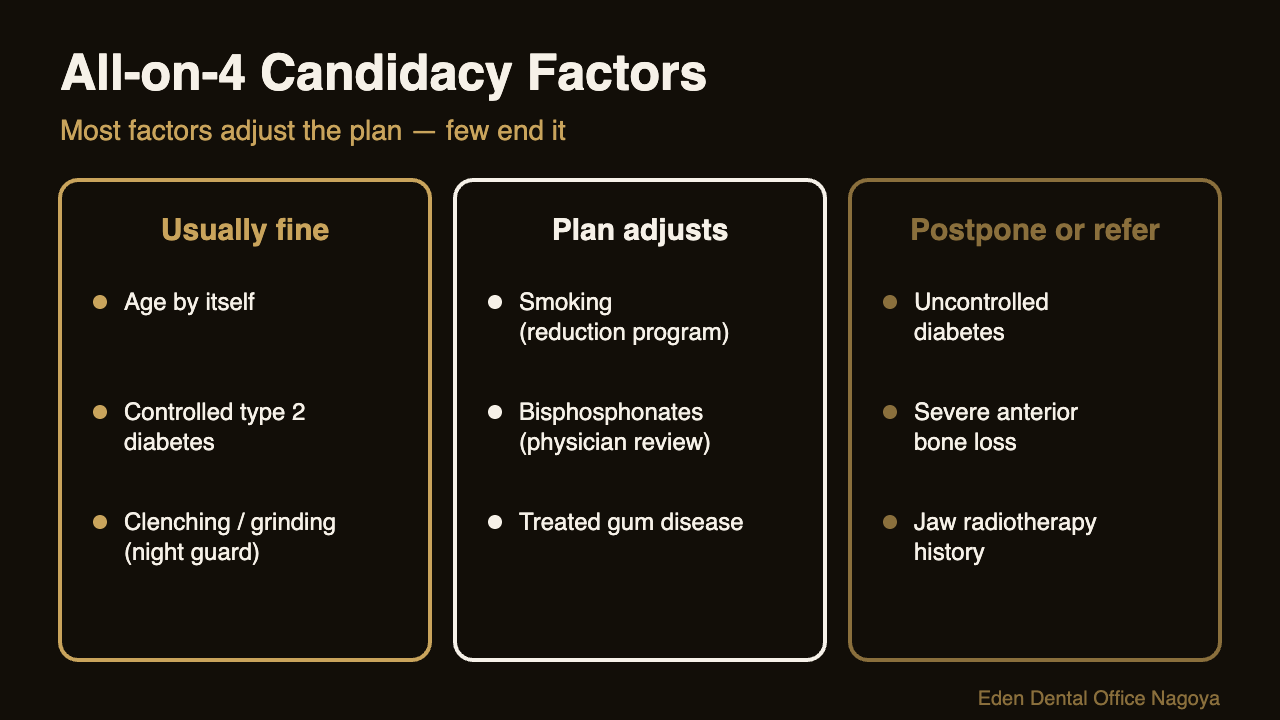
In our experience, medical and behavioral factors change more treatment plans than bone volume does. A meta-analysis of risk factors for implant failure found that smoking and radiotherapy to the jaw significantly raised failure rates, while controlled diabetes and osteoporosis showed a much smaller effect than most patients fear.
| Factor | Typical effect on candidacy | What changes in the plan |
|---|---|---|
| Smoking | Raises failure and complication risk | Reduction or cessation program before surgery; more frequent maintenance |
| Type 2 diabetes (controlled) | Rarely disqualifying | HbA1c reviewed with your physician; healing monitored more closely |
| Uncontrolled diabetes | Surgery postponed | Treatment resumes once glycemic control is documented |
| Osteoporosis medication (bisphosphonates) | Case-by-case | Drug type, dose, and duration reviewed; physician consultation before any extraction or placement |
| Active gum disease | Must be treated first | Periodontal therapy precedes implant surgery |
| Heavy clenching or grinding | Not disqualifying | Bridge material selection and a night guard protect the prosthesis |
| Age alone | Not a criterion | Overall health and healing capacity matter; we treat patients in their 80s |
None of these items is a yes/no switch. They are inputs into a risk conversation that should end with a written plan — not a verbal “you’re not a candidate” delivered after a five-minute look at an X-ray.
How we actually assess candidacy at Eden
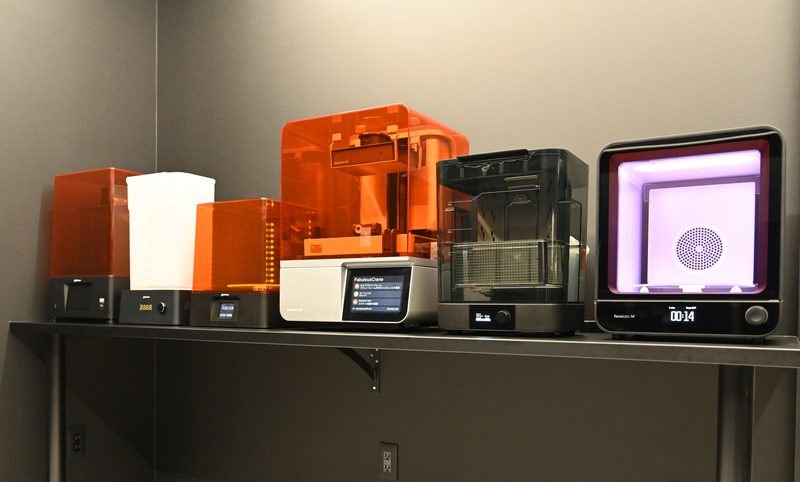
At Eden Dental Office in Nagoya, candidacy assessment is a data exercise before it is a judgment call. We take a CBCT scan and measure the bone in three dimensions, then plan implant positions digitally in our in-house lab — the same workflow we use to design the surgical guides and same-day provisional bridge. Because the planning software shows exactly how much bone each Straumann BLX fixture would engage at each angle, we can usually tell a patient not just whether All-on-4 is possible, but how much margin the anatomy offers. Patients traveling from Tokyo, Osaka, or overseas can send existing CT data ahead by secure transfer, so the first visit starts from analysis rather than from zero.
For upper jaws where the sinus has expanded into the ridge, the choice is typically between tilted placement and a sinus lift with grafting — each with distinct costs, timelines, and healing profiles. We present both on paper and let the anatomy, and the patient, decide.
When All-on-4 is not the right answer
An honest candidacy assessment sometimes points away from All-on-4. If several healthy natural teeth remain, extracting them for a full-arch bridge is rarely justified; segmented implant work preserves them instead. If budget is the binding constraint, an implant overdenture on two to four implants restores chewing at a lower entry cost, at the price of being removable. And in the most severe upper-jaw resorption cases, zygomatic implants — anchored in the cheekbone — may be discussed; this is a specialized procedure, and we refer such cases to appropriate surgical colleagues rather than force an All-on-4 that the bone cannot support.
What a candidacy assessment costs
Our comprehensive check-up package, which includes the examination and imaging needed to begin this assessment, is ¥40,000 (listed on our fee page). Full All-on-4 treatment fees depend on the number of arches, the bridge material, and whether adjunct procedures are needed; we do not publish a single figure because no single figure would be honest. What we do commit to: a realistic breakdown of full-arch fees at consultation, and a written estimate in English — itemized, with each contingency priced — before any treatment begins. Details of our published packages are on the fee page.
Once you are confirmed as a candidate, the next thing worth understanding is the upkeep — see how an All-on-4 bridge is cleaned and maintained.
Frequently Asked Questions
Can I get All-on-4 with severe bone loss?
Often, yes. Tilted implants use remaining anterior bone and avoid grafting in many cases. A CBCT scan gives a definitive answer.
Am I too old for All-on-4?
Age by itself is not a criterion. Healing capacity and overall health are what we assess, together with your physician where relevant.
Does diabetes rule out implant treatment?
Controlled diabetes generally does not. We review your HbA1c and coordinate with your physician; uncontrolled diabetes means postponing, not abandoning, treatment.
Do I need a bone graft before All-on-4?
Usually not — avoiding grafts is the point of the tilted-implant design. Severe anterior bone loss is the main exception.
Can candidacy be assessed remotely before I travel?
Partially. We can review existing CT data sent in advance; final confirmation requires an in-person examination and our own imaging.
Risks and important notes
All implant surgery carries risks, including infection, implant failure requiring replacement, nerve disturbance, sinus complications in the upper jaw, and fracture or wear of the bridge over time. Risk is higher for smokers and for patients with unmanaged systemic conditions. Full-arch treatment also requires lifelong professional maintenance, which has its own costs. All candidacy decisions are made after clinical examination and imaging — no assessment in an article can substitute for one. Individual results vary.
If you have been told you are not a candidate for implants, that conclusion deserves a second look with three-dimensional imaging. You can read more about our implant treatment philosophy, or contact us on WhatsApp in English to arrange a consultation — including a review of imaging you already have.