Bone Graft & Sinus Lift Cost in Japan: Implant Add-On Fees
Reviewed by Dr. Ryosuke Murai, DDS, MSD — Prosthodontist, trained at Indiana University School of Dentistry (U.S.). Last updated July 2026.
You compared two implant quotes and one of them includes a line called “GBR” or “sinus lift” that the other quote never mentions. A bone graft or sinus lift is a separate surgical procedure with its own fee, and it can change the total dental implant cost in Japan more than the choice of clinic does. Whether you need one is decided by your anatomy — bone height, width, and the position of the maxillary sinus — not by a price list. This article is written for self-pay patients who want to understand what grafting procedures do, when they are justified, and which factors move the added fee, before committing to implant treatment planned and restored under one roof. It is part of our complete guide to dental implant costs in Japan.
Why one implant quote includes a graft and another doesn’t
An implant needs a certain volume of healthy bone to be stable: enough width to surround the fixture and enough height to anchor its full length without invading the sinus or the nerve canal. When a tooth has been missing for years, the ridge shrinks — studies of post-extraction healing consistently describe the greatest volume loss in the first months. In the upper molar region, the maxillary sinus often sits low, leaving only a few millimeters of usable bone.
Two honest clinicians can still produce different quotes for the same mouth. One may plan a shorter or more tapered fixture that engages the bone you already have; the other may prefer to rebuild the ridge first. Neither is automatically wrong — but you should be able to see the reasoning, which is why we have written separately about what a written implant quote in Japan should itemize. If a graft appears on your quote, it should be named (GBR, crestal sinus lift, lateral window), justified by a CBCT finding you can look at, and priced as its own line.
GBR, crestal sinus lift, lateral window: what each one fixes
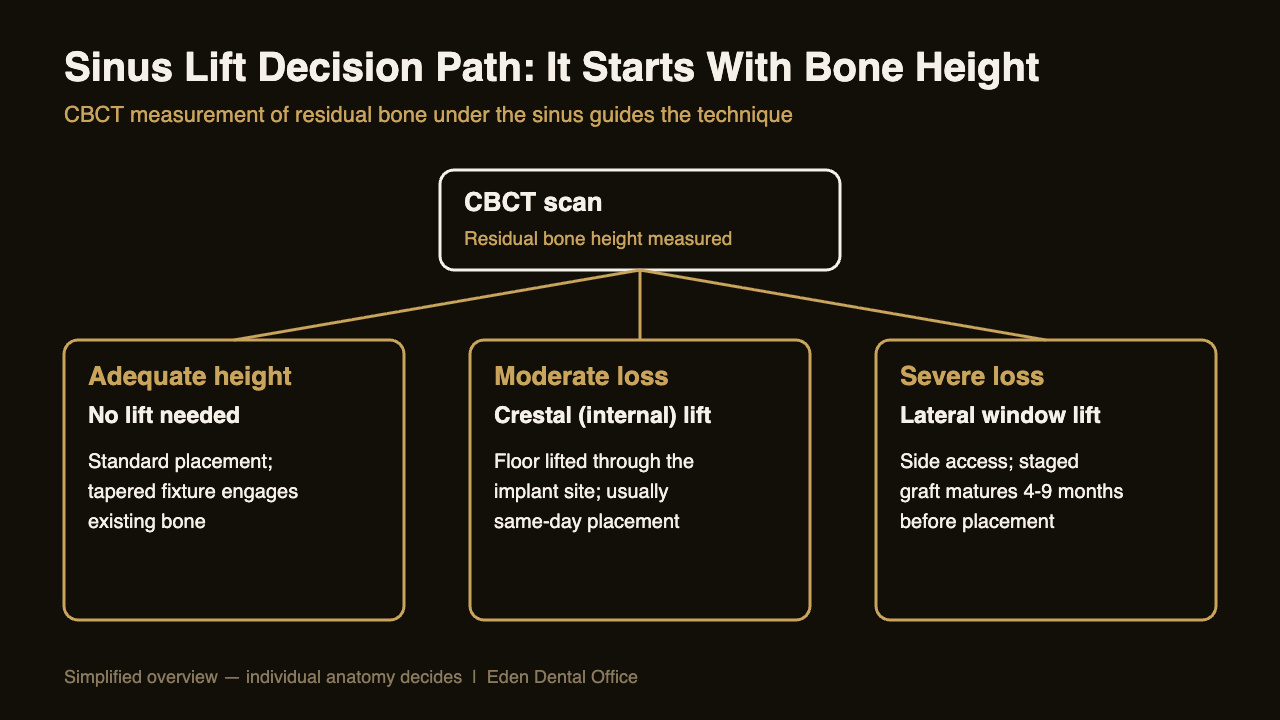
Most grafting in implant dentistry falls into three procedures. The table below summarizes what each addresses and how it typically affects your treatment timeline.
| Procedure | What it fixes | Typical timing | Added healing time |
|---|---|---|---|
| GBR (guided bone regeneration) | Ridge too narrow or locally deficient; graft material plus a membrane rebuilds contour | Often simultaneous with implant placement; staged if the defect is large | 0–6 months depending on staging |
| Crestal (internal) sinus lift | Upper molar area with moderate bone height; sinus floor is lifted through the implant site itself | Same surgery as implant placement | Usually none beyond normal integration |
| Lateral window sinus lift | Upper molar area with severe height loss; sinus is accessed from the side and grafted | Staged (graft matures first) or simultaneous when enough native bone remains | 4–9 months when staged |
The clinical evidence for these procedures is mature. A systematic review of sinus floor elevation techniques found high implant survival across both crestal and lateral approaches, and earlier comparative work reported survival after sinus augmentation broadly in line with implants placed in untouched bone. Grafting is routine, well-studied surgery — but it is still surgery, with its own consent, risks, and fee.
What moves the added fee in Japan
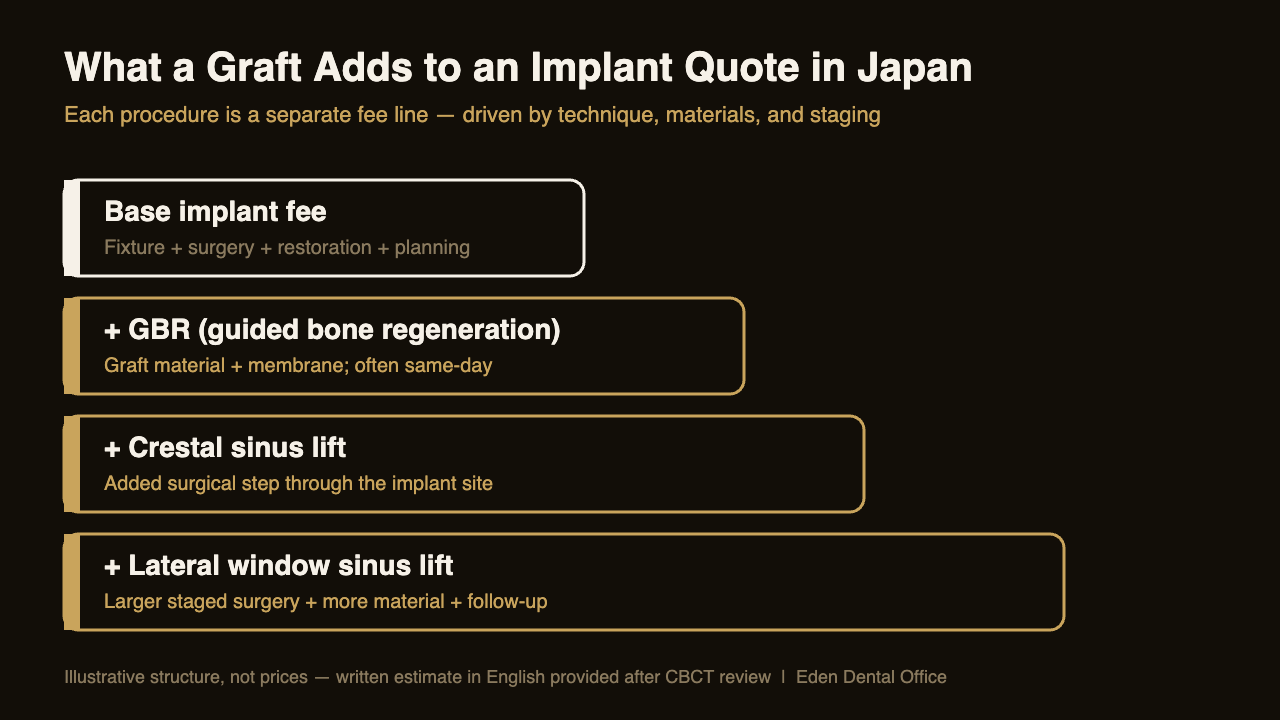
Because implant treatment is self-pay, every clinic sets its own grafting fees, and the range across Japan is wide. Rather than quoting numbers that may not apply to you, it is more useful to know the five drivers that determine where in the range your case lands:
- Technique. A crestal lift done through the implant site adds modest surgical time. A lateral window is a larger procedure — longer surgery, more material, more follow-up — and is priced accordingly.
- Material class and volume. Bone substitutes (xenografts and synthetic materials) and collagen membranes are consumables with real unit costs. A small contour graft uses a fraction of the material a full sinus graft does.
- Staged versus simultaneous. If the graft must heal before the implant is placed, you are paying for two surgical visits and additional imaging, not one.
- Imaging and planning. CBCT scans, digital planning, and surgical guides may be bundled or billed separately — this varies by clinic and is worth checking line by line.
- Location and overhead. The same procedure is often quoted higher in central Tokyo, for reasons we unpack in why Tokyo and Nagoya quotes for the same implant differ.
One more driver works in the other direction: good planning can remove the graft entirely. That is the subject of the next section.
How we plan graft cases at Eden
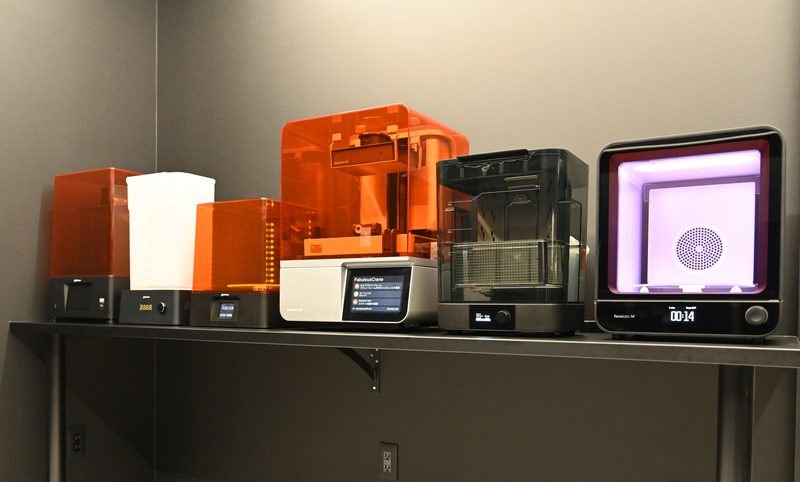
At Eden, every potential graft case starts with a CBCT scan reviewed against the prosthetic plan — where the final tooth needs to be — rather than simply where bone happens to remain. In our clinic, we plan fixture position with guided-surgery software and 3D-printed surgical guides produced in our in-house digital lab, and we use the Straumann BLX and TLX systems, whose tapered designs are engineered to achieve stability in reduced bone. In a meaningful number of upper molar cases, careful angulation or a crestal lift performed through the osteotomy lets us avoid a lateral window altogether — which removes months of healing and an entire fee line from the estimate. This planning philosophy comes directly from Dr. Murai’s prosthodontic training at Indiana University: the restoration is designed first, and surgery serves that design. We have also written about what Straumann’s premium pricing actually buys in this planning chain.
What this costs
Eden publishes anchor fees on its site — a check-up package at ¥40,000 is the published starting point for a full diagnostic assessment — and treatment-specific fees are listed on our fee page. For grafting procedures, we do not publish a single number because, as the drivers above show, an honest figure depends on technique, material volume, and staging. What we commit to instead: after your CBCT review, you receive a written estimate in English that itemizes the implant, any graft procedure, materials, and follow-up, before any treatment begins. Japanese national health insurance does not cover implant treatment or the grafting performed for it, apart from narrow congenital and trauma exceptions handled at designated hospitals; general context on the system is available from the Ministry of Health, Labour and Welfare. When comparing totals internationally, remember that grafting inflates U.S. fees too — see how Japanese implant fees compare with U.S. pricing — and that the graft is a one-time cost, unlike the 10-year maintenance budget every implant carries.
Grafting fees also appear as add-on lines in full-arch work; our guide to what an All-on-4 fee in Japan includes shows where they sit in the total.
Frequently Asked Questions
Do all dental implants in Japan require a bone graft?
No. Many patients have adequate bone, and modern tapered fixtures and guided planning let clinicians use existing bone more efficiently. A CBCT scan is the only reliable way to know.
Does a sinus lift hurt?
The procedure is done under local anesthesia. Afterward, most patients describe swelling and pressure managed with ordinary analgesics for several days. Discomfort varies with technique and individual healing.
Does Japanese health insurance cover bone grafts for implants?
Not when the graft is performed for implant treatment, which is self-pay. Coverage exists only for specific congenital or trauma-related cases treated at designated hospitals.
How long does healing take after a lateral window sinus lift?
When staged, the graft typically matures for four to nine months before the implant is placed, then the implant integrates for several more months. Simultaneous placement shortens the calendar when enough native bone allows it.
Can the graft and implant be placed on the same day?
Often, yes — GBR and crestal lifts are commonly done at placement. Large defects and severe sinus pneumatization usually require staging. Your CBCT determines which path is realistic.
Risks and what to expect
Grafting procedures carry specific risks in addition to those of implant surgery: sinus membrane perforation during elevation, post-operative sinusitis, infection or exposure of the graft material, and partial loss of grafted volume that occasionally requires re-grafting. Smoking and uncontrolled diabetes measurably raise these risks. Costs, healing times, and outcomes described here are typical patterns, not promises for your case. Individual results vary. General patient information on implants is also maintained by the American Dental Association.
If your quote elsewhere includes a large graft — or you have been told you have “no bone” — a CBCT-based review is worth a trip. You can read about our implant treatment approach, then reach us on WhatsApp in English to arrange an assessment and a written estimate.
Because tilted implants often reduce the need for grafting altogether, they feature heavily in All-on-4 full-arch treatment, which we explain here.