All-on-4 Cost in Japan: A Realistic Full-Arch Fee Breakdown
Reviewed by Dr. Ryosuke Murai, DDS, MSD — Prosthodontist, trained at Indiana University School of Dentistry (U.S.). Last updated July 2026.
A reader in Yokohama recently wrote to us after collecting three All-on-4 quotes that differed by more than double. None of the three clinics itemized what the figure covered. That gap is the real story of All-on-4 cost in Japan: full-arch treatment is self-pay, prices are unregulated, and two identical-looking numbers can describe very different plans. This guide is written for self-pay, quality-first patients — in Japan or abroad — who want to understand what a complete full-arch fee should include before they compare clinics. If you have not yet read how the treatment itself works, start with our guide to All-on-4 treatment in Japan, then use this article to decode the quotes; our implant treatment page explains how Eden structures full-arch care.
Why All-on-4 quotes vary so widely in Japan
Japanese national health insurance does not cover implant-supported full-arch rehabilitation, so every clinic sets its own fee. That freedom produces a wide spread, and the spread is rarely about greed at the high end or generosity at the low end. It is usually about scope.
A low quote often prices only the surgical day: four implants and an acrylic provisional bridge. The final bridge — the part you actually live with for years — may be quoted later, sometimes for a sum comparable to the surgery itself. A complete quote prices the entire journey: diagnostics, surgery, the provisional phase, the definitive bridge, and a defined follow-up period. When you normalize quotes to the same scope, much of the shocking variation disappears. We described the same effect for single implants in our comparison of implant costs in Japan and the U.S., and it is amplified in full-arch work because there are simply more components to leave out.
What a complete All-on-4 fee should include
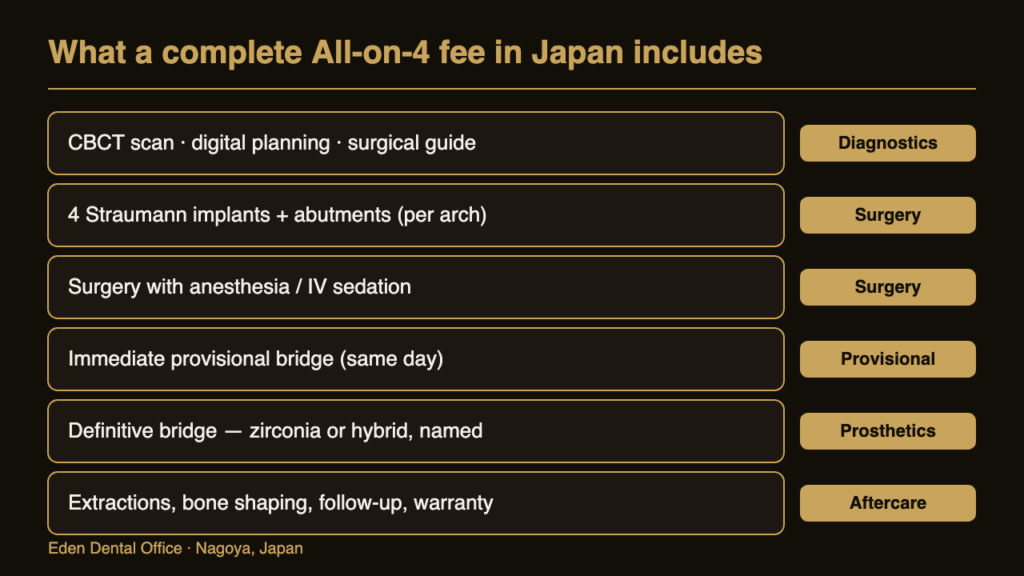
Before comparing any two numbers, ask each clinic to confirm — in writing — which of the following items the figure covers.
| Component | In a complete quote | Commonly billed separately |
|---|---|---|
| CBCT scan, digital planning, surgical guide | Included | Often an added planning fee |
| Four implants (per arch), abutments | Included, brand named | Brand unstated or “equivalent” |
| Surgery, anesthesia or IV sedation | Included, sedation specified | Sedation billed per session |
| Immediate provisional bridge | Included | Included (rarely omitted) |
| Definitive bridge (zirconia or hybrid) | Included, material named | Quoted later, priced separately |
| Extractions and bone shaping | Included | Per-tooth surcharge |
| Follow-up visits and adjustments | Defined period included | Per-visit fees |
| Warranty terms | Written, with conditions | Verbal or absent |
The single most consequential line is the definitive bridge. Materials differ sharply in cost and behavior — monolithic zirconia, titanium-acrylic hybrid, and ceramic-veneered frameworks each age differently — and a quote that defers this decision defers most of the price. A peer-reviewed systematic review of the All-on-4 concept notes that prosthetic complications, not implant loss, account for most long-term maintenance events (Soto-Peñaloza et al., 2017), which is precisely why the bridge material and its warranty deserve as much scrutiny as the surgery.
Six drivers that move the number
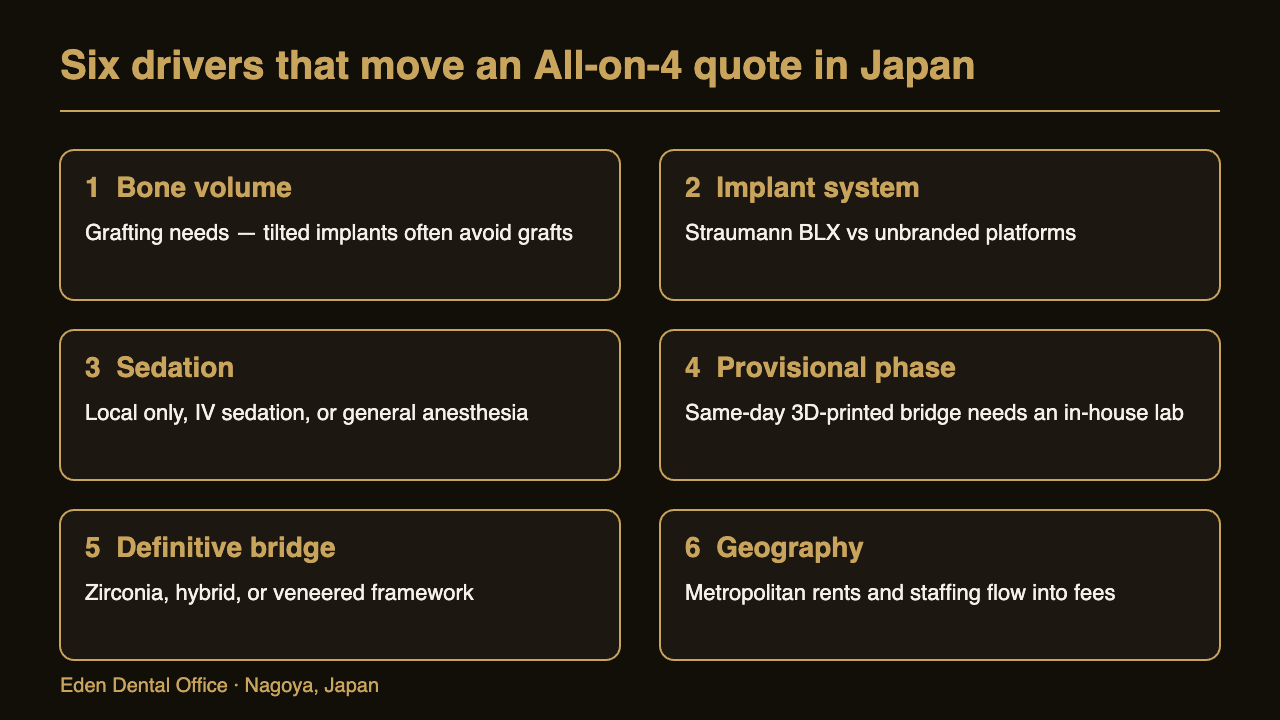
First, bone volume. All-on-4 was designed to work around bone loss by tilting the posterior implants, so many patients avoid grafting altogether — one reason full-arch treatment can cost less than expected in atrophic cases. When grafting is unavoidable, it is priced as an addition; our article on bone graft and sinus lift fees in Japan explains those ranges.
Second, the implant system. We use Straumann exclusively — the BLX system for most full-arch cases — and component pricing for a Swiss premium system is materially higher than for unbranded alternatives, which shows up honestly in the fee. Third, sedation: local anesthesia alone, IV sedation with an anesthesiologist, or general anesthesia sit at very different price points. Fourth, the provisional phase — a 3D-printed or milled provisional made the same day requires an in-house lab or a fast external one. Fifth, the definitive bridge material, discussed above. Sixth, geography: metropolitan rents and staffing costs flow into fees, a pattern we documented for single implants in Tokyo versus Nagoya pricing.
How Japan compares internationally for full-arch fees
Patients comparing Japan with the United States, the U.K., or Singapore should compare complete-scope quotes only. In the U.S., published full-arch fees typically bundle surgery and prosthetics per arch, and the long-term clinical evidence base is the same one Japanese clinicians rely on: the concept’s originating research group has reported outcomes on the completely edentulous mandible at up to ten years of follow-up (Maló et al., 2019). What differs is cost structure — malpractice premiums, staffing, and laboratory economics — not the biology. In our experience, patients who normalize scope usually find that premium Japanese full-arch treatment, on a Straumann platform with an in-house digital laboratory, sits well below comparable U.S. metropolitan pricing while using the same implant systems and materials.
What this costs at Eden
We do not publish a single All-on-4 price, because a responsible full-arch fee cannot be quoted before diagnostics. The number depends on bone volume, extractions, sedation choice, provisional design, and the definitive bridge material — the six drivers above. What we commit to instead: after a CBCT scan and digital planning session, you receive a written, itemized estimate in English covering every component in the table above, with no later surprises. Current diagnostic and preventive package fees are listed on our fee page, and financing routes common in Japan — including interest-conscious staging of the surgical and prosthetic phases — are covered in our article on how patients pay for implant treatment in Japan.
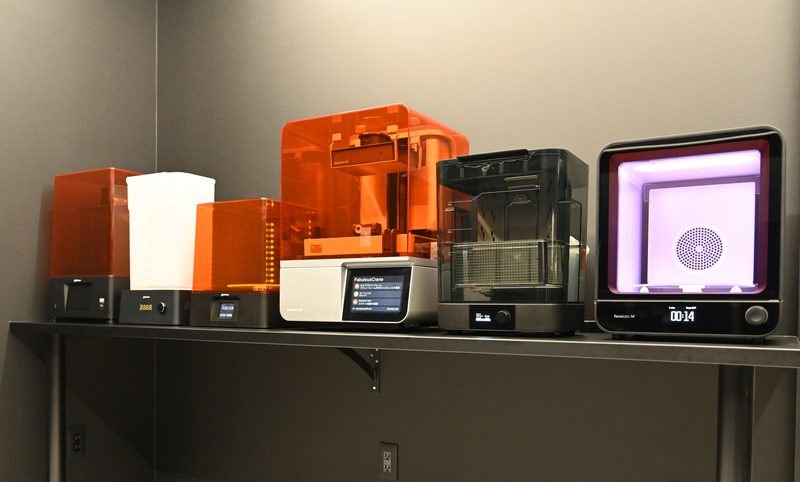
At Eden, we plan every full-arch case in our in-house digital laboratory: the CBCT data and intraoral scan are merged, the bridge is designed digitally before surgery, and a 3D-printed surgical guide positions each Straumann BLX implant to the plan. When insertion torque permits immediate loading, the provisional bridge we deliver that day was manufactured meters from the operating room — one reason our fly-in patients from Tokyo and overseas can compress the surgical phase into a single trip.
Cost and schedule go together: for how the fee maps onto each stage of treatment, see our breakdown of the All-on-4 timeline from surgery day to final bridge.
Fee structure is one input; the shape of the spending over a decade is another. We compare the upfront and recurring costs of both full-arch routes in All-on-4 versus an implant overdenture.
Before pricing anything, it is worth confirming the treatment suits your anatomy; see what actually decides All-on-4 candidacy.
Material choice is one of the biggest single line items in a full-arch quote, so it is worth reading our breakdown of what acrylic and zirconia bridges each cost you over ten years before you compare estimates.
Frequently Asked Questions
Is All-on-4 covered by Japanese health insurance?
No. Implant-supported full-arch rehabilitation is self-pay in Japan, with narrow exceptions for congenital conditions and jaw loss from trauma or tumor surgery treated at designated hospitals.
Why do All-on-4 quotes in Japan differ so much?
Mostly scope. Some quotes cover only surgery and a provisional bridge; complete quotes add diagnostics, the definitive bridge, follow-up, and warranty. Normalize the scope before comparing figures.
Does the price include the final bridge?
Not always — this is the most commonly deferred item. Ask whether the definitive zirconia or hybrid bridge, in a named material, is inside the written figure.
Is a cheaper full-arch quote a false economy?
Not automatically, but review evidence shows prosthetic complications drive most long-term maintenance, so an underspecified bridge or absent warranty can cost more over a decade than it saves upfront.
Can overseas patients get a quote before traveling?
We can review existing CBCT data and photographs remotely to give a provisional range in English, then confirm the itemized estimate after in-person diagnostics. Contact us by WhatsApp to start.
Risks, limitations, and a note on results
All-on-4 is surgery, and it carries the risks of implant surgery generally: infection, implant failure requiring replacement, nerve or sinus involvement, and prosthetic complications such as fracture or wear of the bridge over time. Smoking, uncontrolled diabetes, and untreated gum disease raise failure risk. Full-arch treatment also requires committed hygiene and periodic professional maintenance for as long as you have it. Costs, timelines, and outcomes depend on individual anatomy and health. Individual results vary.
If you are weighing full-arch options, the most useful next step is a scope-complete, written estimate you can compare line by line. Read more about how we plan implant treatment at Eden, or message us on WhatsApp in English to arrange a consultation — in person in Nagoya, or starting from your existing records if you are elsewhere in Japan or abroad.
More on this topic: Implant Guides — every article we have published in this cluster, grouped by stage.