
All-on-4 Timeline in Japan: Same-Day Teeth to Final Bridge
Reviewed by Dr. Ryosuke Murai, DDS, MSD — Prosthodontist, trained at Indiana University School of Dentistry (U.S.). Last updated July 2026.
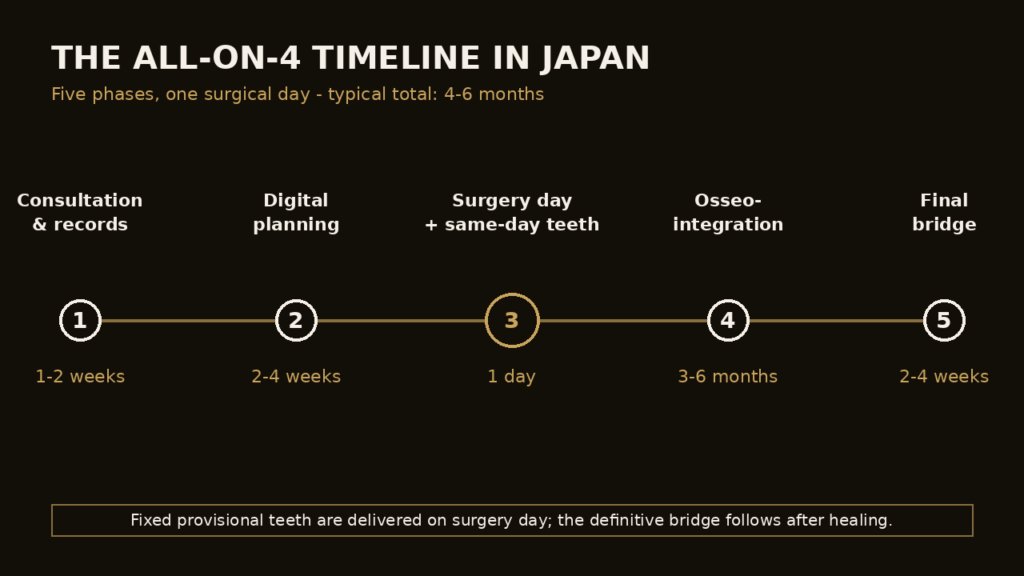
“Same-day teeth” is the most misunderstood phrase in full-arch dentistry. The All-on-4 timeline in Japan does deliver a fixed set of teeth on the day of surgery — but the bridge you walk out wearing is a provisional, and the definitive one arrives three to six months later, after your implants have fused with bone. From first CT scan to final bridge, plan on roughly four to six months in total, with only one surgical day inside it. This guide lays out each phase with realistic durations. It is written for self-pay patients who put quality first — whether you live in Nagoya, are coming from Tokyo or Osaka by Shinkansen, or are planning treatment around international travel. For what the treatment itself involves, start with our complete All-on-4 guide for Japan; for fees, see the realistic full-arch fee breakdown.
The Whole Timeline at a Glance
Every full-arch case moves through the same five phases, even though the durations shift with bone quality, medical history, and how far you travel for care. The table below is the schedule we walk patients through at the first consultation — treat it as a planning frame, not a promise.
| Phase | Typical duration | What happens | Visits required |
|---|---|---|---|
| 1. Consultation & records | 1–2 weeks | CT scan, photos, digital impressions, medical review, written estimate in English | 1 |
| 2. Digital planning | 2–4 weeks | Implant positions planned on the CT; surgical guide designed and 3D-printed; provisional bridge pre-made | 0 (remote) |
| 3. Surgery day | 1 day | Extractions if needed, four implants placed, fixed provisional bridge attached the same day | 1 |
| 4. Osseointegration | 3–6 months | Implants fuse with bone; soft-diet period; short check-ups, some possible remotely | 1–3 |
| 5. Final bridge | 2–4 weeks | New impressions, try-in, shade matching, definitive bridge fitted | 2–3 |
Add the phases together and a straightforward upper- or lower-arch case runs about four to six months. Cases that need bone grafting or a sinus lift first can run longer — we cover those fees and timelines in our article on bone graft and sinus lift costs in Japan.
What “Same-Day Teeth” Actually Means
The All-on-4 concept, documented in long-term follow-up studies such as Maló and colleagues’ longitudinal research on PubMed, was designed around immediate loading: four implants placed in one arch, angled to use available bone, strong enough as a group to support a fixed bridge right away. That is why the surgery day ends with teeth, not with a removable denture.
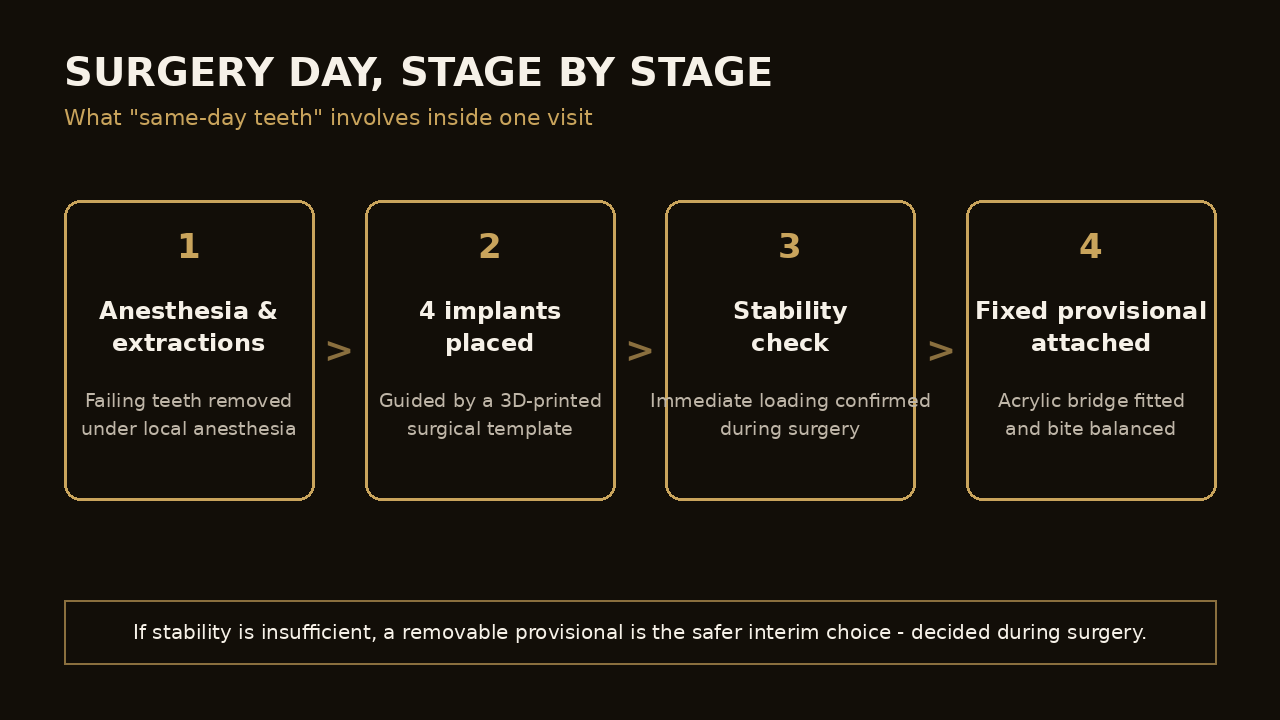
Two honest caveats. First, immediate loading depends on implant stability measured during surgery; if the bone does not grip the implants firmly enough, the safer decision is a removable provisional for some weeks — this is decided intraoperatively, and a careful clinician will tell you so beforehand rather than promise the fixed version unconditionally. Second, the same-day bridge is acrylic on a reinforced frame: comfortable and natural-looking, but deliberately lighter than the final bridge, because newly placed implants should not carry full chewing force.
Surgery Day, Step by Step
The day itself typically runs several hours in the chair. It starts with local anesthesia (with sedation options discussed in advance), removal of any failing teeth, and placement of the four implants. When surgery is guided, the drilling sequence follows a 3D-printed template made from your CT plan, which is a major reason the provisional bridge can be prepared before you ever sit down. After placement, the surgical sites are closed, the pre-made provisional is adjusted and fixed to the implants, and your bite is balanced. You leave with fixed teeth and a written aftercare protocol in English.
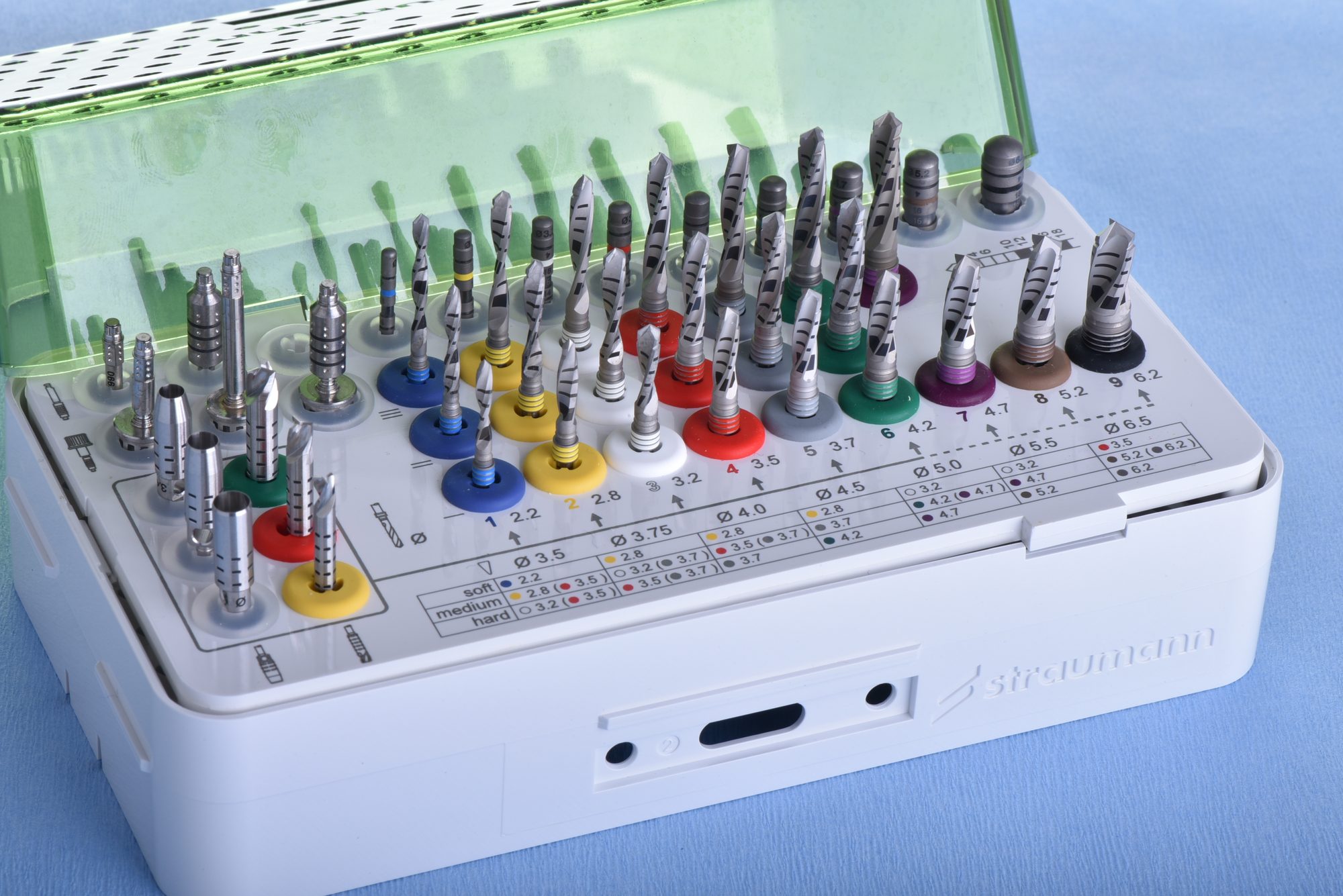
At Eden, we plan every full-arch case digitally: the CT, the facial photos, and the intraoral scan are merged into one plan, the surgical guide is printed in our in-house lab, and we place Straumann implants (BLX and TLX systems) because their design is well suited to immediate-load protocols. Having the lab inside the clinic also means the provisional can be modified the same afternoon if the bite needs refining — nothing is shipped out or waited on.
Weeks 1–12: The Quiet Phase That Decides the Result
Osseointegration — the biological fusing of titanium and bone — is the phase patients underestimate. For the first days, expect swelling and manageable soreness controlled with standard medication. For roughly six to eight weeks, you eat a soft diet: the provisional bridge is fixed and looks complete, which makes it tempting to test it on hard food, and resisting that temptation is the single biggest thing you control in your own outcome. General guidance on living with implants is published by the American Dental Association’s MouthHealthy resource.
Check-ups during this phase are short. For patients visiting Nagoya from other regions or from abroad, we design the schedule around travel: the essential in-person visits are surgery day and the final-bridge appointments, while interim reviews can often be handled with photographs and messaging in English over WhatsApp, with in-person checks consolidated into fewer trips.
The Final Bridge: Why Waiting Is a Feature
Once integration is confirmed, the definitive bridge is made: new digital impressions, a try-in to verify fit and appearance, shade matching against your skin tone and remaining teeth, and delivery. Materials are discussed case by case — monolithic zirconia and hybrid designs behave differently in wear, weight, and repairability — and this is where a prosthodontic background matters most, because the final bridge is above all a piece of precision prosthetics. Waiting three to six months is not lost time; it is what allows the definitive bridge to be built on implants that are biologically ready to carry it for the long term.
What This Costs
All-on-4 in Japan is self-pay, and the fee depends on materials, whether extractions or grafting are needed, and the bridge you choose — we published a dedicated breakdown of what a complete All-on-4 fee in Japan should include. We do not quote full-arch figures on this page because honest numbers require your CT scan; after the first consultation you receive a written, itemized estimate in English before any treatment begins. Published anchor fees at Eden, such as the ¥40,000 comprehensive check-up package, are listed on our fee page. A full overview of implant treatment at Eden is on our dental implants page.
Timeline is only one axis of the decision. Patients weighing a removable alternative should also read how the two designs differ day to day in our All-on-4 and overdenture comparison.
Timelines assume you are a suitable case to begin with — our article on bone loss, health conditions, and All-on-4 candidacy explains how that is assessed.
The provisional bridge you wear during healing also tells us which final material fits your bite — see how we choose between an acrylic hybrid and a zirconia arch.
Timelines stretch more often in the maxilla — the reasons are set out in what actually differs between the upper and lower arch.
Timelines for single implants run on a different clock. We set out the visit-by-visit sequence and realistic recovery expectations in our guide to the implant procedure in Japan.
A full-arch surgical day is long by design, and it is the case type for which patients most often ask about being sedated. What that would mean in practice is set out in our guide to sedation for implant surgery in Japan.
Fitting a bridge on the day of surgery depends on each fixture reaching a required torque, which is one part of how implant stability is measured and interpreted.
Patients flying in from Tokyo or overseas should read this alongside our guide to structuring a dental treatment trip to Japan, which covers stay lengths and safe intervals before flying.
Frequently Asked Questions
Do I really get teeth on the day of surgery?
In most cases, yes — a fixed provisional bridge is attached the same day. If implant stability is insufficient during surgery, a removable provisional is the safer interim choice.
How many trips to Japan does All-on-4 require?
Typically two concentrated visits: one for surgery and one for the final bridge, with interim checks arranged around travel. Your written plan maps each visit before you commit.
How long until I can eat normally?
A soft diet is standard for roughly six to eight weeks after surgery. Normal eating resumes progressively, and fully once the definitive bridge is fitted.
Can the timeline be shorter than four months?
Rarely, and only when bone quality allows early integration confirmed by testing. Compressing the schedule for convenience works against implant survival, so we do not recommend it.
What if I need a bone graft first?
Grafting adds healing time before or during implant placement, extending the total timeline. Your CT scan determines this at the planning stage, never mid-treatment as a surprise.
Risks, Limitations, and Disclaimer
All-on-4 is major oral surgery. Risks include infection, implant failure requiring replacement, provisional bridge fracture during the healing phase, and altered speech or bite sensation while adapting. Smoking, uncontrolled diabetes, and certain medications raise failure risk and may change the recommended timeline. Costs, durations, and visit counts above are typical figures, not commitments; your written treatment plan is the reference for your case. Individual results vary.
If you are weighing full-arch treatment and want a clear, English-language schedule mapped to your own scan, our implant treatment page explains how a consultation works, and you can reach the clinic directly on WhatsApp — we are two minutes from Fushimi Station in Nagoya, one Shinkansen stop plus a short subway ride from anywhere on the Tokaido line.
More on this topic: Implant Guides — every article we have published in this cluster, grouped by stage.