All-on-4 in Japan: How Full-Arch Implant Treatment Works
Reviewed by Dr. Ryosuke Murai, DDS, MSD — Prosthodontist, trained at Indiana University School of Dentistry (U.S.). Last updated July 2026.
All-on-4 is a way of rebuilding an entire upper or lower arch of teeth on just four implants, with a fixed bridge that does not come out at night. In Japan it is offered almost exclusively as self-pay treatment at private clinics, which means the planning quality, the implant system, and the laboratory behind the bridge vary far more than the name suggests. This guide is written for English-speaking patients — residents of Tokyo, Osaka, or Nagoya, and patients considering traveling to Japan — who are facing the loss of many teeth and want to understand what full-arch treatment involves before they sit in anyone’s chair. It covers how the concept works, who it suits, the realistic timeline, what drives the fee, and the questions worth asking at a consultation for implant treatment.
What All-on-4 Actually Is — and What It Is Not
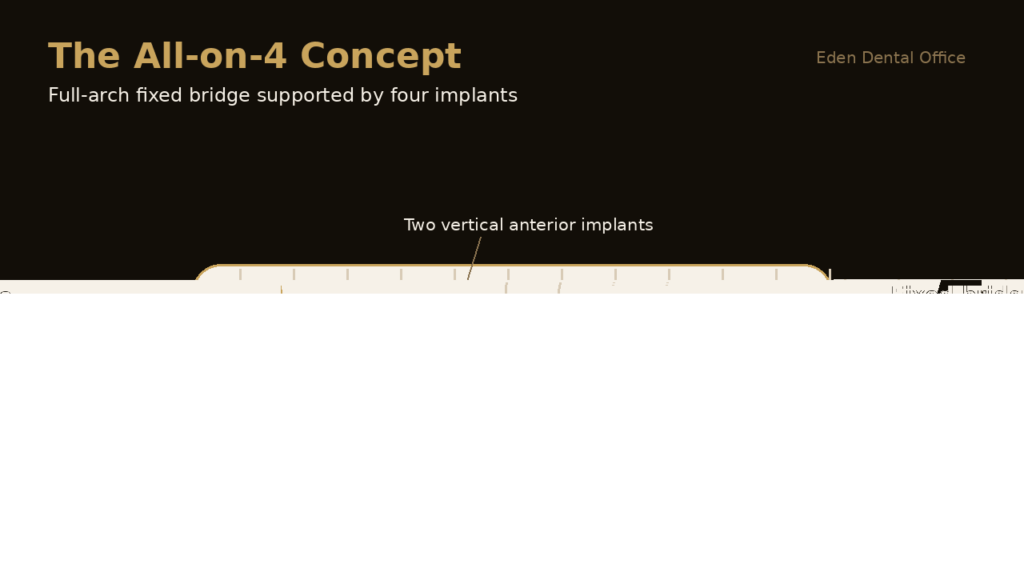
The concept, introduced by Dr. Paulo Maló and colleagues in the late 1990s, places two implants vertically in the front of the jaw and two implants tilted at up to 45 degrees further back. Tilting the rear implants lets them anchor in denser bone near the front of the jaw while still emerging far enough back to support a full row of teeth. A screw-retained bridge of ten to twelve teeth is then fixed onto those four implants — often on the same day as surgery, in provisional form.
Three clarifications save patients a great deal of confusion. First, “All-on-4” is a treatment concept, not a brand of implant; the number of implants is a starting point, and many arches are better served by five or six. Second, the bridge is fixed but not untouchable — it is designed to be removed by the dentist for maintenance. Third, the same-day teeth are provisional: a stronger definitive bridge replaces them after healing, and the quality gap between clinics shows up most clearly in that final bridge.
The published evidence behind the concept is substantial. A longitudinal study following mandibular All-on-4 patients for 10 to 18 years reported high implant and prosthesis survival, and a systematic review found cumulative implant survival above 97 percent at three years. Long-term data also exist specifically for Japanese patients followed for 3 to 17 years, which matters if you are weighing treatment here rather than abroad.
Who Full-Arch Treatment Suits — and Who It Does Not
The typical candidate is not someone missing every tooth already. More often it is a patient with what clinicians call terminal dentition: many teeth failing at once from deep decay, advanced gum disease, or repeated re-treatment, where saving each tooth individually has become a losing strategy. For these patients, a planned transition to a full-arch bridge can be more predictable than years of piecemeal extractions and partial dentures.
The tilted-implant design also helps patients with bone loss in the back of the jaw, because it often avoids the sinus lifts and major grafting that single rear implants would require — procedures we describe in our article on bone graft and sinus lift fees in Japan. That said, All-on-4 is not automatic. Heavy uncontrolled diabetes, active gum infection, heavy smoking, and certain medications all change the risk picture, and a patient with several sound, savable teeth deserves a serious discussion about keeping them. A responsible plan sometimes concludes that full-arch surgery is the wrong tool.
Age by itself is rarely the deciding factor. Patients in their seventies and eighties complete full-arch treatment routinely when their general health supports surgery, while a forty-year-old with untreated periodontitis may need months of preparatory care first. What matters is the biology in the scan and the chart, not the birth year — which is why the assessment should always start with a CT, a periodontal examination, and a frank medical history rather than a sales conversation.
The Treatment Timeline at a Japanese Clinic
Full-arch treatment in Japan follows a recognizable arc, though the number of visits varies with each case:
| Stage | What happens | Typical timing |
|---|---|---|
| Diagnostics | CT scan, photographs, digital impressions, bite records | Visit 1 |
| Planning & written estimate | 3D surgical plan, bridge design, itemized fee in writing | 1–3 weeks after diagnostics |
| Surgery day | Extractions if needed, four (or more) implants placed, provisional fixed bridge fitted | One day |
| Healing | Implants integrate with bone; soft diet at first | 3–6 months |
| Definitive bridge | Final impressions, try-in, delivery of the long-term bridge | 2–5 visits |
| Maintenance | Professional cleaning, screw checks, bridge removal and inspection | Every 4–6 months, ongoing |
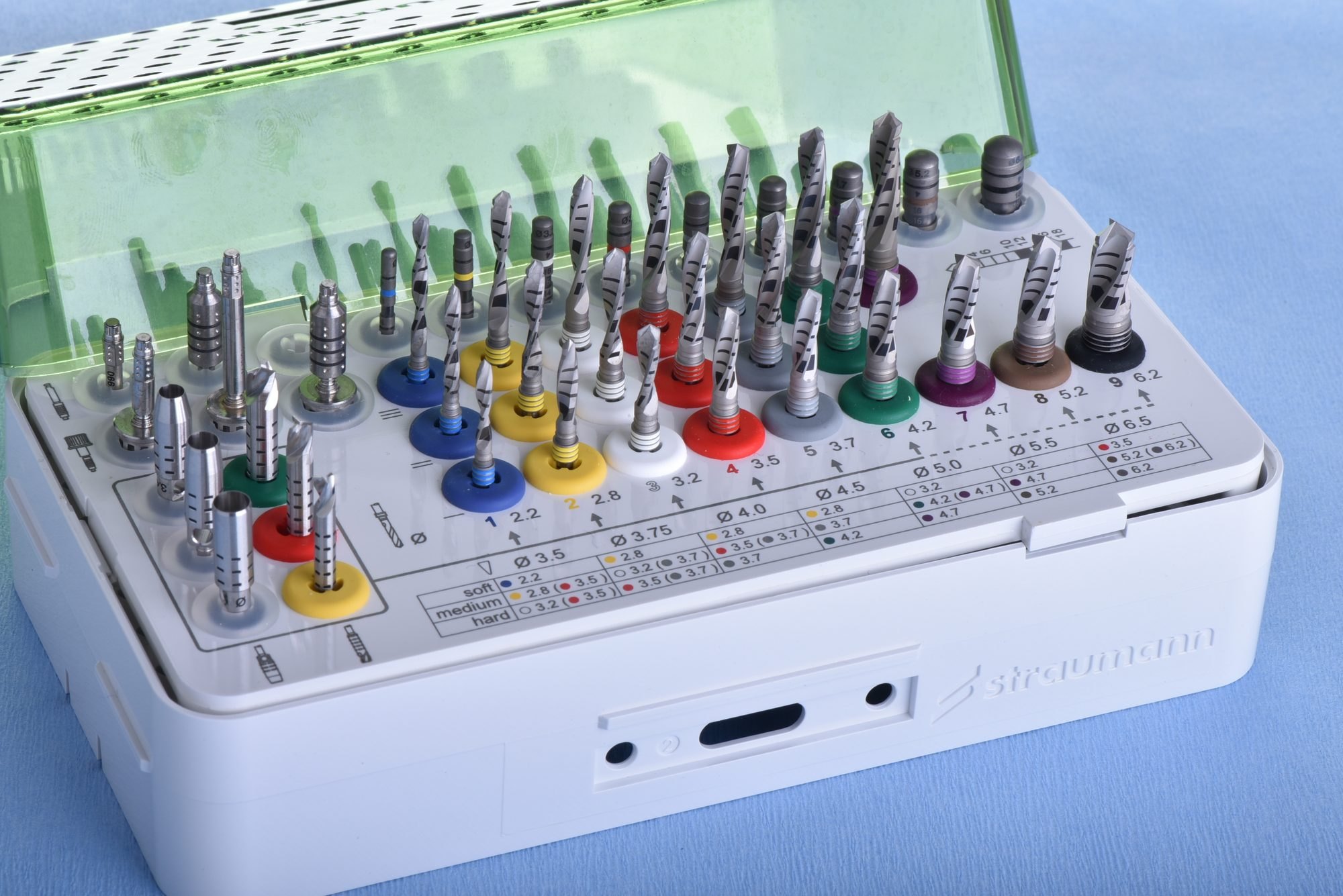
At Eden, we plan every full-arch case digitally before surgery: the CT data and intraoral scans are merged, the implant positions are set on screen, and a surgical guide is 3D-printed in our in-house lab so that the tilted implants land where the plan says they should. Because the milling and printing happen in the same building, the provisional bridge is designed before surgery rather than improvised on the day, and adjustments during the healing months do not wait on an outside laboratory. We place Straumann implants exclusively — for full-arch work, the BLX system — because the long-term documentation and worldwide availability of parts matter more over a 20-year horizon than any single feature of the surgery itself.
For patients coming from Tokyo — about 100 minutes by shinkansen — or from overseas via Chubu Centrair airport, the visit structure above compresses well: diagnostics and planning can be arranged around one trip, surgery around a second, with remote check-ins by WhatsApp between them.
“Teeth in a Day”: What Immediate Loading Really Means
The phrase that sells full-arch treatment — walking out with fixed teeth on the day of surgery — is real, but it deserves an accurate explanation. When four implants are joined rigidly by a bridge on the day they are placed, the connection splints them together, distributing chewing forces so that no single implant is overloaded while the bone heals around it. This is why immediate loading works for a cross-arch bridge in situations where loading a single implant on day one would be unwise. The mechanics depend on primary stability: each implant must be seated firmly enough in bone at surgery, measured in newton-centimeters of insertion torque, for the surgeon to commit to same-day teeth. When stability falls short — softer bone, an unexpected defect — the responsible decision is a conventional healing period first, and patients should know before surgery that this fallback exists.
The provisional bridge fitted that day is deliberately lighter than the final one, usually reinforced acrylic. It looks like teeth and functions for careful eating, but its real job is to protect the implants and shape the gums while integration completes. Patients who treat the provisional as indestructible are the ones who crack it. The definitive bridge — commonly milled zirconia or a titanium-acrylic hybrid — is made months later against healed, stable tissue, which is precisely why it fits and functions better than anything made on surgery day could.
Living with a Full-Arch Bridge: Hygiene and Long-Term Care
A fixed full-arch bridge changes how you clean your mouth, and clinics that skip this conversation leave patients unprepared. Natural flossing is replaced by cleaning under the bridge: interdental brushes, floss threaders or superfloss, and for many patients a water flosser directed along the junction between bridge and gum. It takes most people a few weeks to become fluent, and the hygienist’s role in those early months is as important as the surgeon’s was on the day of placement.
Professional maintenance follows a rhythm: reviews and cleaning every four to six months, periodic radiographs to monitor bone levels, and — typically once every year or two — removal of the entire bridge so the implants and gum surfaces can be inspected and cleaned directly, then the bridge re-secured with fresh screws. This is the appointment that catches small problems while they are still small. The main biological risk in later years is peri-implantitis, an inflammatory condition around implants that behaves like gum disease and is far easier to prevent than to treat. The ongoing economics of this care — what maintenance visits cost and why they protect the investment — follow the same logic we outline in our article on implant maintenance costs over ten years in Japan.
For patients who travel to Nagoya for treatment, maintenance is designed around distance: routine cleaning can be handled by a local hygienist near home, with the bridge-removal inspections scheduled at Eden during periodic visits, and photographs or concerns handled over WhatsApp between them.
All-on-4 Compared with the Alternatives
A full-arch bridge on implants is one of three realistic answers to a failing arch. The honest comparison looks like this:
| All-on-4 fixed bridge | Implant-retained overdenture (2–4 implants) | Conventional full denture | |
|---|---|---|---|
| Stays in place | Fixed; removed only by the dentist | Snaps on and off; you remove it daily | Rests on the gums; adhesive often needed |
| Chewing efficiency | Closest to natural teeth | Much improved over a plain denture | Limited, especially in the lower jaw |
| Bone preservation | Implants stimulate bone in loaded areas | Partial stimulation | Bone continues to shrink over time |
| Palate coverage (upper) | None — palate stays open | Usually reduced | Full palate coverage affects taste and speech |
| Surgery required | Yes, four or more implants | Yes, fewer implants | None |
| Relative cost | Highest | Intermediate | Lowest (insurance versions exist) |
| Maintenance | Professional cleaning and periodic bridge removal | Attachment parts wear and need replacement | Relines and remakes as bone changes |
None of these is universally right. A patient who wants the least surgery and the lowest fee may be well served by an overdenture; a patient who never wants to take teeth out at night, and who accepts the surgical and financial commitment, is the natural full-arch candidate. What matters is that the choice is made from a written comparison of your own case — not from a slogan.
What All-on-4 Costs in Japan
Full-arch treatment is self-pay in almost every scenario; Japanese national health insurance covers dentures but not implant-supported bridges except in rare reconstructive cases, a distinction we explain in our article on implants and Japanese health insurance. Because clinics package the work differently, we do not quote a single national figure — and you should be cautious with any website that does. The fee is driven by a handful of identifiable factors: how many implants the arch actually needs, whether extractions and any grafting are included, the material of the definitive bridge (acrylic on titanium, or monolithic zirconia), whether the provisional bridge and surgical guide are itemized, and how many years of maintenance and warranty are built in.
Our fee structure for implant work is published on the fees page, and every full-arch plan at Eden is presented as a written, itemized estimate in English before any treatment begins. For the wider context of what implant fees include in this country, see the complete guide to dental implant costs in Japan, our breakdown of what a proper implant quote itemizes, and the options for staging payments across treatment. Patients comparing Japan with home-country pricing may also find our Japan-versus-U.S. cost comparison useful: full-arch work shows the same pattern, with Japanese fees typically sitting well below U.S. metropolitan quotes for equivalent implant systems.
For a line-by-line look at what full-arch fees include and the variables that move them, see our breakdown of All-on-4 costs in Japan.
Patients often ask how long the whole process runs from first scan to finished teeth; we map it out phase by phase in our guide to the All-on-4 treatment timeline in Japan.
A fixed full-arch bridge is not the only way to use implants for a whole jaw. If you are also considering a removable option, our comparison of All-on-4 and implant overdentures in Japan sets the two designs side by side on chewing, hygiene, and ten-year maintenance.
Bone volume, medical history, and habits all shape whether this treatment fits — we cover that assessment in detail in our guide to All-on-4 candidacy in Japan.
Long-term success depends as much on hygiene as on surgery; our guide to cleaning and maintaining an All-on-4 bridge sets out the daily routine and recall schedule.
Once the surgical plan is settled, the remaining decision is the prosthesis itself: our comparison of acrylic hybrid versus monolithic zirconia bridges explains how that choice affects wear, repairs, and long-term upkeep.
Arch anatomy also shapes the plan: see how All-on-4 differs between the upper and lower jaw before assuming one quote fits both.
Full-arch treatment is designed with redundancy in mind, which is why the loss of a single implant under the bridge is usually managed as a repair rather than a restart.
Full-arch treatment follows the same underlying biology as a single implant. Readers weighing one missing tooth rather than a whole arch may prefer our step-by-step account of what the implant procedure and recovery involve in Japan.
Frequently Asked Questions
Is All-on-4 done in one day in Japan?
The surgery and the provisional fixed bridge are usually completed in one day. Diagnostics happen beforehand, and the definitive bridge comes after a healing period of several months, so the full treatment spans multiple visits.
Do I need a bone graft for All-on-4?
Often not — the tilted rear implants are specifically intended to use existing bone and avoid sinus lifts. Severe bone loss can still require grafting or a six-implant design; only a CT scan can say.
How long does an All-on-4 bridge last?
Published follow-up studies report high implant survival at 10 or more years. The bridge itself is a wearing part: provisionals last months, and definitive bridges are typically serviced or renewed over the years. Individual results vary.
Can I eat normally after full-arch surgery?
You leave with fixed teeth, but the first weeks call for a soft diet while the implants integrate. Normal eating resumes progressively, with fewer restrictions once the definitive bridge is fitted.
Is Straumann used for All-on-4?
Yes. The concept is not tied to one manufacturer, and at Eden full-arch cases are planned on the Straumann BLX system, chosen for its long published track record and worldwide parts availability.
Risks, Limitations, and Costs — Read Before Deciding
Full-arch implant treatment is major dental surgery. Risks include implant failure to integrate (requiring replacement), infection, nerve disturbance, sinus involvement in the upper jaw, fracture or wear of the bridge, and peri-implantitis in later years — the reason lifelong maintenance visits are not optional. Smoking, uncontrolled diabetes, and poor hygiene raise every one of these risks. Treatment is self-pay, fees depend on the factors described above and are always confirmed in a written English estimate before treatment, and the timeline from surgery to definitive bridge typically spans three to six months or longer. Individual results vary.
If you are weighing a failing arch and want an unhurried, evidence-based assessment — including the option of not doing full-arch surgery — you can read more about our approach on the implant treatment page or message us in English on WhatsApp to arrange a consultation.
More on this topic: Implant Guides — every article we have published in this cluster, grouped by stage.