All-on-4 vs Implant Overdenture in Japan: How to Choose
Reviewed by Dr. Ryosuke Murai, DDS, MSD — Prosthodontist, trained at Indiana University School of Dentistry (U.S.). Last updated July 2026.
A patient flew in from Yokohama last month with two treatment plans in her bag: one for All-on-4, one for an implant overdenture, and no clear explanation of why the fees were so different. Choosing between All-on-4 and an implant overdenture in Japan is less about which is “better” and more about how each one behaves in your mouth, in your bathroom, and in your budget over ten years. Both replace a full arch of teeth on dental implants; one is fixed in place, the other clips on and off. This guide is written for self-pay patients who want the trade-offs explained before they sign anything — the same conversation we have in English at our implant consultations in Nagoya.
Two Ways to Put a Full Arch on Implants
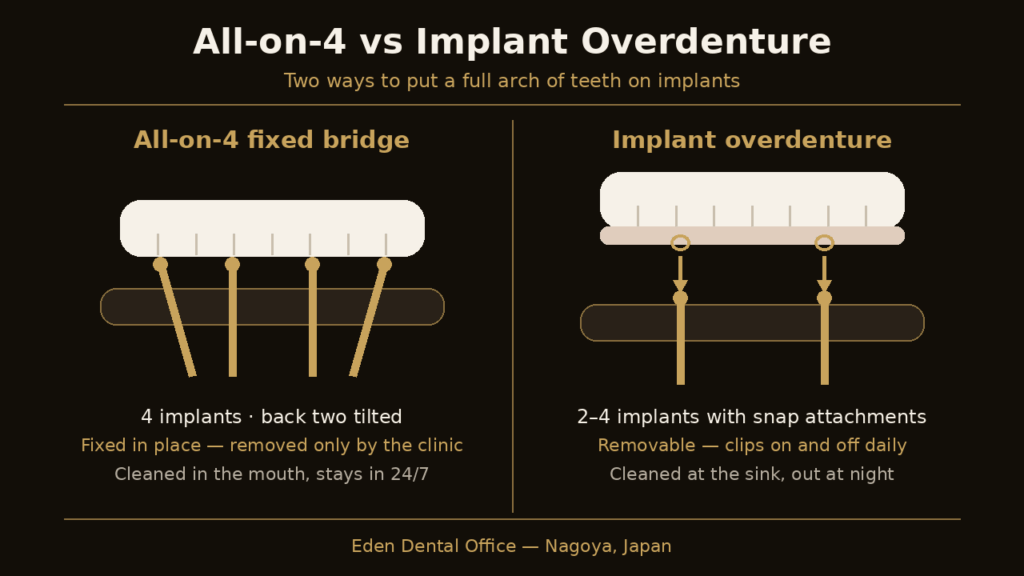
An All-on-4 bridge is a one-piece row of teeth screwed onto four implants — the back two tilted to use the strongest available bone. Only a dentist can remove it. You treat it like fixed teeth: it stays in around the clock, and you clean around it rather than taking it out. We covered the mechanics in our full All-on-4 guide for Japan.
An implant overdenture is a removable denture that snaps onto two to four implants through attachments — small connectors such as locator abutments, or a milled bar. The implants stop it from lifting or sliding, which is the main complaint with conventional dentures. But it is still a denture: you take it out every night, and the plastic base covers part of your palate or gum ridge. The landmark McGill consensus statement concluded as far back as 2002 that a two-implant overdenture — not a conventional denture — should be the first-choice standard of care for the edentulous lower jaw.
Daily Life: Where the Two Options Feel Different
On chewing, the fixed bridge wins on force and confidence; reviews report superior masticatory efficiency and occlusal stability for fixed full-arch prostheses. An overdenture chews far better than a conventional denture but still moves microscopically on its attachments, and very hard or sticky foods remain a negotiation.
On hygiene, the ranking reverses. An overdenture comes out, gets brushed at the sink, and the attachments are easy to reach. An All-on-4 bridge must be cleaned in place along its underside with interdental brushes and a water flosser — a real skill that we rehearse with patients, and a genuine consideration if dexterity is limited. Speech usually adapts within weeks for both, though palate-free fixed bridges tend to feel more natural sooner.
| All-on-4 fixed bridge | Implant overdenture | |
|---|---|---|
| Implants typically used | 4 per arch (tilted posteriors) | 2–4 per arch |
| Removable by you | No — fixed, removed only by the clinic | Yes — out every night for cleaning |
| Chewing stability | Highest; behaves like fixed teeth | Good; slight movement on attachments |
| Home cleaning | In the mouth; interdental brushes, water flosser | At the sink; simpler with limited dexterity |
| Recurring parts | Screw checks, occasional tooth repairs | Attachment inserts, relines, denture teeth wear |
| Palate coverage (upper) | None | Often reduced, sometimes present |
| Typical fee position | Higher upfront, fewer recurring parts | Lower upfront, more recurring parts |
Maintenance Over Ten Years, Not Ten Weeks
The comparison most treatment plans skip is what happens after year one. An overview of systematic reviews comparing fixed and removable full-arch prostheses found more maintenance events and complications with implant overdentures — mostly small, predictable ones: nylon attachment inserts wear out and are swapped in minutes, the acrylic base needs periodic relining as the gum ridge changes, and denture teeth wear faster than ceramic or composite bridge teeth. A fixed bridge asks less often, but when it does ask — a chipped tooth, a loose screw — the visit involves the clinic, not the bathroom sink. Both options need professional cleaning and implant checks on a fixed rhythm; we outline the recall economics in our article on implant maintenance costs in Japan.

Who Tends to Choose Which
Patterns emerge after enough of these consultations. Patients who choose the fixed All-on-4 arch usually name the same reasons: they never want to see their teeth in a glass, they entertain or present for work, and they want chewing that does not require thinking. Patients who choose an overdenture often prioritize different things: a smaller surgical footprint with fewer implants, simpler cleaning as they age, easier repairs while traveling, and a lower initial commitment while they decide how far to take treatment. Age alone is a poor predictor — we have seen patients in their forties choose overdentures for practical reasons and patients in their eighties do well with fixed arches. Two factors deserve more weight than most people give them: manual dexterity, because a fixed bridge you cannot clean becomes a liability rather than an upgrade, and the condition of the opposing jaw, because a full arch always bites against something and the two prostheses wear differently against natural teeth, ceramic, or acrylic.
How We Decide at Eden: Same CT, Two Simulations
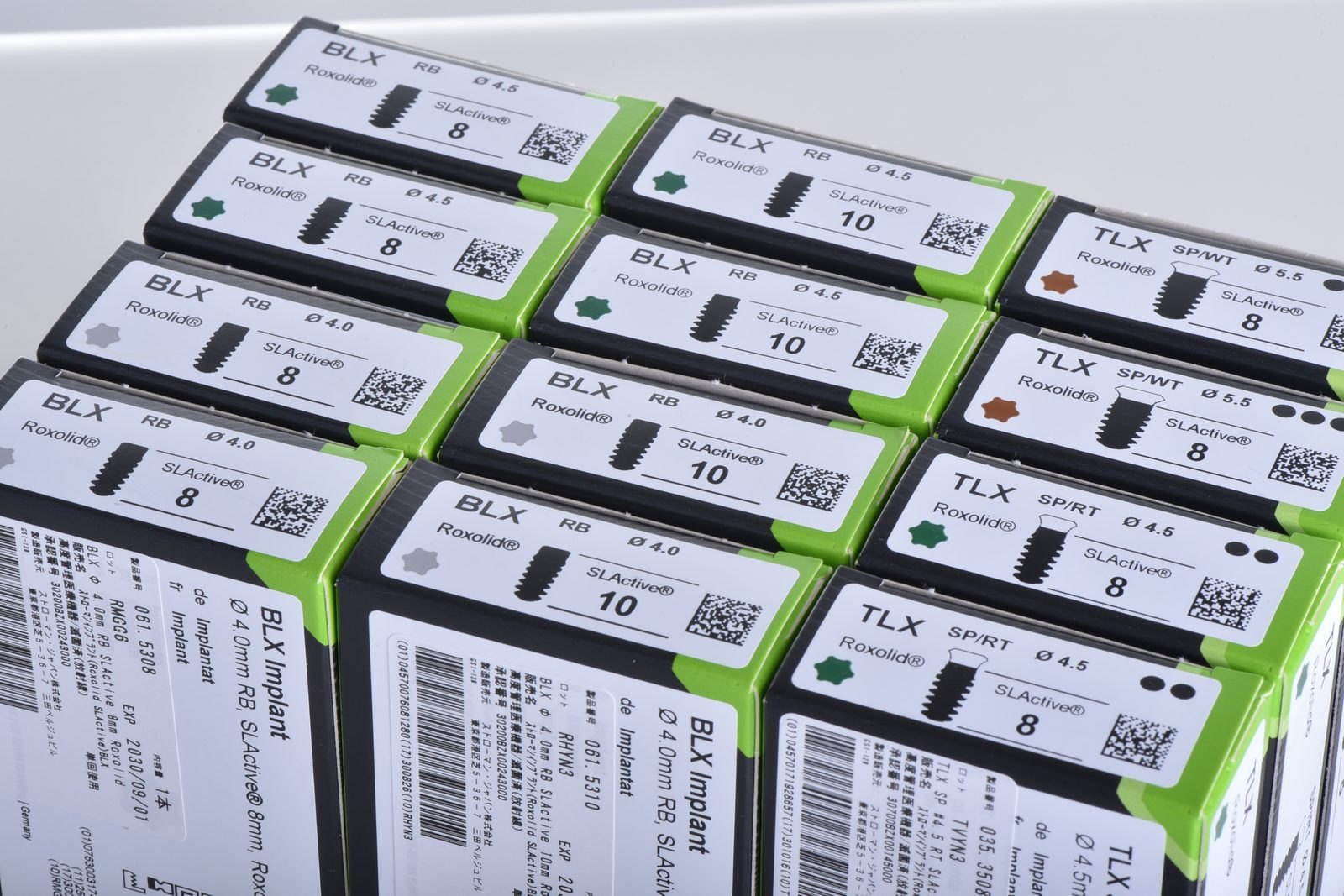
At Eden, we plan both options from the same CT scan before recommending either. Our in-house digital lab simulates a fixed Straumann BLX arch and an overdenture on the same bone data, then we compare lip support, available bone, bite space, and how each design would be cleaned by this particular patient. Where bone has receded significantly, an overdenture’s acrylic flange can restore lip support that a fixed bridge cannot; where bone and hygiene ability are good, the fixed arch is usually the recommendation. If surgery is indicated, we place implants with 3D-printed surgical guides made in the building. That two-simulation habit comes directly from prosthodontic training at Indiana University: the denture question is decided by the prosthesis, not the implants.
If neither option seems obviously right, the deciding factor is often anatomy rather than preference; read more on All-on-4 candidacy and bone loss.
Whichever design you choose, both require lifelong hygiene; we cover the routine in our guide to cleaning full-arch implants.
For a comparable either-or decision on the front teeth, see veneers versus composite bonding and how we choose between them.
Frequently Asked Questions
Do implant overdentures come out at night?
Yes. You remove the overdenture nightly to clean it and let the gum tissue rest. The implants and attachments stay in place.
How many implants does each option need?
All-on-4 uses four implants per arch. Overdentures typically use two to four, depending on the jaw and attachment design.
Which option costs less in Japan?
An overdenture is usually lower upfront because it uses fewer implants and simpler components, but attachments and relines add recurring costs over the years.
Can I upgrade from an overdenture to All-on-4 later?
Sometimes. It depends on how many implants you have, where they sit, and remaining bone. Planning for that possibility from the start is wise.
What if I have significant bone loss?
Tilted-implant designs and overdenture flanges each handle bone loss differently. A CT scan determines which is realistic; see our All-on-4 timeline article for how assessment works.
What This Costs in Japan
Full-arch fees in Japan are self-pay and vary with the number of implants, the attachment system or bridge material, whether grafting is needed, and the laboratory work behind the prosthesis — which is why we do not publish a single number here. As a structural rule, an implant overdenture sits lower on the upfront fee scale and higher on the recurring-parts scale than a fixed All-on-4 arch; our All-on-4 fee breakdown walks through the fixed-bridge side line by line. Published anchors at our clinic include the comprehensive check-up package at ¥40,000, which is where full-arch planning begins. Before any treatment, you receive a written estimate in English covering both options where both are viable, with the recurring maintenance costs of each stated next to the upfront fee — details are on our fee page.
Risks and Honest Downsides
Both options involve implant surgery, with its usual risks of infection, nerve injury, sinus involvement, and implant failure requiring removal. Overdentures add attachment wear, relines, and the possibility that some patients never accept a removable prosthesis psychologically. Fixed bridges add hygiene demands, higher upfront cost, and more involved repairs. Neither option lasts indefinitely without maintenance, and outcomes depend on bone, health, smoking status, and home care. Individual results vary.
If you are weighing these two plans — or holding two quotes that do not explain themselves — bring them to an English consultation at our implant clinic in Nagoya. Message us on WhatsApp and we will schedule a CT-based comparison of both designs for your jaw.
More on this topic: Implant Guides — every article we have published in this cluster, grouped by stage.