
How to Clean All-on-4 Implants: Daily Care and Checkups
Reviewed by Dr. Ryosuke Murai, DDS, MSD — Prosthodontist, trained at Indiana University School of Dentistry (U.S.). Last updated July 2026.
A full-arch bridge does not decay. That single fact leads a surprising number of patients to relax their hygiene after treatment, and it is the most expensive mistake they can make. Cleaning All-on-4 implants is different from cleaning teeth: the target is not the bridge surface but the narrow space underneath it, where the prosthesis meets gum tissue. This guide explains the daily routine, the tools that matter, and the professional maintenance schedule we use at our Nagoya clinic — written for self-pay patients in Japan and abroad who have invested in full-arch implant treatment and want it to last. If you are still learning how the treatment itself works, start with our guide to All-on-4 in Japan.
What you are actually cleaning
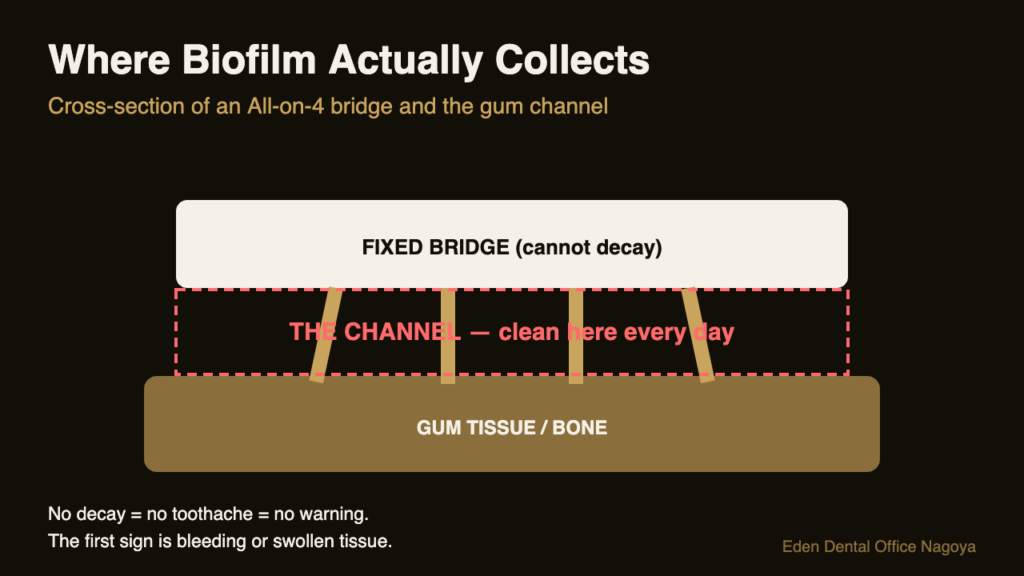
An All-on-4 bridge is fixed to four implants and sits slightly above the gum, leaving a shallow channel running the length of the arch. Food debris and bacterial biofilm collect in that channel. Because the bridge cannot decay, there is no toothache to warn you — the first sign of trouble is usually bleeding or swollen tissue around an implant, which is peri-implant mucositis.
That condition is common enough to take seriously. A systematic review of peri-implant disease in full-arch restorations found peri-implant mucositis in a substantial share of patients, with prevalence varying widely between studies and hygiene protocols. The encouraging part is that mucositis is reversible when caught early. Left alone, it can progress to peri-implantitis, which involves bone loss and is far harder to treat.
So the goal of daily cleaning is narrow and specific: disrupt biofilm along the tissue side of the bridge, every day, without exception.
The daily routine
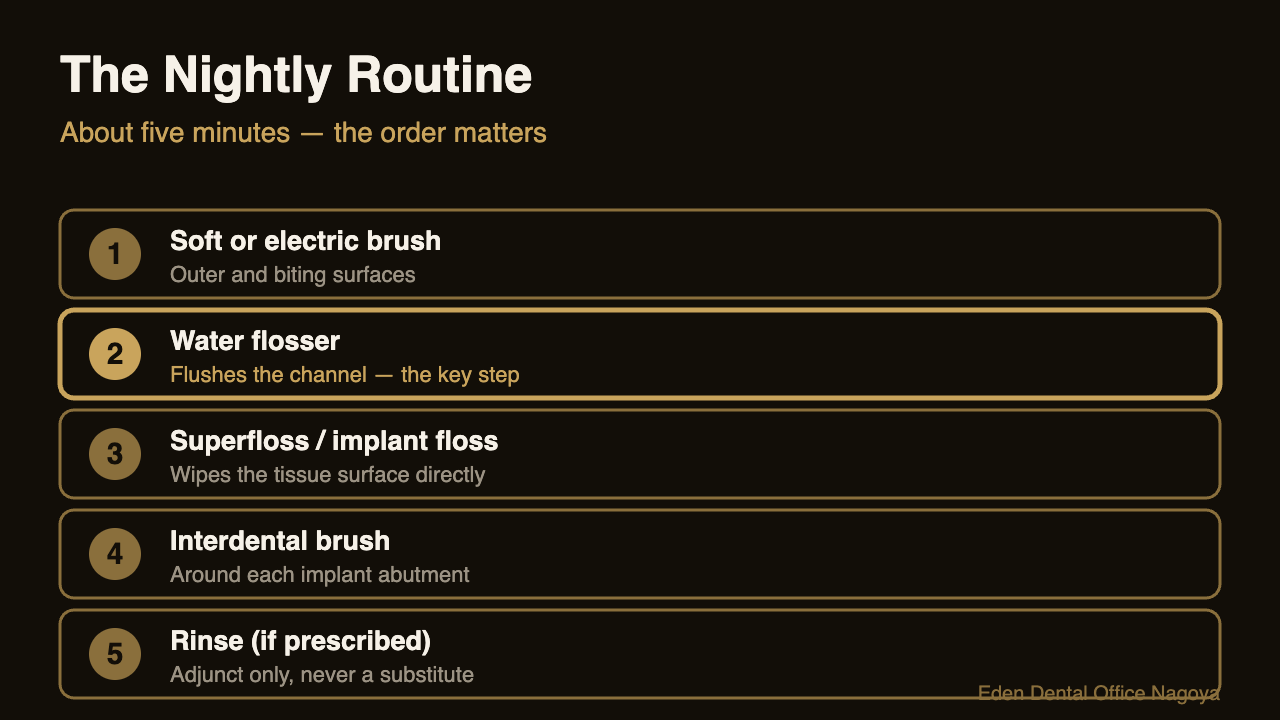
Most patients settle into a routine of about five minutes, twice a day. The sequence matters more than the total time.
| Step | Tool | What it does | When |
|---|---|---|---|
| 1 | Soft toothbrush or electric brush | Cleans the outer and biting surfaces of the bridge | Morning and night |
| 2 | Water flosser, angled along the gum line | Flushes debris from the channel under the bridge — the single most important step | Night, minimum |
| 3 | Superfloss or implant-specific floss | Threads under the bridge and wipes the tissue surface directly | Night |
| 4 | Interdental brush at implant sites | Cleans around each implant abutment where the channel is tightest | Night |
| 5 | Antimicrobial rinse (if prescribed) | Adjunct only — never a substitute for mechanical cleaning | As directed |
The water flosser does the heavy lifting. A study of patients with axial and tilted implants supporting a complete fixed denture reported meaningful rates of peri-implant mucositis even in maintained patients, which underlines how much the under-bridge area depends on active flushing rather than brushing alone. Aim the tip at the junction between bridge and gum, work slowly along the arch, and expect the first week to feel awkward.
How we design bridges to be cleanable
Hygiene is partly a design problem, and it is decided long before you take the bridge home. At Eden Dental Office, we mill the final framework in our in-house digital lab, which lets us control the tissue surface directly: we keep the underside convex and polished rather than concave, so a water flosser jet can actually reach every point of it. A bridge with deep recesses is a bridge that cannot be cleaned, no matter how disciplined the patient is.
We also plan implant positions with this in mind during the initial candidacy and planning assessment, spacing the Straumann fixtures so that an interdental brush fits between them. At the fitting appointment we hand you the specific tool sizes for your bridge — generic advice is not much use when the gap measurements are unique to your case.
Professional maintenance schedule
Home care handles biofilm. It cannot handle what accumulates below the gum line, and it cannot detect early bone change. That requires scheduled professional visits.
Our standard protocol for full-arch patients is a hygiene visit every three to four months in the first year, then every four to six months if tissue stays healthy. At each visit we measure probing depths around every implant, check the torque on the prosthetic screws, and take radiographs annually to compare bone levels against the baseline taken the day the bridge was fitted. Roughly once a year — sooner if there is any inflammation — we remove the bridge entirely, clean both the prosthesis and the abutments under direct vision, and re-torque everything to specification. This is not possible with a bridge that has been cemented rather than screw-retained, which is one reason we screw-retain full-arch cases.
For patients who travel to us from Tokyo, Osaka, or overseas, we coordinate a hybrid schedule: routine hygiene visits with a local practice, and the annual bridge-off inspection with us. We send your local clinic the written protocol and radiographic baseline so that everyone is working from the same record.
What maintenance costs
Our comprehensive check-up package is ¥40,000 and our annual membership tiers run ¥88,000–¥288,000 per year, both listed on our fee page. Membership is generally the sensible structure for full-arch patients, because it bundles the recall visits that this protocol requires rather than billing them one at a time. The broader ten-year picture — including component replacement and the eventual wear of the bridge material — is covered in our article on the long-term cost of implant maintenance in Japan, and full treatment fees are set out in our All-on-4 fee breakdown. Exact figures for your case appear in a written English estimate before treatment begins; current published packages are on the fee page.
How much cleaning effort a bridge demands depends partly on what it is made of; our guide to All-on-4 bridge materials covers how glazed zirconia and acrylic differ in plaque and stain behavior.
Frequently Asked Questions
Can I floss normally with All-on-4?
Not with ordinary floss. You need superfloss or implant floss that threads under the bridge, since the arch is one connected piece.
Is a water flosser necessary or optional?
We treat it as necessary. It is the only home tool that reliably flushes the channel between bridge and gum.
How often should the bridge be removed and cleaned?
Usually once a year, sooner if there is inflammation. This requires a screw-retained design, which we use for full-arch cases.
What are the warning signs I should not ignore?
Bleeding when cleaning, swelling, persistent bad odor, or any sense of movement in the bridge. Contact us promptly.
Can my local dentist handle maintenance if I live far away?
Yes for routine hygiene. We provide your local clinic with the protocol and baseline radiographs, and handle the annual inspection ourselves.
Risks and important notes
Even with disciplined hygiene, implants can develop peri-implant mucositis or peri-implantitis, and bone loss around an implant may require surgical treatment or implant removal. Bridge materials wear, chip, or fracture over time, and prosthetic screws can loosen. Smoking and unmanaged diabetes raise these risks. Maintenance is a lifelong cost, not a one-time fee, and skipping recall visits is the most common reason full-arch cases fail. Nothing in this article replaces examination by your treating clinician. Individual results vary.
If you have a full-arch bridge and are unsure whether your current routine is adequate — or you are still choosing between treatment options and want to understand the long-term commitment — you can read about how we approach implant treatment, compare the alternatives in our guide to fixed bridges versus implant overdentures, or message us on WhatsApp in English.