
Clear Aligners With Gum Disease in Japan: Is It Safe?
Reviewed by Dr. Ryosuke Murai, DDS, MSD — Prosthodontist, trained at Indiana University School of Dentistry (U.S.). Last updated October 2026.
Many adults considering clear aligners already have some gum disease, receding gums or teeth that have drifted apart as bone support was lost. The published reviews suggest that tooth movement is generally compatible with a treated, stable periodontium, provided the inflammation is controlled first and the forces stay light. This article explains what the reviews report, why the order of care matters more than the appliance, and how a clinic in Japan approaches aligners when the gums are involved. It is written for patients who want to know whether treatment is realistic before booking a trip.
Why gum health comes before tooth movement
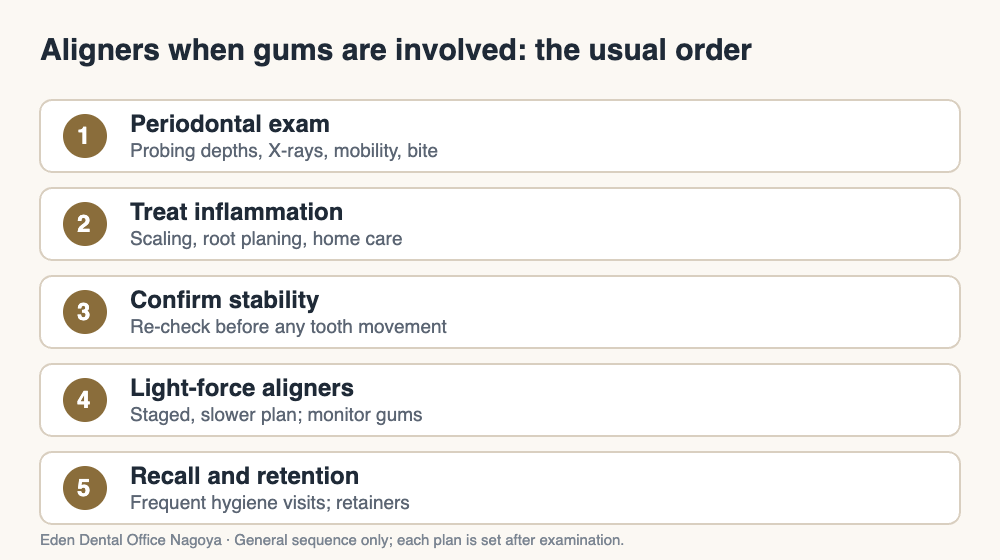
Teeth sit in bone and are held by the surrounding ligament. When periodontitis has reduced that support, the same pressure from an aligner is concentrated on less bone, and inflamed gum tissue responds poorly to movement. For this reason the first step is never the scan for aligners. It is a periodontal examination: probing depths, X-rays, tooth mobility and a check of how the teeth meet. If active inflammation is present, it is treated with cleaning below the gumline and home-care coaching, and tooth movement waits until the tissue is stable.
This order is the same whatever appliance is used. Aligners do have one practical advantage, which is that they can be removed for cleaning, so plaque control is easier than around fixed brackets. That convenience only helps if the patient actually cleans between wear periods, and aligners worn over unclean teeth keep plaque against the gums for many hours.
What the systematic reviews report
A 2023 systematic review of orthodontic treatment in periodontally compromised patients included five studies with 366 participants. All patients had periodontal treatment before tooth movement and were kept on regular recall. The authors reported lower probing depths and clinical attachment gains after combined treatment, concluded that orthodontics can be used to stabilize findings and improve function and esthetics, and cautioned that the studies were few and heterogeneous (Clin Oral Investig 2023).
A 2022 systematic review and meta-analysis of 26 studies, all at high risk of bias, found minimal periodontal change after orthodontic therapy in treated periodontitis patients with a healthy but reduced periodontium, compared with patients without periodontitis. It concluded that in stable treated patients tooth movement had no significant impact on periodontal outcomes, based on a small number of low-quality studies (J Clin Periodontol 2022).
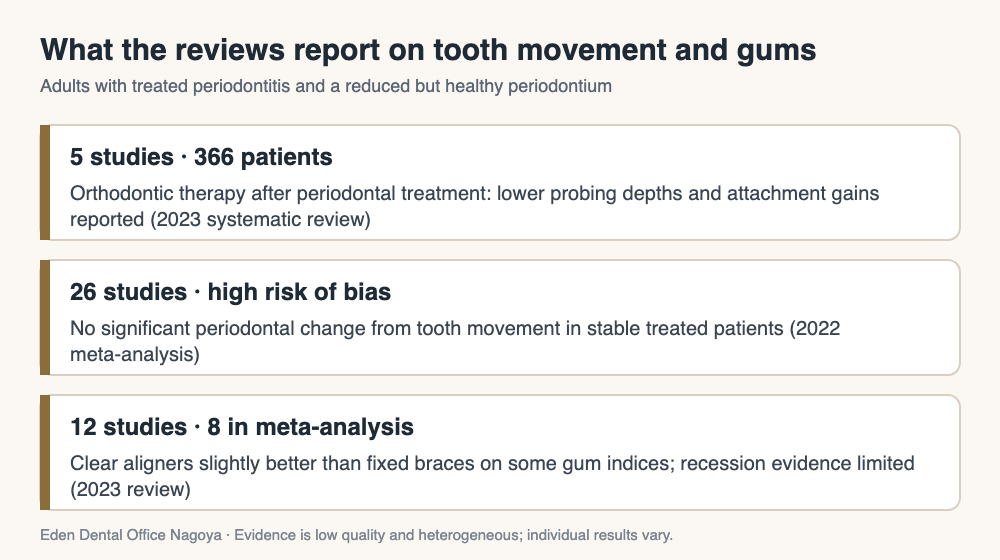
On the comparison most patients ask about, a 2023 systematic review and meta-analysis of 12 studies compared periodontal health during treatment with clear aligners and with fixed appliances. Aligners appeared to maintain slightly better periodontal indices, but only plaque index at mid-term and probing depth at long-term follow-up reached statistical significance, and heterogeneity between studies was very high (Med Oral Patol Oral Cir Bucal 2023).
| Question | What the reviews report | How firm is it |
|---|---|---|
| Can treated periodontitis patients have tooth movement? | Yes, when inflammation is controlled; probing depths and attachment improved after combined care | 5 studies, 366 patients, heterogeneous |
| Does tooth movement harm a reduced but healthy periodontium? | No significant change in periodontal outcomes | 26 studies, high risk of bias |
| Are aligners gentler on the gums than braces? | Slightly better indices on some measures | 12 studies, very high heterogeneity |
| Does the evidence settle recession risk? | No; recession data are limited | Low-quality, short follow-up |
None of these reviews tested a single brand or protocol, and most of the included studies were small. They support a cautious conclusion: tooth movement is not forbidden in a patient with treated gum disease, but it is a planned, supervised treatment and not a cosmetic shortcut.
How the plan changes when gums are involved
When bone support is reduced, the plan is usually slower and more conservative than for a healthy adult. Teeth are moved in smaller steps with lighter forces, treatment is paused for hygiene visits, and the gums are re-measured at intervals. Some movements are avoided altogether. Teeth with advanced mobility may be better held together with a splint or restored than moved. Where tooth movement leaves a visible gap at the gumline after crowding is corrected, the options are described in our article on black triangles after clear aligners.
Because Dr. Murai is a prosthodontist, planning also looks ahead to what the teeth will carry. Crowns, bridges or implants in the same mouth change what can be moved and what must be held still, which is covered in our guide to clear aligners with crowns, veneers or implants. After active movement, retention is more important than usual, because teeth with less bone support relapse more readily; see retainers after clear aligners. If you are weighing aligners against braces, our comparison of clear aligners and braces for adults sets out the other differences.
What this costs and how long it takes
Treatment is quoted in writing in English after the examination, because gum treatment, aligner stages, hygiene visits and retainers are priced separately and the total depends on how much periodontal work is needed. General fee information is on our fees page, and the standard aligner timeline and cost are in the clear aligners in Japan guide. Patients with gum disease should expect a longer course than the usual one, with more frequent recall visits. Visitors from overseas can combine the examination, gum treatment and aligner delivery with remote monitoring, but planning around visits is covered in our guide to a dental treatment trip to Nagoya.
Frequently Asked Questions
Can I have clear aligners if I have gum disease?
Often, but only after the gum disease has been treated and is stable. Reviews of orthodontic treatment in adults with treated periodontitis report no significant harm to the periodontium when inflammation is controlled and forces are light.
Will aligners make my gums recede?
Reviews comparing aligners with fixed braces found no clear excess of recession with aligners, and slightly better gum indices in some measures, but the evidence on recession itself is limited and heterogeneous.
Why is my treatment slower if I have gum disease?
Teeth with reduced bone support are moved with lighter forces in smaller steps, and treatment pauses for hygiene visits. The plan is set to protect the gums rather than to finish as fast as possible.
Do I need a gum examination before aligners?
Yes. Probing depths, X-rays, tooth mobility and bite are checked first, because untreated inflammation is the main reason tooth movement becomes risky.
Are gum problems a reason to avoid aligners altogether?
Not necessarily. Some patients with advanced bone loss are better served by splinting, restorations or no tooth movement at all, and that is decided at examination.
Risks, limits and what to expect
Tooth movement in a patient with reduced bone support can increase tooth mobility, expose root surface or cause gum recession, and untreated inflammation makes each of these more likely. Aligners do not treat gum disease, and they cannot be started until it is under control. The reviews cited here are small, heterogeneous and graded low in quality by their own authors, and cannot predict the outcome for an individual mouth. Some patients are advised that tooth movement is not worth the risk. Individual results vary.
If you would like your gums and teeth examined and a realistic aligner plan explained, a consultation is the right first step. We give a written estimate in English, and you can reach the clinic on WhatsApp. Our treatments page sets out the services we offer.
More on this topic: Aligner Guides — every article we have published in this cluster, grouped by stage.