Does Light-Activated Whitening Work? Evidence for Japan

Reviewed by Dr. Ryosuke Murai, DDS, MSD — Prosthodontist, trained at Indiana University School of Dentistry (U.S.). Last updated October 2026.
Light-activated whitening is often sold as the faster, stronger option, with lamps, lasers and “accelerators” priced as a premium step. The pooled evidence does not support that claim. Systematic reviews of randomized trials found no meaningful difference in colour change or sensitivity between in-office whitening with light and the same gel without it. This article explains what the reviews report, what actually drives a whitening result, and how to judge a quote that includes a light. It is written for patients comparing clinics in Japan before booking.
Why clinics add a light
The idea is simple: light or heat might speed the breakdown of hydrogen peroxide into the reactive molecules that lift stain. Lamps using blue LED, halogen, plasma arc, laser and, more recently, violet light have all been marketed on that basis. In a short chairside appointment, a visible lamp also gives the treatment a sense of technology. The question for a patient is whether it changes the result enough to be worth paying for, and the trial data are the way to answer it.
There is also a practical point about heat. Lamps warm the tooth and the surrounding tissue, and the pulp is sensitive to temperature rise, so any light used in a protocol has to be applied with care and with the gums isolated. Because the reviews show no benefit in colour or in sensitivity from adding light, the sensible default is to avoid extra heat and light exposure unless there is a specific reason for it. This is a conservative reading of the evidence rather than a claim that lights are dangerous, and some clinics use them within sensible limits. What we would caution against is treating the lamp as the part of the appointment that does the work, or paying for a stronger-sounding protocol that the gel and contact time do not justify.
What the systematic reviews report
A 2018 systematic review and meta-analysis in the Journal of Dentistry pooled 21 randomized trials in adults. It found no significant difference in colour change, and no difference in the risk or intensity of tooth sensitivity, between in-office bleaching with light and without it, at both high and low peroxide concentrations. The authors graded the evidence for colour change as moderate and explicitly noted that the commercial claim of faster, better results was not confirmed (J Dent 2018).
A 2019 network meta-analysis of 28 randomized trials compared different light systems directly. No type of light-activated in-office bleaching was superior to light-free bleaching with either high or low concentration gels, and the authors observed that “laser whitening” is often used as a marketing term (Clin Oral Investig 2019). A companion network meta-analysis of 32 studies looked only at sensitivity and found no evidence that light activation changed its risk or intensity, although the certainty of the evidence was graded low (Oper Dent 2021).
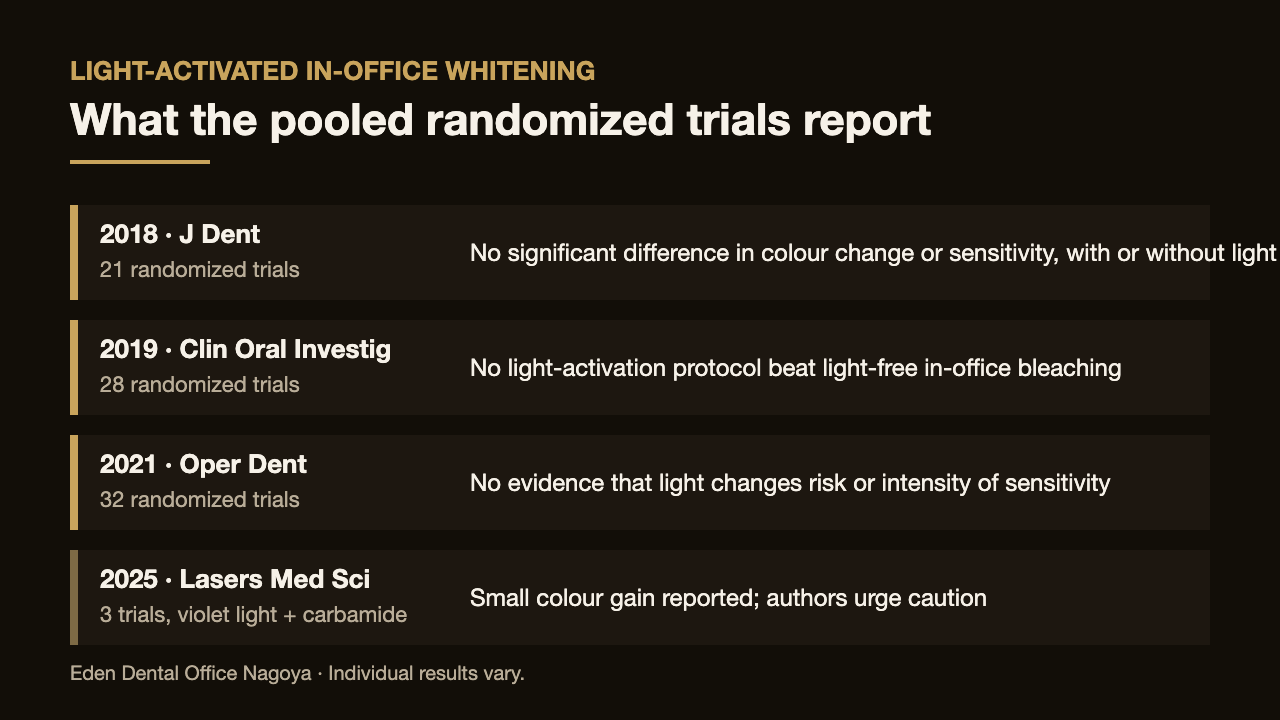
The picture is not entirely closed. A 2025 meta-analysis of just three trials reported a small colour benefit when violet light was added to carbamide peroxide, with no added sensitivity, and described its own evidence as moderate and to be interpreted with caution (Lasers Med Sci 2025). Three small trials are a hypothesis, not a reason to pay more, and the larger reviews above remain the better guide.
| Question | What the reviews report | How firm is it |
|---|---|---|
| Does light improve colour change? | No significant difference with or without light | 21 and 28 trials; moderate certainty for colour change |
| Does light raise or lower sensitivity? | No evidence of an effect either way | 32 studies; low certainty |
| Does the lamp type matter? | No light system was superior to light-free bleaching | Network meta-analysis, 28 trials |
| Does violet light add anything? | A small gain with carbamide peroxide in three trials | Few trials; interpret with caution |
What does change a whitening result
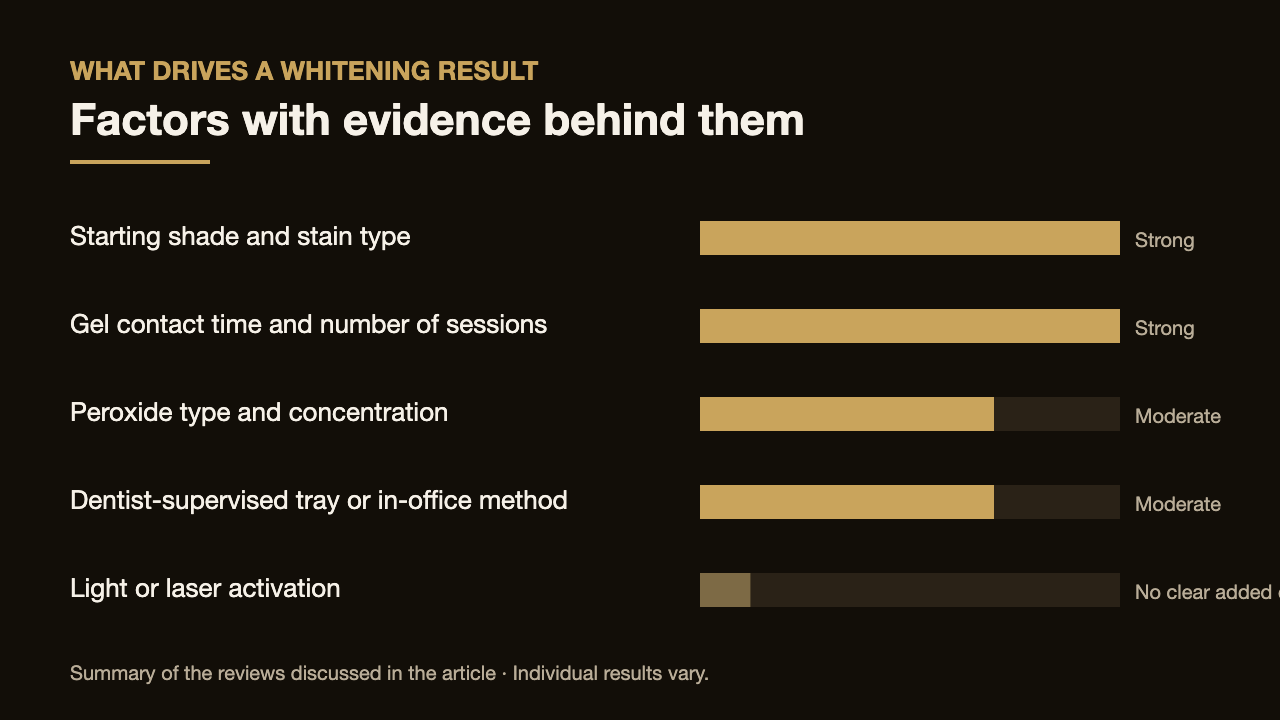
If light is not the variable, something else is. The factors that consistently matter are the starting shade and the type of stain, the length of time the gel stays in contact with the tooth, the number of sessions, and the peroxide used. A tooth that is yellow from ageing responds differently from one that is grey from tetracycline, and a single chairside hour cannot match several days of tray wear at lower strength. Our article on hydrogen and carbamide peroxide gel strength explains how concentration and chemistry compare, and the longevity guide covers why results fade.
Stain also has to be separated from colour. Surface stain from coffee or tea is removed by professional cleaning, not by bleaching, which is why we often examine and clean before whitening; see whitening or cleaning: which removes stain. In our clinic, we plan whitening around the patient’s teeth and restorations first and treat equipment as secondary, because crowns, veneers and fillings do not change shade and need to be considered, as described in whitening teeth with crowns, veneers or fillings.
How to read a quote that includes a light
A light is not unsafe in itself, and some patients find a single supervised appointment more convenient than trays. The point is to know what you are paying for. Ask four questions: which peroxide and what concentration is used, how long the gel stays on the teeth, how the gums are protected, and what is charged for the light itself. If a lamp is priced as the reason for a stronger result, the evidence above does not back that. If it is simply part of the appointment, the decision rests on the gel and the plan. General pricing information, including our whitening package, is on the fees page, and the complete overview of options is in our teeth whitening in Japan guide.
Sensitivity is the real trade-off with any in-office method, because high-strength gel is applied in a short window. Light does not reduce it, so the protection comes from the plan, gel strength and desensitizing steps; see tooth sensitivity after whitening and whether whitening damages enamel. Our whitening page lists what we offer.
Frequently Asked Questions
Does light make teeth whitening work faster?
Systematic reviews of randomized trials found no significant difference in colour change between in-office whitening with light and the same gel without it.
Is laser whitening more effective than other methods?
A network meta-analysis found no light system, laser included, superior to light-free in-office bleaching. The authors noted that “laser whitening” is often used as a marketing term.
Does a whitening light cause more sensitivity?
The reviews found no evidence that light changes the risk or intensity of sensitivity, although the certainty of that evidence ranges from very low to moderate.
Is violet light different?
A small 2025 meta-analysis of three trials reported a modest colour benefit when violet light was added to carbamide peroxide, with no added sensitivity. The evidence is limited and needs larger trials.
Should I pay extra for a light?
The evidence does not show that a light improves the result. Compare quotes on gel type, contact time and gum protection, and ask for the charge for each item in writing.
For a side-by-side look at clinic and home protocols, see at-home versus in-office whitening and what the evidence shows.
Risks, limits and what to expect
Whitening can cause temporary tooth sensitivity and gum irritation, does not change the colour of crowns, veneers or fillings, and is not suitable for every tooth or every patient, so an examination comes first. The reviews cited here pool trials with different gels, lamps and protocols, and several were graded as having unclear or high risk of bias, so they describe averages and not your own teeth. Whitening fades over time and may need repeating. Individual results vary.
If you would like your teeth examined and a whitening plan explained, a consultation is the right first step. We give a written estimate in English, and you can reach the clinic on WhatsApp.
More on this topic: Whitening Guides — every article we have published in this cluster, grouped by stage.