Digital Smile Design in Japan: How a Smile Is Planned First
Reviewed by Dr. Ryosuke Murai, DDS, MSD — Prosthodontist, trained at Indiana University School of Dentistry (U.S.). Last updated October 2026.
Digital Smile Design in Japan, at its simplest, means that your new smile is drawn, measured and tested before any tooth is touched. Photographs, video and a digital scan of your mouth are combined on screen into a proposed design; that design is then turned into a physical mock-up you can wear, look at in a mirror and photograph in ordinary light. Only after you have approved it does it guide the clinical work. This guide explains how that planning sequence runs at our clinic in Nagoya, what the published evidence does and does not show, what is decided on screen versus in the mouth, and where design software stops being useful. It is written for self-pay patients comparing clinics in Tokyo, Singapore, London or the United States, who would rather understand the reasoning than be shown a glossy before-and-after.
What Digital Smile Design is, and what it is not
The phrase gets used loosely, so a definition helps. Digital Smile Design is a planning method, not a treatment and not a product you receive. It sits in front of treatment such as porcelain veneers, crowns, orthodontic alignment or implant restoration, and its job is to answer one question early: what should the finished teeth look like on this face, and is that achievable with the tissue we have?
Three things are commonly confused with it. A filter on a photograph that whitens and straightens teeth is entertainment; it knows nothing about your enamel, your bite or your gum line. A generic smile library, where a template is dropped over your teeth, ignores the proportions of your own face. And a rendering is a picture, whereas a design only becomes useful when it is translated into something physical and measured against the teeth you actually have.
The method itself is straightforward. Reference lines are drawn on a frontal photograph: the line between the pupils, the midline of the face, the position of the lip at rest and in a full smile. Tooth proportions are then designed against those lines rather than against a textbook average. The design is superimposed on a digital scan of the teeth, so that what was drawn can be measured: how many tenths of a millimeter the edge of a tooth would move, how much ceramic thickness that implies, whether the gum margin needs to change. That last step is what separates planning from picture-making.
The planning sequence, step by step
The order in which things happen matters more than the software. At Eden, a case moves through the stages below, and the person who designs the smile is the same prosthodontist who will later prepare the teeth and approve the laboratory work. Stages overlap, and the number of visits depends on the case, so we state the sequence rather than a fixed timetable.
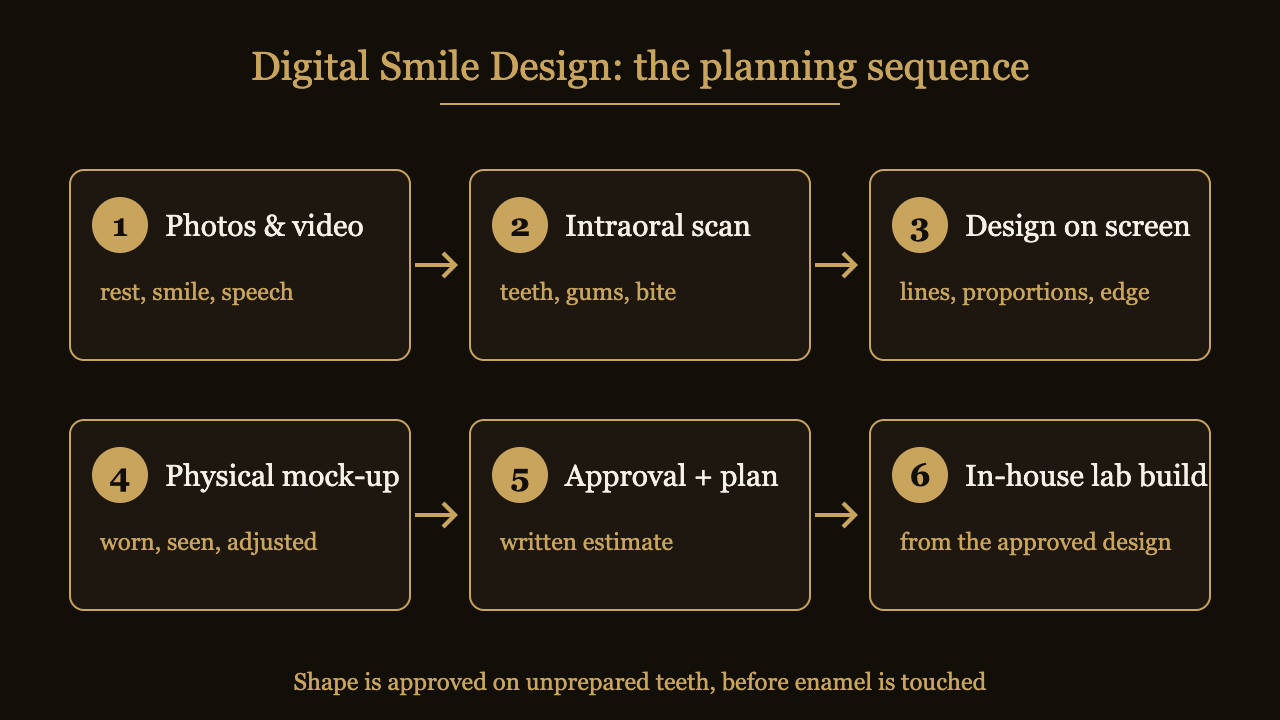
1. Photographs and video. A standard set of photographs at rest, in a natural smile and in a full smile, plus short video of speech. Video matters because teeth behave differently when you talk than when you hold a posed smile, and the edge position of the front teeth is judged largely in motion.
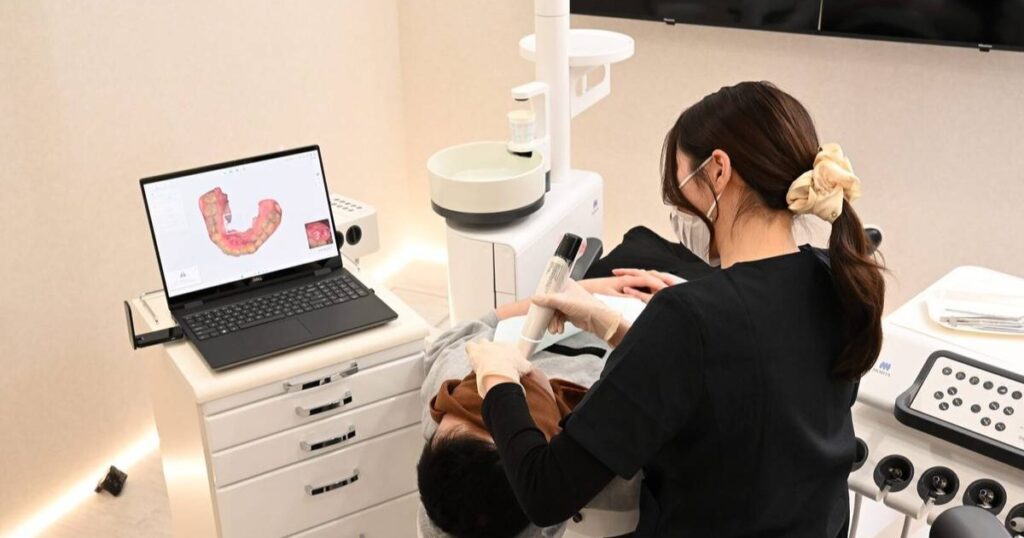
2. Intraoral scan and bite records. Our intraoral scanner captures the teeth and gums digitally, with no impression trays. If you are arriving from overseas, existing X-rays and photographs can start this stage before you travel; our guide to sending dental records to a clinic in Japan explains what is useful to send.
3. Design on screen. Reference lines, tooth proportions, edge position and gum levels are drawn and checked against the scan. This is where most of the thinking occurs, and where a design that looks attractive but cannot be built is caught.
4. Physical mock-up. The approved digital design is converted into a temporary shape that sits over your own teeth. This is the stage most patients remember. You can see it from the front, from the side and in a mirror, speak with it in place, and have it photographed. Changes are made at this stage, in minutes, at no cost to your enamel.
5. Approval and written plan. Once the mock-up is accepted, it becomes the reference for everything that follows: preparation depth, ceramic thickness, and the brief to the laboratory. You receive the plan and a written estimate in English before any irreversible step.
6. Build in our in-house laboratory. Because the dental laboratory is inside the clinic, with its own 3D printers, the technician works from the approved design directly, and adjustments to shade or shape do not wait on a courier. In our clinic, we plan the preparation through the mock-up rather than by eye, so the tooth is reduced for where the final restoration will sit, not measured from where the tooth happens to stand today.
What the published evidence shows
It is reasonable to ask whether this is demonstrably better, or simply more impressive in a consultation room. The honest answer is that the evidence is encouraging and still modest.
A 2025 systematic review in Cureus examined Digital Smile Design and patient-centered outcomes in esthetic restorative dentistry. Seven studies met its inclusion criteria, spanning randomized trials, observational studies and qualitative work, and the authors report that design-guided treatment was associated with higher patient satisfaction, treatment acceptance, communication and perceived predictability than conventional approaches. The same authors are careful about the limits: study designs and outcome measures varied, several samples were small, and they call for longer, higher-quality follow-up.
A second review, in Dentistry Journal (2024), looked at the digital workflow for esthetic veneers from design to cementation. After screening 169 records and assessing twenty studies in detail, it concluded that digitally designed and fabricated laminate veneers showed greater predictability and accuracy than the conventional workflow, particularly for preparation and cementation guides.
| Claim you may hear | What the evidence supports | How firmly |
|---|---|---|
| Design improves communication and patient satisfaction | Consistent finding across the seven studies in the 2025 review | Moderate; small and mixed samples |
| Digital workflows are more accurate for veneer preparation and cementation guides | Reported in the 2024 workflow review of twenty studies | Moderate; accuracy, not long-term survival |
| Design software makes veneers last longer | No direct evidence either way; longevity depends on bite, enamel and material | Not established |
| A digital preview shows exactly how the result will look in your mouth | Not supported; a preview is a plan, and a physical mock-up is a closer test | Overstated |
Read that table the way a careful patient should. Design is well supported as a way to agree on a result and to build it accurately. It is not evidence that the restoration will last longer, and anyone who implies it does is selling the software rather than describing the science. Longevity is a separate question, which we cover in our guide to porcelain veneers in Japan.
What actually gets decided on screen
A smile design is a set of measurable decisions. Each one changes what the clinical treatment will involve, which is why design is not cosmetic decoration done before the real work.
| Design variable | What is assessed | What it changes in treatment |
|---|---|---|
| Incisal edge position | How much of the upper front teeth shows at rest and in speech | Whether teeth are lengthened, and how thick ceramic must be at the edge |
| Tooth proportions | Width-to-length ratio of the central incisors, a figure often quoted at roughly 75–80% in esthetic dentistry | Whether teeth look too short or too narrow, and whether gum levels must move |
| Gum line and symmetry | Height of the gum margins on each side and how much gum shows when smiling | Whether gum contouring before veneers is needed |
| Midline and cant | Alignment of the dental midline with the face, and tilt against the pupil line | How much correction is possible with restorations, and what needs orthodontics |
| Shade and translucency | Overall brightness relative to skin, eyes and neighboring teeth | Material choice and whether whitening should come first |
Notice that several rows end with the words “whether” or “what needs orthodontics”. Design is as much about deciding what not to do as what to do. A proposal that adds ceramic to every tooth by default is rarely the most conservative plan.
Why the mock-up matters more than the rendering
An on-screen preview is an excellent tool for thinking and a poor tool for deciding. Screens are flat, lit from within and viewed at a distance you choose. Your smile is none of those things. That is why the physical mock-up carries more weight in our process than the rendering that precedes it, and why we treat the two as different stages rather than interchangeable ones.
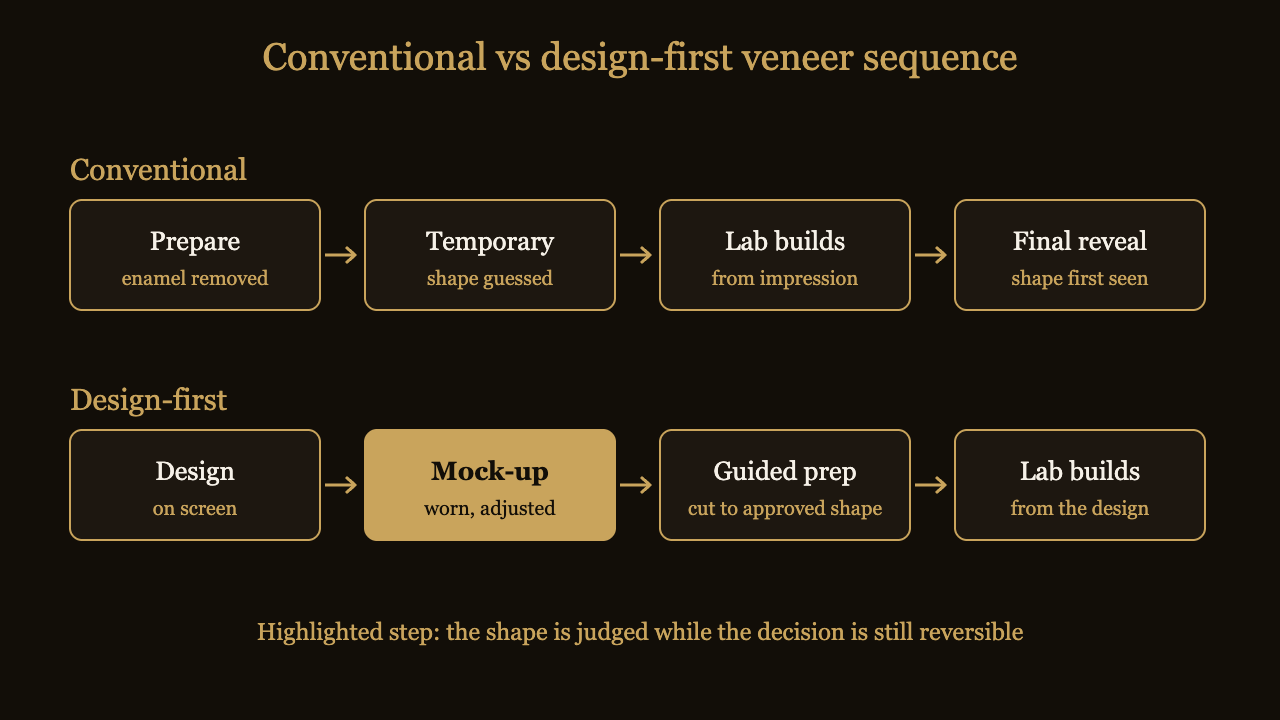
In the conventional sequence, the tooth is reduced first, a temporary is made, and the final shape is revealed only when the ceramic arrives. If the shape disappoints, the enamel is already gone. In the design-first sequence, the shape is tested on unprepared teeth, and the preparation is then guided by the approved form. Two practical advantages follow. You see and approve the shape while the decision is still fully reversible, and the preparation is cut for the intended outcome, which in many cases removes less enamel than preparing freehand. The second point is a clinical judgment that depends on the case rather than a promise, and enamel removed in any preparation does not grow back.
The mock-up also reveals things a screen cannot. Speech sounds, such as the “s” and “f” sounds, expose whether a lengthened edge touches the lower lip. Lip support shows whether the front teeth sit too far forward. And the reaction of the person who knows your face well, whether that is you, your partner or a colleague, is information worth having before anything irreversible is done.
When design is not enough
Software can draw a beautiful tooth on a tooth that cannot hold one. Several situations limit what design can promise, and a straightforward plan names them early.
The tooth cannot support the restoration. Where a tooth is heavily filled, root-treated or fractured, a veneer may not have enough sound enamel to bond to, and a crown may be the more predictable choice. We set out that decision in veneers versus crowns in Japan.
The teeth are in the wrong place. Crowding, rotation and midline problems can sometimes be disguised with ceramic, but at a cost in enamel. If the teeth can be moved instead, alignment first may be the conservative route; braces or veneers and our overview of clear aligners in Japan explain when each makes sense.
The bite is driving the problem. If worn or chipped front teeth reflect grinding or an unstable bite, a beautiful design placed over them will meet the same forces. The bite is addressed as part of the plan, often with a night guard, and a prosthodontic assessment of function comes before any decision about shape.
The expectation exceeds what the tooth allows. A single front tooth beside natural neighbors is the hardest case to hide, as we explain in matching a single front tooth veneer. A smaller change, such as the conservative approach in no-prep veneers, suits only some teeth, and design is how that suitability is checked rather than assumed.
Planning from outside Nagoya
Many of our patients live in Tokyo, elsewhere in Japan or overseas, and the planning method suits that. Photographs, video and existing records can be reviewed before you travel, so the first visit is spent on the scan, the design and the mock-up rather than on basic data collection. The distance is manageable: about 100 minutes by bullet train from Tokyo, roughly 40 minutes from Chubu Centrair International Airport. Our overview of the dental treatment trip to Nagoya covers how visits are organized, and video consultations explain what can and cannot be judged remotely. A video review can discuss goals and suitability, but it cannot replace the scan and clinical examination that confirm the plan.
If you are arriving for a larger smile makeover, ask for the sequence in writing: which steps happen on which visit, what stays reversible until you approve it, and how the temporary shape is protected between appointments.
What this costs
The cost depends on the treatment the design is leading to, not on the design itself. Veneers, crowns, alignment, gum contouring and whitening are priced differently, and a smile design often combines several. We do not publish a single figure for “a smile design”, because that figure would hide more than it showed. What we can say is that the fee is built from the number of teeth, the ceramic chosen, any preparatory treatment such as whitening, gum contouring or alignment, and the laboratory work. Our fee pages are the starting point, and you receive a written estimate in English, with the plan, before any treatment begins. Fee drivers are explained further in our veneer guide linked above.
Frequently Asked Questions
Is Digital Smile Design a treatment I pay for separately?
It is a planning method rather than a treatment, and it leads into whichever treatment suits your teeth. How planning is itemized is stated in your written estimate, which you receive in English before any treatment begins.
Will my result look exactly like the on-screen preview?
No preview can promise that. The physical mock-up is a closer test than a screen image, but ceramic, light and your own teeth all influence the final appearance, which is why shade and shape are checked again during the build.
Do I need to be in Nagoya for the design stage?
Early planning can begin remotely with photographs, video and existing records. The scan, the clinical examination and the physical mock-up need you in the chair, so at least one visit is required before the design can be confirmed.
Does a digital design mean less of my tooth is removed?
It can, because preparation is guided by the approved shape rather than estimated freehand. That depends on the case, and any preparation removes enamel that does not return, so the conservative choice may sometimes be no preparation at all.
Can design software fix a bite problem or crooked teeth?
It can show what is possible and what is not, but it cannot correct either. Bite problems and tooth position are addressed clinically, sometimes through alignment or a night guard, before any ceramic is planned.
Risks, limits and what to expect
Digital Smile Design reduces uncertainty; it does not remove it. A mock-up is a temporary shape on unprepared teeth, and the finished restoration is made of different material, so small differences in shade, edge and surface are expected and are refined during the build. Treatments that follow a design, particularly veneers and crowns, involve removing enamel that does not grow back, and from that point the tooth will need a restoration of some kind. Ceramic can chip or debond, especially under grinding. Temperature sensitivity is common for a few weeks, and gum tissue takes time to settle around new margins. The published evidence for design-guided care concerns satisfaction, communication and accuracy; it does not show that restorations last longer. Individual results vary.
If you would like your goals assessed before you decide anything, the most useful first step is a consultation that separates what you want from what your teeth can carry. Records, a design proposal and a written estimate in English come before any preparation, and you can reach the clinic on WhatsApp. Our aesthetic and cosmetic dentistry page sets out how consultation, design and laboratory work fit together, and the guide to replacing old veneers is a useful read if you are redoing earlier work.
More on this topic: Veneer and Cosmetic Guides — every article we have published in this cluster, grouped by stage.