
Dental Implant Cost: Japan vs the U.S., Honestly Compared
Reviewed by Dr. Ryosuke Murai, DDS, MSD — Prosthodontist, trained at Indiana University School of Dentistry (U.S.). Last updated July 2026.
Is dental implant cost in Japan vs the USA really a fraction of the price? The honest answer: a Straumann-based single implant in Japan is often meaningfully less expensive than an equivalent plan in a major American city — but the gap is smaller than headline comparisons suggest once you count everything both fees include. This article is written for self-pay, quality-first patients: expatriates already living in Japan, and international readers weighing implant treatment at a Japanese clinic against care back home. We compare what each country’s fee typically covers, why the difference exists, and how to read two quotes from two countries without being misled.
Start with the structure, not the sticker price
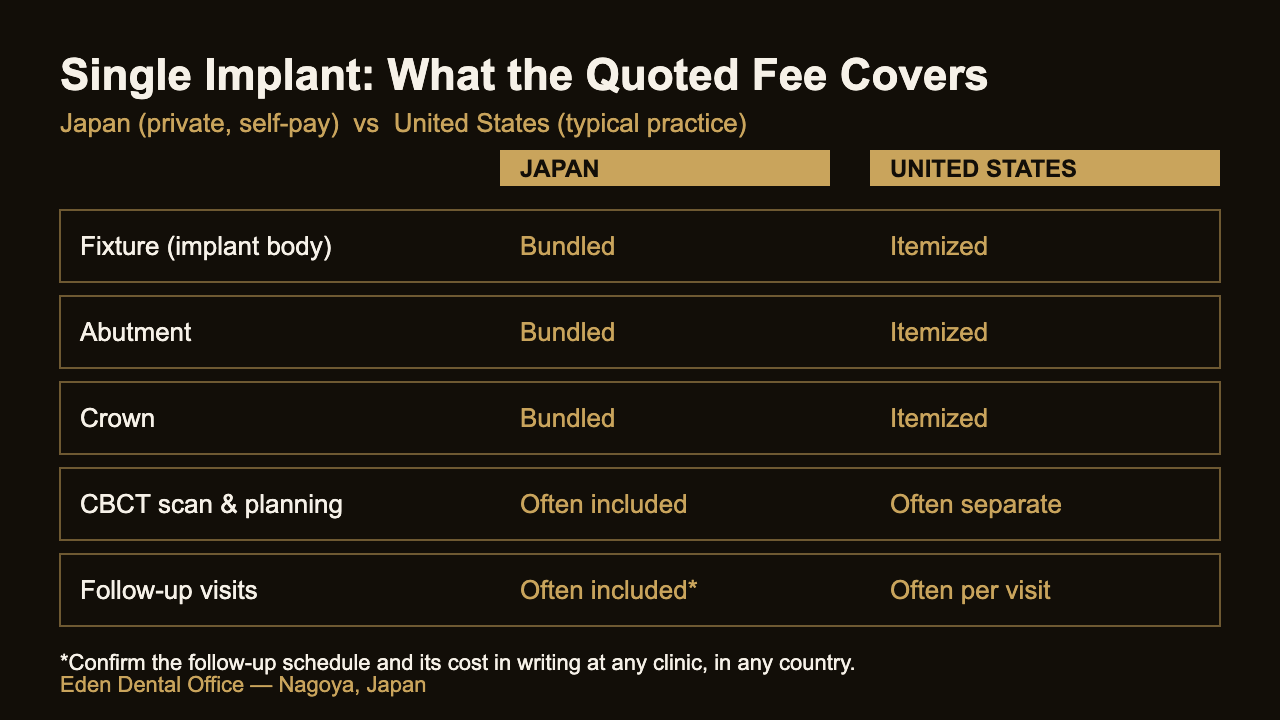
An “implant” is never one fee. A complete single-tooth restoration involves the fixture (the titanium screw), the abutment (the connector), the crown, plus diagnostics: CBCT imaging, planning, surgery, and follow-up. In the United States, these are frequently quoted as separate line items, and published estimates for the complete sequence commonly run from about US$3,000 to US$6,000 or more per tooth in metropolitan areas, before any grafting. Peer-reviewed cost analyses indexed on PubMed and consumer guidance from the American Dental Association both stress the same point: the range is wide because the components are priced separately.
In Japan, dental implants sit outside the national insurance system in almost all cases — covered only in narrow hospital reconstruction scenarios — so private clinics set their own self-pay fees — a system explained in English by the Ministry of Health, Labour and Welfare. Japanese quotes more often bundle fixture, abutment, and crown into one figure. That bundling is convenient, but it also means two quotes that look identical can cover very different things. Our complete English guide to implant costs in Japan unpacks the Japanese side of this in detail.
Japan vs the U.S.: a line-by-line comparison
| Item | United States (typical practice) | Japan (private, self-pay) |
|---|---|---|
| How fees are quoted | Itemized: surgery, abutment, crown billed separately | Usually bundled into one per-tooth figure |
| Insurance role | Dental plans may reimburse part of the crown | Almost always fully self-pay; no insurance involvement |
| CBCT scan & planning | Often a separate diagnostic fee | Frequently included in the package |
| Implant brand disclosure | Varies; ask which system is used | Varies; premium clinics state it (Eden uses Straumann only) |
| Laboratory work | Usually outsourced to an external lab | Outsourced or in-house; in-house shortens timelines |
| Follow-up visits | Often billed per visit | Often included for a defined period — confirm in writing |
| Tax treatment | May qualify for U.S. medical expense deduction | Eligible for Japan’s medical expense deduction (iryōhi kōjo) |
The pattern to notice: neither country is uniformly “cheaper” line by line. The Japanese advantage appears at the total, and it is driven by structural factors rather than lower-grade materials.
Why the totals differ
Three forces explain most of the gap. First, clinical labor and facility overhead cost less in Japan than in large U.S. metros, and malpractice-insurance overhead is far lower. Second, the yen’s exchange rate in recent years has made yen-denominated fees comparatively economical for anyone earning in dollars. Third, workflow: a clinic with its own digital laboratory removes an external-lab margin and courier delays from the chain.
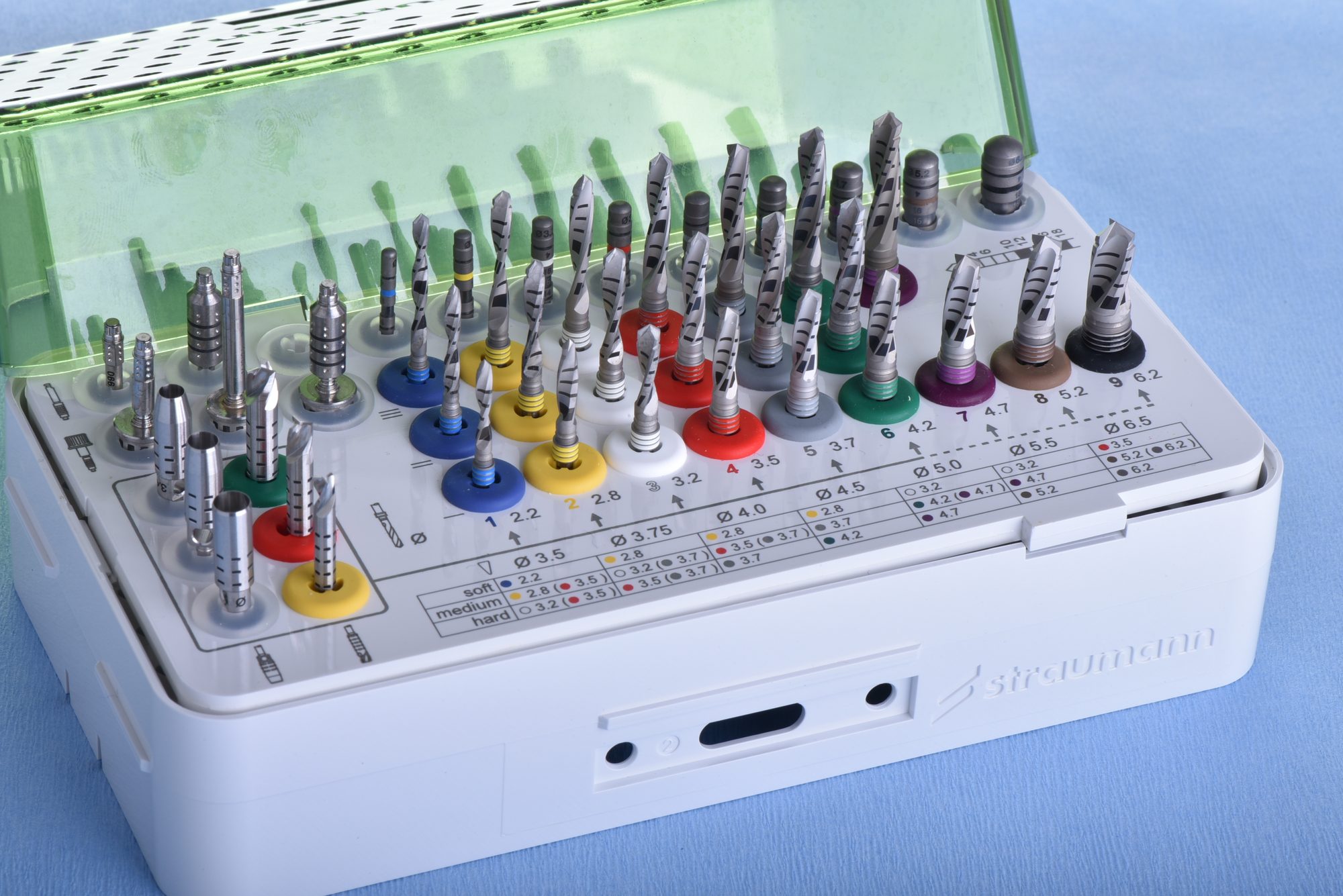
What the gap is not explained by is the implant itself. A Straumann BLX fixture placed in Nagoya is the same Swiss-made component placed in Boston, with the same published research record. If a quote in either country is dramatically below its local market, the savings usually come from somewhere less visible — an unbranded fixture, an outsourced crown of unclear provenance, or follow-up that quietly costs extra. We examined that trade-off in what premium implant pricing actually buys in Japan.
One more factor belongs in an honest comparison: your own logistics. If you already live in Japan, treatment here removes flights, hotels, and time off work from the equation entirely — the comparison is simply local care versus a medical trip home. If you would be traveling to Japan for treatment, add those costs to the Japanese side, and note that implant treatment requires at least two visit windows (placement, then restoration after healing), which a clinic with an in-house lab can compress but not eliminate. A fair comparison is total cost of a finished, maintainable tooth, not the fee on page one of either quote.
A prosthodontist’s view: comparing like with like
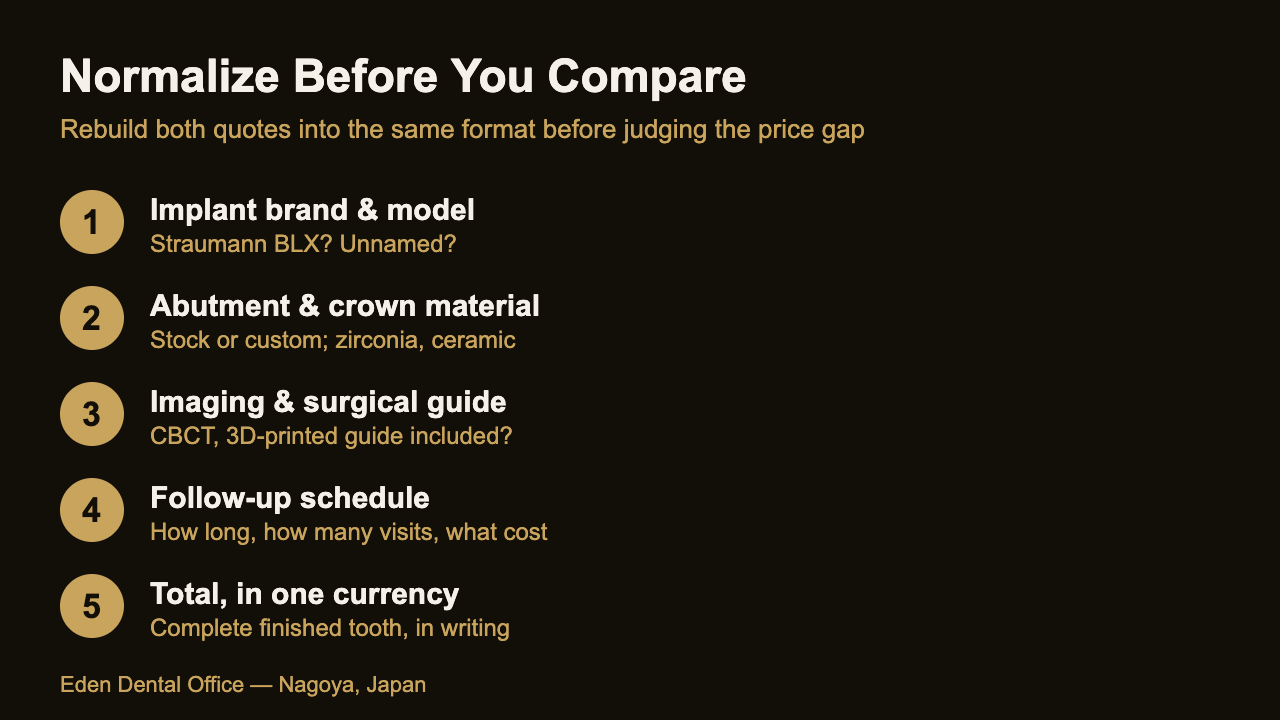
At Eden, we plan every implant case on a CBCT scan, design the surgical guide digitally, and 3D-print it in our in-house lab — the same workflow I trained on during my prosthodontics residency at Indiana University School of Dentistry. When a patient brings us a U.S. quote to compare, the first thing we do is rebuild both plans into the same format: fixture brand, abutment type, crown material, guide, imaging, and the follow-up schedule, each with a yen or dollar figure attached. Roughly half the “price difference” patients think they see disappears or widens once the two quotes describe the same scope of work. That normalization, in English and in writing, is the comparison that actually matters.
What this costs
We deliberately do not publish a single implant price on this page, because a responsible figure depends on bone volume, the number of teeth involved, and whether grafting or a sinus lift is needed. Our published anchors: a comprehensive check-up package is ¥40,000, and full details are on the fee page. For implant treatment, you receive a written, itemized estimate in English at consultation — fixture, restoration, and follow-up separated — so it can be compared line by line against any quote from home. Payment is self-pay; costs may qualify for Japan’s medical expense deduction if you are a tax resident.
Frequently Asked Questions
Are implants cheaper in Japan than in the United States?
Often, yes, for equivalent premium components — but the difference varies by city and scope. Compare complete, itemized quotes rather than headline figures.
Is the implant quality the same in Japan?
The component can be identical. Eden places only Straumann (BLX/TLX) fixtures, the same Swiss system used by clinics in the U.S. and Europe.
Does Japanese health insurance cover dental implants?
In almost all cases, no. Implants are self-pay in Japan, which is why private clinics quote their own package fees.
Can I do the surgery in Japan and the crown at home?
It is possible but requires coordination between dentists. We provide records in English so a colleague abroad can continue care if needed.
Will follow-up visits cost extra?
Policies differ by clinic in both countries. Ask for the follow-up schedule and its cost in writing before treatment begins.
The same normalization method works within Japan as well — see what moves an implant quote between Tokyo and Nagoya.
Risks, limitations, and a note on comparisons
Implant treatment carries risks in any country: infection, implant failure requiring removal, nerve injury, and sinus complications in the upper jaw. Smokers and patients with uncontrolled diabetes face higher failure rates. Treatment typically spans three to six months from placement to final crown, and grafted cases take longer. Cost comparisons in this article describe typical market structures, not a promise about any individual case. Individual results vary.
If you are weighing an American quote against treatment in Japan, the most useful next step is a consultation where both plans are put side by side in the same terms. You can read how we approach implant treatment planning at Eden, or message us on WhatsApp in English to arrange a consultation — in person in Nagoya, two minutes from Fushimi Station, or remotely first.
To normalize the figures you gather on either side of the Pacific, start with what belongs inside a complete implant quote in Japan.