Are Dental Implants Covered by Health Insurance in Japan?
Reviewed by Dr. Ryosuke Murai, DDS, MSD — Prosthodontist, trained at Indiana University School of Dentistry (U.S.). Last updated July 2026.
Japan’s health insurance system has a well-earned reputation: show your card, pay 30% at the front desk, and most dentistry is settled. Many residents assume dental implants work the same way — and they do not. Dental implants are not covered by health insurance in Japan in almost every case; they are classified as jiyū shinryō (self-pay treatment), and this applies equally to Japanese citizens and foreign residents. A handful of narrow, hospital-based exceptions exist. This article explains how the coverage rules actually work, when the exceptions apply, what insurance will pay for instead, and the legitimate ways — including a tax deduction most foreign residents overlook — to reduce what a self-pay implant really costs. It is written for readers considering implant treatment at a private Japanese clinic on a self-pay, quality-first basis.
How Japan’s dental coverage works — and where implants sit
Public insurance in Japan (whether National Health Insurance or an employer plan) reimburses a defined list of medical and dental procedures. The list, maintained by the Ministry of Health, Labour and Welfare, is built around restoring basic function at a standardized fee: fillings, extractions, root canal treatment, resin or metal crowns on natural teeth, dentures, and bridges. For anything on the list, the patient typically pays 30% of a nationally fixed price.
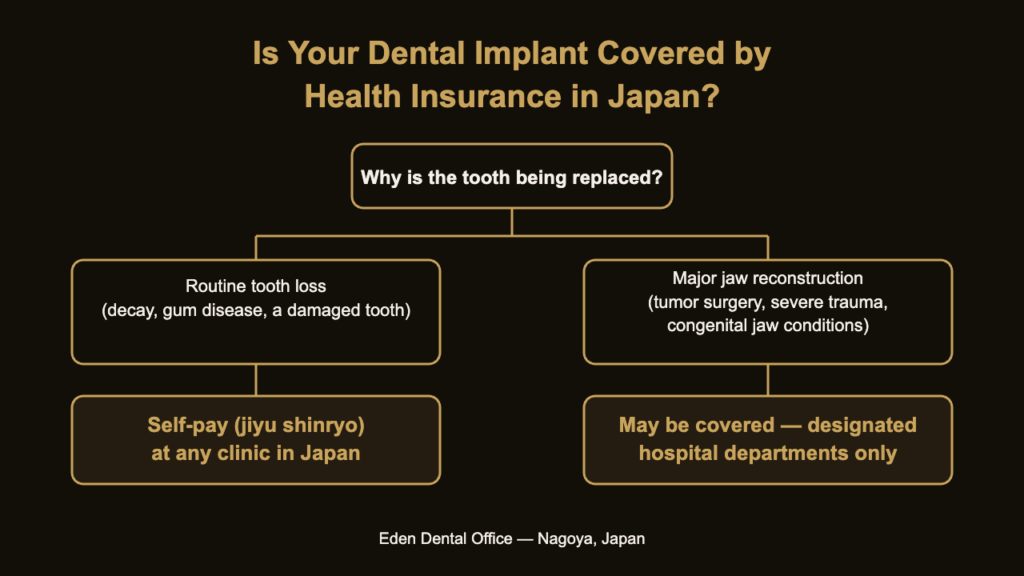
Implants for ordinary tooth loss — a tooth lost to decay, gum disease, a failed root canal, or an accident that damaged the tooth itself — have never been added to that list. The system’s logic is that a covered denture or bridge already restores chewing function; the implant is treated as an elective upgrade, however strong the clinical arguments for it may be in a given mouth. There is no appeal process and no nationality clause. If your case is routine tooth replacement, the answer is the same everywhere in Japan: self-pay.
The narrow exceptions: hospital-based jaw reconstruction
Coverage does exist for one category of patient. When a large section of the jawbone is missing — after tumor surgery, severe trauma, or certain congenital conditions affecting jaw development — implant-supported reconstruction can be performed under public insurance. Three conditions define this pathway: the bone loss must be extensive and medically documented, the treatment must take place at a hospital oral and maxillofacial department that meets designated facility standards (in practice, mostly university hospitals), and the indication must fall within the criteria — routine periodontal or decay-related tooth loss does not qualify, no matter how many teeth are involved.
If you believe your history could meet these criteria, the correct first step is a referral to a university hospital, not a private clinic. We are candid with patients about this: when someone arrives at Eden with a reconstruction case that belongs in the covered hospital pathway, we say so and write the referral.
Covered or self-pay? The common scenarios
| Scenario | Insurance status | Notes |
|---|---|---|
| Implant for a tooth lost to decay or gum disease | Self-pay | Applies to residents and visitors alike |
| Implant after jaw resection or major trauma | May be covered | Designated hospital departments only, strict criteria |
| Denture or bridge as the alternative | Covered (30% co-pay) | Standard materials only; premium versions are self-pay |
| Ceramic crown on an implant | Self-pay | The restoration follows the fixture’s status |
| Implant maintenance at a private clinic | Self-pay | Confirm the schedule and fee in writing |
| Medical expense deduction (iryōhi kōjo) | Tax relief, not insurance | Self-pay implant fees generally qualify |
What self-pay status actually changes
Because no reimbursement schedule applies, a self-pay clinic chooses its components and workflow on clinical grounds alone — which is precisely why quality varies so much between clinics, in both directions. At Eden, self-pay status is what allows us to standardize on the Straumann BLX and TLX systems rather than an unbranded fixture, to plan every case on CBCT imaging, and to design and 3D-print the surgical guide in our own in-house digital laboratory instead of waiting on an outside vendor. That planning discipline is the workflow I brought back from my prosthodontics training at Indiana University School of Dentistry, and it is the part of an implant fee that never appears as a line item. Our English guide to implant costs in Japan breaks down where the rest of the fee goes.
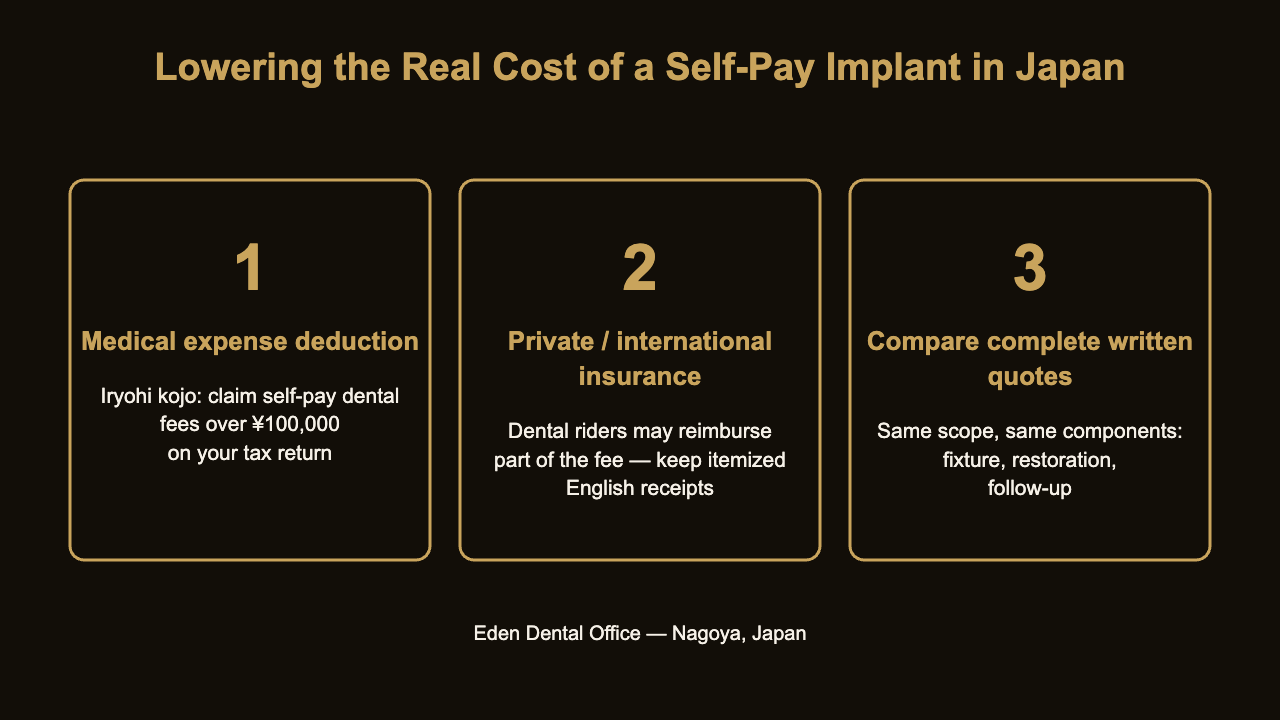
Three legitimate ways to lower the real cost
1. Japan’s medical expense deduction. Self-pay dental implants placed to restore function are generally accepted as deductible medical expenses. If your household’s total medical spending in a calendar year exceeds ¥100,000 (or 5% of income, whichever is lower), the excess — up to ¥2,000,000 — can be deducted from taxable income on a final tax return. Related transport costs can be included. Foreign residents who are tax residents of Japan can claim it; the National Tax Agency publishes English guidance, and we issue receipts formatted for the filing.
2. Private and international insurance. Some expatriate health plans and employer international policies include dental riders that reimburse part of implant treatment even though Japanese public insurance does not. The deciding factor is usually documentation: an itemized estimate and receipts in English, separating fixture, restoration, and diagnostics. We prepare these as standard.
3. Compare complete written quotes. Since every clinic prices independently, the spread between quotes is wide — but a low figure often covers a narrower scope. What a premium fee includes is examined in our article on Straumann implant pricing in Japan, and if you are weighing treatment here against care abroad, the Japan–U.S. cost comparison shows how to put two countries’ quotes into the same format before deciding.
Even without insurance coverage, the outlay is rarely a single lump sum: see how staged payments, cards, and dental loans spread implant costs in Japan.
Frequently Asked Questions
Why does Japanese insurance exclude dental implants?
The covered treatment list restores basic function at standardized fees. Dentures and bridges fill that role, so implants are classified as elective self-pay treatment.
Do the hospital exceptions apply to ordinary tooth loss?
No. They require extensive, documented jaw-bone loss from tumor surgery, major trauma, or congenital conditions, treated at designated hospital departments.
Can foreign residents claim the medical expense deduction?
Yes, if you are a tax resident of Japan and file a final tax return. Keep itemized receipts for the calendar year.
Will an international health plan reimburse an implant in Japan?
Some plans with dental riders reimburse part of the fee. Check your policy and request itemized English documentation from the clinic.
Are dentures or bridges covered instead?
Yes. Standard-material dentures and bridges are covered at a 30% co-pay; premium materials move them into self-pay territory.
What this costs
We do not publish a flat implant price, because an honest figure depends on bone volume, the number of teeth, and whether grafting is required. Our published anchors are on the fee page — for example, a comprehensive check-up package is ¥40,000 — and every implant patient receives a written, itemized estimate in English before any treatment: fixture, restoration, diagnostics, and follow-up listed separately, so the figures work for insurance claims and the tax deduction alike.
Risks and limitations
Implant treatment carries surgical risks including infection, implant failure requiring removal, nerve disturbance, and sinus complications in the upper jaw; smoking and uncontrolled diabetes raise failure rates. Treatment usually spans three to six months from placement to final restoration. Insurance and tax rules summarized here reflect the system as of July 2026 and can change — confirm current criteria with the hospital or tax office handling your case. Individual results vary.
If you are deciding between a covered denture, a bridge, and a self-pay implant, the useful next step is a consultation where all three are planned against your actual anatomy and budget. You can read how we approach implant planning and treatment at Eden — two minutes from Fushimi Station in Nagoya, one Shinkansen stop from most of Japan — or message us on WhatsApp in English.
Once you know coverage rarely applies, the next step is the line items a complete implant estimate should show before you sign anything.
The same self-pay rules apply to full-arch work; our guide to All-on-4 implant treatment in Japan explains where insurance stops.