Dental Implant Cost in Tokyo vs Nagoya: What Moves the Price
Reviewed by Dr. Ryosuke Murai, DDS, MSD — Prosthodontist, trained at Indiana University School of Dentistry (U.S.). Last updated July 2026.
If you live in Tokyo and have started collecting implant consultations, you may have noticed something odd: the same Straumann implant, a similar crown, and a nearly identical treatment plan can carry very different price tags depending on the clinic’s address. Understanding dental implant cost in Tokyo versus Nagoya starts with separating what is genuinely fixed in a quote from what simply tracks local rent and payroll. This guide walks through both, then looks honestly at the trade-off between treating in central Tokyo and traveling about 100 minutes by Shinkansen to a clinic like ours in Nagoya. It is written for self-pay patients who want their budget going into implant treatment itself, rather than into someone’s real estate.
Two kinds of costs live inside every implant quote
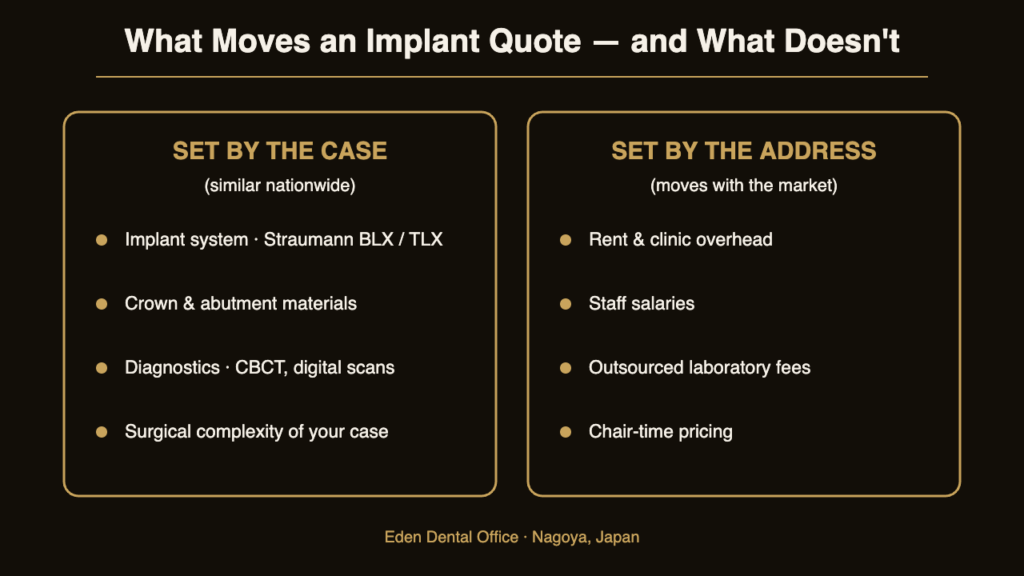
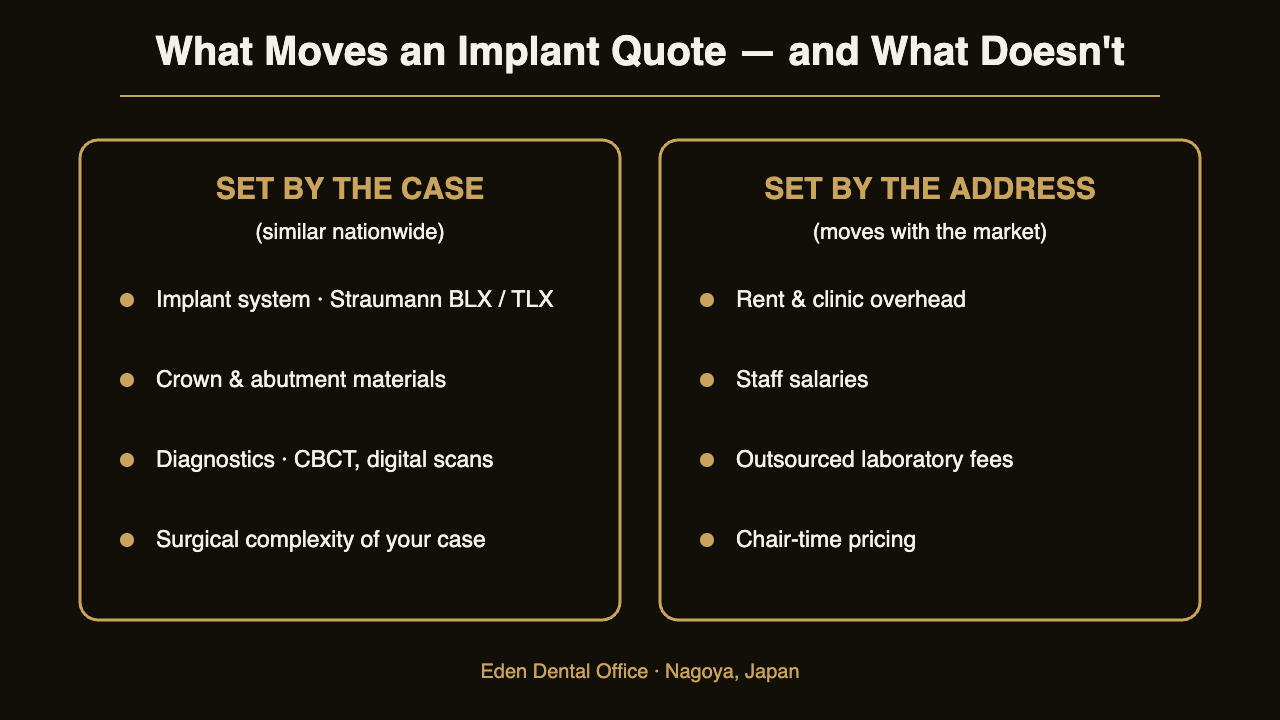
An implant fee is not one number; it is a bundle. Some components are priced by manufacturers and suppliers and barely move between prefectures. Others are priced by the local market the clinic operates in, and they move a great deal. When two quotes differ, the first question worth asking is which layer the difference comes from — we cover the layers themselves in our guide to what a Japanese implant quote actually includes.
| Cost component | Fixed or location-sensitive? | Why |
|---|---|---|
| Implant fixture and connective parts (e.g., Straumann BLX/TLX) | Essentially fixed | Manufacturer pricing does not depend on the clinic’s address |
| Crown and abutment materials (zirconia, titanium) | Largely fixed | Supplier-priced; small variation by lab arrangement |
| Diagnostics (CBCT scan, digital impressions) | Largely fixed | Equipment-driven; similar machines nationwide |
| Clinician and staff time | Location-sensitive | Salaries follow the local labor market |
| Rent and clinic overhead | Strongly location-sensitive | Central-Tokyo commercial rent is among the highest in Japan |
| Laboratory work | Depends on the model | Outsourced lab fees vary; an in-house lab changes the equation |
Why central-Tokyo quotes often carry a premium
None of this is a comment on quality. Tokyo has excellent clinicians, and a higher quote does not mean you are being overcharged — it often means the clinic pays Ginza or Omotesando rent and staffs accordingly. The point is narrower: when you compare quotes, part of the difference reflects cost structure rather than treatment. A clinic in Nagoya’s business district carries meaningfully lower fixed costs than an equivalent clinic in central Tokyo, and that difference flows through to self-pay fees. For orientation on what implants cost across Japan as a whole, and which clinical factors move the number, see our complete guide to dental implant costs in Japan.
A useful habit when reading any quote: normalize it first. Confirm the implant system, what the fee includes, how many visits it covers, and what follow-up looks like. We describe this method in detail in our Japan-versus-U.S. cost comparison, and the same discipline applies within Japan.
What does not change with the address
The implant itself is the same product wherever you are treated. A Straumann BLX fixture placed in Nagoya is identical to one placed in Tokyo, made in the same Swiss factories and regulated under the same Japanese approval framework overseen by the Ministry of Health, Labour and Welfare. Surgical standards, sterilization requirements, and record-keeping rules are national. What actually separates outcomes is planning and restorative execution — the parts that depend on the clinician, not the postal code. Patient education resources from the American Dental Association make the same point: implant success is driven by case selection, technique, and maintenance.
At Eden, every implant case is planned restoration-first: we take a CBCT scan, design the final tooth position digitally, and produce the 3D-printed surgical guide in our in-house digital lab before surgery is scheduled — a workflow Dr. Murai built around the prosthodontic training he received at Indiana University School of Dentistry. We place Straumann BLX and TLX systems exclusively, and because the lab is inside the clinic, restorative adjustments happen the same day instead of waiting on an external laboratory’s shipping schedule.
The travel math: is Nagoya practical from Tokyo?
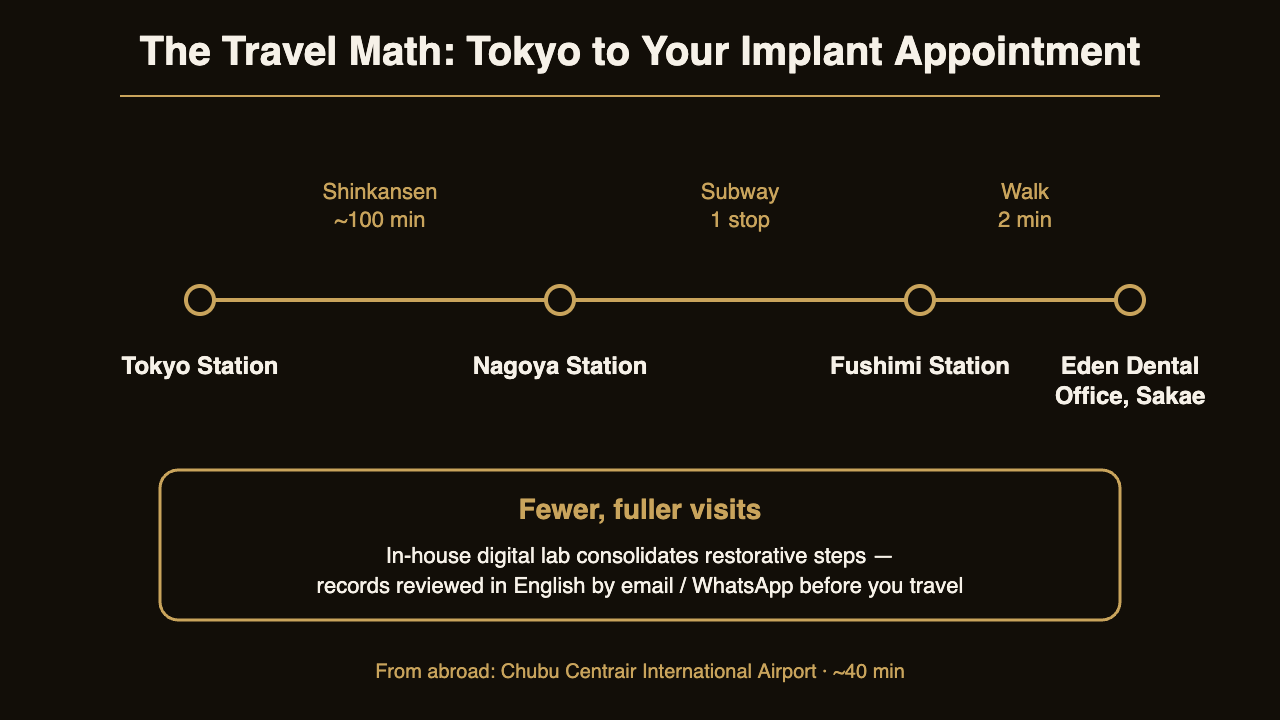
Nagoya is about 100 minutes from Tokyo by Shinkansen. Our clinic sits in Sakae, a two-minute walk from Fushimi Station — one subway stop from Nagoya Station — and Chubu Centrair International Airport is roughly 40 minutes away for patients coming from abroad. A straightforward single-implant case typically involves three to five visits spread over three to six months, and much of the early conversation can happen remotely: we review existing X-rays and records in English by email or WhatsApp before you ever board a train.
The Shinkansen fare is a known, bounded cost you can check today; the spread between two implant quotes is often not. Whether travel makes sense depends on your case complexity and schedule, which is why we put the visit plan in writing before you commit. Because lab work happens in-house, we can also consolidate restorative steps so that a Tokyo-based patient makes fewer, fuller visits rather than many short ones.
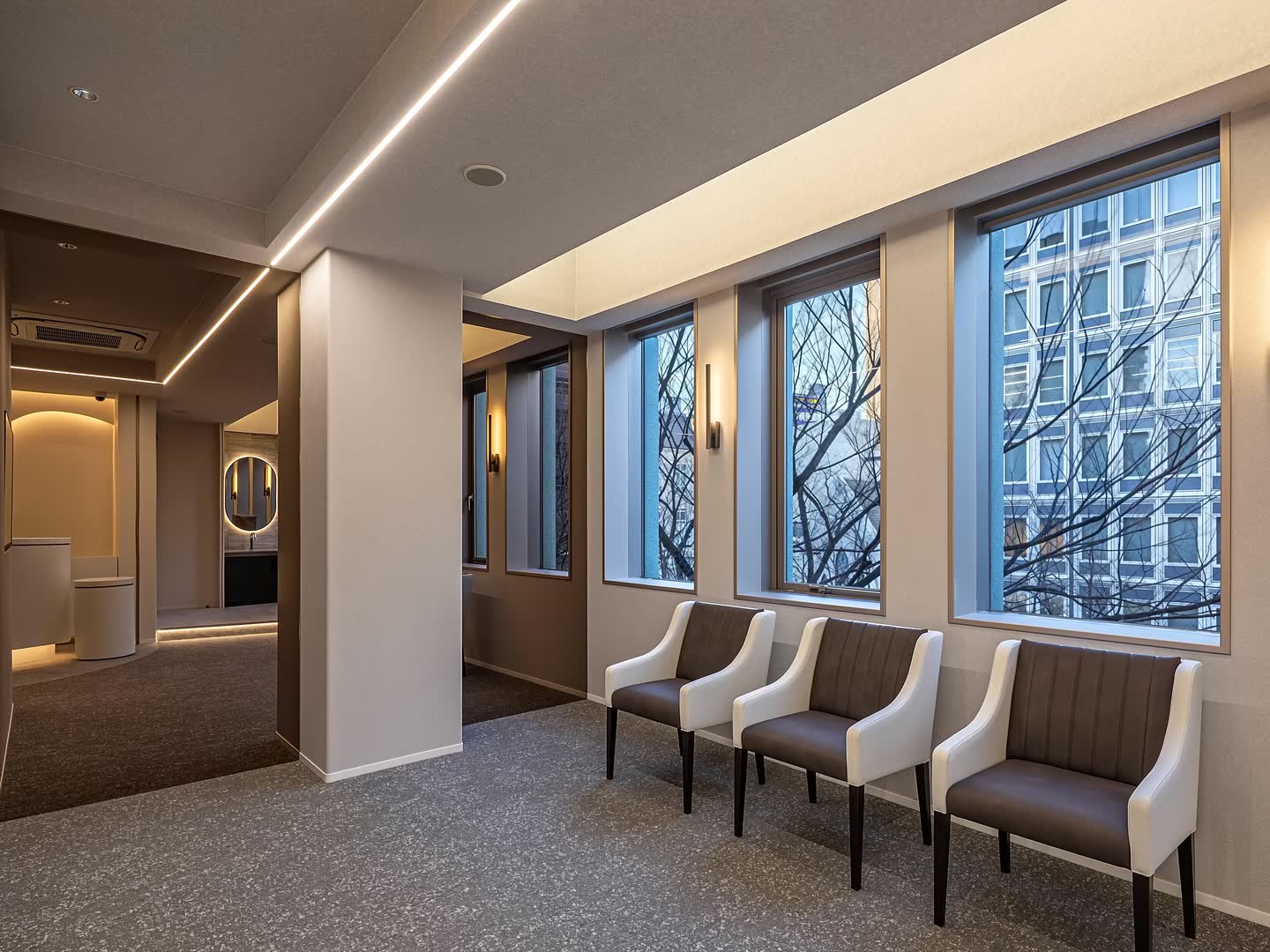
What this costs
Implant fees at Eden are quoted per case after diagnostics, and you receive a written estimate in English before any treatment begins — no number in this article should substitute for that document. Published anchors from our fee page for orientation: a comprehensive check-up package is ¥40,000, a whitening package ¥75,000, and annual membership tiers run ¥88,000 to ¥288,000. Implants in Japan are almost always self-pay; our article on implants and Japanese health insurance explains the narrow exceptions. Travel costs are yours to weigh, but they are transparent in a way clinic overhead never is.
Frequently Asked Questions
Is implant treatment less expensive in Nagoya than in Tokyo?
Often the total quote is lower because clinic overhead differs, but always compare like-for-like: same implant system, same included items, same follow-up coverage. The gap varies case by case.
How many trips from Tokyo does one implant require?
Typically three to five visits over three to six months. Our in-house lab lets us consolidate restorative appointments, so travelers usually make fewer, longer visits. Individual timelines vary.
Can the first consultation happen before I travel?
Yes — we review existing records, X-rays, and photographs in English by email or WhatsApp. A final treatment plan still requires in-person diagnostics, including a CBCT scan.
Is the Straumann implant the same product everywhere in Japan?
Yes. The fixture is identical regardless of clinic. What differs between clinics is diagnosis, surgical planning, restorative design, and maintenance — the factors that actually shape outcomes.
What about follow-up care after I return to Tokyo?
We design the maintenance schedule around your travel and can coordinate routine hygiene visits with a dentist near you, while implant-specific reviews remain with us.
Risks, limitations, and a note on individual results
Dental implant treatment is surgery. Risks include infection, implant failure requiring removal, damage to adjacent structures, nerve disturbance, and sinus complications in the upper jaw. Bone volume, gum condition, smoking, and conditions such as diabetes can change both the plan and the fee — sometimes substantially — and some patients are better served by alternatives to implants. Traveling for treatment adds scheduling considerations that we plan for explicitly, but cannot eliminate. Costs, visit counts, and timelines stated here are general orientation, not a quotation. Individual results vary.
If you are weighing Tokyo quotes and want a second data point, start with our implant treatment page or message us on WhatsApp in English — we will tell you honestly whether the trip is worth it for your case.
Grafting can also shift the total — see what a bone graft or sinus lift adds in Japan.