Japan Dental Costs vs the World: How to Compare Real Value
Reviewed by Dr. Ryosuke Murai, DDS, MSD — Prosthodontist, trained at Indiana University School of Dentistry (U.S.). Last updated August 2026.
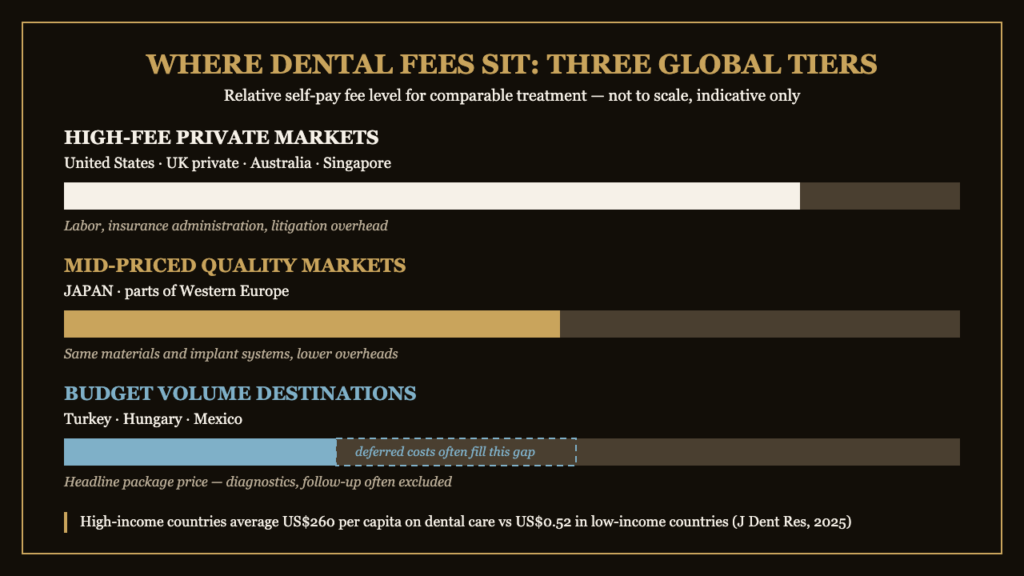
High-income countries spend an average of US$260 per person per year on dental care; low-income countries spend US$0.52 — a five-hundred-fold gap documented in a 2025 analysis in the Journal of Dental Research. Japan dental costs sit in an unusual position on that map: private, self-pay dentistry here is priced well below the American and Singaporean private sector, yet the equipment, materials and training behind it are the same — and often better documented. This guide is written for self-pay patients in Japan and abroad who are comparing countries, not coupons: it explains what actually drives a dental fee, what budget quotes leave out, and how to read a fee structure published in English before committing to treatment anywhere.
Where Japan Sits on the Global Dental Cost Map
Most international comparisons collapse into three broad tiers. At one end are the high-fee private markets — the United States, private practice in the United Kingdom and Australia, and Singapore — where clinical overheads, staff salaries and insurance administration push fees for a single implant or veneer to levels that surprise even affluent patients. At the other end are the volume destinations marketed to dental tourists: Turkey, Hungary, Mexico and parts of Southeast Asia, where package pricing and high patient throughput produce headline figures that can be a third of American fees or less.
Japan occupies the middle ground, and for reasons that have little to do with marketing. Clinical labor costs are lower than in the US; malpractice and administrative overheads are a fraction of American levels; and the country runs a universal insurance system that anchors baseline dentistry at regulated fees, which in turn restrains what the private, self-pay sector can charge. The result is that premium work — Straumann implants, layered ceramic veneers, full-arch rehabilitation — is routinely priced below comparable private treatment in Boston, London or Sydney, without the compromises that make the budget tier cheap.
| Tier | Examples | What drives the fee | What to verify |
|---|---|---|---|
| High-fee private markets | US, UK private, Australia, Singapore | Labor, rent, insurance administration, litigation overhead | Whether the fee includes the lab work and follow-up, or bills them separately |
| Mid-priced quality markets | Japan, parts of Western Europe | Lower overheads with comparable materials, equipment and training | English documentation, implant brand, who does the surgery |
| Budget volume destinations | Turkey, Hungary, Mexico | Package pricing, high throughput, shorter protocols | What the package omits; who manages complications after you fly home |
Two caveats make honest comparison harder than the table suggests. Tier averages hide enormous variation inside each country — a university-affiliated clinic in Budapest and a volume implant mill outside Antalya are both “budget destinations” on paper and entirely different propositions in practice. And published prices measure different things in different markets: an American quote often includes case management a Japanese quote itemizes separately, while a Turkish package price may include hotel nights but not the CBCT scan. The tiers are a starting map, not a verdict; the sections below are about converting any quote, from any tier, into a number you can actually compare.
Why the Same Crown Has Three Different Price Tags
A ceramic crown is not a commodity, even when the material name on the invoice is identical. The fee you are quoted is the sum of at least five inputs: the clinician’s time and training, the diagnostic workup, the laboratory that designs and fabricates the restoration, the materials and components themselves, and everything that happens after delivery — adjustments, maintenance, and responsibility when something fails.
Countries differ most on the laboratory and the aftercare. In high-fee markets the lab is usually an external business with its own margin, shipping schedule and remake policy. In budget destinations the lab is often the anonymous part of the package — the patient never learns where the crown was milled or by whom. At Eden, we take a third route: our digital laboratory is inside the clinic, one floor from the treatment rooms. Crowns and full-arch prosthetics are designed and milled in-house, surgical guides are 3D-printed on site, and implant cases are planned digitally on Straumann BLX and TLX fixtures. That structure removes an external markup, but more importantly it means the person who designed your restoration can remake or adjust it the same week — a cost item that never appears on any quote until you need it.
Same Materials, Different Economics: What You Are Buying in Japan
A fair question follows from the tier table: if Japanese fees are lower than American ones, what has been taken out? For serious private clinics, the answer is overhead, not clinical substance. The implant fixtures are the same Swiss-manufactured Straumann components an American surgeon would place. The ceramics come from the same German and Japanese suppliers. The planning software, cone-beam CT imaging and intraoral scanners are the same international products; at Eden we plan aesthetic cases with Digital Smile Design, photograph and scan before we touch a tooth, and rehearse full-arch surgeries digitally before the patient sits down. None of this is discounted in Japan — a Straumann fixture costs a Japanese clinic roughly what it costs a clinic in Chicago.
What differs is everything around the clinical work. Japanese practices carry lighter administrative staffing because there is no insurance-claim adjudication industry to feed. Litigation exposure, and the defensive costs that follow from it, are structurally lower. Rents outside central Tokyo are modest by global-city standards. And Japan’s universal insurance system creates a price-aware public, which disciplines the self-pay market: a private clinic asking Singapore prices in Nagoya would simply have no patients. The saving reaches you not because something was removed from your treatment, but because less of your fee is spent on things that were never treatment in the first place.
The Currency Effect: What a Weak Yen Means for Overseas Patients
For patients earning in dollars, euros or Singapore dollars, currency movement has quietly repriced Japanese dentistry. Yen-denominated fees have become materially less expensive in foreign-currency terms over recent years, while Japanese clinics continue to buy Swiss implants, German ceramics and American software at world prices. The arithmetic favors the patient: you pay local Japanese fees for internationally sourced materials. Currency is not a reason to choose a clinic — but when the clinical offer is already comparable, it changes the total cost of a treatment trip meaningfully, particularly for larger plans such as implant work compared line by line between Japan and the United States.
Reading a Quote: What Low Headline Prices Leave Out
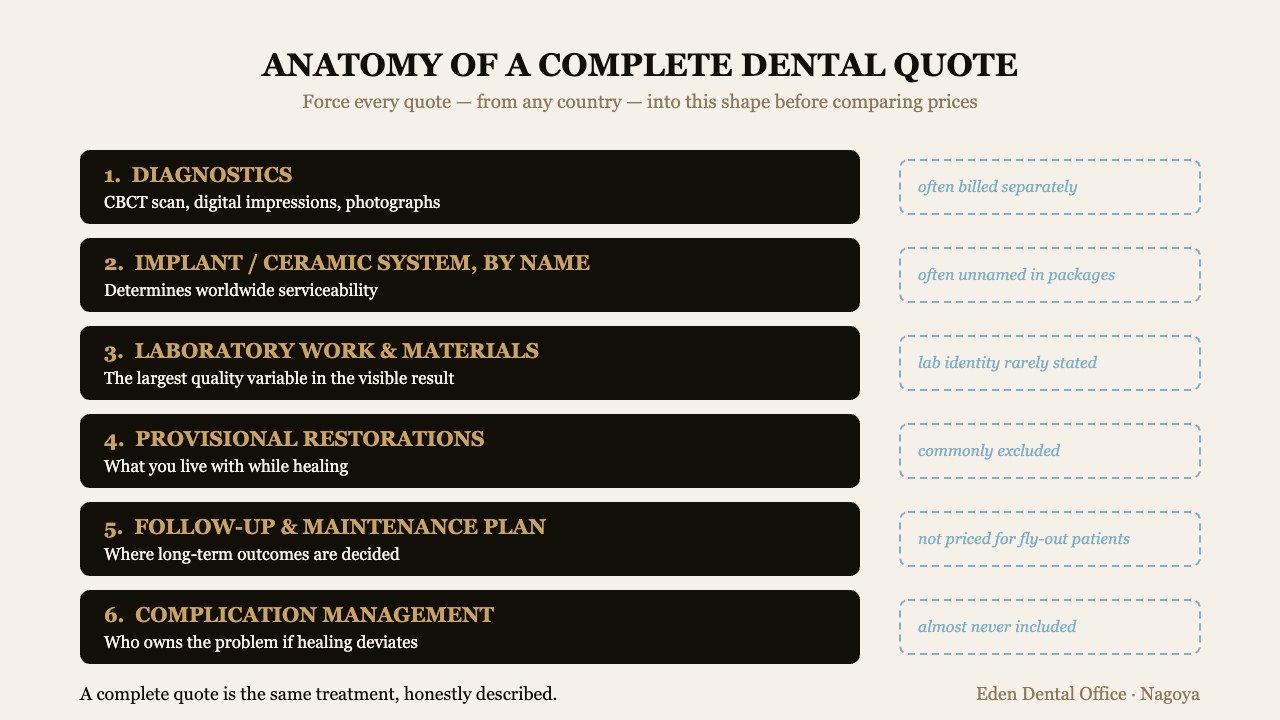
The single most common mistake self-pay patients make is comparing headline numbers rather than complete quotes. A fee that looks unbeatable often describes only the implant fixture or only the crown — not the case that has to be built around it. Before comparing countries, force every quote into the same shape:
| Line item | Why it matters | Often missing from headline quotes |
|---|---|---|
| Diagnostics: CBCT, scans, photographs | Determines whether the plan is safe and realistic | Frequently billed separately, or skipped |
| Implant brand and components | Determines future serviceability worldwide | Brand unnamed in many packages |
| Laboratory work and materials | The largest quality variable in the visible result | Lab identity and material grade rarely stated |
| Provisional restorations | You live with these for weeks or months | Commonly excluded |
| Follow-up visits and maintenance | Where long-term outcomes are actually decided | Not priced for fly-out patients |
| Complication management | Someone must own the problem if healing does not go to plan | Almost never included |
We have written separately about what a complete implant quote in Japan should itemize; the same logic applies to veneers, full-arch work and orthodontics. A complete quote is not more expensive than a headline price — it is the same treatment, honestly described.
The Hidden Cost of Distance: When Complications Come Home
The academic literature on dental tourism keeps returning to one structural problem: the economics only work if nothing goes wrong. A 2012 review in the Australian Dental Journal describes dentists confronting complications in implants placed abroad on systems they could not identify — no brand, no component records, no compatible parts. When the implant system is unknown, even a simple screw loosening can become a diagnostic project, and the cost of managing that falls on the patient, at home-market prices.
This is why we treat documentation as part of the treatment. Every Eden patient leaves with records in English — implant brand and lot, component specifications, CBCT data on request — so that any competent dentist in New York or Singapore can maintain the work. If you are weighing a treatment trip, our guide to planning a dental treatment trip to Japan covers visit counts, healing intervals and when it is safe to fly; the short version is that a well-planned trip prices in the follow-up, and a cheap one prices it out.
How Dental Fees Work in Japan — With and Without Japanese Insurance
Japan’s national insurance covers baseline dentistry at regulated fees for residents enrolled in the system, but it does not cover the categories most international patients travel for: implants, ceramic veneers, whitening and most full-arch rehabilitation are self-pay for everyone, Japanese citizens included. We have covered how Japanese health insurance treats implant work in detail; the practical consequence is simple. An overseas patient without Japanese insurance is not paying a foreigner surcharge — they are paying the same self-pay fee as a local patient, from a published fee schedule. Larger plans can also be structured over time; see our overview of financing options for larger treatment plans.
What Transparent Pricing Looks Like at Eden
Our published anchors are deliberately simple: a comprehensive check-up package at ¥40,000, a whitening package at ¥75,000, and annual membership tiers from ¥88,000 to ¥288,000 that bundle examinations, hygiene visits and priority scheduling. For treatment fees beyond these — implant cases, veneers, full-mouth plans — the range depends on diagnostics, and we put it in writing: every patient receives a written estimate in English before any treatment begins, itemized in the shape of the table above. The current schedule is on our fee page. Nagoya itself is part of the value calculation: clinic overheads here are lower than central Tokyo’s, which is one reason the same implant system is often priced lower in Nagoya than in Tokyo, one Shinkansen ride apart.
One more cost most international comparisons ignore entirely: the years after treatment. A full-arch prosthesis or a set of veneers is not a purchase but the start of a maintenance relationship, and the lifetime cost of dentistry is dominated by how well that relationship works. This is what our membership tiers are for — structured recall, professional hygiene and early intervention priced annually rather than crisis by crisis. When you compare countries, ask what year three looks like, and what it costs, in each of them. A clinic that has designed for year three will have an answer in writing; a package that ends at the airport will not.
A Practical Framework for Comparing Value Across Countries
Strip the comparison down to five questions and ask them of every clinic, in every country. First, what implant or ceramic system will be used, by name — and is it serviceable worldwide? Second, who performs the surgery and what is their training — a question of record, not of adjectives. Third, where is the laboratory, and who remakes the work if the shade or fit is wrong? Fourth, what does the written quote include, line by line? Fifth, who is responsible — and at what cost — if a complication appears after you leave? A clinic that answers all five in writing is comparable; a clinic that answers with a package price is not. Price differences between honest answers are real savings. Price differences between an honest answer and a silent one are usually deferred costs.
Applied to Japan specifically, the framework tends to produce a consistent result for patients already living in Asia or willing to travel: fees meaningfully below the US, UK and Singapore private tier; materials, imaging and implant systems identical to those markets; documentation available in English; and follow-up that can realistically be attended from Tokyo, Osaka or an international flight into Chubu Centrair. Whether that calculation favors your case depends on its size — the larger and more complex the plan, the more the quality-to-fee gap matters and the less the airfare does.
When two quotes differ sharply, the cheapest way to resolve it is rarely to pick one — it is an independent second opinion on the treatment plan, reviewed against your own imaging.
For a treatment-level example of how Japanese fees are structured, our breakdown of what teeth whitening costs in Japan shows the package model in practice.
For the prevention side of the value equation, see how a preventive membership changes the economics of dental care in Japan.
Frequently Asked Questions
Is dental treatment in Japan cheaper than in the United States?
For self-pay treatment, generally yes. Lower clinical overheads and a regulated baseline market keep Japanese private fees below typical US private-practice levels for comparable materials and implant systems, though the difference varies by procedure and city.
Why are quotes from budget dental tourism destinations so much lower?
Package pricing achieves low headline figures through volume, shorter protocols, unnamed materials and the exclusion of diagnostics, provisionals, follow-up and complication management. The quoted number is real; the omissions become visible later, usually at home-market prices.
Can I pay for Japanese dental care without Japanese health insurance?
Yes. The treatments international patients typically seek — implants, veneers, whitening, full-arch work — are self-pay in Japan regardless of insurance status, so overseas patients pay the same published fees as local self-pay patients.
Does Eden Dental Office provide written estimates in English?
Yes. Every patient receives an itemized written estimate in English before treatment begins, covering diagnostics, materials, laboratory work, provisionals and follow-up, based on the published fee page.
How does the yen exchange rate affect overseas patients?
Fees are set in yen, so patients earning in dollars, euros or other strong currencies have seen the effective cost of Japanese treatment fall as the yen weakened. Currency should refine a comparison, not drive it.
Costs, Risks and a Necessary Disclaimer
Every figure in this article describes fee structures, not clinical outcomes. All dental treatment carries risks — infection, implant failure, ceramic fracture, the need for retreatment — and those risks, not prices, should be the first topic of any consultation. Costs for individual cases depend on diagnostics and case complexity; our published anchors are the ¥40,000 check-up package, the ¥75,000 whitening package and membership tiers of ¥88,000–¥288,000 per year, with all other fees provided as a written English estimate after examination. Individual results vary.
If you are comparing countries for a significant dental investment, start with the numbers you can verify: review our fee structure, then message us on WhatsApp in English with your current quote — we will tell you plainly what it includes, what it omits, and whether traveling to Nagoya makes financial sense for your case.