Dental Implants in Japan: Medications and Medical Conditions
Blood thinners, bisphosphonates and diabetes rarely rule out dental implants in Japan. What the evidence shows, and what we check before implant surgery.
Dental implant guides in English for treatment in Japan: Straumann implant costs, CBCT planning, surgery staging, recovery and long-term maintenance.
Start with the cluster guide, Dental Implant Cost in Japan, or go to Dental Implants for how we plan and price this treatment. Every article below is reviewed by Dr. Ryosuke Murai, DDS, MSD — Prosthodontist, trained at Indiana University School of Dentistry (U.S.). Individual results vary.
This collection was written one question at a time, in the order patients actually asked, which is not the order anyone would choose to read it. What follows is the map. Each section below covers one stage of implant treatment in Japan and links to the articles that go into detail on it. If you would rather start with a single long guide, begin with Dental Implant Costs in Japan and come back here for the parts that apply to you.
Two things shape almost everything on this page. The first is that implant treatment at Eden Dental Office is self-pay, planned and restored by a prosthodontist who trained at Indiana University School of Dentistry in the United States, using Straumann BLX and TLX implants and an in-house digital laboratory. The second is that a great many of the people reading this do not live in Nagoya, and some do not live in Japan. Where that changes the answer, the articles say so.
Cost is the question that brings most people here, and it is also the question where a single figure is the least useful thing anyone can give you. Price in Japanese implant dentistry moves with the number of implants, the condition of the bone underneath them, the material of the crown on top, and whether the clinic is quoting the surgery alone or the finished tooth.
Dental implant costs in Japan is the anchor article for this cluster and the place to start. What is actually included in an implant quote is the one to read immediately afterwards, because it is the article that lets you compare two written estimates that look thousands of yen apart and work out whether they are quoting the same treatment. Straumann implant cost in Japan explains what a premium implant system buys and, just as importantly, what it does not.
Three articles handle comparison across borders and cities, which is the natural next question for anyone weighing treatment abroad: implant cost in Japan versus the United States, Tokyo versus Nagoya, and the wider comparison of Japanese dental costs against other countries. Two more deal with the money itself rather than the price: how implant payment plans work in Japan and whether Japanese national health insurance covers implants. The short answer to the second is that it does not, in almost every case, and the article explains the narrow exceptions.
Two costs are commonly left out of first quotes and both have their own article: bone grafting and sinus lift fees, and maintenance over a ten-year horizon. The second of those is the one most likely to change how you compare clinics, because an implant is not a one-off purchase.
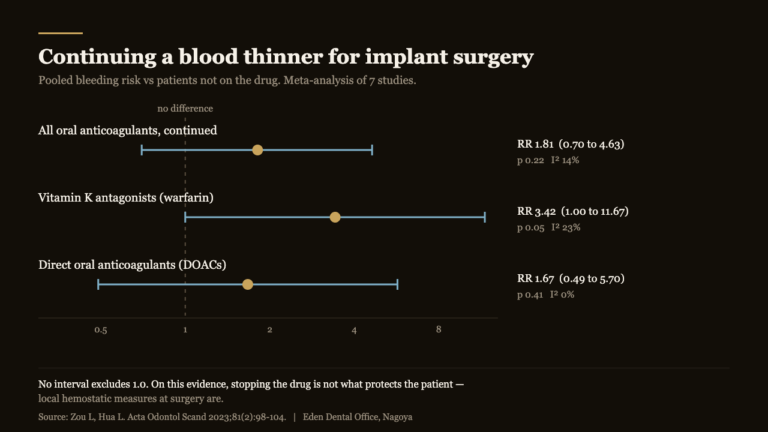
Planning is where implant treatment is either made straightforward or made complicated, and it happens before any appointment involving surgery. CBCT scans before dental implants describes what a three-dimensional scan shows that a panoramic radiograph cannot, and how those measurements drive the surgical guide we print in the clinic. Medications and medical conditions covers the health history that genuinely changes an implant plan, including anticoagulants, bisphosphonates and diabetes, and separates those from the conditions that people worry about unnecessarily.
For full-arch cases, All-on-4 candidacy is the planning article, dealing with bone loss, general health and age.
The dental implant procedure in Japan is the stage-by-stage account: what happens on the day, what the following fortnight feels like, and where the honest discomfort sits. Sedation options covers the range from local anaesthesia alone through to intravenous sedation and who each level suits.
Healing is measured, not assumed. Implant stability, ISQ and torque explains the numbers we take at placement and again before loading, and why those numbers, rather than a fixed number of weeks, decide when a tooth goes on. Aftercare in the first two weeks is the practical companion: what is normal, and what warrants a call.
Patients tend to think of implant treatment as surgery. Prosthodontists tend to think of it as the crown stage with a surgical prelude, because the visible result and the long-term hygiene both live here.
The implant crown stage covers impressions and how the gum is shaped around the emerging tooth. Screw-retained versus cemented implant crowns is the design decision behind that, and it has real consequences for retrievability and for cement-related inflammation. Gum tissue around dental implants deals with how much attached tissue an implant needs and what we do when there is not enough.
Nine articles cover full-arch implant treatment, which is a different undertaking from replacing one tooth and deserves its own reading path. All-on-4 in Japan is the guide; All-on-4 cost in Japan is the fee breakdown; the All-on-4 timeline runs from same-day teeth through to the final bridge.
The decisions inside that treatment each have an article. All-on-4 versus an implant overdenture is the first fork. Upper versus lower jaw explains why the two arches are not the same problem. Acrylic versus zirconia bridge materials is the choice that most affects both cost and how the bridge ages.
Two articles deal with what happens afterwards, and they are the ones we would ask a prospective patient to read most carefully: daily cleaning and checkups, and what happens if one implant fails under the bridge. Full-arch implant treatment is not maintenance-free, and a clinic that tells you otherwise is selling rather than planning.
It is worth being concrete about the workflow these articles keep referring to, because "digital dentistry" is a phrase that has been used to mean almost anything. In our clinic an implant case begins with a CBCT scan and an intraoral scan rather than a putty impression. Those two data sets are merged so that the implant position is planned against the finished tooth rather than against the bone alone, which is the whole point of prosthetically driven planning and the reason a prosthodontist rather than a surgeon leads it. The surgical guide is then designed and printed in the clinic, and the provisional restoration is designed in the same file.
We place Straumann BLX and TLX implants and no others. That is a deliberate narrowing rather than a claim of superiority: a single system means one set of components, one set of torque values, one restorative platform to stock, and a documented service life the literature can actually be read against. It also means that if you move away from Nagoya, any prosthodontist anywhere can identify what is in your jaw and order parts for it, which is not true of every implant sold in Japan. Straumann implant cost in Japan goes further into what that decision costs and what it buys.
The restorative side is finished in an in-house digital laboratory, which mainly buys time rather than quality on any single crown: shade and contour problems can be corrected the same day instead of across a two-week cycle with an outside laboratory. For patients travelling in from another city or another country, that is often the difference between two visits and three.
These articles are written to be useful whether or not you are treated here, and the most useful thing this collection can do is give you the questions. Five are worth asking anywhere.
Which implant system, and why that one? The answer should name a manufacturer and a line, not a country of origin. Does the quoted fee end at the implant or at the finished tooth? This is the single largest source of apparent price differences between Japanese clinics and is dealt with in what an implant quote includes. What happens if bone volume turns out to be insufficient? Grafting and sinus lift fees are frequently absent from a first estimate; see bone graft and sinus lift cost. What does the maintenance schedule cost, per year, for ten years? Covered in implant maintenance cost in Japan. What is written down, and when? A Japanese clinic should give you a mitsumori-sho, an itemised written estimate; how to read a Japanese dental estimate explains what it should contain and how long it holds.
Implant dentistry has a large body of long-term outcome data behind it, and clinical studies of established systems generally report survival for the large majority of implants at ten years. That is a statement about survival in studied populations, not a promise about any individual tooth, and it is not the same thing as saying nothing will need attention. Crowns and bridges on top of implants wear, chip and are periodically remade; screws loosen; the gum and bone around an implant can become inflamed and lose support if plaque control lapses, which is why aftercare and cleaning around full-arch bridges get their own articles here rather than a paragraph at the end of a sales page.
The factors that move an individual outcome the most are within reach: smoking, control of diabetes, treatment of existing gum disease before implants are placed, grinding, and turning up for maintenance visits. The factors nobody controls, such as healing capacity and anatomy, are why we measure stability with ISQ and insertion torque rather than loading everything on a schedule.
Implant treatment involves healing time, which means it cannot be compressed into a single visit the way some cosmetic work can. The articles on structuring a trip, sending records ahead and flying after oral surgery live in the planning a dental trip collection. The clinic is a two-minute walk from Fushimi Station in central Nagoya, one stop from Nagoya Station, roughly one hundred minutes from Tokyo by Shinkansen and about forty minutes from Chubu Centrair International Airport.
Implant treatment carries surgical risk, including infection, nerve disturbance, sinus involvement in the upper jaw and implant loss, and it requires lifelong maintenance visits and daily cleaning. Smoking, uncontrolled diabetes and untreated gum disease all raise the risk of failure. Nothing on this page is a diagnosis or a quotation. Published fees for the packages we list are on the fees page; treatment fees are set case by case and are given to you in writing before anything begins. Individual results vary.
Blood thinners, bisphosphonates and diabetes rarely rule out dental implants in Japan. What the evidence shows, and what we check before implant surgery.
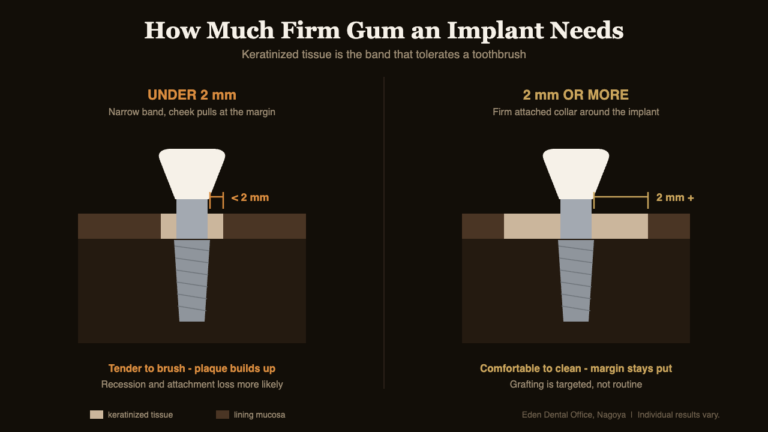
Gum tissue around dental implants in Japan: how much keratinized tissue you need, what grafting changes, and when the evidence says it is worth it.
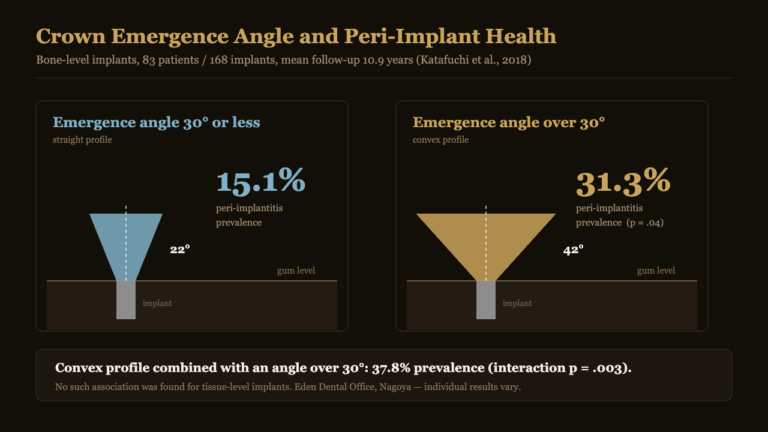
What happens between an integrated implant and the final crown in Japan: healing abutments, gum shaping, digital scans, timing and what it costs.
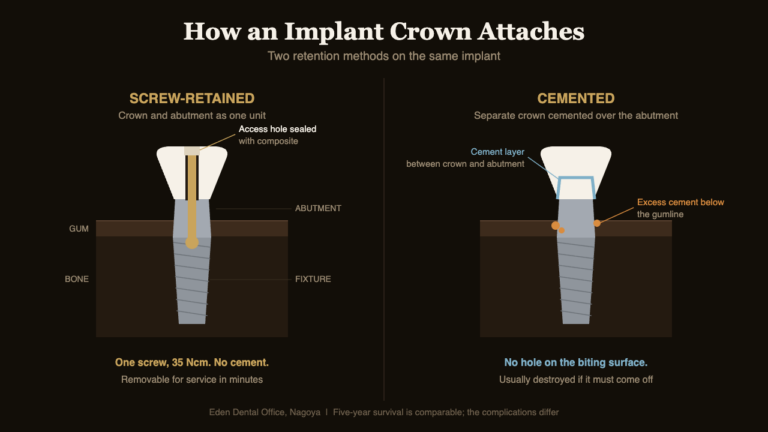
Screw-retained vs cemented implant crowns in Japan: how each attaches, what the residual-cement evidence shows, and how the retention choice is planned.
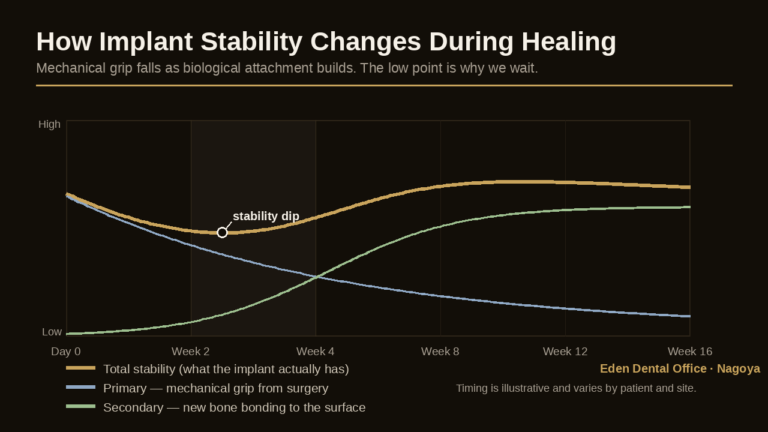
Dental implant stability in Japan, explained: what ISQ and insertion torque measure, why healing times differ, and when a crown can safely be fitted.
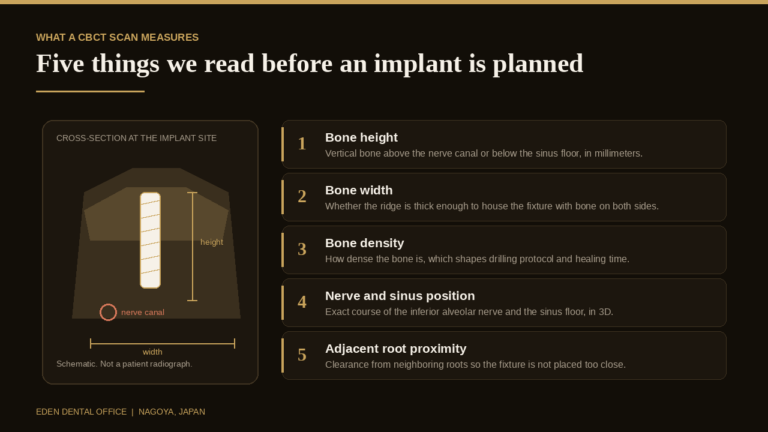
A CBCT scan in Japan measures bone height, width, density and nerve position in 3D before dental implant surgery, and often changes the plan.
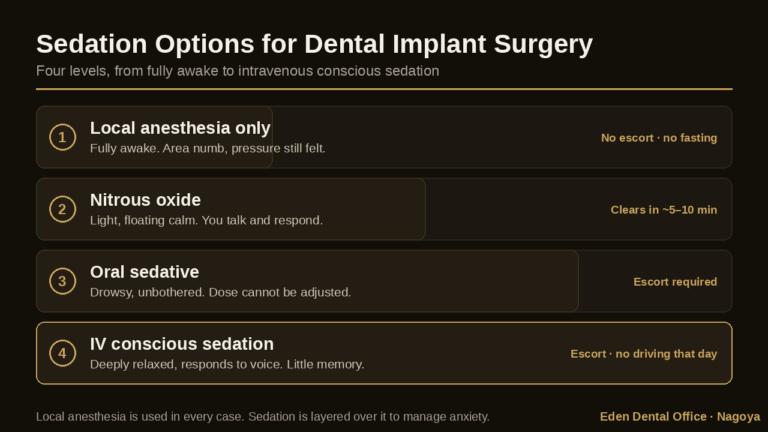
Sedation for dental implant surgery in Japan: nitrous oxide, oral and IV conscious sedation compared — who needs it, how it is monitored, what it costs.
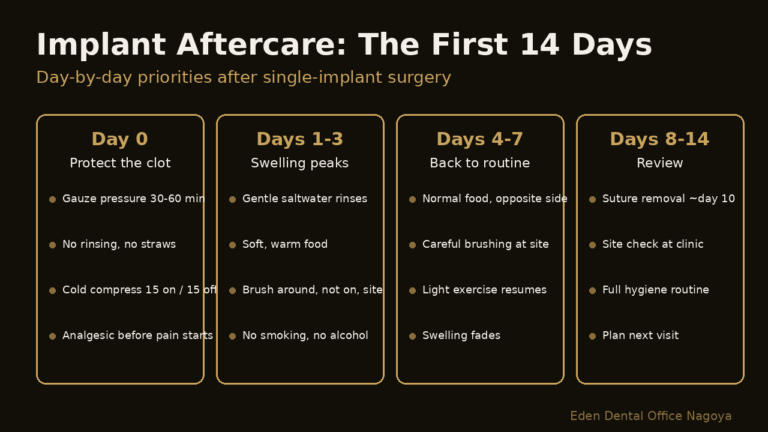
Dental implant aftercare in Japan: a U.S.-trained prosthodontist's day-by-day guide to the first two weeks — eating, rinsing, smoking and warning signs.
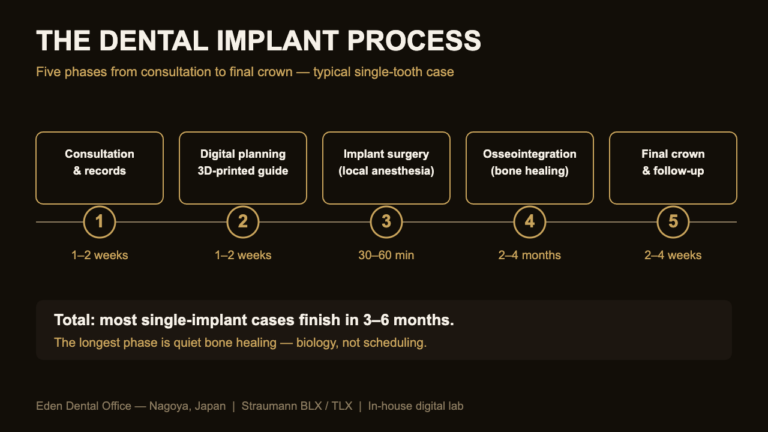
The dental implant procedure in Japan explained by a U.S.-trained prosthodontist: five phases, realistic pain and recovery, and how many visits.
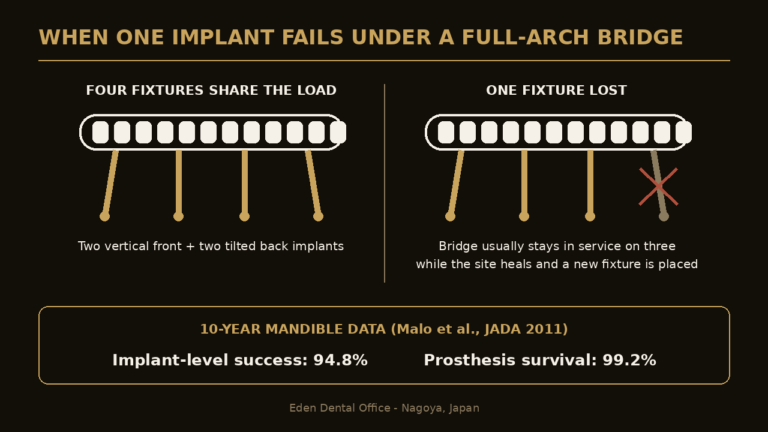
What happens if one implant fails under an All-on-4 bridge in Japan? Failure rates, warning signs, and how a full-arch repair is planned, in English.