Dental Implant Quotes in Japan: What’s Included in the Fee
Reviewed by Dr. Ryosuke Murai, DDS, MSD — Prosthodontist, trained at Indiana University School of Dentistry (U.S.). Last updated July 2026.
Two quotes for the same missing tooth can differ by several hundred thousand yen — and the lower number is not always the smaller bill by the end of treatment. A complete dental implant quote in Japan should itemize seven things: diagnostics and CT planning, the surgical guide, the implant fixture, the surgery itself, the abutment, the final crown, and structured follow-up. If any of those is missing from the paper in front of you, you are not reading the price; you are reading part of it. This article is for self-pay patients who want to read a Japanese implant estimate the way a clinician does — what belongs in it, which add-ons are legitimate, and which questions expose an incomplete number. It pairs with our complete guide to dental implant costs in Japan and our implant treatment page.
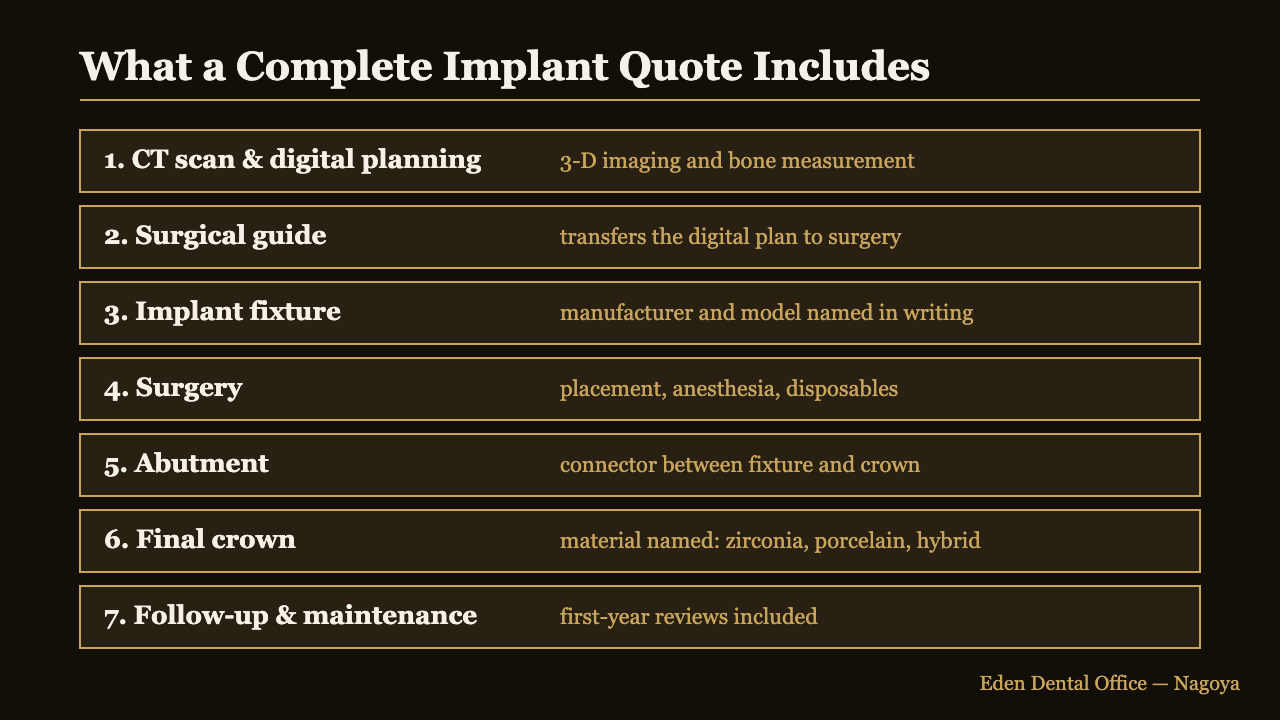
The Seven Line Items a Complete Quote Should Show
Japanese clinics are not required to present implant estimates in a standard format, so two documents quoting “one implant” may cover very different scopes of work. Before comparing totals, confirm that both quotes account for each of the items below — whether bundled into one figure or listed separately matters less than whether they are accounted for at all.
| Line item | What it covers | What to check |
|---|---|---|
| CT scan & digital planning | 3-D imaging, bone volume measurement, prosthetically driven position planning | Sometimes billed separately as “diagnostics” after the quote is issued |
| Surgical guide | A custom template that transfers the digital plan to surgery | Freehand placement is cheaper to quote; ask which method the figure assumes |
| Implant fixture | The titanium body placed in bone | Manufacturer and model should be named in writing |
| Surgery | Placement procedure, anesthesia, sterile disposables | Confirm whether a second-stage (uncovering) procedure is included |
| Abutment | The connector between fixture and crown | Custom abutments cost more than stock ones and are often quoted later |
| Final crown | The visible tooth, including shade matching and fitting | Material (zirconia, porcelain-fused, hybrid) changes the figure substantially |
| Follow-up & maintenance | Post-operative checks, occlusal adjustment, first-year reviews | Ask how many visits are covered and what a maintenance visit costs afterward |
The fixture brand deserves particular attention. A quote that names the exact system — for example, what Straumann’s premium pricing actually buys — tells you something verifiable. A quote that says only “implant” does not. Published long-term data is brand-specific: a 10-year study of Straumann tissue-level implants reported a 98.8% survival rate (Buser et al., 2012, PubMed), and results from one manufacturer cannot be assumed for another.
Add-Ons That Legitimately Change the Total
Not every difference between quotes is a red flag. Several procedures are genuinely case-dependent, and an honest clinic will present them as conditional items with their own figures rather than folding them silently into a bigger number — or worse, leaving them out and adding them mid-treatment.
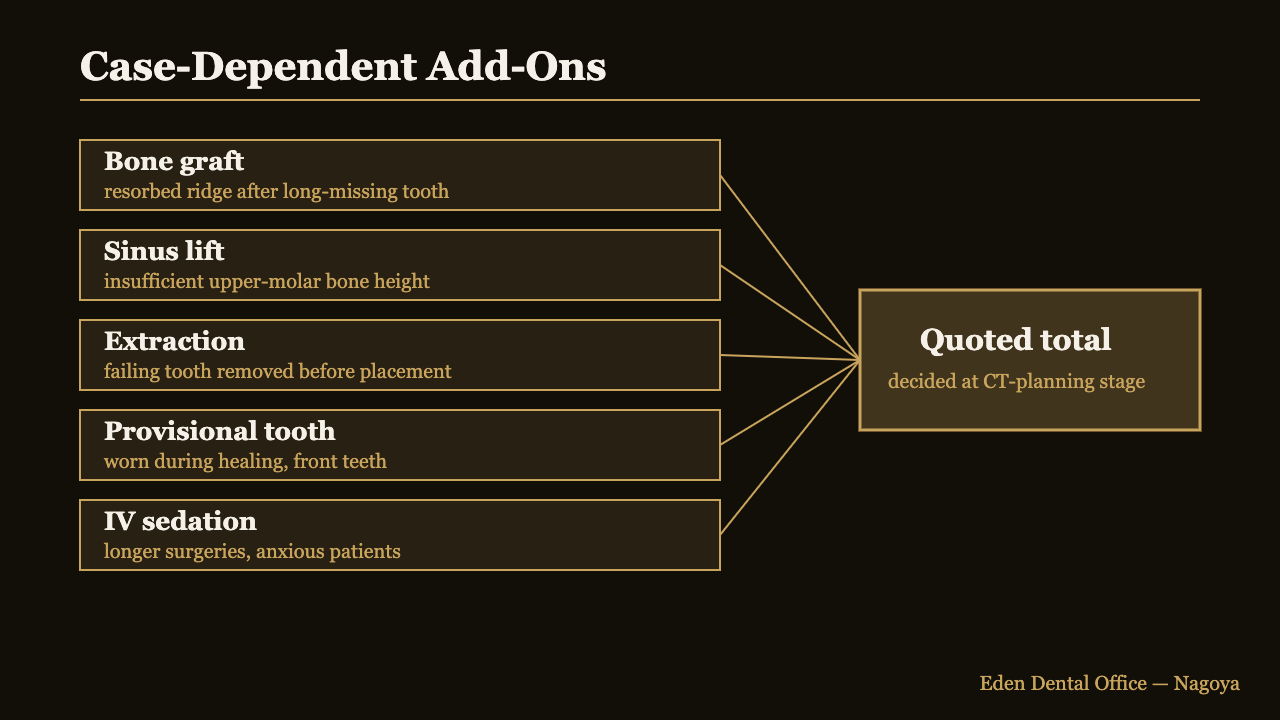
The common ones: bone grafting when the ridge has resorbed after a long-missing tooth; a sinus lift when upper-molar bone height is insufficient; extraction of a failing tooth before placement; a provisional tooth to wear during healing, which matters greatly in the front of the mouth; and intravenous sedation for longer surgeries or anxious patients. Each has a clinical trigger that is visible on a CT scan, which is why a serious estimate can only follow imaging — a figure quoted over the phone or from a panoramic X-ray alone is a placeholder, not a plan. Whether any of these applies to you is exactly the kind of question that separates a five-minute consultation from a proper diagnostic work-up, and it is also where when health insurance covers implants in Japan becomes relevant: almost never for the implant itself, occasionally for related procedures after specific diagnoses.
Questions That Expose an Incomplete Number
Five questions do most of the work. Which fixture system, by name? Is the final crown included, and in what material? Was this figure produced after a CT scan of my bone? What happens to the price if grafting turns out to be necessary? And how many follow-up visits are included in the first year? A clinic that answers all five in writing has given you a price. A clinic that answers two of them has given you an advertisement.
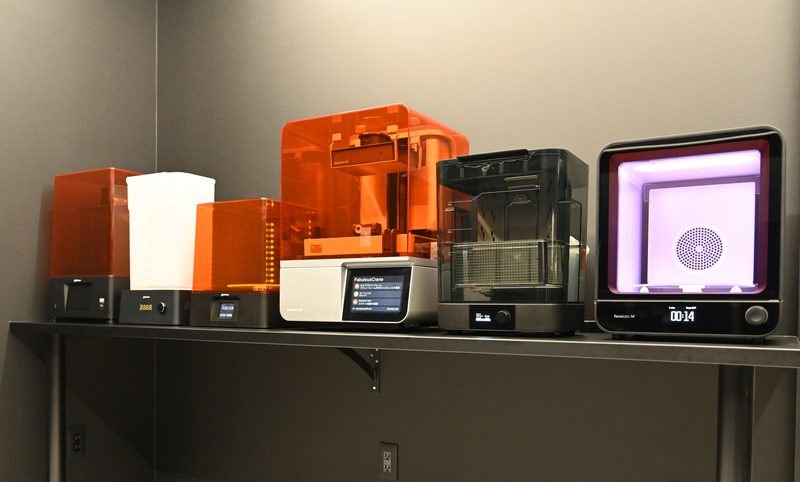
At Eden, we issue every implant estimate in writing, in English, only after CT imaging and digital planning are complete. We place Straumann BLX and TLX fixtures exclusively, design and mill the restoration in our in-house digital laboratory, and 3-D print surgical guides on site — so the figures on our estimates are not waiting on a third-party lab’s invoice to change. This is also why we can plan single-visit-friendly treatment sequences for patients who travel to Nagoya from Tokyo, Osaka, or overseas; the planning logic is described on our dental implant page. For a broader market view, see how Japanese implant fees compare with U.S. prices.
What This Costs
Implant treatment in Japan is self-pay in nearly all cases, and totals move with the variables above: bone volume, graft requirements, fixture count, crown material, and the complexity of the surgical plan. For that reason we do not publish a single implant price out of context; our fee page explains the structure, and every patient receives a written, itemized estimate in English before any treatment is scheduled. Two figures we do publish: a comprehensive diagnostic check-up package at ¥40,000, which includes the imaging and examination an implant plan is built on, and annual membership tiers from ¥88,000 to ¥288,000 that cover structured preventive care. Japan’s National Tax Agency also allows medical expense deductions that can apply to implant treatment for eligible taxpayers — an English overview of the health system is available from the Ministry of Health, Labour and Welfare.
Once the quote itself is clear, the practical follow-up is how and when you pay it — covered in our article on implant payment plans and financing options in Japan.
Frequently Asked Questions
Is the crown included in a Japanese implant quote?
Not always. Many advertised figures cover the fixture and surgery only. Confirm in writing that the abutment and final crown — with the material named — are inside the total before comparing prices between clinics.
Why do implant quotes in Japan vary so widely?
Different scopes, not just different margins. Fixture brand, crown material, guided versus freehand surgery, in-house versus outsourced lab work, and whether follow-up is bundled all move the number. Itemization reveals which of these each quote actually includes.
Are CT scans and surgical guides usually extra?
Frequently, yes. Some clinics bill CT imaging as separate diagnostics and treat a surgical guide as an optional upgrade. Ask whether the quoted figure assumes guided surgery and includes the planning imaging it depends on.
Can I get an implant estimate in English in Japan?
At internationally oriented clinics, yes. At Eden Dental Office in Nagoya, estimates are prepared in English after CT planning, itemized by stage, and issued in writing before any treatment begins. WhatsApp is our preferred channel for arranging this.
Is a cheaper implant quote a worse implant?
Not automatically — but a lower figure with an unnamed fixture, no CT-based planning, and no included crown is a smaller scope, not a better deal. Compare complete, itemized totals for the same scope of work.
Once you can read a quote line by line, the next question is location: our comparison of implant pricing in Tokyo versus Nagoya shows which line items actually change with the address.
Risks, Costs and Individual Outcomes
Implant surgery carries risks that no quote line can remove: infection, nerve disturbance, sinus involvement in the upper jaw, and early or late implant loss requiring removal and, in some cases, re-grafting before a second attempt. Smoking, uncontrolled diabetes, and untreated gum disease raise these risks measurably. Costs are self-pay, case-dependent, and confirmed only in a written estimate after diagnostics; timelines typically run three to eight months from placement to final crown depending on healing and grafting. Individual results vary.
If you are weighing quotes now — from anywhere in Japan or abroad — send them to us on WhatsApp and book a diagnostic consultation. We will tell you, in English and in writing, what each number does and does not include, and what a complete plan for your case looks like. A quote covers the placement; for the years that follow, read what the first year of maintenance typically includes.
A quote may also list a bone graft or sinus lift as its own line, which we explain separately.